Sigua Amarillo
Ocotea cernua — A dioecious lowland laurel whose fragrant flowers feed bees and whose yellow-green leaves keep toucans, cotingas, and monkeys supplied with oily drupes across both Costa Rican slopes.
Sigua amarillo is one of Costa Rica’s most widespread lowland Ocotea. Paul Nees described it in 1836 as Oreodaphne cernua, and Heinrich Mez later transferred it to Ocotea. Today the species ranges from southern Mexico to Bolivia, but in the Brunca Region it thrives in humid and very humid forest from sea level to about 900 meters, stretching from Tortuguero and the San Carlos plains to Carara, Dominical, and the Golfo Dulce foothills. Kew’s Plants of the World Online now treats O. cernua as synonymous with O. leptobotra, yet Costa Rican field manuals retain the familiar name because the tree is so well known locally.
Lowland Range
The Manual de Plantas de Costa Rica records O. cernua from both slopes: Caribbean localities in the Cordilleras de Tilarán and Talamanca, the San Carlos and Tortuguero plains, and Baja Talamanca; Pacific localities from Guanacaste through Carara, the Valle Central, Dominical, and the Golfo Dulce foothills. This versatility explains why the tree extends north into southern Mexico and south into the Guianas, Brazil, and the Greater Antilles— wherever humid evergreen forest persists, sigua amarillo can follow.
Identification
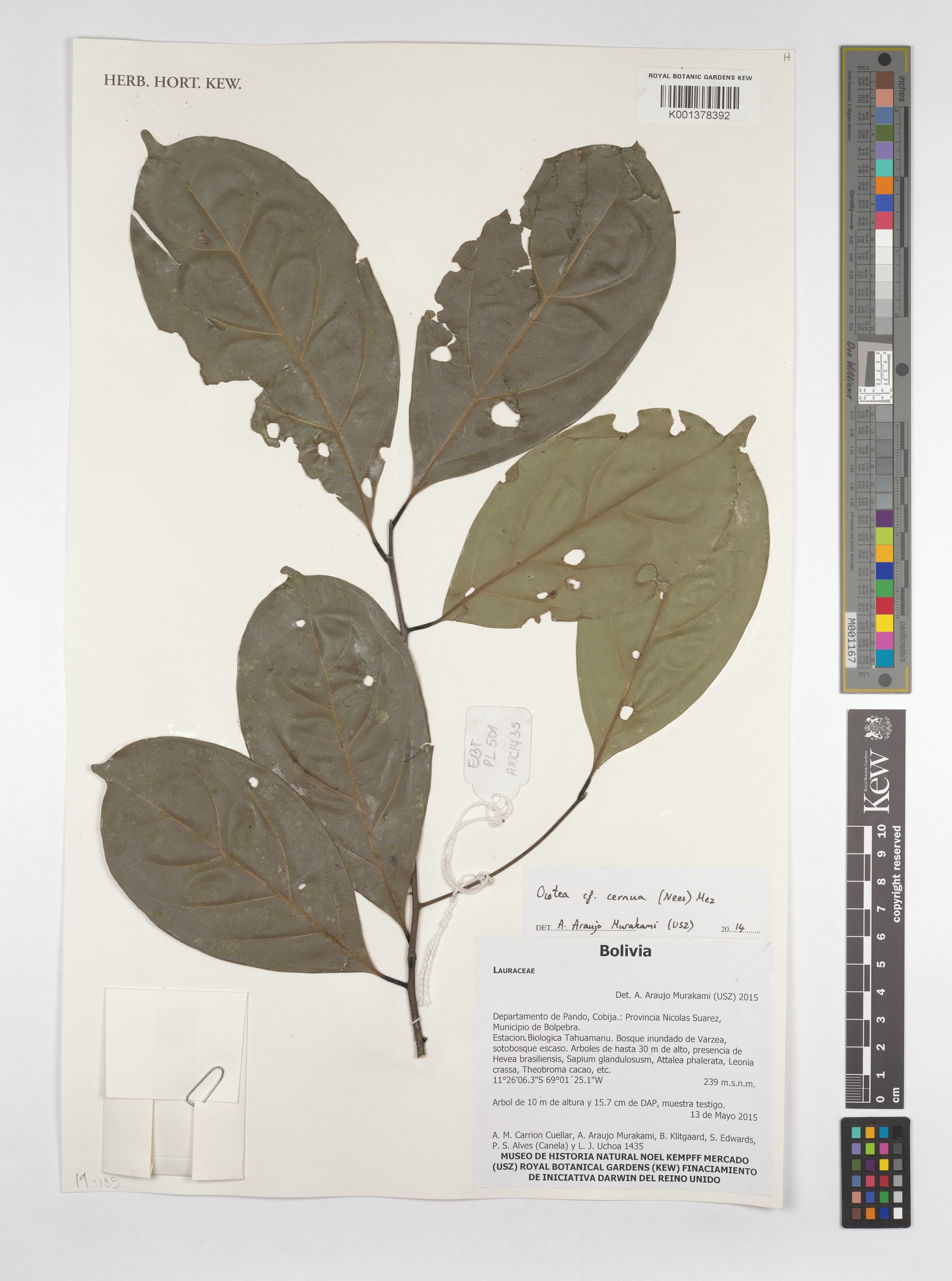
Leaves measure 4–16 × 1.5–7.5 cm, elliptic to elliptic-oblong, and end in a distinct tail-like apex (caudate-acuminate). They are glabrous on both surfaces, occasionally with a dusting of hairs along the midrib, and lack domatia. Each side of the blade carries 3–6 secondary veins, while the fine tertiary veins form a subtle raised net. Petioles are 0.6–2 cm long. Inflorescences are racemes or narrow panicles 2.5–12 cm and completely glabrous. The species is dioecious, so individual trees produce either male or female flowers; each flower is 2.5–4 mm wide with 1–1.8 mm tepals that dry black. Fruits are 1.5–1.8 cm long and sit in a convex cupule 0.5–0.8 cm tall that wraps more than half the drupe. When dried, cups keep their curved sides, helping field botanists distinguish the species from look-alikes such as O. meziana or O. laetevirens, whose cups remain straight or concave.

Seasonal Rhythms
Herbarium records show flowering almost year-round but peaking between January and July (with additional flushes in September, November, and December). Fruiting branches appear shortly after, and collectors note that the flowers are sweetly fragrant. Because male and female flowers occur on separate trees, monitoring a stand often reveals alternating bursts of pollen-rich and fruit-bearing crowns throughout the transition from dry to wet season.
Wildlife Connections
Dioecy turns O. cernua groves into seasonal resource hot spots: pollinators visit the male trees for nectar and pollen, then move among the female trees to fertilize the glossy green fruit. Later, Keel-billed Toucans (Ramphastos sulfuratus), Yellow-throated Toucans (R. ambiguus), Collared Aracaris (Pteroglossus torquatus), Turquoise and Yellow-billed Cotingas, plus white-faced capuchins (Cebus imitator) and spider monkeys (Ateles geoffroyi) swallow the lipid-rich drupes whole and transport the seeds to perches scattered across lowland ridges and mangrove edges. Even though O. cernua lacks the headline status of highland Lauraceae, it quietly supports the dry-season diets of many iconic coastal frugivores. Additionally, the caterpillars of the butterfly Memphis mora feed exclusively on the leaves of this species.
Taxonomy & Conservation
Plants of the World Online treats O. cernua as a synonym of O. leptobotra, reflecting recent taxonomic consolidations. Field botanists in Costa Rica continue to use the older name because herbarium specimens, forestry guides, and indigenous plant lore all refer to sigua amarillo. Despite its broad range, the species has not been assessed by the IUCN Red List, so its global conservation status remains undefined. Given ongoing lowland deforestation, especially outside protected areas such as Carara, Palo Seco, and Corcovado, monitoring of dioecious Ocoteas like this one remains important.
Resources & Further Reading
Floristic References
Primary Costa Rican treatment with habitat, identification, and phenology notes for O. cernua.
Synonymy with Ocotea leptobotra, distribution summary, and herbarium imagery.
Data Sources
Explains how toucans, cotingas, and primates move lipid-rich Lauraceae fruits through lowland forests.
Summarizes diets of toucans, cotingas, and monkeys that include lowland Lauraceae such as O. cernua.