Ira Zoncho
Ocotea calophylla — A high-montane laurel whose lustrous silvery-brown undersides make it unmistakable among Costa Rica's páramo-edge forests and the cloud-wrapped cordilleras of Colombia and Venezuela.
When Burger and van der Werff surveyed Costa Rica's Lauraceae, they found only three national collections of Ocotea calophylla, two tagged "ira zoncho" and one "yema huevo." Yet those few herbarium sheets revealed one of the most distinctive laurels in Central America: a tree whose leaves look like they belong to a different family altogether. The dense, silky hairs coating the leaf undersides gleam copper to silver depending on the light, giving the foliage a texture more reminiscent of Sapotaceae than typical Lauraceae.
The Costa Rican populations cling to windswept ridges between 2,150 and 3,300 meters on Cerro de la Muerte and the northern Talamancas, at the upper edge of where trees can grow. The species' main range stretches through the Colombian and Venezuelan Andes, where GBIF documents roughly 400 records from Boyacá, Cundinamarca, Tolima, and Mérida. This disjunct distribution, a handful of Costa Rican trees separated by over 1,000 kilometers from the nearest Andean populations, hints at ancient cloud-forest connections now severed by lower, warmer terrain.
Identification

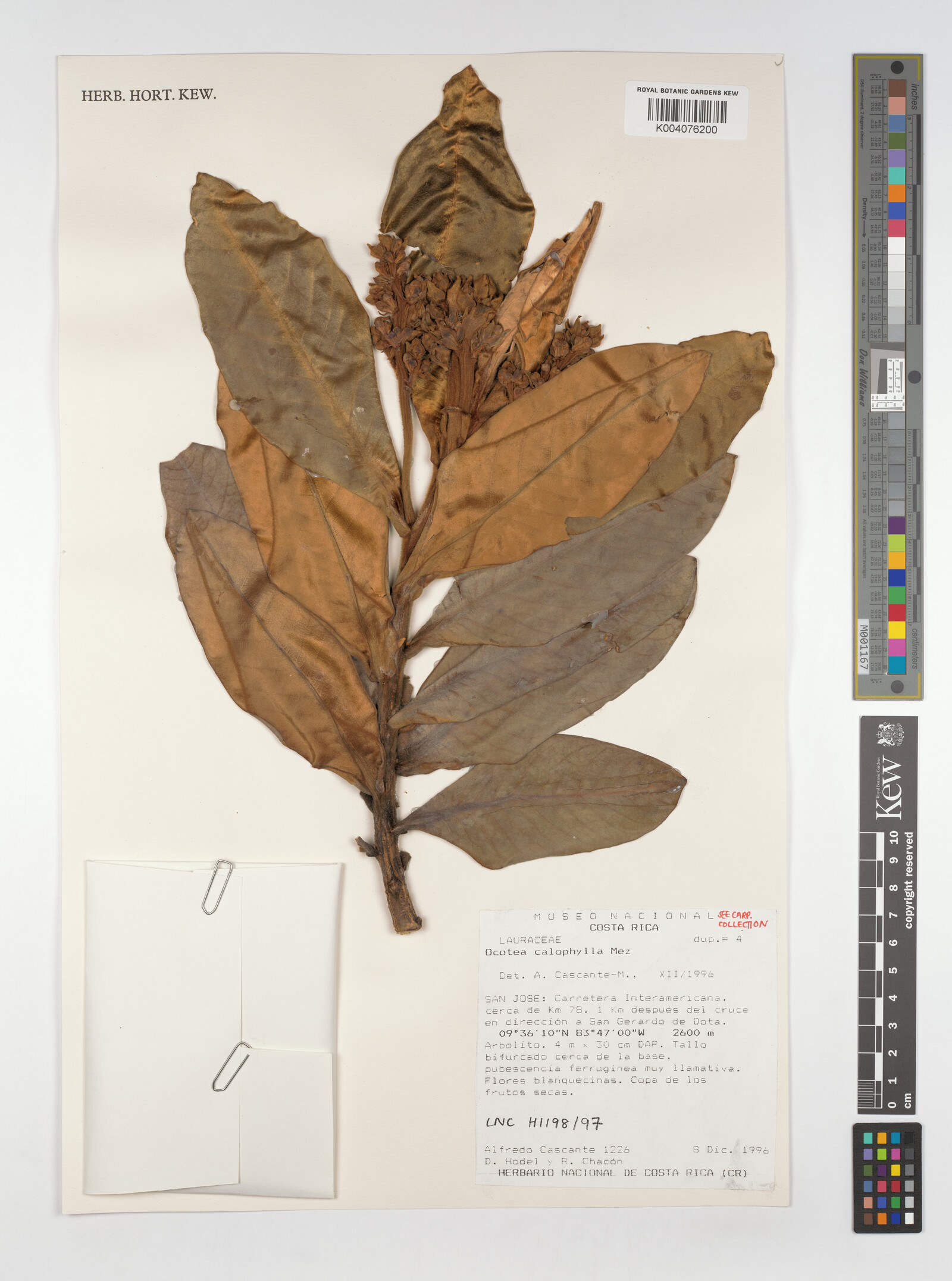
Leaves
The leaves are the key to recognizing this species. They measure 10–19 cm long by 4–6 cm wide, with very short stalks (nearly sessile). The base tapers gradually and the margins roll slightly under (revolute). The upper surface dries to a dull gray-green and is nearly hairless, while the lower surface is completely covered in lustrous, silky hairs that lie flat against the leaf (appressed indument). These hairs range from coppery-red to silvery-brown depending on age and lighting. The striking two-toned appearance, dull above and metallic-sheened below, distinguishes O. calophylla from every other Costa Rican laurel and can cause initial confusion with members of Sapotaceae.
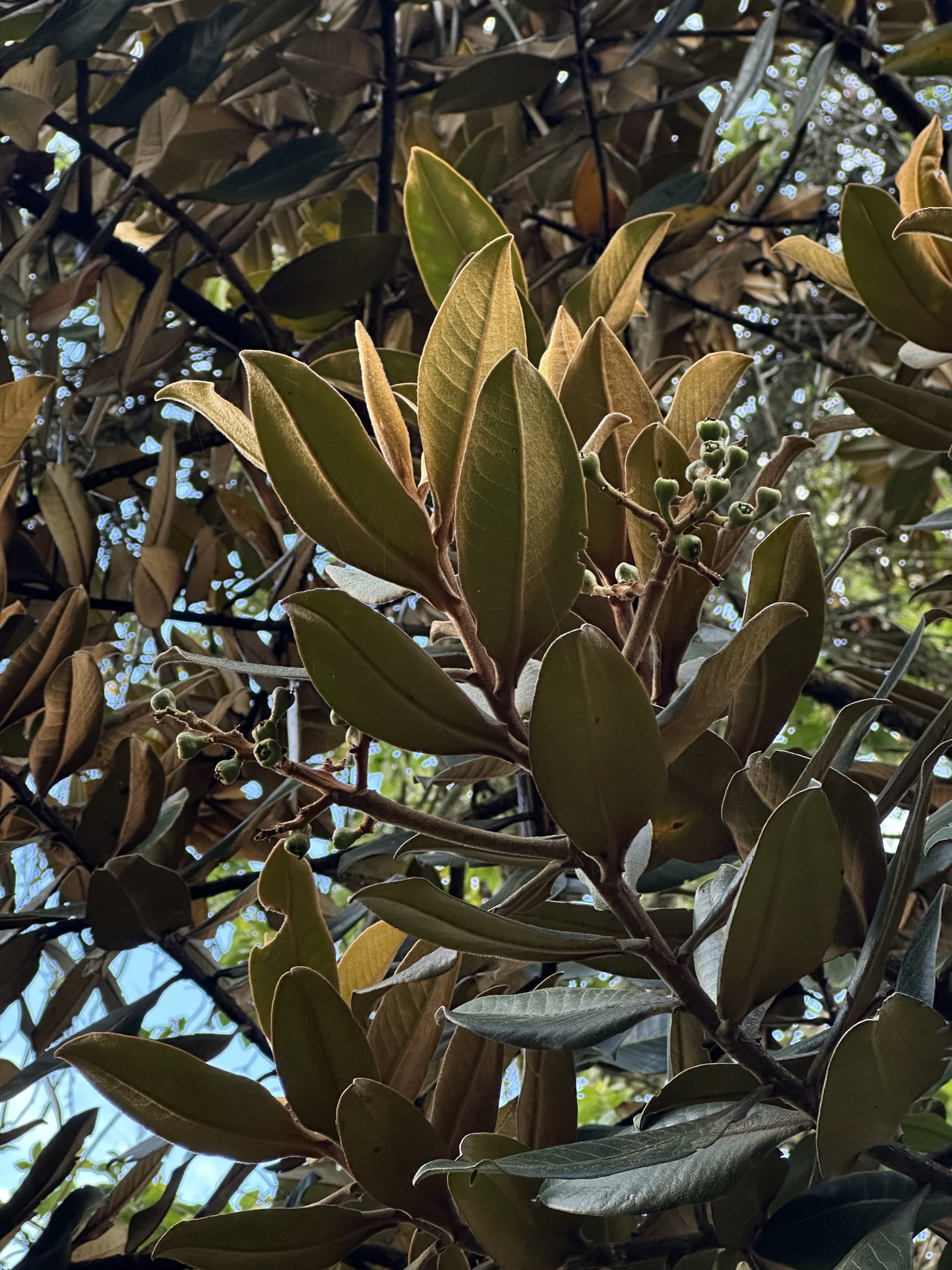
Flowers
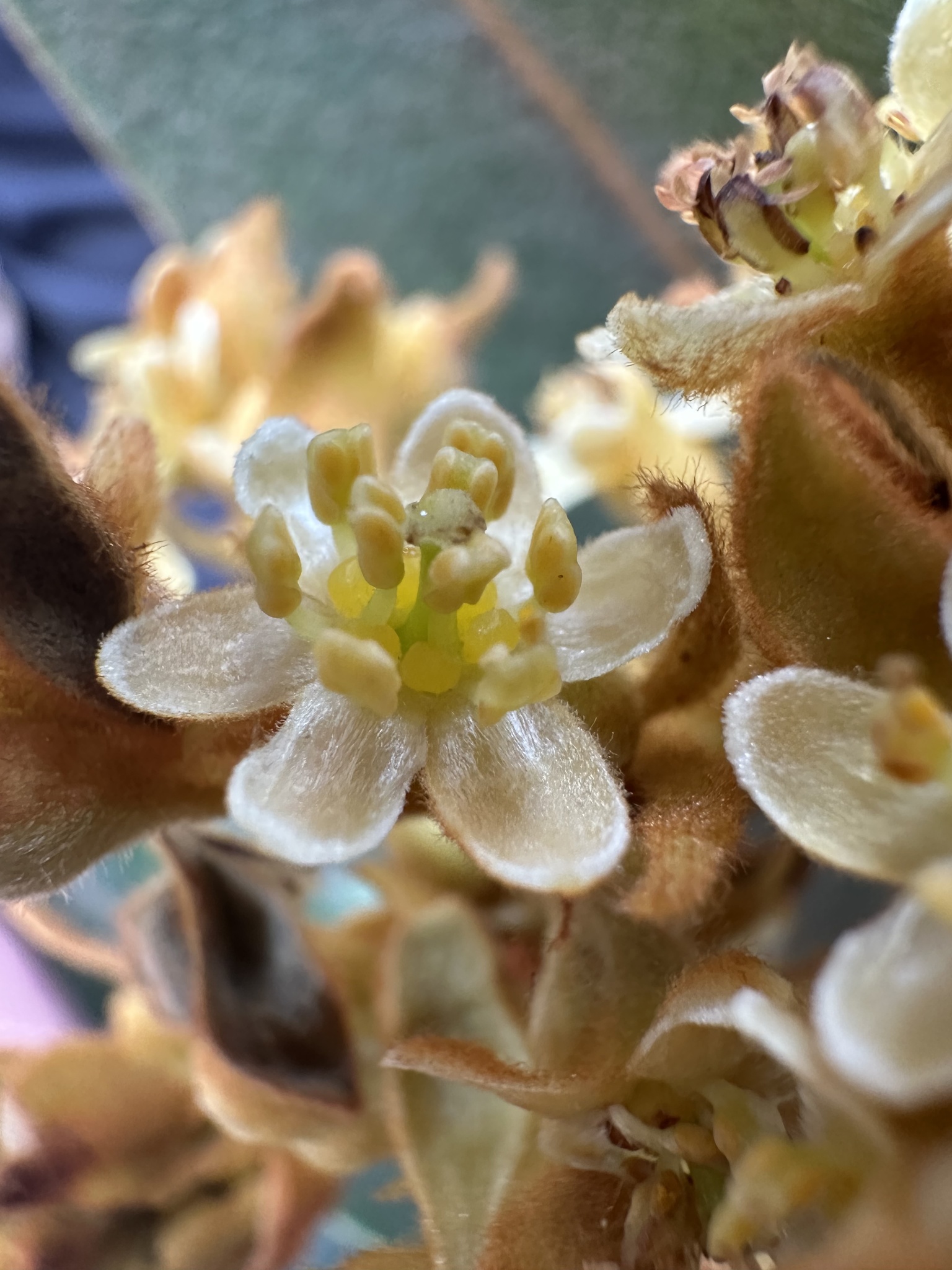
Inflorescences reach 25 cm in length, arranged in compact panicles (branched flower clusters) with reddish-brown axes covered in fine short hairs (puberulent). Individual flowers measure 4–7 mm across, with thick tepals (petal-like structures) about 4 mm long and fleshy anthers borne on filaments of similar length. The pistil reaches 4.5 mm and remains hairless. Flowering occurs in January and February, during the brief dry period at high elevations.
Fruits
The fruits are drupes (fleshy fruits with a single stone) that sit in shallow, saucer-shaped cupules about 1 cm wide. Immature fruits are dark green with pale brown cupules, as recorded on the Field Museum voucher ("frutos verde oscuro, con el cáliz café claro"). The berries swell to about 2 cm when ripe in September. The persistent cupules remain long after the fruit is dispersed, helping field botanists identify the tree even outside fruiting season.
Range & Distribution
In Costa Rica, O. calophylla is known only from the Cerro de la Muerte massif and the upper Río Chirripó watershed, where trade winds deposit more than four meters of annual rainfall. Burger and van der Werff noted that all three Costa Rican specimens came from mossy ridges fully exposed to wind, suggesting the species requires constant cloud immersion and tolerates only the briefest dry spells. The trees grow in the oak-Podocarpus belt at the upper limit of continuous forest, just below where vegetation gives way to páramo grassland.
Across the Andes, GBIF records concentrate along the foggy cordilleras of Boyacá, Cundinamarca, Santander, and Tolima in Colombia, with additional collections from Mérida, Venezuela. The elevational range spans 2,000–3,100 meters, similar to that in Costa Rica. The species shares these cloud-drenched slopes with Weinmannia (encenillo), Clusia, and thickets of Chusquea bamboo, all indicators of the upper montane forest zone.
The Silver Sunscreen
The dense indument that makes O. calophylla so recognizable is more than ornamental. At elevations above 2,600 meters, ultraviolet radiation intensifies dramatically, and temperatures swing from near-freezing nights to sun-scorched middays. Research on high-altitude plants shows that densely packed trichomes (leaf hairs) function as a physical sunscreen, scattering or absorbing incoming UV-B radiation before it damages underlying cells. The silvery sheen comes from reflective surfaces that bounce back excess light, reducing both photoinhibition and heat load.
The appressed hairs that coat O. calophylla leaves contain flavonoids known to absorb UV wavelengths, adding a chemical layer to the physical barrier. Similar pubescence appears in unrelated páramo-edge plants from New Zealand to the Himalayas, a case of convergent evolution wherever species colonize high-altitude treelines. The coppery-to-silver color shift visible on herbarium sheets reflects both the angle of the hairs and their flavonoid content, which changes as leaves age.
Ecology
Pollination in high-elevation Lauraceae remains poorly studied, but the flowers' structure suggests generalist visitors. The thick, fleshy tepals and exposed anthers may attract small flies and beetles that can tolerate the cold, windy conditions. Fruiting in September places ripe drupes at the end of the wet season, when disperser activity peaks before the brief highland dry period.
Unlike their oak neighbors, which form ectomycorrhizal networks with specialized fungi, Lauraceae trees rely primarily on arbuscular mycorrhizas. These ancient symbioses, dating back 400 million years, send fungal filaments directly into root cells to exchange phosphorus and other nutrients. In the nutrient-poor, acidic soils of high-montane forests, this partnership extends the tree's effective root system far beyond what roots alone could reach. The oaks and laurels thus tap different fungal guilds even while sharing the same windswept ridgelines.
Wildlife Connections
High-elevation Lauraceae sustain an entire guild of montane frugivores. Resplendent Quetzals patrol the same ridgelines where O. calophylla grows, swallowing the 2 cm drupes whole and regurgitating the seeds at perch sites across the forest. Volcano Juncos and Large-footed Finches glean fallen fruits from the mossy ground along wind-scoured saddles. Even the Volcano Hummingbird, though primarily a nectar feeder, visits the sunlit gaps in the laurel canopy where Centropogon and other tubular flowers bloom, cross-pollinating the forest community.
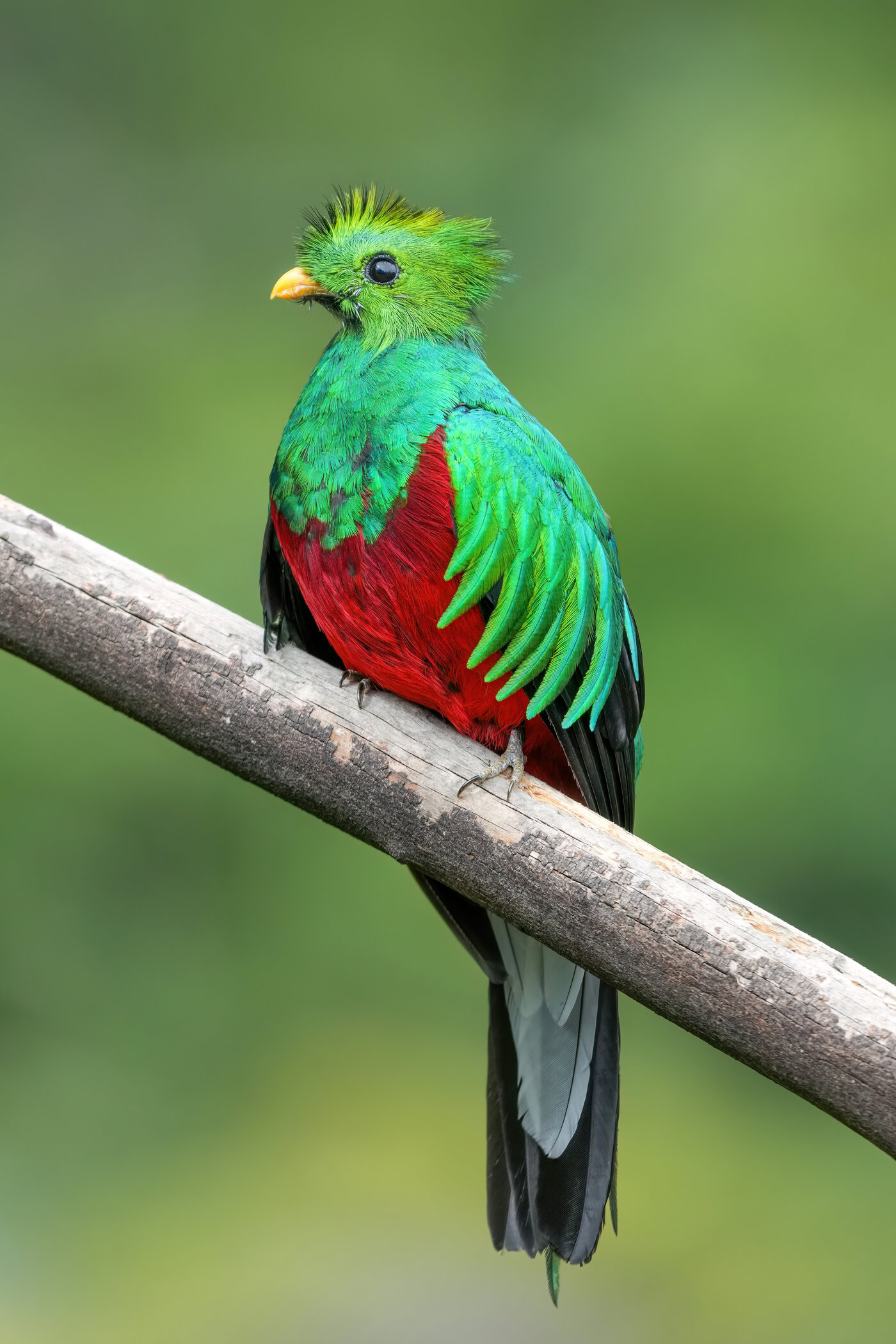
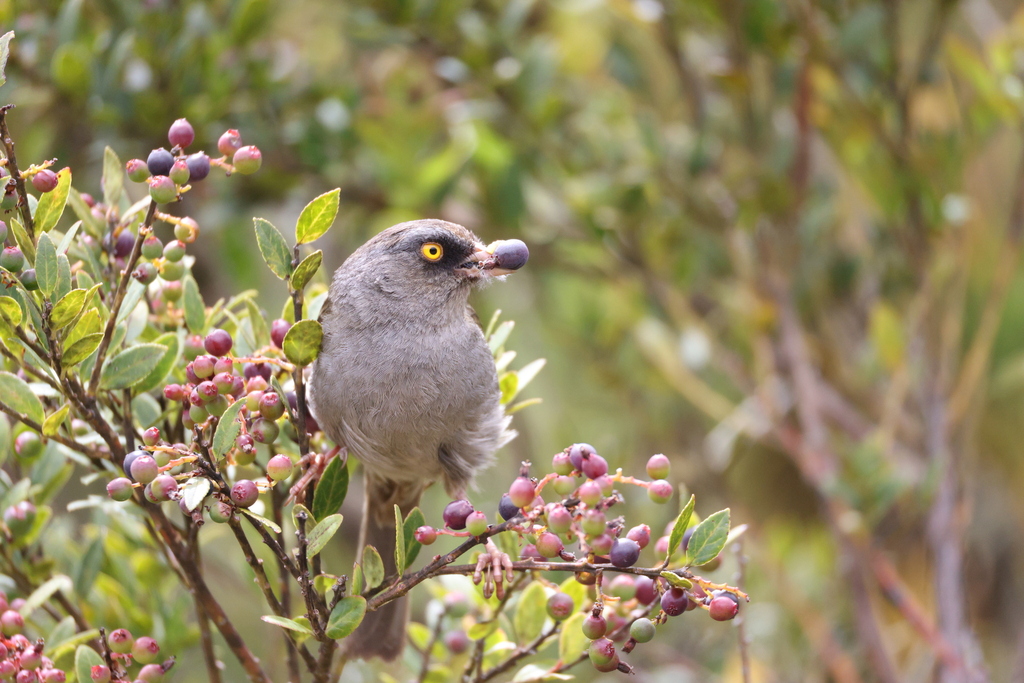


Photos (clockwise from top left): Resplendent Quetzal (Giles Laurent via Wikimedia Commons, CC BY-SA 4.0), Volcano Junco (floris_heemskerk via iNaturalist, CC BY-NC 4.0), Large-footed Finch (carlossch via iNaturalist, CC BY-NC 4.0), and Volcano Hummingbird (carrieseltzer via iNaturalist, CC BY 4.0).
Life on a Sky Island
The handful of O. calophylla trees clinging to Cerro de la Muerte represent an evolutionary outpost, the northernmost fragment of what was once a continuous high-Andean cloud forest. During glacial periods, cooler temperatures allowed such forests to span from Panama to Venezuela. As the climate warmed, highland vegetation retreated upslope, fragmenting into "sky islands" isolated on the highest peaks. The 1,000-kilometer gap now separating Costa Rica's population from the nearest Colombian trees records this long biogeographic divorce.
Costa Rica's Cerro de la Muerte massif thus functions as the northernmost ecological island in a chain of páramo fragments extending from the Andes. The same isolation that gave rise to endemic birds like the Volcano Junco and Timberline Wren also preserves genetic lineages of plants that parted ways with their Andean relatives thousands of years ago. For O. calophylla, every seed dispersed on these windswept ridges carries genes found nowhere else in Central America.
Conservation
No formal Red List assessment exists for O. calophylla, but its Costa Rican populations are minuscule and restricted to the Los Quetzales–La Amistad protected corridor. The species' striking silvery foliage has long attracted plant collectors, prompting herbaria to encourage observation and photography over physical collection. With only three documented Costa Rican specimens, every remaining seed tree matters for the genetic continuity of the Central American population.
Climate change compounds the sky-island problem. A 2023 study of Talamanca's endemic birds predicts that most elevation-restricted species will lose 15–40% of their range by 2070 as suitable habitat shifts upslope. The birds that depend on O. calophylla fruit face shrinking territory, and the tree itself has nowhere higher to go. Already growing at the treeline, it cannot migrate upward into páramo grassland where soil conditions and microclimates differ fundamentally. Conservation efforts must therefore focus on buffering the existing ridgeline forests against fire, cattle incursion, and road expansion, buying time for adaptation in a landscape with vanishing options.
Across the Andes, the species benefits from páramo and upper montane reserves such as Chingaza and Sumapaz in Colombia and Sierra Nevada in Venezuela. These larger Andean populations provide a genetic reservoir, but their connection to Costa Rica's sky island exists only in the fossil record and in our conservation imagination. Protecting both ends of this ancient range is the only way to preserve the full evolutionary story the silvery leaves tell.
Taxonomic History
Carl Mez described Ocotea calophylla in 1889 based on South American material, giving it a name meaning "beautiful-leaved" in reference to the striking indument. However, an earlier name, Pleurothyrium velutinum Meisner (1864), has nomenclatural priority, which renders Mez's combination technically illegitimate. Burger and van der Werff's 1990 Costa Rican treatment kept the local sheets under Ocotea fulvescens for practical reasons, while noting the distinctiveness of the silvery-leaved collections.
Van der Werff's 2022 revision of Andean Lauraceae transfers this species complex to the new genus Andea, with the accepted name now Andea velutina (Meisn.) van der Werff. The genus comprises 25 gynodioecious species, all confined to the Andes except for this single Costa Rican outlier clinging to Cerro de la Muerte. Among the Ocotea species covered on this site, this is the only one affected by the transfer. Collections databases and field guides still widely reference Ocotea calophylla, but researchers should use Andea velutina when publishing new records.
Resources & Further Reading
Species Information
Kew's database entry with accepted nomenclature and distribution summary.
Missouri Botanical Garden's nomenclatural record with synonymy and specimen data.
Interactive map of ~400 records from Costa Rica, Colombia, and Venezuela.
Taxonomy & Nomenclature
Original Latin diagnosis in Jahrbuch des Königlichen Botanischen Gartens Berlin 5: 298.
Fieldiana Botany n.s. 23: 88. Costa Rican account with local names and habitat notes.
Ecology & Conservation
Overview of the protected area that harbors Costa Rica's O. calophylla populations.
Predicts 15–40% range contractions for Talamanca's high-elevation endemic birds by 2070, with implications for the fruit-bearing trees they depend on.
Trichome Physiology & UV Protection
Demonstrates the importance of leaf hair morphology in regulating UV absorption and heat load in high-altitude plants.
Discusses how leaf surface traits including trichomes and UV-absorbing compounds vary with elevation in tropical mountains.
Biogeography & Mycorrhizas
Reviews tropical mycorrhizal associations, noting that Lauraceae rely on arbuscular mycorrhizas while oaks form ectomycorrhizas.
Comprehensive treatment of Andean cloud forest ecology, structure, and conservation, covering the habitat types where O. calophylla thrives.