Muñeco
Cordia collococca — The dioecious pioneer with sandpaper leaves. This drought-tolerant tree thrives in Costa Rica's seasonal Pacific forests, where its whitish folded trunk and sweet red fruits make it easy to recognize once you know where to look.
Walk through a dry Pacific forest in Costa Rica and you may notice a tree with an unusual trunk: whitish bark marked by deep vertical folds near the base, snaking buttress roots extending outward. Touch its leaves and they feel like fine sandpaper. If you find one bearing fruit in May or October, you can pick a sweet red drupe and eat it fresh. This is the muñeco, one of several Cordia species native to the region, and perhaps the least appreciated.
Unlike its famous cousin the laurel (Cordia alliodora), which farmers plant by the thousands in coffee plantations, the muñeco receives little attention. Its wood is useful but not prized. It produces no garlic scent to make it memorable. But the muñeco has qualities the laurel lacks. It tolerates drought better, thrives in seasonal climates where dry months are long and hard, and produces edible fruit that feeds both wildlife and people. In the forests of Guanacaste and the Pacific lowlands, this is the Cordia you are more likely to encounter.
Identification
The Folded Trunk
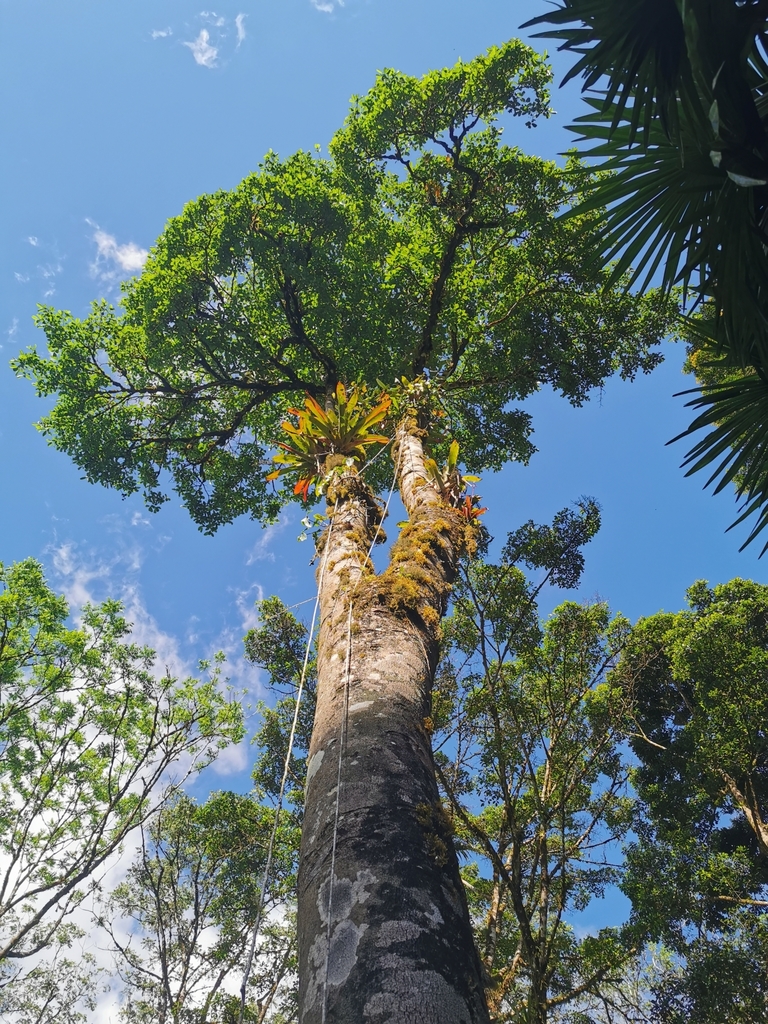
The muñeco's trunk is its most distinctive feature. While the laurel grows straight and cylindrical, the muñeco develops broad vertical folds near its base, creating an irregular cross-section bounded by deep creases. These folds diverge into rounded, snaking buttress roots that extend several meters from the tree. The bark itself is off-white to pale gray, often marked by coin-sized depressions and colonized by lichens and moss that accentuate its pale color.
The Sandpaper Leaves
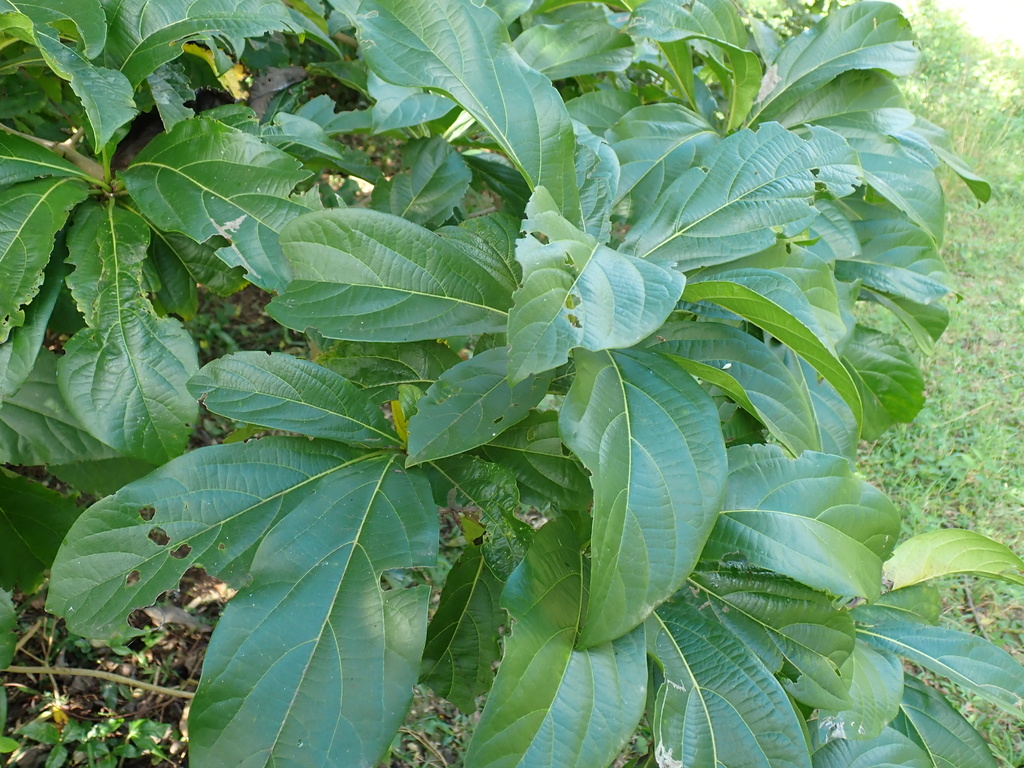
Pick up a muñeco leaf and run your fingers across it. The texture is unmistakable: rough, stiff, abrasive, like fine sandpaper. This is not a subtle distinction. The leaves are simple, alternate, elliptical with rounded tips, measuring about 12 cm long and 7 cm wide. They are notably thick compared to other forest leaves. Before dropping, the foliage cycles through colors: green to yellow to deep chocolate brown, typically shedding in July and February. The crown remains bare for only about a week before new leaves emerge.
Flowers and Fruits
Flowers: Small white blooms about 8 mm across, with five fused petals, brown stamens, and a four-part pistil with a bulbous red ovary. They appear in large axillary panicles, primarily from May through July, with sporadic flowering in other months. The flowers attract insects for pollination.
Fruits: Small red drupes about 1 cm in diameter, maturing in large bunches in the canopy. The flesh is sweet with a mucilaginous (slightly slimy) texture, earning the tree its English name "clammy cherry." Fruiting peaks in May and October. The fruits are edible to humans and eagerly consumed by birds and arboreal mammals including monkeys.
A Tree of Two Sexes
The muñeco is dioecious: individual trees are either male or female, never both. Male trees produce pollen; female trees produce fruit. This is unusual among trees and has practical implications. If you want to harvest fruit or collect seeds, you need a female tree, and there must be a male tree somewhere nearby to provide pollen. In natural forests this is rarely a problem, but in cultivation or restoration projects it matters. Planting only one tree means no fruit, no seeds, no wildlife food source.
The laurel, by contrast, is hermaphroditic: each tree has flowers containing both male and female parts. A single laurel can pollinate itself and produce viable seed. This difference in reproductive strategy may partly explain why the laurel is planted so widely while the muñeco remains a forest tree.
Comparing the Four Cordias
Costa Rica hosts four Cordia species that are commonly encountered. All are pioneers of disturbed sites, but each occupies a different niche and can be distinguished by a few key features.
| Feature | Muñeco | Laurel | L. Negro | M. Blanco |
|---|---|---|---|---|
| Species | collococca | alliodora | megalantha | bicolor |
| Max height | 35 m | 30 m | 60 m | 20 m |
| Leaf test | Sandpaper | Garlic scent | Smooth both sides | White underside |
| Fruit | Red drupe | Wind nutlet | Fibrous, brown | Yellow drupe |
| Habitat | Dry Pacific | Versatile | Very wet forests | Humid lowlands |
| Timber | Moderate | Excellent | Excellent | Moderate |
Ecology
The muñeco is a pioneer species, demanding full sun and colonizing disturbed sites with aggressive success. It thrives in old secondary forest, along roadsides, at pasture margins, and in thickets. In Costa Rica, it is particularly common on the Pacific slope, where it prefers the seasonal climates with pronounced dry periods. You can find it at Manuel Antonio, Punta Leona, Carara, and Corcovado, and it likely occurs throughout the southern Pacific lowlands.
Its range extends from southern Mexico through Central America to northern South America and throughout the Caribbean. It grows from sea level to about 400 meters, though most populations occur below 100 meters. Unlike the laurel, which tolerates a wide range of rainfall, the muñeco is specifically adapted to seasonal climates with distinct wet and dry periods.
Wildlife Value
The muñeco's red fruits make it an important food source for forest wildlife. Birds flock to fruiting trees, and the seeds pass through their digestive systems to germinate elsewhere. Arboreal mammals including monkeys also consume the fruits. The flowers attract various insects for pollination. In seasonal forests where food can be scarce during the dry months, the muñeco's fruiting peaks in May and October provide critical resources.
Uses
Food: The sweet red fruits can be eaten raw. The mucilaginous texture takes some getting used to, but the flavor is pleasant. In some Caribbean countries, the tree has been cultivated specifically for its fruit.
Medicine: Traditional uses include the roots as an emollient (skin softener). Various parts of the plant have been used in folk medicine across its range.
Timber: The wood is tan-colored with dark rays, moderately heavy, and easy to work. It has been used for fence posts and firewood. While not as valuable as laurel timber, researchers have identified the muñeco as a potentially commercial species that could be developed for sustainable forestry.
Reforestation: The muñeco has potential for restoration projects in dry Pacific forests. Its drought tolerance, fast growth, wildlife food value, and ability to establish on degraded land make it a candidate for ecological restoration, particularly where seasonal rainfall limits options.
Conservation
The muñeco is not threatened. Its wide range from Mexico through South America and the Caribbean, combined with its pioneer habit and ability to thrive in disturbed areas, ensures healthy populations. The IUCN lists it as Least Concern. Seeds are conserved at Kew's Millennium Seed Bank as an additional safeguard.
The tree does not need protection so much as recognition. In a landscape dominated by the laurel's economic importance, the muñeco remains overlooked. Yet it fills an ecological niche the laurel cannot: the drought-tolerant, fruit-producing pioneer of truly seasonal forests. As climate change makes dry seasons longer and more severe in parts of Central America, trees like the muñeco may become more valuable, not less.
Costa Rica's four Cordias together illustrate how closely related species can partition the landscape. The laurel thrives in coffee farms and mid-elevation slopes across the country. The muñeco claims the dry seasonal forests of the Pacific. The muñeco blanco fills the humid lowlands of both coasts. And the laurel negro towers over the wettest forests near sea level. Each has its place, each its leaf test, each its contribution to the forest.
Resources & Further Reading
Species Information
General overview of the species including taxonomy and distribution.
Detailed species account with photographs and Costa Rican distribution information.
Species profile from the Osa Peninsula botanical collection.
Comprehensive information on uses, cultivation, and ecology.
Taxonomic information and native range from Kew Gardens.
Occurrence records and distribution maps from worldwide collections.
Community observations with photographs from Mexico to South America.
Scientific Literature
Scientific review comparing C. collococca with related Caribbean Cordia species.