Manteco
A canopy tree with wood so hard a chainsaw cannot bite it, flowers that produce oils found nowhere else in its 5,800-species family, and a name that traces back to an 18th-century Carib word from the forests of French Guiana.
In 1775, the French apothecary-botanist Jean-Baptiste Aublet published a monumental flora of French Guiana in which he made an unusual choice: rather than coining Latin or Greek genus names, he preserved the indigenous words his Galibi (Kali'na Carib) informants used for the plants they showed him. Of the 208 new genera Aublet described, 74 carried Galibi names. One of these was Mouriri, from mouririchira, a Kali'na word for a small tree with fleshy fruits. Two and a half centuries later, the genus Aublet named from those Guianese forests has expanded to 86 recognized species stretching from southern Mexico to the Amazon basin. Mouriri gleasoniana, described from Mexican and Guatemalan material in 1940, is among the few that reach Mesoamerica, where it grows as a canopy tree of wet lowland forests from Tabasco and Oaxaca through Central America to Panama.
What makes this tree remarkable is less visible. Mouriri belongs to the Melastomataceae, a vast family of over 5,800 species famous as the largest radiation of "pollen flowers" in the tropics: plants whose blooms offer nothing to visiting insects except pollen. Mouriri breaks this rule. Its anthers bear tiny oil glands (elaiophores) that secrete a complex cocktail of fatty acids, amino acids, and carotenoids, making it the first lineage within the family documented to produce floral oils. Bees harvest these oils through buzz pollination (sonication), vibrating their flight muscles at specific frequencies to shake the anthers open. The wood, too, is extraordinary: in field tests at Manuel Antonio National Park, a razor-sharp chainsaw blade reportedly skipped across the surface of a Mouriri gleasoniana limb without biting in, the wood proving, in the words of forest ecologist Patrick Harmon, "as resistant as steel and as flexible and resilient as hickory."
Identification
Habit
Mouriri gleasoniana ranges from a large shrub 3 m tall to a canopy tree reaching 35 m, depending on habitat and forest maturity. In the well-developed wet forests of Manuel Antonio National Park, mature trees grow 20 to 35 m tall with trunk diameters near 60 cm. The trunk is predominantly round in cross-section, with shallow, sinewy bulges, and branching occurs at relatively low levels. The crown is described as very thin, open, and airy. Flora Mesoamericana records a broader size range of 3 to 18.5 m, which likely reflects the spectrum from edge or secondary-growth individuals to full canopy trees in primary forest. The species is evergreen, producing new foliage between September and November.
Bark
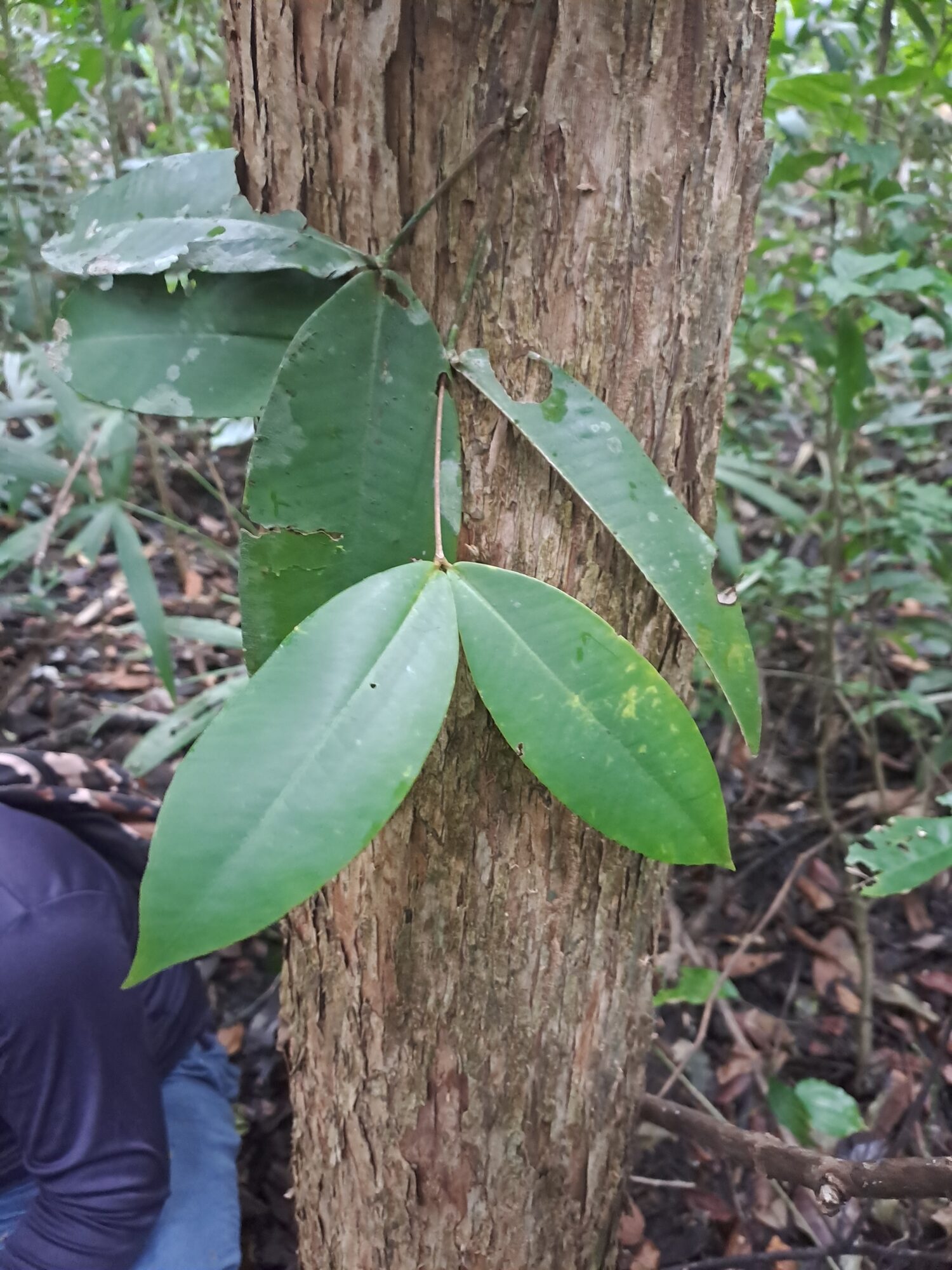
The bark is thin, papery, and tan-colored, marked by hairline vertical cracks that cause it to exfoliate in narrow strips. Externally it appears grayish and somewhat scaly. This bark pattern is diagnostic among the trees of Manuel Antonio National Park, where Harmon noted it is "not observed on other MANP species." The common name manteco, used along the Pacific coast of Costa Rica, may derive from manteca (Spanish for fat, butter, or grease), perhaps referencing a greasy or waxy texture to the bark surface.
Leaves
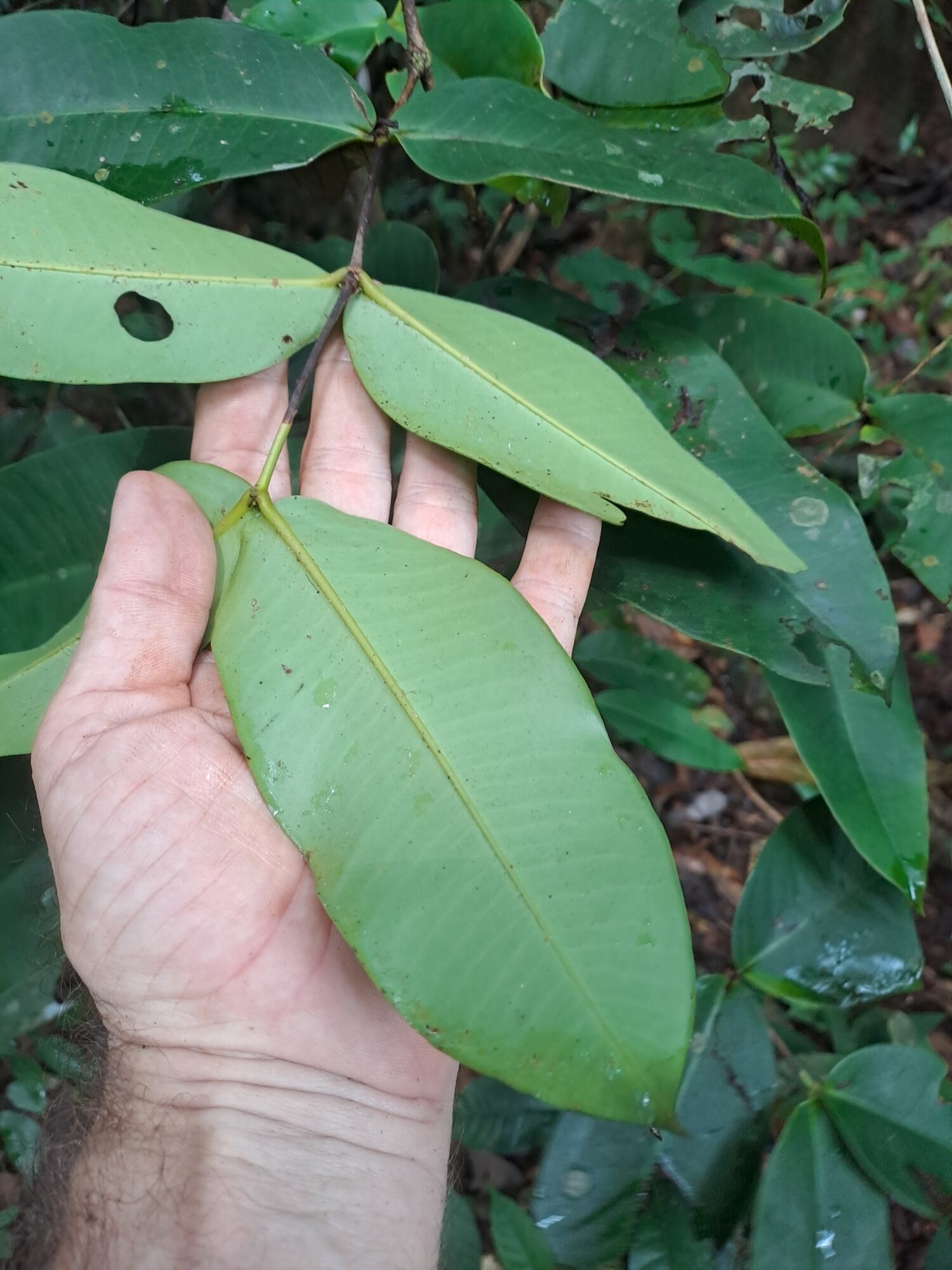
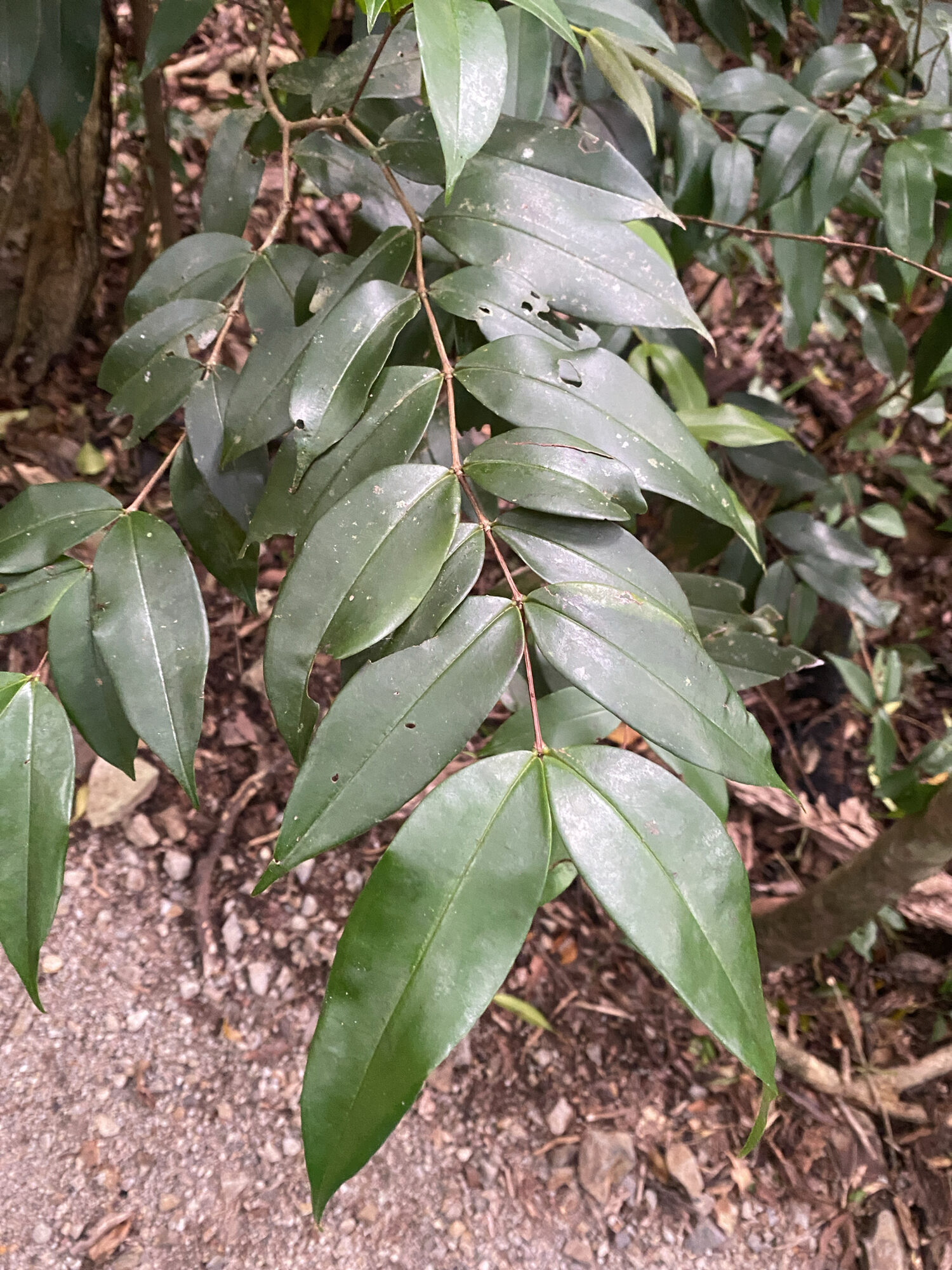
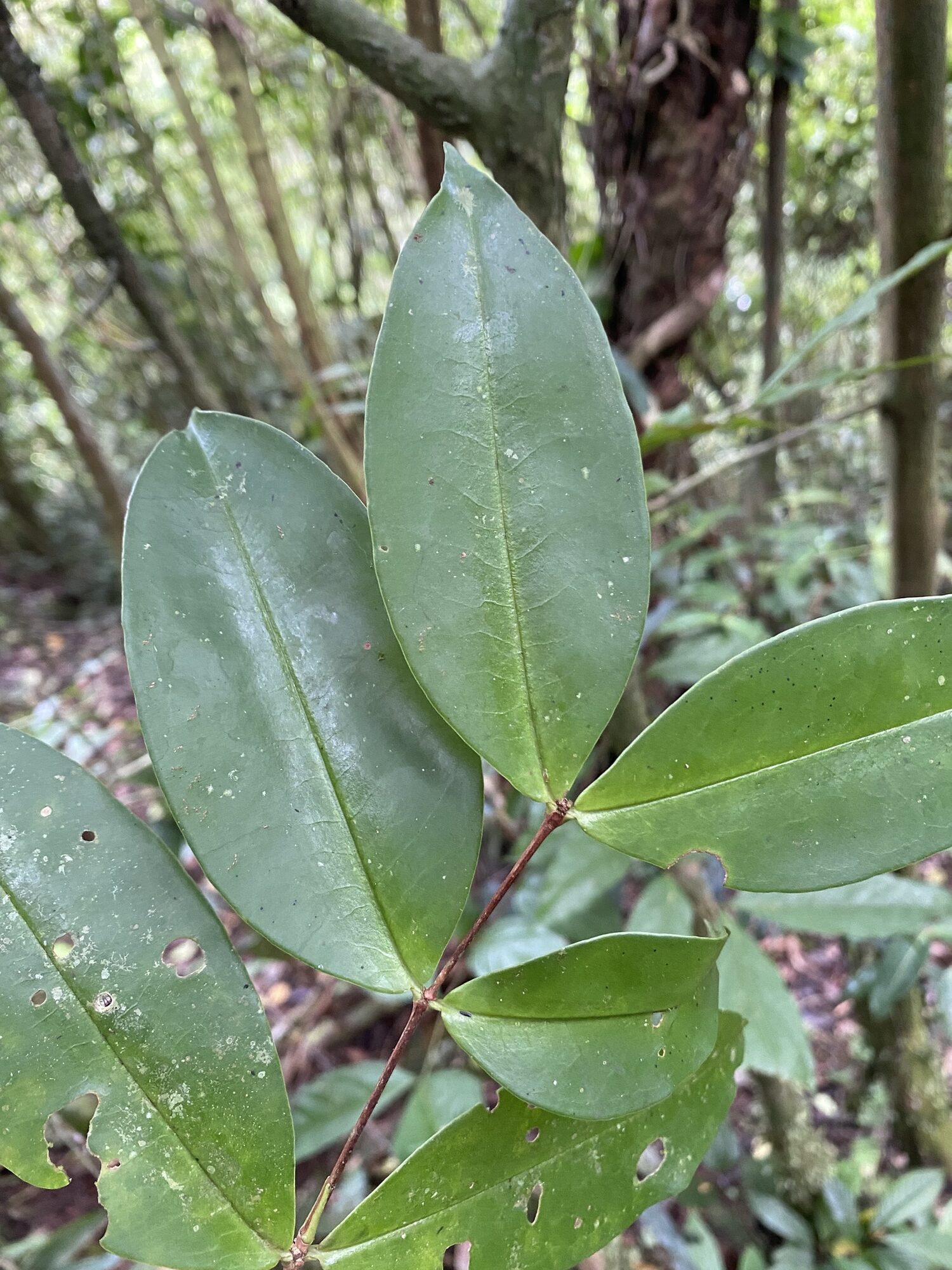
The leaves are simple, opposite, smooth, and very nearly sessile (lacking a visible petiole), measuring approximately 11 x 3 cm. Blades are narrowly elliptical to ovate-elliptical, tapering to acuminate apices. The most striking feature is the venation: unlike the vast majority of Melastomataceae, whose leaves display the conspicuous parallel (acrodromous) veins that are the family's visual hallmark, Mouriri gleasoniana has a single very prominent midrib with only faint, inconspicuous secondary veins. This is a shared character of the subfamily Olisbeoideae, connecting Mouriri with the Old World genus Memecylon. Harmon described the leaf arrangement as "more typical of a Myrtaceae" than of a melastome. New foliage emerges "longitudinally coiled around the mid-rib," pink in color with a limp, rubbery texture, before unfurling and hardening to a dark glossy green.
Flowers
Flowers appear in regularly spaced clusters of 1 to 7 blossoms from old leaf scars along bare sections of the twigs, a pattern called ramiflory (flowering from the wood). Each flower is small, approximately 1 cm across, with five widely separated petals that are pink (rarely white), sometimes with pink edges shading to white at the center. Golden buds reveal the petal color within. Ten yellow-anthered stamens surround a single white pistil, all supported by a deep, cup-like calyx on a 1 cm pedestal. The petals detach easily, and during peak bloom, Harmon described "a literal rain of white, confetti-like corolla parts" falling beneath the tree. At Manuel Antonio, flowering occurs from late May through early July; broader Costa Rican data suggests a wider window spanning January and May through October. The flowers are pollinated by bees through buzz pollination (sonication): the bees grip the anthers and vibrate their flight muscles at high frequency to release pollen and the distinctive floral oils from the anther elaiophores.
Fruits
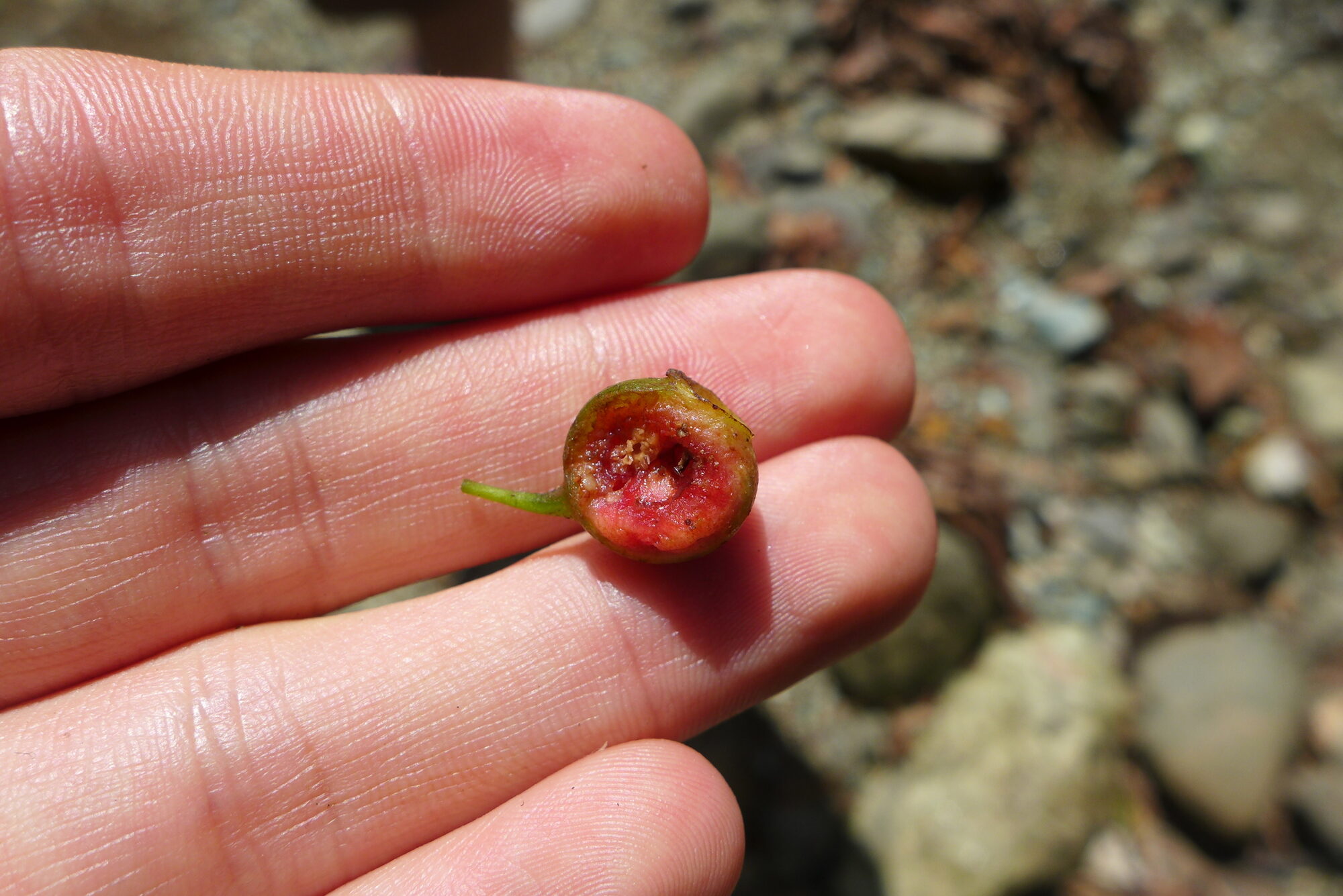
The fruits are fleshy drupes, basically globular but irregularly shaped and lobed, ripening from green to red. Each is crowned by the persistent calyx, which forms a shallow cup-like ring at the apex. Fruits average about 2 cm in diameter, though some individual trees consistently produce larger fruits up to 4 cm. Each drupe contains 2 to 4 hard-coated, popcorn-shaped seeds approximately 0.5 cm long, dull brown in color. Germination occurs within one to two months of fruit fall, but seed viability is quite low. At Manuel Antonio, fruiting occurs from November through January.
Distribution
Mouriri gleasoniana ranges from the states of Tabasco and Oaxaca in southern Mexico through Guatemala, Belize, Honduras, Nicaragua, and Costa Rica to Panama. GBIF holds 442 occurrence records across seven countries, with Costa Rica accounting for the largest share: 170 records (38.5%), followed by Mexico (143 records, 32.4%) and Panama (41 records). The elevation range spans sea level to 1,300 m, though the species is most common below 800 m.
In Costa Rica, the species occurs on both Caribbean and Pacific slopes. Caribbean populations are documented from the Sarapiquí plains, Puerto Viejo, Braulio Carrillo National Park, the Tortuguero lowlands, and the eastern Talamanca Cordillera (Amubri, 280 m). On the Pacific side, records span from Cerro Turrubares (800 m) and the Manuel Antonio region south through the Térraba-Sierpe watershed to the Osa Peninsula and Golfo Dulce. The Brunca region is well represented with 55 localities, including Corcovado National Park (Estación Agujas), Esquinas National Park near La Gamba, the Reserva Forestal Golfo Dulce (Los Mogos, Chocuaco, Bahía Chal), Rancho Quemado along the Fila División, and the upland corridor between Potrero Grande and Tres Colinas at 1,250 m. The earliest Costa Rican collection dates to 1921; the most recent confirmed record is from 2016. The species favors very humid forest, forest margins, and lake edges, with a preference for well-drained ridgetop soils.
Ecology
The pollination biology of Mouriri is among the most unusual in the Melastomataceae. In 1981, Stephen and Marlo Buchmann published the first documentation of floral oil production in the family, studying Mouriri myrtilloides in Panama. They found that the anthers bear epithelial elaiophores that produce nonvolatile oils containing at least 13 fatty acids, along with glucose, amino acids, carotenoids, and phenolic glycosides. This discovery was significant because the Melastomataceae, with over 5,800 species, is otherwise uniformly a "pollen-only" family. The oil-producing trait is confined to the subfamily Olisbeoideae, the small clade to which Mouriri belongs. Documented bee visitors to Mouriri flowers include carpenter bees (Xylocopa), stingless bees (Melipona, Trigona), and oil-collecting bees (Centris). In M. guianensis, flowers open around 18:00 with peak bee activity between 05:00 and 06:00 the following morning, and the crepuscular sweat bee Megalopta amoena uses its mandibles to pry open the anther pores.
Seed dispersal presents a more troubling picture. At Manuel Antonio, Harmon observed that many fruits fall to the ground and rot beneath the parent tree, "not highly regarded by the local, remnant wildlife community." He speculated that "perhaps Mouriri's principle seed dispersers no longer inhabit this region." Manuel Antonio is one of Costa Rica's smallest national parks at roughly 6.8 km², and its mammal fauna is depauperate compared to larger protected areas. The observation that fruits accumulate uneaten beneath the canopy suggests a disrupted mutualism, a pattern documented across fragmented tropical forests where large frugivores have been lost. The fruits are probably consumed by small mammals and birds where these dispersers remain present, but the identity of the historical principal dispersers remains unknown.
Taxonomic History
Paul Carpenter Standley (1884-1963) described Mouriri gleasoniana in 1940, publishing the species in Publications of the Field Museum of Natural History, Botanical Series (volume 22, page 361) as part of his prolific "Studies of American Plants" series. Standley had joined the Field Museum in Chicago in 1928 and spent the next two decades building what became one of the world's finest herbarium collections of Central American plants, conducting intensive fieldwork in Guatemala (1938-1941 with Julian Steyermark), Honduras, and Costa Rica, where he authored the Flora of Costa Rica (1937-1938). The holotype of M. gleasoniana is deposited at the Field Museum, with isotypes at the Arnold Arboretum, the Lundell Herbarium, and the New York Botanical Garden. Type material came from Mexico (Tabasco and Oaxaca) and Guatemala.
The species epithet gleasoniana honors Henry Allan Gleason (1882-1975), the American ecologist and taxonomist at the New York Botanical Garden. Gleason is remembered today less for his taxonomic work than for an idea that revolutionized ecology. In 1926, he published "The Individualistic Concept of the Plant Association," arguing that plant communities are not discrete, self-organizing units (as Frederic Clements's dominant paradigm held) but rather assemblages of individual species, each responding independently to environmental gradients. The concept was largely dismissed during Gleason's career; only in the late 20th century, as quantitative gradient analysis became standard practice, did ecologists recognize that Gleason had been essentially right. That a tree named for a man who saw forests as collections of individuals, rather than fixed communities, should itself be a species whose seed dispersal is failing as its forest community unravels at Manuel Antonio carries a certain irony.
The genus Mouriri was monographed by Thomas Morley (1917-2002), a professor of botany at the University of Minnesota who earned his Ph.D. at UC Berkeley in 1949. Morley's first sectional revision of Mouriri appeared in 1953, and his Flora Neotropica monograph on the Memecyleae (the group now placed in subfamily Olisbeoideae) was published in 1976 as Monograph 15. It was in this monograph that Morley described Mouriri coibensis as a new species (page 143), based on material from Coiba Island, Panama, the largest island in Central America and now a UNESCO World Heritage Site. Morley reduced M. coibensis to varietal rank in 1989 in the Annals of the Missouri Botanical Garden (76: 437), recognizing it as M. gleasoniana var. coibensis. Subsequent work has fully synonymized the Coiba populations under M. gleasoniana, confirming that the island and mainland trees are a single species. Morley published on the genus for nearly half a century (1953-1998), ultimately recognizing 86 species. The species Mouriri morleyii was named in his honor.
Similar Species
Two features make M. gleasoniana easy to distinguish from other trees in its range. First, the leaves: the nearly sessile, opposite, single-veined blades are unlike anything else in the Melastomataceae, whose species nearly all display conspicuous parallel veins. Second, the bark: the thin, papery, tan bark exfoliating in narrow strips is distinctive and not shared by other species in the same forests. The only congener in Costa Rica is Mouriri myrtilloides Poir., which occurs on the Caribbean slope at 0 to 500 m and has a much wider range extending to South America and the Caribbean islands. M. myrtilloides has smaller leaves and was the subject of the Buchmanns' pioneering 1981 study on floral oil production in Melastomataceae. Where the two species overlap on the Caribbean slope, careful attention to leaf size and bark characters should separate them.
Conservation Outlook
The IUCN lists Mouriri gleasoniana as Least Concern, a status supported by its broad geographic range across seven countries from Mexico to Panama and its occurrence in multiple protected areas, including Manuel Antonio and Corcovado national parks in Costa Rica, Esquinas National Park, the Golfo Dulce Forest Reserve, and likely Braulio Carrillo and Tortuguero. The species is also included in SIREFOR's list of tree species of forestry importance in Costa Rica.
The formal assessment may, however, mask subtler concerns. The species is described as "occasional" and of "limited distribution" within its habitats, favoring well-drained ridgetop soils in mature wet forest. It is not a generalist pioneer that rebounds after logging. The impaired seed dispersal observed at Manuel Antonio raises questions about the species' reproductive future in fragmented forests where large frugivores have been lost. Even where the tree persists, the disruption of its seed-dispersal mutualism could gradually shift its population structure toward aging stands without effective recruitment. In larger, intact forests like those of the Osa Peninsula and Corcovado, where disperser communities remain relatively complete, the species is probably secure. The concern is for populations in smaller or more isolated fragments, where the tree may stand but no longer reproduce effectively.
Resources & Further Reading
Species Information
Plants of the World Online entry with accepted name, distribution, and synonymy.
442 global occurrence records, specimen images, and distribution maps.
Detailed species account from Patrick Harmon's Los Árboles del Parque Nacional Manuel Antonio, the primary field reference for this species.
Costa Rican distribution data, phenology, and habitat information.
Conservation assessment: Least Concern.
Taxonomy & Nomenclature
Nomenclatural data, type specimens, and literature citations from Missouri Botanical Garden.
International Plant Names Index record with publication details and type distribution.
Analysis of the 208 new genera Aublet described in his 1775 flora of French Guiana, including the Galibi origin of Mouriri.
Scientific Literature
The first documentation of floral oil production in Melastomataceae, studying M. myrtilloides in Panama.
Flowering phenology and interaction with the crepuscular bee Megalopta amoena. Acta Amazonica 46(3): 281-290.
Molecular phylogeny of the subfamily including Mouriri, using nuclear GapC gene sequences. Systematic Botany 31(1).
Comprehensive treatment of the subfamily in Systematics, Evolution, and Ecology of Melastomataceae (Springer).
Description of a new species with notes on the foliar stomatal crypts diagnostic of Neotropical Olisbeoideae.
Related Reading
Biography of the ecologist honored in the species epithet, including his influential individualistic concept of plant associations.
Archival records of the botanist who described M. gleasoniana at the Field Museum.
Papers of the Mouriri monographer who described M. coibensis and revised the genus over five decades.
Citizen science observations with field photographs from across the species' range.
Index of the monograph series including Morley's 1976 treatment of Memecyleae (Monograph 15).