Mortiño del Poás
Vaccinium poasanum — A cloud forest blueberry that grows both on the ground and as an epiphyte high in the canopy of Costa Rica's montane forests. First discovered on Volcán Poás in 1896, this species produces small bell-shaped flowers and colorful berries that sustain birds in the misty highlands.
High in the cloud forests of Costa Rica's volcanic cordilleras, where mist drifts through ancient oaks draped in moss and bromeliads, a relative of the common blueberry makes its home. Vaccinium poasanum belongs to the same genus as the blueberries, cranberries, and bilberries of the northern hemisphere. But unlike its ground-hugging temperate cousins, this tropical species has adapted to life in the canopy, often growing as an epiphyte on the branches of towering oak trees.
The species takes its name from Volcán Poás, the active volcano north of San José where American botanist John Donnell Smith first collected it in March 1896. Smith, a Baltimore-born lawyer turned botanist who would eventually donate over 100,000 plant specimens to the Smithsonian Institution, recognized this as a new species and published its description the following year. The name poasanum commemorates this type locality, anchoring the species forever to Costa Rica's volcanic highlands.
Identification
Vaccinium poasanum is one of approximately 500 species in the genus Vaccinium, which includes familiar fruits like blueberries, cranberries, and lingonberries. In Central America, several Vaccinium species are known locally as "mortiño," a name also applied to related wild blueberries in South America. This species stands out for its dual lifestyle: it can grow either as a terrestrial shrub rooted in the forest floor or as an epiphyte perched on the branches of host trees, typically oaks. The largest individuals occasionally reach small tree dimensions.
Physical Characteristics
Growth form: A variable species that can grow as a shrub, scandent (climbing) plant, or small tree depending on conditions. When terrestrial, it typically reaches 2-5 meters tall with smooth, glabrous branchlets. When growing as an epiphyte high in the canopy, it may remain smaller but can still reach substantial size. The largest individuals occasionally grow to 10 meters.
Leaves: Leathery (coriaceous) and alternately arranged, measuring 3-8 cm long and 2.5-4 cm wide. The blade shape is ovate to lanceolate or elliptic, tapering to a point at both ends. The margins are entire with a slight inward roll (revolute). The surface is mostly glabrous but may have sparse reddish glandular hairs, especially on the underside. Short petioles (leaf stalks) measure 1-4 mm long.
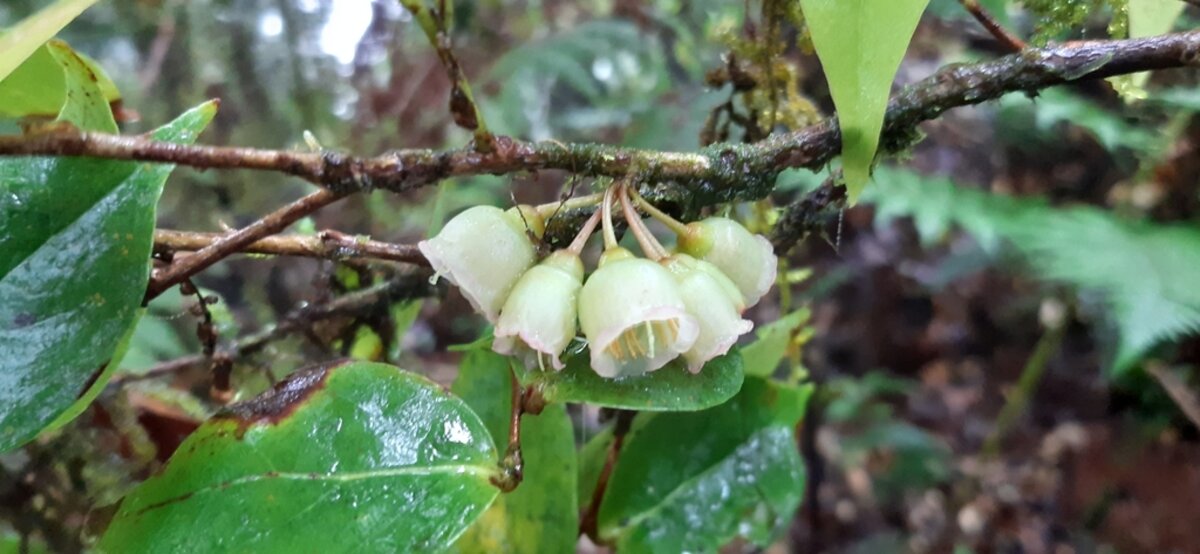
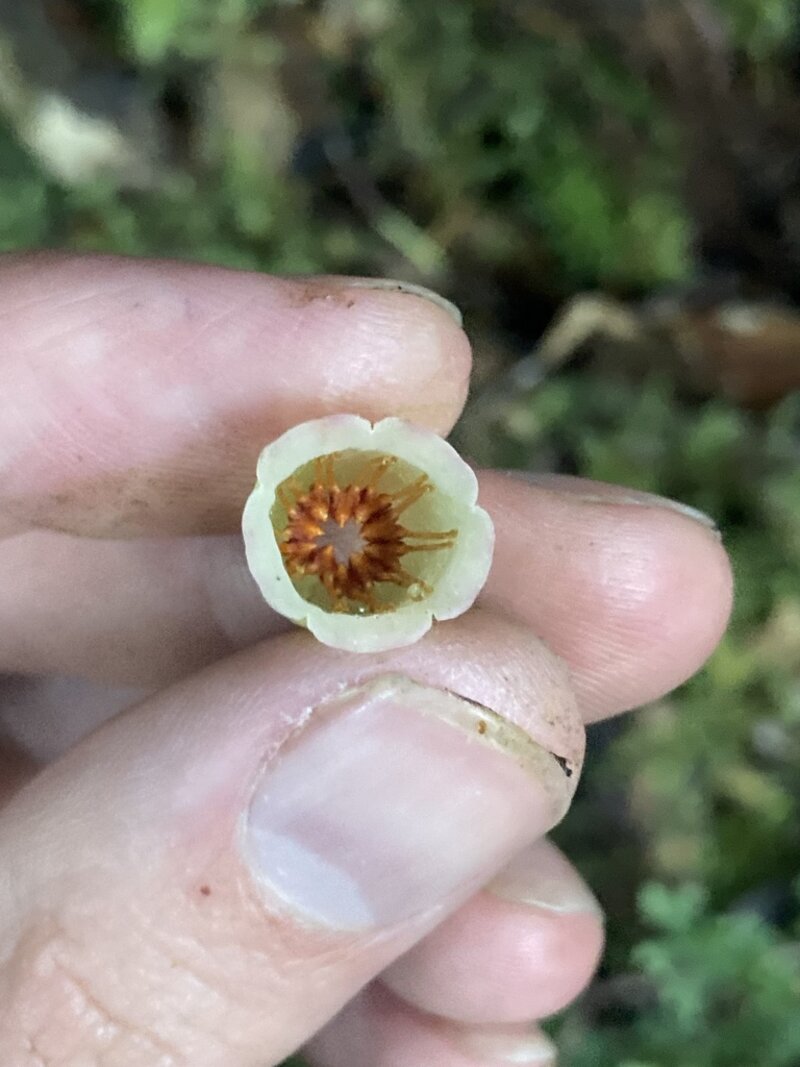
Flowers: The inflorescence consists of axillary, umbel-like racemes, typically 2-4 cm long with a glabrous to slightly hairy rachis. Each cluster bears several flowers on slender pedicels 7-15 mm long. The corolla is broadly cylindric (bell-shaped), measuring 8-12 mm long and 6-10 mm in diameter. Flower color ranges from pale yellowish or greenish-white to occasionally tinged with bright rose or pink. Two small, lance-ovate bracteoles appear near the middle of each pedicel.
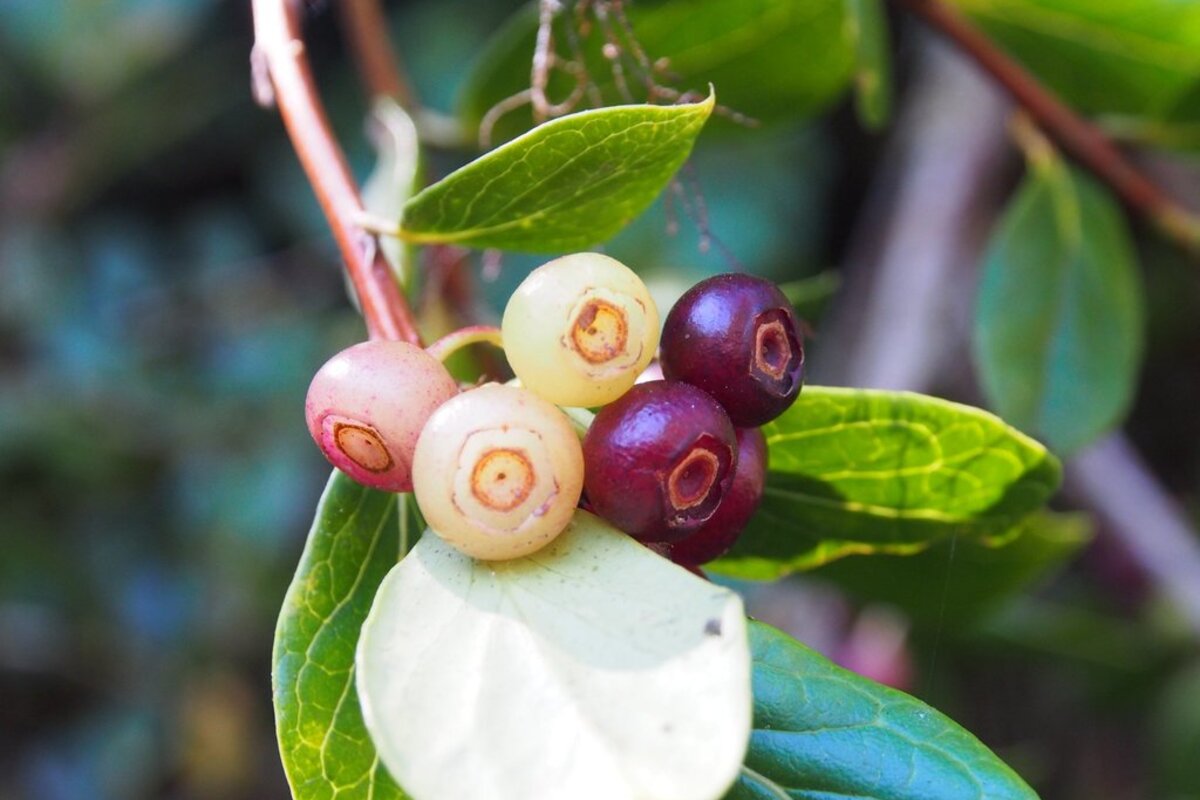
Fruit: A small berry that develops from the inferior ovary, four- or five-parted. The berries transition through several colors as they ripen, starting pale green or cream-colored, passing through pink and rose, and finally reaching deep purple when fully mature. Like other Vaccinium species, the berries are edible and presumably palatable, though they are not harvested commercially. Each berry contains numerous small, smooth seeds.
A Life in the Clouds
The montane cloud forests where Vaccinium poasanum grows are among the most species-rich ecosystems on Earth, particularly for epiphytes. These forests are characterized by persistent cloud cover and fog, which bathes the vegetation in moisture and creates a microclimate unlike anywhere else. Trees here are shorter than in lowland rainforests but carry tremendous loads of epiphytic plants: bromeliads, orchids, ferns, mosses, and members of the heath family like V. poasanum.
Epiphytic vascular plants represent approximately 10% of all vascular flora globally, but in tropical cloud forests they can account for up to 50% of local plant species richness. The ability of V. poasanum to grow as an epiphyte allows it to access the abundant light and moisture available in the canopy, escaping competition for space on the often-crowded forest floor. The thick, leathery leaves help the plant conserve water during brief dry periods between fog events.
Habitat & Distribution
Vaccinium poasanum ranges through the highlands of Central America from Guatemala and Honduras through El Salvador and Nicaragua to Costa Rica and western Panama. In Costa Rica, it is found along the volcanic cordilleras and the Talamanca mountains, primarily above 2,300 meters elevation. The species has been documented at Volcán Poás (its type locality), in the mountains around San José, and in La Amistad International Park, which straddles the Costa Rica-Panama border and extends into the Brunca region of southern Costa Rica.
Ecosystem: Upper montane cloud forest transitioning to páramo. These forests are dominated by evergreen oaks (Quercus copeyensis and Q. costaricensis), which can form 80% of the canopy and reach 30-35 meters tall. The understory and epiphyte community is exceptionally diverse.
Elevation: 2,300 to 2,600 meters, with some records extending higher toward the páramo zone.
Climate: Cool and humid year-round, with frequent cloud immersion. Temperatures are moderate, rarely exceeding 20°C during the day or dropping below 5°C at night. Annual rainfall is high, but the persistent fog provides additional moisture that sustains the rich epiphyte community.
Co-occurring Species
In the upper montane cloud forests of the Cordillera de Talamanca, Vaccinium poasanum grows alongside a distinctive community of trees and shrubs. The canopy is dominated by two species of evergreen oaks: Quercus copeyensis and Quercus costaricensis. These oaks are the ecological backbone of the forest, their massive branches providing substrate for countless epiphytes including V. poasanum.
Other canopy associates include Magnolia sororum, one of Costa Rica's endemic magnolias; Weinmannia pinnata; and Schefflera rodriguesiana. The arborescent subcanopy includes members of genera like Ardisia, Comarostaphylis, Cornus, Ilex, Ocotea, Oreopanax, Styrax, Symplocos, Viburnum, and Zanthoxylum. The epiphytic community is extraordinarily rich, with dozens of bromeliad species and hundreds of orchid species.
Wildlife Interactions
The bell-shaped flowers of V. poasanum suggest pollination by small insects or possibly hummingbirds. The flower morphology, with its narrow opening and pale coloration, is typical of species pollinated by bees or other small insects. Some Vaccinium species in other regions are "buzz pollinated," requiring bees to vibrate their flight muscles to dislodge pollen from the anthers. Whether V. poasanum employs this mechanism is unknown, as detailed pollination studies have not been conducted.
The colorful berries are certainly consumed by birds, which disperse the seeds throughout the forest. Cloud forests host numerous frugivorous bird species that depend on small berries like those of Vaccinium. The various ripeness stages visible on a single plant, from green through pink to purple, mean that fruit is available over an extended period, providing a reliable food source for the highland bird community. Small mammals may also consume the berries and contribute to seed dispersal.
Conservation
Vaccinium poasanum is classified as Least Concern by the IUCN Red List, indicating that the species faces no immediate threat of extinction. Its distribution across multiple Central American countries and its ability to grow in both terrestrial and epiphytic habitats provide some resilience against localized threats.
However, the cloud forest habitat where this species thrives faces significant pressures. About half of assessed epiphytes globally are considered threatened, with the figure reaching nearly 60% for Neotropical species. Central American cloud forests are identified as centers of endemism that are particularly vulnerable to climate change. As temperatures rise, cloud forests are expected to shift upward in elevation, but species like V. poasanum that already occupy high-elevation habitats have limited room to move. Changes in cloud formation patterns could also reduce the moisture that sustains these ecosystems.
The presence of V. poasanum in La Amistad International Park, a UNESCO World Heritage Site and one of the largest protected areas in Central America, provides important protection for populations in the Talamanca range. Continued conservation of cloud forest habitats remains essential for the long-term survival of this and countless other species that depend on these misty highlands.
Discovery and Naming
John Donnell Smith (1829-1928) was an unlikely botanist. Born in Baltimore, he graduated from Yale in 1847 and practiced law before the American Civil War, where he served as a Confederate artillery captain and was severely wounded at the Battle of Gettysburg. After the war, he returned to business and began studying botany as an avocation in his fifties. What started as a hobby became an obsession.
Smith focused his attention on Central American flora, making collecting expeditions to Guatemala and Costa Rica and collaborating with other botanists working in the region. In March 1896, he collected the type specimen of Vaccinium poasanum on the slopes of Volcán Poás at 2,377 meters elevation. He recognized it as a new species and published the description in Botanical Gazette the following year, choosing the epithet poasanum to honor the volcano where he found it.
Over his botanical career, Smith amassed more than 100,000 mounted plant specimens and a botanical library of over 1,600 volumes, all of which he donated to the Smithsonian Institution in 1906. His work, Enumeratio plantarum guatemalensium (1889-1907), documented 3,736 plant species from Central America. The genus Donnellsmithia was named in his honor. Today, the type specimen of Vaccinium poasanum resides in the Smithsonian's collection, a lasting connection between a Baltimore lawyer and a Costa Rican volcano.

Key Sources & Resources
Species Information
Authoritative taxonomic information and accepted name status from the Royal Botanic Gardens, Kew.
Detailed botanical description including morphological features of leaves, flowers, and fruit.
Overview of the genus including blueberries, cranberries, and related species.
Biodiversity Databases
Distribution records and occurrence data from the Global Biodiversity Information Facility.
Community observations with photographs from Costa Rica, Guatemala, and other locations.
Featured observation highlighting the species from Volcán Poás National Park.
Botanical History
Biography of the American botanist who discovered and named the species in 1897.