Mangle Rojo Híbrido
Rhizophora × harrisonii — A natural hybrid red mangrove whose arching prop roots create underwater labyrinths where juvenile hammerhead sharks find refuge. In Costa Rica's Golfo Dulce, this species bridges ocean and forest in one of the world's few tropical fjords.
In the brackish waters of Golfo Dulce, where the Río Esquinas empties into one of the world's only tropical fjords, a forest rises from the sea. Here, mangrove roots arch into the water like flying buttresses, creating a maze of submerged passages. Among them swims a young scalloped hammerhead shark, one of thousands that use these protected shallows as a nursery. Above the waterline, the tangled roots support a tree with glossy, elliptical leaves and torpedo-shaped seedlings dangling from its branches. This is Rhizophora × harrisonii, the hybrid red mangrove, a species born from the ongoing interbreeding of two parent species that has stabilized into its own distinct form.
Unlike most hybrids, which are often sterile or unstable, Rhizophora × harrisonii has become a recognizable and reproductively viable component of mangrove forests from West Africa to the Americas. Its characteristics blend those of its parents: the salt tolerance of Rhizophora mangle and the affinity for freshwater input of Rhizophora racemosa. In estuaries where large rivers meet the sea, where neither parent species dominates completely, the hybrid finds its niche.
Identification
Taxonomy & Nomenclature
Rhizophora × harrisonii was first described in 1918 by Alleyne Leechman, a botanist working in British Guiana (now Guyana). The type specimen was collected near Georgetown, at the edge of the Atlantic where South America's great rivers discharge into the sea. Leechman named the species in honor of Sir John Burchmore Harrison, then Director of Science and Agriculture for British Guiana, recognizing his contributions to botanical research in the colony.
The genus name Rhizophora derives from Greek rhiza (root) and phoros (bearing), referring to the prop roots that characterize these mangroves. The multiplication sign (×) in the scientific name indicates hybrid origin. Modern genetic studies have confirmed what early botanists suspected: this species represents a stabilized hybrid between Rhizophora mangle and Rhizophora racemosa. Rather than being a sterile cross or an ephemeral hybrid swarm, it has become a self-perpetuating population with intermediate characteristics.
The Rhizophoraceae, or mangrove family, belongs to the order Malpighiales. This may seem surprising, as Malpighiales is a diverse order that includes everything from willows to passionflowers to rubber trees. But molecular phylogenetics has confirmed this placement, grouping the Rhizophoraceae with other families adapted to tropical forest life. Within the family, Rhizophora is the most species-rich genus, with representatives on tropical coastlines worldwide. Historical synonyms for R. × harrisonii include Rhizophora × brevistyla Salvoza (1936).
Physical Characteristics
Leaves: The leaves are elliptical, 11-15 cm long and 4-7 cm wide, with an acute apex and cuneate (wedge-shaped) base. They are glabrous (hairless) and leathery, with black dots visible on the undersides. This dotting pattern helps distinguish the species from its parent R. mangle, whose leaves lack such punctation. The leaves are arranged oppositely on the branches.
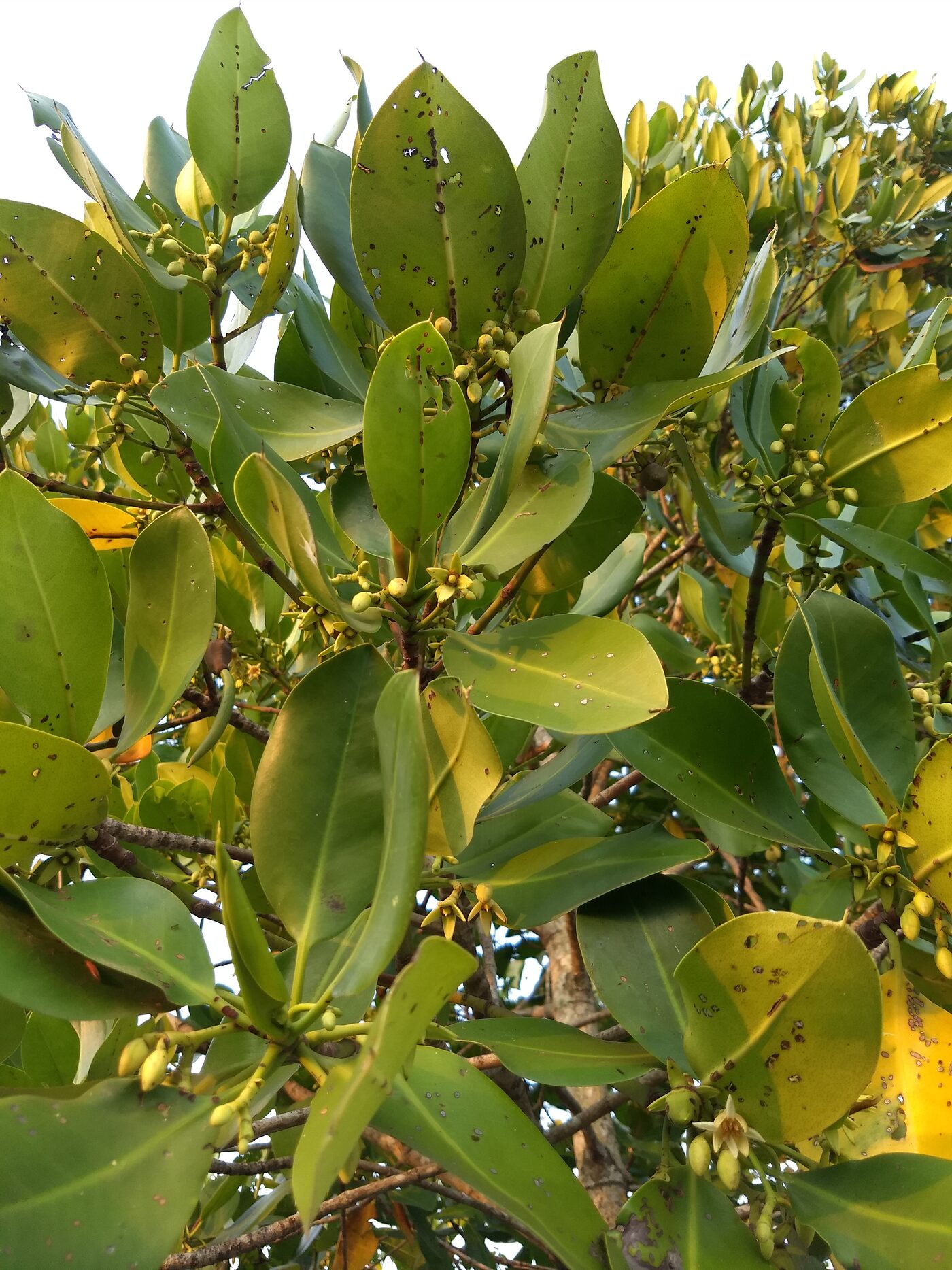
Flowers: The inflorescence is 5-12 cm long and branches 3-5 times, bearing many small flowers. Individual flowers are about 1 cm long, with oval to slightly elliptical buds and acute apexes. Each flower has 8 stamens and 2 stigmatic branches. The flowers are pollinated by wind and insects, including bees and flies that visit the mangrove forest.
Propagules: The fruit is oval-lanceolate, about 4 cm long and 1.5 cm wide. From it emerges the distinctive propagule, a torpedo-shaped structure 15-30 cm long. This length is intermediate between the shorter propagules of R. mangle and the longer ones of R. racemosa, reflecting the hybrid's intermediate nature.
Distinguishing the Hybrid from Its Parents
In Costa Rica's mangroves, three Rhizophora species may occur together: the hybrid R. × harrisonii and its parent species R. mangle and R. racemosa. Distinguishing them requires attention to several key features, as the hybrid shows intermediate characteristics.
| Character | R. mangle | R. × harrisonii | R. racemosa |
|---|---|---|---|
| Leaf underside | No black dots | Black dots present | Black dots present |
| Propagule length | 20-40 cm | 15-30 cm | 25-65 cm |
| Inflorescence | 2-4 flowers, 1-2 branches | Many flowers, 3-5 branches | Many flowers, 5+ branches |
| Flower buds | Rounded apex | Acute apex | Acute apex |
| Habitat preference | Most salt-tolerant; seaward fringe | Intermediate; estuaries with freshwater input | Requires freshwater; river-influenced zones |
The easiest field identification begins with examining leaf undersides. If no black dots are present, the tree is likely R. mangle. If dots are present, look at propagule length and habitat: propagules over 30 cm suggest R. racemosa, while intermediate lengths (15-30 cm) in estuarine settings indicate the hybrid. The inflorescence structure, when flowers are present, provides additional confirmation: R. mangle produces simple inflorescences with few flowers, while both R. racemosa and the hybrid produce much-branched inflorescences with many flowers.
The Prop Roots
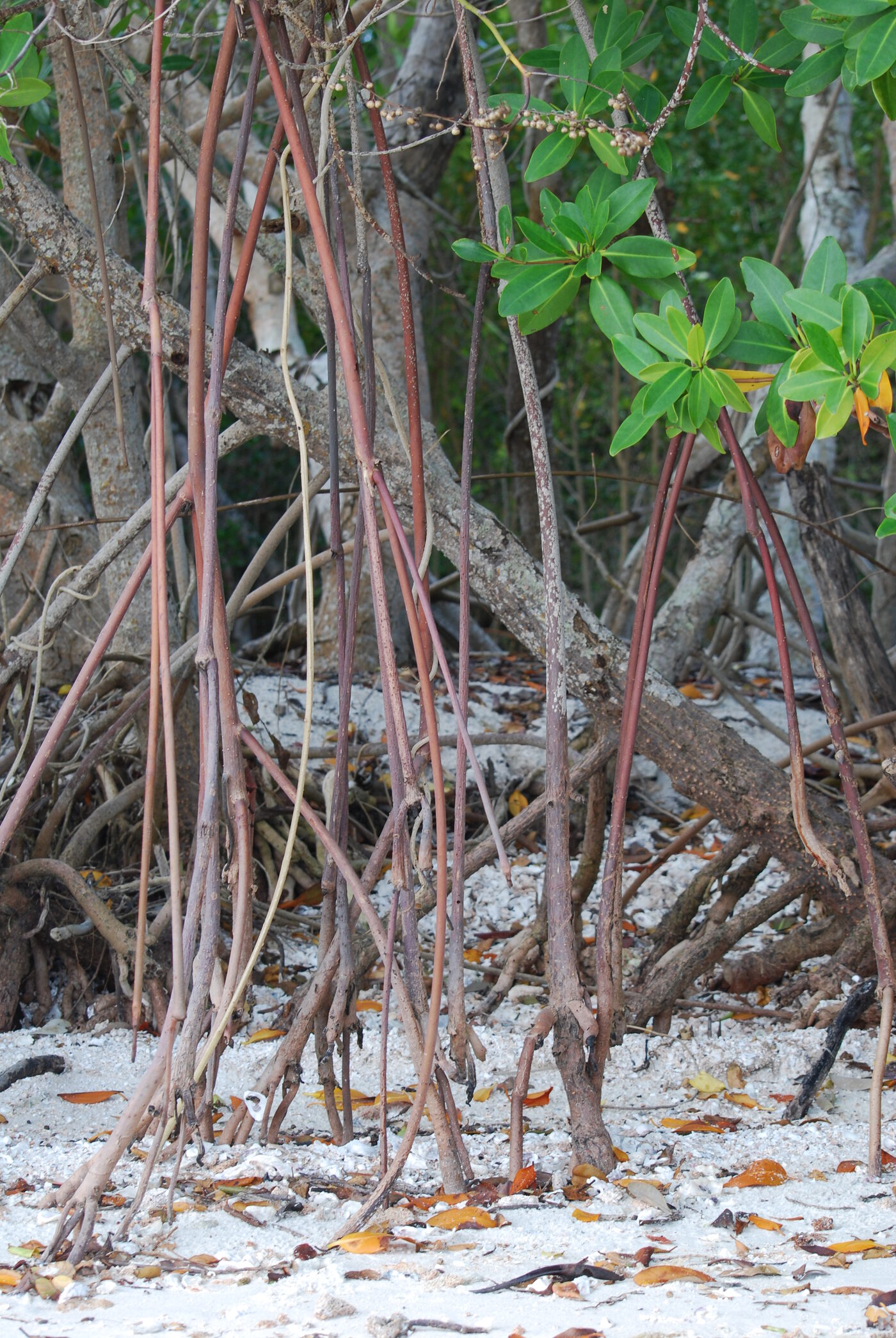
Among mangrove genera, Rhizophora is best known for its prop root system. While black mangroves (Avicennia) produce pencil-like pneumatophores and white mangroves (Laguncularia) have cable roots, Rhizophora species develop arching prop roots called rhizophores. These structures emerge from the cambium of the main stem or branches and grow downward toward the substrate. Unlike true roots, which originate from the root system, rhizophores are modified branches with positive geotropism. They divide in a sympodial pattern as they grow, creating the characteristic arching architecture that gives mangrove forests their otherworldly appearance. All three Rhizophora species in Costa Rica, including both parent species and the hybrid, share this root type.
These roots serve multiple functions. First, they provide stability in the soft, shifting sediments of the intertidal zone. Like flying buttresses on a cathedral, they distribute the tree's weight across a wide area, anchoring it against waves and currents. Second, they function as breathing organs. The waterlogged soils of mangrove forests are anaerobic, lacking the oxygen that roots need for respiration. The prop roots have lenticels on their surface, small pores that connect to air spaces within the root tissue. At low tide, these lenticels take up oxygen; at high tide, the air spaces supply oxygen to the submerged portions of the root system.
Third, the roots help exclude salt. Rhizophora species have highly suberized (waxy) root tissues that act as an ultrafiltration membrane. As water moves into the root, over 90% of the salt is excluded at the root surface. This allows the tree to thrive in seawater that would kill most plants, though it grows best in the brackish conditions where freshwater dilutes the ocean's salinity.

Viviparous Reproduction
Rhizophora species are famous for their viviparous reproduction, a strategy that gives their offspring a head start in the challenging mangrove environment. After fertilization, the seed does not enter dormancy like most plant seeds. Instead, it germinates immediately while still attached to the parent tree. The embryonic root, called the hypocotyl, pierces through the fruit and grows downward, eventually reaching 15-30 cm in length for R. × harrisonii.
This pencil-shaped propagule hangs from the parent tree for months, photosynthesizing and accumulating reserves. When it finally detaches, it is not a seed but a seedling, already equipped with chlorophyll, stored nutrients, and a developing root system. If it falls at low tide onto suitable substrate, it can begin rooting immediately. If it falls into water, it floats horizontally, buoyed by air spaces in its tissue. Propagules can remain viable for over a year while floating, potentially traveling hundreds of kilometers on ocean currents.
Upon stranding, dehydration triggers the propagule to shift from horizontal floating to vertical orientation. The heavier root end sinks, the lighter shoot end rises, and root development accelerates. Research shows that propagules that strand vertically have establishment success rates around 50%, compared to only 10% for those stranding horizontally. Lower salinity accelerates root development, which may explain why R. × harrisonii often colonizes areas with significant freshwater input.
Habitat & Distribution
Rhizophora × harrisonii has an amphi-Atlantic distribution, occurring on both sides of the tropical Atlantic and extending into the eastern Pacific. In the Americas, its range stretches from Mexico's Gulf coast through Central America and the Caribbean to Brazil, and along the Pacific coast from Mexico to Peru. In Africa, it grows from Senegal to Angola. This wide distribution reflects the dispersal abilities of its floating propagules, which can cross oceans on currents.
In Costa Rica, the hybrid mangrove occurs primarily along the Pacific coast, where the country's most extensive mangrove systems are found. The Térraba-Sierpe National Wetland, Central America's largest mangrove swamp covering over 30,000 hectares, harbors populations of R. × harrisonii alongside its parent species R. mangle and R. racemosa. Further south, the mangroves of Golfo Dulce, one of only four tropical fjords in the world, provide additional habitat.
The ecological requirements of R. × harrisonii appear intermediate between its parent species. Rhizophora mangle is the most salt-tolerant species in the genus, able to colonize fully marine conditions. Rhizophora racemosa requires more freshwater, typically growing where large rivers dilute coastal salinity. The hybrid thrives in transitional zones where neither parent dominates, often in estuaries with substantial but variable freshwater input.
The Mangrove Zones
In Costa Rica, eight species of mangrove trees from four different plant families form the coastal wetlands. These species arrange themselves in distinct zones based on their tolerance to flooding and salinity. Moving from ocean to land, Rhizophora species (including the hybrid) typically occupy the seaward fringe, growing in the deepest water. Their prop roots can tolerate permanent inundation and the highest salinity. Behind them, Avicennia (black mangroves) grow in the mid-intertidal zone, using vertical pneumatophores to breathe in waterlogged soils. Laguncularia racemosa (white mangrove) often colonizes areas with lower salinity, excreting salt through specialized leaf glands. Conocarpus erectus (buttonwood) occupies the landward edge, in areas rarely flooded by tides.
Co-occurring Species
Within Costa Rica's mangrove forests, R. × harrisonii grows alongside a characteristic community of trees and associated species. In the Rhizophoraceae, it may co-occur with both parent species as well as Pelliciera rhizophorae, the tea mangrove. Black mangroves are represented by Avicennia germinans, A. bicolor, and occasionally A. tonduzii. The understory may include the large mangrove fern Acrostichum aureum, which can dominate disturbed areas. Salt-tolerant herbs like Batis maritima and Sesuvium portulacastrum grow on exposed mudflats.
Ecological Importance
Mangrove forests are among the most productive ecosystems on Earth, and Rhizophora × harrisonii contributes to this productivity alongside its co-occurring species. A single hectare of mangrove in Costa Rica generates an estimated $8,700 annually in ecosystem services, including coastal protection, carbon storage, water filtration, and support for fisheries.
Nursery Habitat
The tangled prop roots of Rhizophora create some of the most important nursery habitat in tropical coastal ecosystems. A global analysis estimated that mangrove forests support an annual abundance of over 700 billion juvenile fish and invertebrates. In Costa Rica's Golfo Dulce, research in the Zancudo mangrove documented 82 fish species from 30 families. More than half were estuarine transients, fish that use the mangrove as juveniles before migrating to deeper waters as adults. An estimated 71% of captured species had commercial value, demonstrating the mangroves' importance for regional fisheries.
Perhaps most dramatically, the mangroves of Golfo Dulce serve as a critical nursery for the scalloped hammerhead shark (Sphyrna lewini). Neonates and juveniles find food and protection from predators in the sheltered, nutrient-rich waters among the mangrove roots. Recognizing this importance, the Costa Rican government in May 2018 designated the wetlands in northern Golfo Dulce as a shark sanctuary, creating 4,000 hectares of "no-take" zone. This was Costa Rica's first shark sanctuary, established specifically to protect the mangrove nursery habitat.

Carbon Storage
Mangroves are remarkably efficient at sequestering carbon. Their waterlogged soils prevent decomposition of organic matter, locking carbon away for centuries or millennia. This "blue carbon" makes mangroves up to ten times more effective at carbon storage per hectare than upland tropical forests. As climate change accelerates, the carbon sequestration capacity of mangrove ecosystems becomes increasingly valuable.
Coastal Protection
The dense root systems of mangroves dissipate wave energy, buffer shorelines against storms, and trap sediments that would otherwise be lost to erosion. Communities behind healthy mangrove forests experience reduced flooding and storm damage. In an era of rising seas and intensifying storms, this natural infrastructure provides protection that would cost millions to replicate artificially.
Wildlife Relationships
The mangrove ecosystem supports an extraordinary diversity of wildlife, from microscopic organisms in the sediment to large marine predators that use the forest as a nursery.
The Piangua
For at least 1,200 years, indigenous communities have harvested the piangua clam (Anadara tuberculosa) from Costa Rica's mangroves. This bivalve buries itself in the mud among mangrove roots, filtering organic particles from the water. Today, piangua harvesting remains an important livelihood for coastal communities around Térraba-Sierpe, though overharvesting and habitat loss have reduced populations. Sustainable management of this traditional fishery depends on maintaining healthy mangrove forests.
Traditional Uses
Like other Rhizophora species, R. × harrisonii has been used by coastal communities for generations. Kew's Plants of the World Online notes that the species "is used as a medicine," though specific applications are not detailed. More broadly, red mangrove bark is rich in tannins and has been used traditionally for treating fevers, dysentery, and skin conditions across the species' range. The wood is dense, durable, and resistant to decay in wet conditions, making it valuable for construction of fish traps, boats, and dock pilings.
Conservation
Rhizophora × harrisonii has not been formally assessed by the IUCN, likely because its hybrid status complicates classification. However, like all mangrove species, it faces significant threats from human activities and climate change.
Costa Rica has taken significant steps to protect its mangroves. The Térraba-Sierpe National Wetland was designated a Forest Reserve in 1977 and recognized as a RAMSAR Wetland of International Importance in 1995. Under Costa Rican law, mangrove cutting is prohibited except under special permits. The 2018 establishment of the Golfo Dulce shark sanctuary demonstrates continued commitment to protecting these ecosystems.
Restoration efforts are underway in degraded areas. Organizations including Misión Tiburón are working to restore 20 hectares of mangrove habitat in Golfo Dulce, using propagules of Rhizophora and other mangrove species to revegetate damaged sites. These efforts recognize that protecting juvenile shark habitat requires maintaining the mangrove forests on which they depend.
For visitors to Costa Rica's Pacific coast, a boat trip through the mangroves offers a window into one of the world's most productive and important ecosystems. Watch for the arching prop roots of Rhizophora, the torpedo-shaped propagules dangling from branches, and the remarkable wildlife that depends on this forest between land and sea. In these coastal wetlands, where rivers meet the ocean and fresh water mixes with salt, the hybrid red mangrove has found its place, bridging not only two parent species but two worlds.
Key Sources & Resources
Species Information
General overview of the species with information on distribution, taxonomy, and hybrid status.
Authoritative taxonomic information, hybrid formula, and distribution from the Royal Botanic Gardens, Kew.
Detailed information on red mangrove ecology, prop roots, and vivipary applicable to the genus.
Costa Rica Mangroves
Overview of Central America's largest mangrove wetland and its biodiversity.
Information about the Golfo Dulce Hope Spot and shark nursery conservation efforts.
Details on Costa Rica's first shark sanctuary and mangrove restoration projects.
Official RAMSAR wetland designation record including area (30,654 hectares) and conservation status.
Scientific Research
Research documenting 82 fish species and the importance of the mangrove as a nursery.
Taxonomic revision confirming hybrid status between R. mangle and R. racemosa.
Global analysis estimating the contribution of mangroves to fish and invertebrate populations worldwide.
Mangrove Ecology
Scientific study on the anatomy, morphology, and ecology of Rhizophora prop roots.
Information on mangrove conservation challenges and restoration in Costa Rica.
Comprehensive overview of mangrove ecology, salt exclusion mechanisms, and propagule dispersal.