Mangle Racemosa
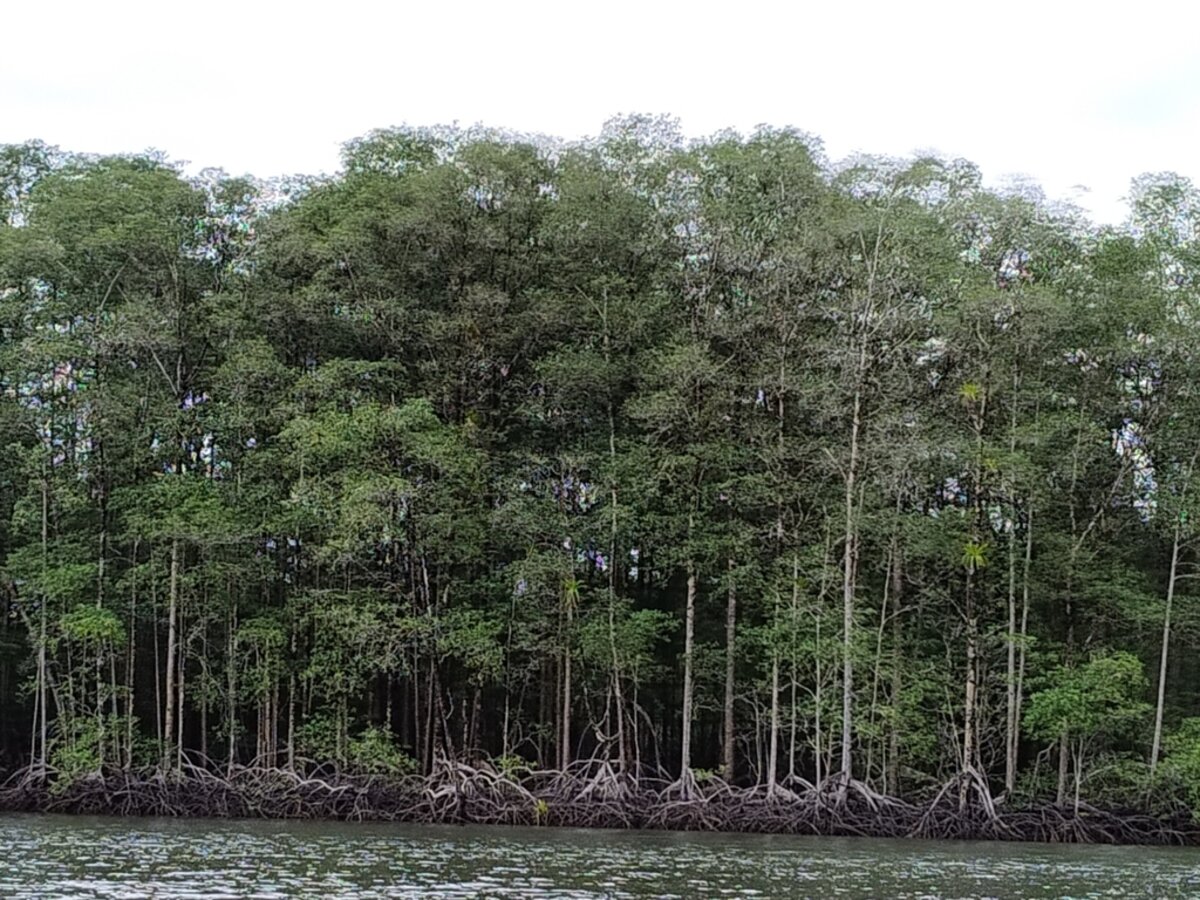
Rhizophora racemosa — In the Térraba-Sierpe wetlands where freshwater rivers meet the Pacific, this red mangrove dominates the landscape. Its towering stilt roots stabilize sediments, shelter fish, and protect Costa Rica's most important coastal ecosystem.
Where the Térraba and Sierpe rivers empty into the Pacific Ocean, they create Central America's largest mangrove system. Here, in the brackish waters where freshwater mixes with sea, grows Rhizophora racemosa: the dominant red mangrove of Costa Rica's southern Pacific coast. Studies of the Térraba-Sierpe National Wetland have found that this species accounts for nearly half of all mangrove cover, with over 7,600 hectares of forest dominated by its distinctive stilt roots. Unlike its more famous relative Rhizophora mangle, which thrives in the saltiest waters at the ocean's edge, R. racemosa prefers the brackish zones where river water dilutes the sea.
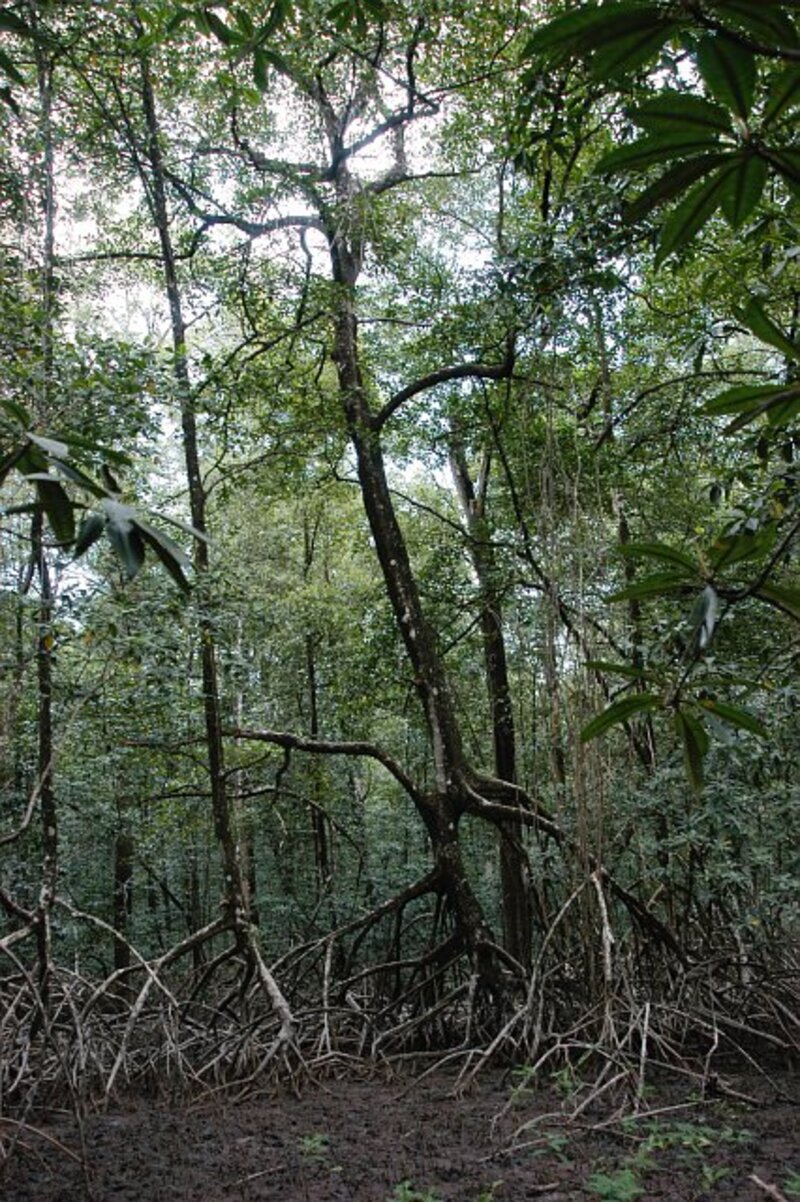
Stand at the edge of a mangrove channel in Sierpe, and you will see trees rising 20 to 30 meters above the water, supported by an intricate scaffold of aerial roots that arch from the trunk into the mud below. These are not true roots in the anatomical sense, but specialized organs called rhizophores, with vascular tissue arranged more like a stem than a root. They anchor the tree in unstable sediments, absorb oxygen from the air through pores called lenticels, and create the tangled underwater architecture that makes mangroves the most productive nursery habitat on Earth.
Identification
Taxonomy & Nomenclature
Rhizophora racemosa was described by German botanist Georg Friedrich Wilhelm Meyer in 1818, based on specimens collected along the Essequibo River in what is now Guyana. Meyer named the species in his work Primitiae Florae Essequeboensis, the first systematic flora of that region. The genus name Rhizophora comes from Greek rhiza (root) and phoros (bearing), referring to the conspicuous stilt roots. The species epithet racemosa means "bearing racemes," describing the branched flower clusters that distinguish this species from its relatives.
For much of the 20th century, R. racemosa was treated as a variety of the widespread Rhizophora mangle. Modern taxonomic work, however, recognizes it as a distinct species based on differences in floral structure, habitat preference, and geographic distribution. The two species can hybridize where their ranges overlap, producing Rhizophora × harrisonii, which shows intermediate characteristics and was first described by Leechman in 1918. In Costa Rica, all three taxa occur along the Pacific coast, with R. racemosa dominating the large river-influenced systems of the south, R. mangle more common in higher-salinity areas, and the hybrid R. × harrisonii found where the two parent species meet.
Distinguishing from R. mangle
Separating Rhizophora racemosa from R. mangle requires careful observation. The most reliable diagnostic feature is the position of flower buds along the branch: in R. racemosa, mature buds and flowers occur 7-9 nodes down from the growing tip, while in R. mangle they appear only 2-4 nodes from the apex. The inflorescences of R. racemosa are also more branched, with multiple flowers in raceme-like clusters, whereas R. mangle typically produces pairs or trios of flowers. Some authorities report that R. mangle leaves have small black spots (cork warts) on the underside, absent or less pronounced in R. racemosa. In the field, habitat provides a useful clue: R. racemosa predominates where rivers bring abundant fresh water, while R. mangle tolerates the highest salinities at the seaward fringe.
Physical Characteristics
Stilt roots: The defining feature of Rhizophora is its network of aerial prop roots, which arch from the trunk and lower branches into the substrate. In R. racemosa, these can extend several meters from the trunk, creating a tangled maze that shelters fish and invertebrates. Anatomical studies have revealed that these structures, though commonly called "roots," have vascular tissue arranged like stems, with endarch protoxylem and collateral bundles. Botanist Pitot (1958) proposed they be termed "rhizophores" rather than true roots. Lenticels on the surface of these aerial organs allow gas exchange, a critical adaptation for roots growing in oxygen-poor mud.

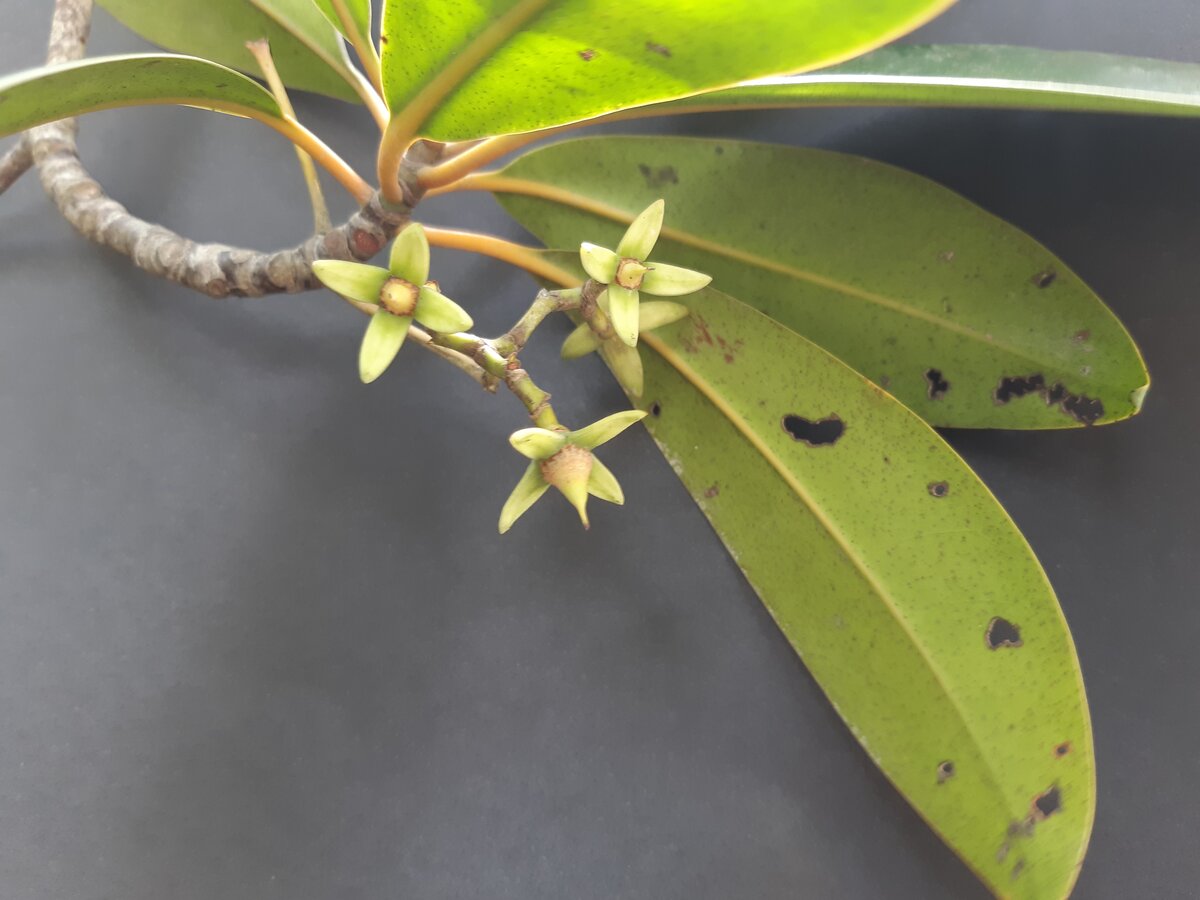
Leaves: The leaves are opposite, simple, elliptical, 8-15 cm long and 4-7 cm wide, with entire margins and slightly rolled edges. They are leathery and glossy dark green above, paler below, with an inconspicuous midrib. In dried specimens, fine corky warts may be visible on the lower surface. The paired stipules at the base of each leaf pair are interlocking, a characteristic shared by all Rhizophora species.
Flowers: The small, yellowish-white flowers appear in branched clusters (racemes) in the leaf axils. Each flower has four leathery sepals, four narrow petals, and eight stamens. Unlike many tropical trees, R. racemosa relies primarily on wind pollination, though some insect visitation occurs. Flowering peaks in the late dry season, from February to April in Costa Rica.
Propagules and Vivipary
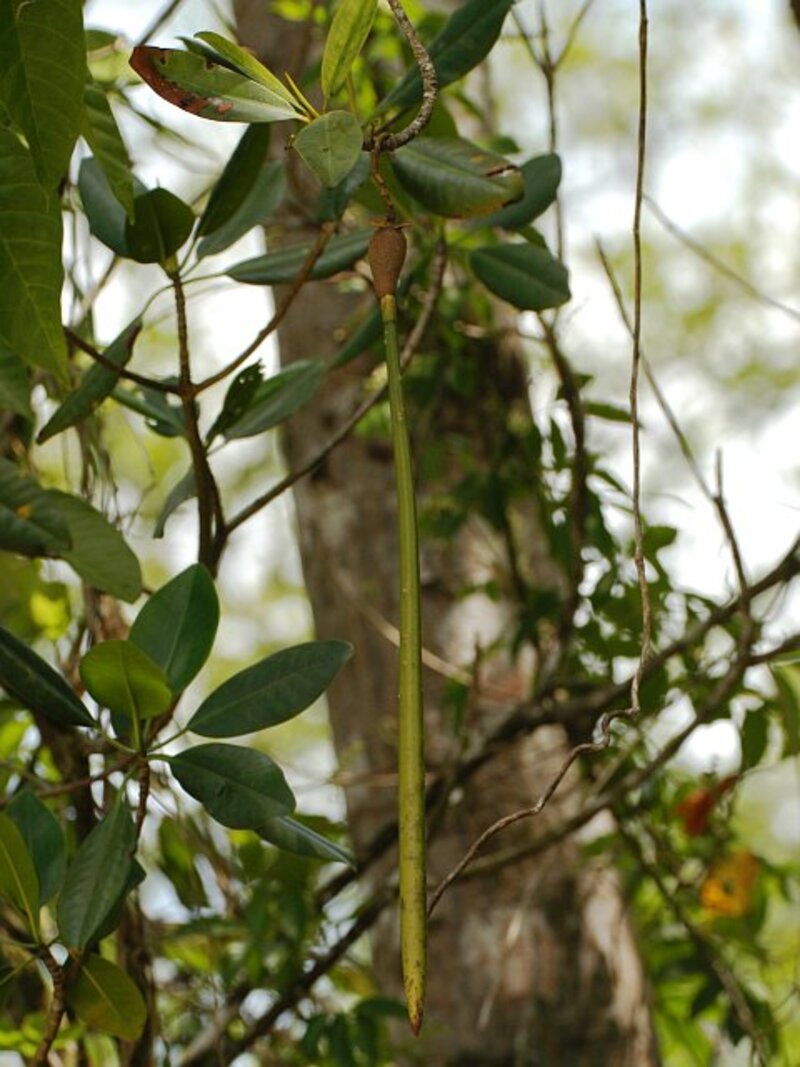
One of the most remarkable features of Rhizophora is its vivipary: the embryo germinates while still attached to the parent tree, growing into an elongated propagule that can reach 50 cm before dropping. This structure is neither a seed nor a fruit in the conventional sense, but a fully developed seedling complete with a long hypocotyl and embryonic root. Propagules require 14-18 weeks to develop on the tree after flowering, with an additional 14-18 weeks of maturation before they fall, typically between August and November.
When the propagule falls, it may float for months in salt water while remaining viable, carried by currents to colonize new substrates. Rhizophora propagules have superior dispersal capacity compared to other mangroves, maintaining viability for a year or more. Upon stranding in suitable habitat, the propagule quickly roots and establishes. This reproductive strategy bypasses the vulnerable seedling phase, giving Rhizophora an advantage in the dynamic, challenging mangrove environment.
Habitat & Distribution
Rhizophora racemosa has an amphi-Atlantic distribution, occurring on both sides of the tropical Atlantic Ocean. In the Americas, it ranges from Honduras south through Central America, along the Pacific and Atlantic coasts of South America to Brazil, and occurs in Trinidad and other Caribbean islands. In Africa, it grows from Senegal to Angola. Unlike R. mangle, which has the widest distribution of any New World red mangrove, R. racemosa appears more restricted to large river estuaries where freshwater input moderates salinity.
In Costa Rica, R. racemosa dominates the mangrove forests of the southern Pacific coast, where the Térraba and Sierpe rivers create vast brackish wetlands. Studies in the Térraba-Sierpe National Wetland have documented that this species and the tea mangrove Pelliciera rhizophorae together account for over 85% of the mangrove area. R. racemosa shows continuous distribution throughout the wetland, with highest abundance (45%) and the largest area (7,670 ha) of any single species. Further north, in the Gulf of Nicoya and Guanacaste, R. mangle becomes more prevalent as precipitation decreases and salinity increases.
Mangrove Zonation
Mangrove species arrange themselves in distinct zones based on their tolerance to flooding and salinity. In Costa Rica's Pacific mangroves, the classic zonation pattern places Rhizophora species along channel edges and in the lowest intertidal zones, where they tolerate the deepest and most prolonged flooding. Behind the Rhizophora zone, black mangrove (Avicennia germinans) occupies slightly higher ground that is less frequently inundated. White mangrove (Laguncularia racemosa) and buttonwood (Conocarpus erectus) grow in the landward fringe, in areas of lower salinity with more freshwater influence.
Within the Rhizophora zone itself, R. racemosa and R. mangle segregate by salinity. R. racemosa dominates where river discharge is strongest and salinity lowest, while R. mangle predominates at the seaward edge where salt concentrations are highest. The hybrid R. × harrisonii occupies an intermediate position. This ecological segregation explains why R. racemosa reaches its greatest abundance in the Térraba-Sierpe system, where two major rivers provide year-round freshwater input, while it is less common in the drier northern Pacific where freshwater is scarce.
Co-occurring Species
In the Térraba-Sierpe wetland, Rhizophora racemosa grows alongside a characteristic community of mangrove species. The tea mangrove (Pelliciera rhizophorae) is the second most abundant species, accounting for nearly 40% of the mangrove area. This unusual species, endemic to the Pacific coast of Central and South America, produces large white flowers pollinated by the endemic Mangrove Hummingbird. Avicennia germinans and A. bicolor (black mangroves) occupy higher ground, while Laguncularia racemosa (white mangrove) and Conocarpus erectus (buttonwood) occur at the landward margins. The mangrove fern (Acrostichum aureum) forms dense stands in disturbed areas and clearings.
Ecological Importance
Mangrove forests are among the most productive ecosystems on Earth, and Rhizophora racemosa contributes to this productivity through multiple pathways. Its roots stabilize sediments against erosion, its leaves fuel detrital food webs, and its structure creates the complex three-dimensional habitat that makes mangroves such productive nurseries for marine life.
Fish Nursery
The tangled stilt roots of Rhizophora create sheltered habitat where juvenile fish can hide from predators while feeding on the abundant detritus and small invertebrates of the mangrove ecosystem. Global analyses estimate that mangrove forests support an annual abundance of over 700 billion juvenile fish and invertebrates. In the Térraba-Sierpe wetland, more than 55 species of fish use the mangroves, including commercially important species like snook, tarpon, snapper, and mullet. According to commonly cited estimates, 75% of commercially caught fish depend at some stage on mangroves or food webs traced back to these forests.

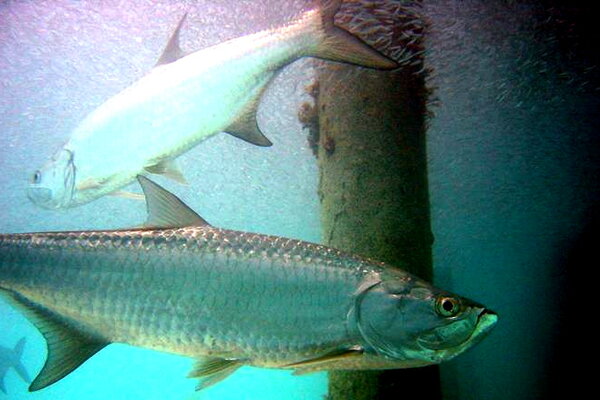
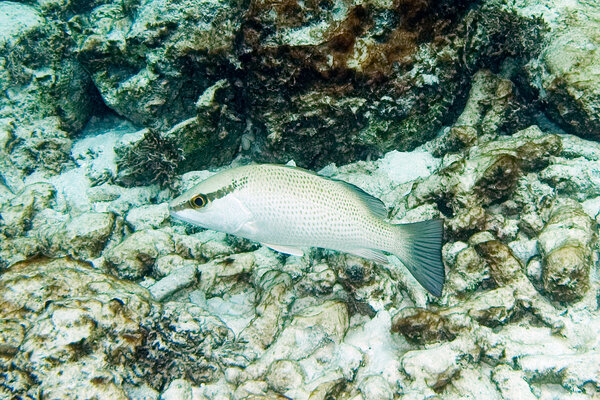
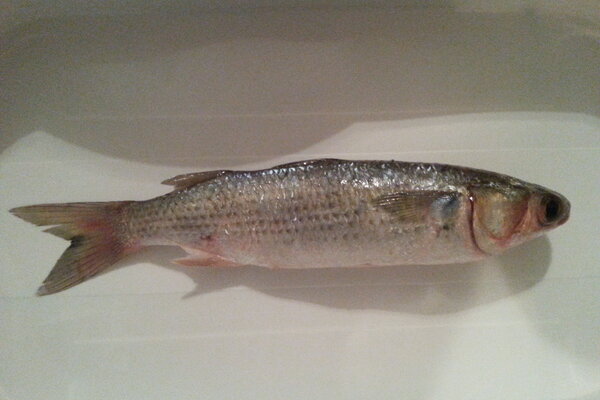
Commercially important fish species that depend on mangrove forests as nursery habitat. Photos: Wikimedia Commons (CC BY/CC BY-SA).
Carbon Sequestration
Mangroves are remarkably efficient at capturing and storing carbon. The waterlogged, oxygen-poor soils beneath Rhizophora forests trap organic matter and prevent decomposition, locking carbon away for centuries or millennia. This "blue carbon" storage makes mangroves up to ten times more effective at sequestering carbon per hectare than upland tropical forests. As climate change accelerates, the carbon storage capacity of mangrove forests becomes increasingly valuable for climate mitigation.
Coastal Protection
The dense network of Rhizophora stilt roots dissipates wave energy, reducing erosion and protecting inland areas from storm surge. Studies have shown that even narrow mangrove fringes can reduce wave heights by 50-99% over short distances. Communities behind healthy mangrove forests experience less flooding and storm damage than those where mangroves have been removed. In an era of rising seas and intensifying hurricanes, this natural infrastructure provides protection that would cost millions to replicate artificially.
Wildlife Relationships
The Térraba-Sierpe wetland, dominated by Rhizophora racemosa, supports over 300 species of birds, 31 species of mammals, and countless fish, crabs, and other invertebrates. This biodiversity makes it a RAMSAR Wetland of International Importance and one of Costa Rica's most significant conservation areas.
The Piangua Clam
The mangrove forests of Térraba-Sierpe support an important traditional fishery for the piangua clam (Anadara tuberculosa), a blood cockle harvested by local communities for at least 1,200 years. Archaeological evidence from the Térraba region shows that indigenous peoples have relied on this resource since pre-Columbian times. Today, piangua harvest remains a primary source of income for many families living near the wetland, though overharvesting and habitat degradation threaten the fishery's sustainability.
Traditional Uses
Like other red mangroves, Rhizophora racemosa has been used by coastal communities for timber, fuel, and traditional medicine throughout its range. The dense, durable wood resists decay in wet conditions, making it valuable for boat building, fence posts, and construction. Mangrove charcoal burns hot and long, and has historically been an important fuel source. The bark, rich in tannins (12-24% by weight), was once used for leather tanning and dyeing.
In Costa Rica, all mangroves are now protected by law, and commercial extraction is prohibited except under special permits. The stripping of bark for tannins, which kills the trees, was historically a significant threat. Today, the greatest value of Rhizophora racemosa lies in the ecosystem services its forests provide: coastal protection, fish nurseries, carbon storage, and habitat for endangered species.
Conservation
Although Rhizophora racemosa is classified as Least Concern globally by the IUCN, the mangrove ecosystems it dominates face serious threats. Costa Rica lost significant mangrove area during the 20th century to coastal development, agriculture, and aquaculture, particularly shrimp farming. Today, the remaining mangroves are protected by law, but enforcement remains challenging, and indirect threats like pollution and upstream development continue to degrade these ecosystems.
The Térraba-Sierpe National Wetland represents Costa Rica's greatest mangrove conservation success. Designated as a Forest Reserve in 1977 and recognized as a RAMSAR Wetland of International Importance in 1995, this 30,000-hectare system provides critical habitat for the Mangrove Hummingbird, American crocodile, and countless other species. The wetland also supports local livelihoods through traditional fishing and the piangua clam harvest, demonstrating that conservation and sustainable use can coexist.
Climate change poses both threats and opportunities for Rhizophora racemosa. Rising sea levels may drown existing mangrove forests, particularly where coastal development prevents their landward migration. More intense hurricanes and changing precipitation patterns could alter salinity regimes in ways that favor or disadvantage different mangrove species. Yet warmer temperatures may also allow mangroves to expand their range poleward. As conditions change, the ecological role of R. racemosa in Costa Rica's mangroves may shift, but these forests will remain critical for coastal protection, biodiversity, and climate regulation.
For visitors to Costa Rica's southern Pacific coast, a boat trip through the mangroves of Térraba-Sierpe offers an unforgettable experience. Gliding through channels lined with towering Rhizophora racemosa, you enter one of the world's most productive ecosystems. Watch for crocodiles sunning on mudbanks, herons hunting in the shallows, and the flash of a Scarlet Macaw overhead. In the tangle of stilt roots below the waterline, a hidden world of fish and crabs goes about its business, sheltered by the same trees that protect the coast and store carbon for the planet.
Key Sources & Resources
Species Information
General overview of the species with information on distribution, ecology, and taxonomy.
Authoritative taxonomic information and nomenclatural history from the Royal Botanic Gardens, Kew.
Detailed species fact sheet on the closely related R. mangle, with information applicable to R. racemosa.
Costa Rica Mangroves
Overview of Costa Rica's mangrove ecosystems and species, including the eight mangrove species found in the country.
Information about Central America's largest mangrove wetland and the wildlife found there.
Visitor information and ecological overview of the Térraba-Sierpe system.
Scientific Research
Scientific study documenting mangrove species distribution and abundance in Térraba-Sierpe, finding R. racemosa accounts for 45% of mangrove area.
Collection of scientific literature excerpts about R. racemosa ecology, distribution, and taxonomy.
Conservation status and ecology of Costa Rica's only endemic hummingbird, dependent on mangrove habitat.
Mangrove Ecology
Scientific study on the anatomy of Rhizophora stilt roots, demonstrating they are structurally more like stems than true roots.
Comprehensive review of Western Hemisphere Rhizophora species, including taxonomy, distribution, and hybridization.