Malagueto
Guatteria amplifolia — An understory tree of Costa Rica's lowland forests with banana-scented yellow flowers that attract pollinating beetles, and purple aggregate fruits dispersed by forest birds.
In the shaded understory of Costa Rica's lowland rainforests, where filtered light penetrates the dense canopy above, grows a tree whose flowers fill the air with the sweet fragrance of ripe bananas. Guatteria amplifolia, known locally as malagueto or anonillo, belongs to the custard apple family (Annonaceae), relatives of the cherimoya and soursop. Though modest in stature compared to the forest giants that tower above it, the malagueto plays an essential role in the forest's web of life, feeding both the beetles that pollinate its flowers and the birds that disperse its seeds.
The Annonaceae family is ancient, with origins tracing back to the Cretaceous period when dinosaurs still walked the Earth. Today, Guatteria is the largest genus in the family, comprising roughly 300 species distributed across the Neotropics. Within Costa Rica, several Guatteria species inhabit forests from sea level to mid-elevations, but G. amplifolia is among the most widespread, occurring on both the Atlantic and Pacific slopes wherever humid lowland forest remains.
Triana and Planchon
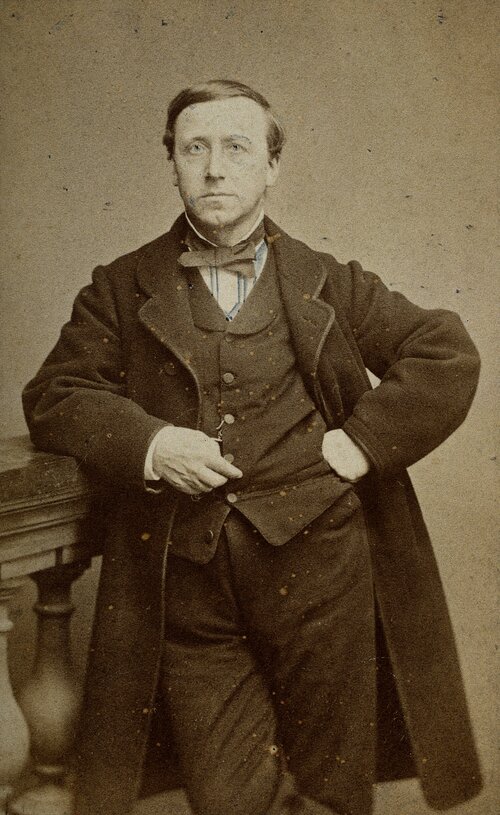
The species was first described in 1862 by two eminent botanists working together on the rich flora of tropical America. José Jerónimo Triana (1828-1890) was Colombia's foremost botanist of the nineteenth century, a man whose life was shaped by both science and the political turbulence of his era. Born in Bogotá, Triana trained as a physician before turning fully to botany, eventually cataloging some 60,000 plant specimens from the Colombian highlands and valleys. His partnership with the French botanist Jules Émile Planchon (1823-1888) proved extraordinarily productive.
Planchon himself would later gain fame for his work on the phylloxera crisis that devastated European vineyards in the 1860s and 1870s, discovering that grafting European vines onto American rootstock could save the wine industry. But in his earlier years, he collaborated extensively with Triana on describing the plants of northern South America. Their joint work, Prodromus Florae Novo-Granatensis, published between 1862 and 1867, documented hundreds of new species from what was then called New Granada (present-day Colombia, Panama, and Venezuela).

The species name amplifolia means "large-leaved" in Latin, a reference to the tree's characteristically broad leaves that distinguish it from some of its relatives. This straightforward name reflects the practical approach of nineteenth-century botanical nomenclature, when descriptive epithets helped naturalists identify plants in the field.
A Taxonomist's Nightmare
The genus Guatteria has long challenged botanists. With approximately 265 species, it is the largest genus in the Annonaceae and one of the largest of all Neotropical trees, rivaled only by Inga and Ocotea. The difficulty lies in the extreme similarity of reproductive features between species combined with enormous variation in vegetative features within species. Two individuals of the same species can look strikingly different depending on light conditions, soil, and age, while flowers from different species can appear virtually identical.
In 2015, a team of botanists led by Paul Maas published a comprehensive revision of the genus aptly titled "Confronting a morphological nightmare." The 219-page monograph recognized 177 species, including 25 newly described. Of all Guatteria in Central America, the authors singled out G. amplifolia as "without any doubt the most problematic and complex species." Under this name, they united several taxa previously treated as distinct, including G. diospyroides, G. inuncta, G. jurgensenii, and G. platypetala. The wide variation that had confused earlier botanists turned out to represent a single, highly variable species.
Identification
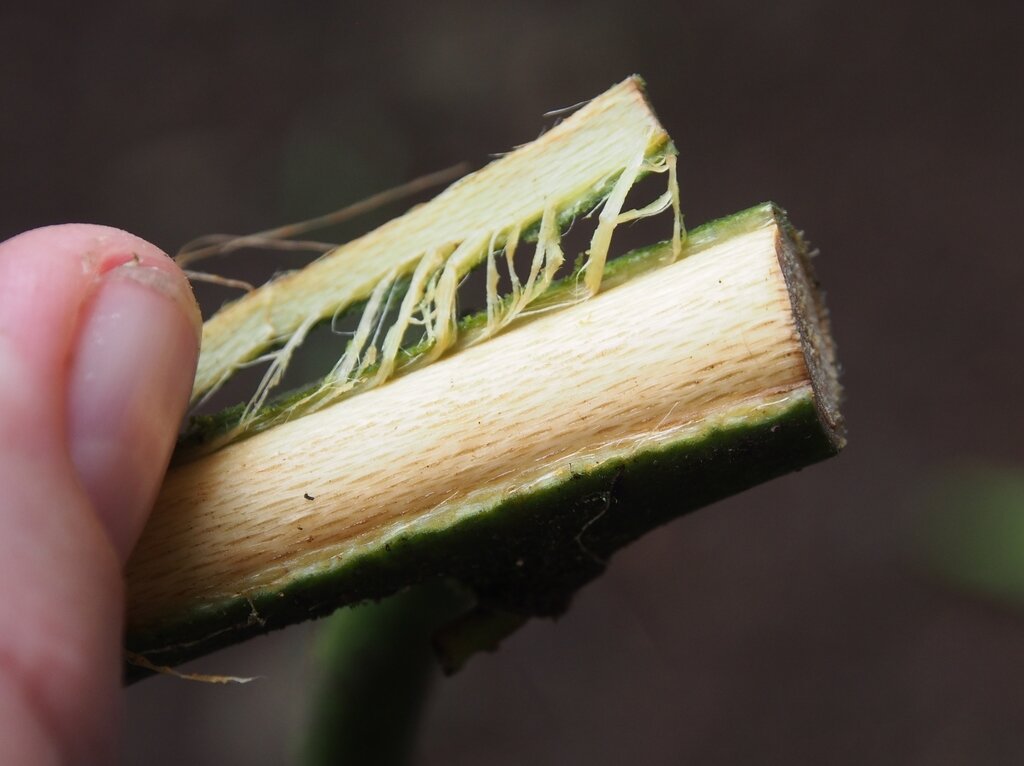
Guatteria amplifolia is typically an understory tree reaching 2-12 meters in height, though exceptional individuals can grow to 20 meters where conditions permit. The trunk is slender, usually less than 30 cm in diameter, with grayish bark that becomes slightly fissured with age. The inner bark is fibrous, a characteristic that has led to traditional uses in rope-making.
Leaves
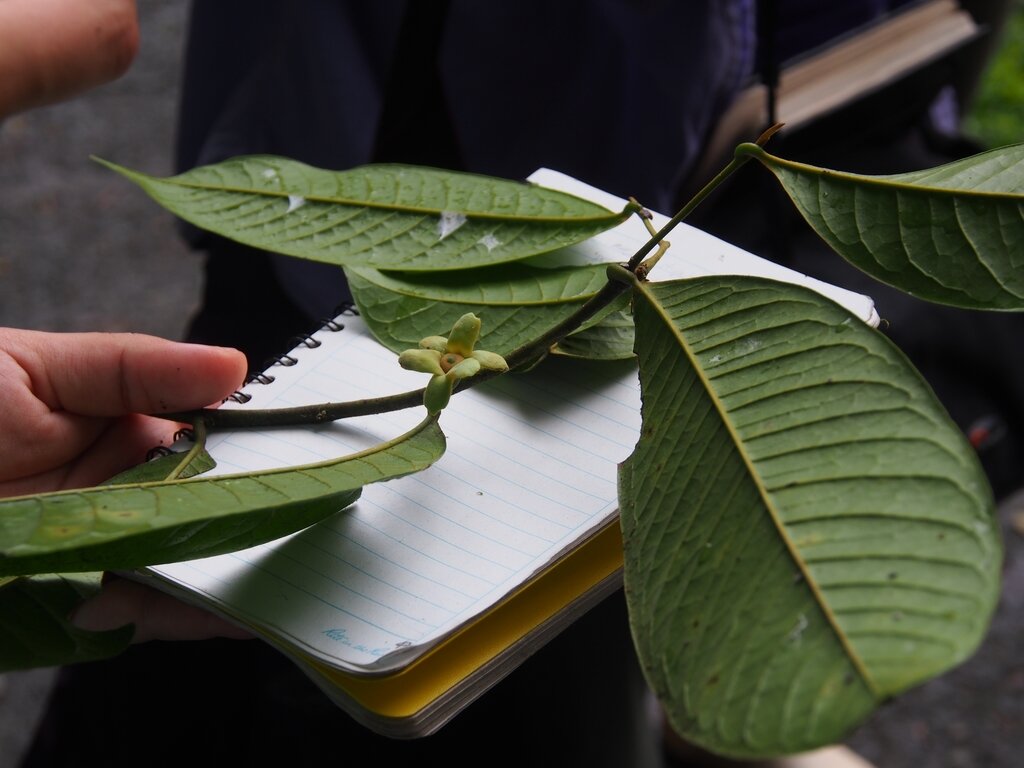
The leaves justify the species name: they are large and broadly rounded, measuring 15-30 cm long and 8-15 cm wide. The leaf shape is obovate to elliptic, broadest toward the tip, with a short-acuminate apex. The upper surface is dark green and glabrous (smooth), while the underside is paler with sparse fine hairs along the midrib. Leaves are arranged alternately along the branches in a distinctive two-ranked pattern, a characteristic of many Annonaceae.
Flowers

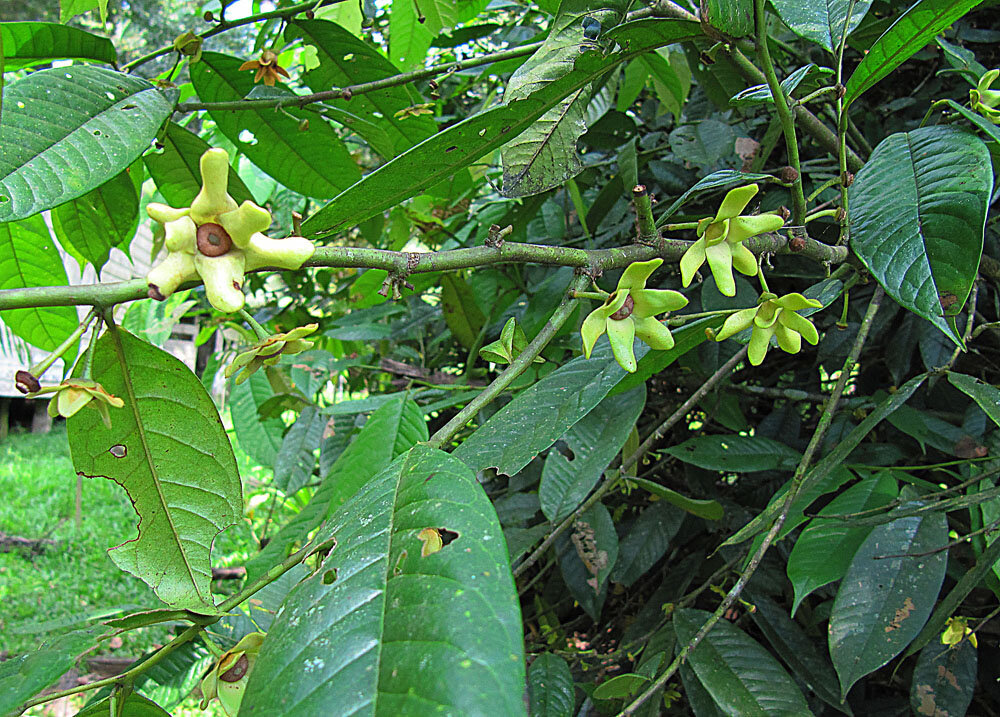
The flowers are perhaps the malagueto's most distinctive feature. Borne singly or in small clusters from leaf axils, each flower has six thick, fleshy petals arranged in two whorls of three. The outer petals are larger than the inner ones, creating a slightly cupped shape. The color is pale yellow to greenish-yellow, and the flowers emit a strong, sweet fragrance often compared to ripe bananas. This fruity scent is key to the tree's pollination strategy.
Fruits
The fruits develop from the multiple carpels of each flower into an aggregate structure. Each fruit consists of numerous individual monocarps (fruitlets) attached to a common stalk. When ripe, the monocarps turn deep purple to black, each containing a single seed surrounded by a thin layer of sweet flesh. The contrasting colors, with the purple-black fruits against a red or pink stalk, make the ripe fruits conspicuous to frugivorous birds, the primary seed dispersers.
Distribution
Guatteria amplifolia ranges from southern Mexico through Central America to Colombia. Within Costa Rica, it occurs on both the Atlantic and Pacific slopes in lowland wet and moist forests, typically below 1,000 meters elevation, though occasional collections have been made up to 1,850 meters. The species is common in the Osa Peninsula, the Caribbean lowlands, and the northern Pacific coast wherever primary or advanced secondary forest remains.
Beetle Pollination
The Annonaceae family is remarkable for its close relationship with beetles. Roughly 90% of species in the family are pollinated by beetles (cantharophily), a pollination syndrome considered ancient. The malagueto's flowers embody this strategy: their fleshy, thick petals, fruity scent, and enclosed chamber create an ideal environment for small beetles.
The primary pollinators are nitidulid beetles (family Nitidulidae), sometimes called sap beetles. These small insects are attracted to the flower's banana-like scent, which mimics the fermenting fruits they typically feed on. When a beetle enters the flower chamber, it finds warmth, shelter, and food in the form of specialized tissue the flower provides. In the process of feeding and mating within the flower chamber, the beetles become covered with pollen and transfer it to the next flower they visit.
Heat as Reward
Many Annonaceae flowers generate heat through a process called thermogenesis, and Guatteria is no exception. The thick, fleshy petals contain accumulated starch and lipids that fuel a respiratory process, warming the flower chamber during anthesis. This warmth serves two purposes: it intensifies the volatilization of floral scents, spreading them farther to attract beetles, and it provides the beetles themselves with an energy reward. Inside the warm chamber, beetles can more efficiently feed, digest, mate, and prepare for flight. The heat production is most intense during the pistillate (female) phase when the flower needs to attract pollinators.
Research on Guatteria has shown that the flowers undergo distinct phases spanning about 24 hours. One day before full anthesis, the petals curve over the flower center, forming a closed, dark pollination chamber. During the first day, the protogynous flowers are receptive in their female phase, emitting strong fruity odors probably consisting of esters and alcohols. Beetles arrive, often forcing their way between the petals, and become trapped inside. During the night, the stigmatic head is shed, and by early morning of the second day, the stamens release their pollen. The beetles, now covered in pollen, are released when the petals drop, ready to visit another flower in its female phase.
Seed Dispersal
While beetles pollinate the flowers, birds disperse the seeds. The colorful ripe fruits, with their sweet flesh and contrasting colors, attract a variety of frugivorous birds. Toucans, tanagers, guans, and various other species have been observed feeding on Guatteria fruits. The birds swallow the monocarps whole, digesting the flesh and passing the hard seeds, often depositing them far from the parent tree.
In Costa Rica's northern lowlands, the crested guan (Penelope purpurascens) has been documented visiting malagueto trees when fruits are ripe. These large, turkey-like birds are important seed dispersers in Neotropical forests, moving seeds considerable distances as they forage through the canopy. Guans typically feed high in trees, taking fruits directly from branches, though they will descend to lower levels where understory species like the malagueto fruit. Birds disperse the seeds of up to three-quarters of tropical tree species, making avian frugivory one of the most important ecological processes in these forests.
This dual system, beetle pollination and bird dispersal, connects the malagueto to multiple ecological networks within the forest. The tree depends on beetle activity for reproduction and in turn provides food resources for birds. As an understory species, it flowers and fruits in the shaded environment below the canopy, making its resources available to animals that forage at lower levels of the forest.
Uses
The malagueto's fibrous inner bark has been traditionally used for making rope and cordage. The long, strong fibers can be stripped from the bark, twisted, and braided into durable lines suitable for various purposes. This use is reflected in one of the tree's common names and has been documented across its range. However, with the availability of synthetic cordage and the decline of traditional forest uses, this practice has become less common.
The wood itself is soft and not particularly durable, limiting its utility for construction. The tree's primary value today lies in its ecological functions and its role in maintaining forest diversity. As a common understory species in humid lowland forests, the malagueto contributes to the complex structure that defines healthy tropical forest ecosystems.
Medicinal Chemistry
Like many Annonaceae, the malagueto produces alkaloids that have attracted the attention of pharmaceutical researchers. Studies of Guatteria amplifolia have isolated four aporphine alkaloids: xylopine, nornuciferine, lysicamine, and laudanosine. These compounds belong to a class of chemicals found throughout the custard apple family and have demonstrated significant biological activity.
The most promising research has focused on treatments for leishmaniasis, a parasitic disease transmitted by sandflies that affects millions of people in tropical regions. Xylopine, one of the alkaloids isolated from the malagueto, demonstrated remarkable selectivity in laboratory tests. With an LD50 of just 3 micromolar against Leishmania mexicana, it was 37 times more toxic to the parasite than to macrophages, the human immune cells where the parasites reside. This selectivity is crucial for any potential drug, as it suggests the compound could target the parasite while sparing host cells.
Additional research has investigated antimalarial compounds from this species. The same class of aporphine alkaloids has shown activity against Plasmodium falciparum, the parasite responsible for the most severe form of malaria. Xylopine has also demonstrated anticancer properties in laboratory studies, inducing oxidative stress and triggering programmed cell death (apoptosis) in colon cancer cells through a caspase-mediated pathway. While these findings are preliminary and have not led to approved medications, they illustrate the pharmaceutical potential that remains locked within tropical forest species.
Conservation
Guatteria amplifolia is classified as Least Concern on the IUCN Red List, reflecting its wide distribution and tolerance of secondary forest habitats. The species persists in forest fragments and regenerating areas where it can establish in the shade of pioneer trees. However, like all forest-dependent species, the malagueto's long-term survival depends on the conservation of Costa Rica's lowland forests.
The humid lowland forests of both coasts have historically faced heavy pressure from agricultural expansion, particularly for banana, palm oil, and cattle operations. While significant protected areas exist, including Corcovado National Park on the Osa Peninsula and Tortuguero National Park on the Caribbean coast, much of the remaining forest exists in private lands and biological corridors where ongoing conservation efforts work to maintain connectivity between protected areas.
Resources & Further Reading
Species Information
Taxonomic information including synonymy, distribution, and nomenclatural history.
Species profile from the Osa Peninsula arboretum with local information.
Distribution records and occurrence data from herbarium specimens worldwide.
Citizen science observations with photographs from across the species' range.
Taxonomy
The definitive 219-page monograph recognizing 177 species of Guatteria, including notes on G. amplifolia as the most complex Central American species.
Detailed species account including synonyms, uses, and ecological information.
Pollination Biology
Comprehensive review of Guatteria pollination mechanisms, thermogenesis, and beetle attraction.
Analysis of pollination syndromes across the family, including beetle and scarab pollination.
Detailed study of beetle behavior in Annonaceae flowers, including timing and pollinator activity.
Medicinal Research
Study documenting xylopine's 37-fold selectivity against Leishmania compared to host cells.
Research on antimalarial compounds isolated from this species.
Study of xylopine's anticancer mechanisms in colon cancer cells.
Regional Databases
Distribution records from Panama including Bocas del Toro, Colón, Darién, and Guna Yala.
Costa Rican records with documentation of crested guan feeding on fruits.
Biographical
Biography of the Colombian botanist who described this and hundreds of other species.
Biography of the French botanist who collaborated with Triana and later saved European vineyards from phylloxera.