Laurel Negro
Cordia megalantha — The giant of the Cordias. Growing up to 60 meters tall in the wet forests of Central America, this timber tree produces flowers so large they earned it the name "megalantha." Its wood rivals the famous laurel in quality, destined for fine furniture and cabinetry.
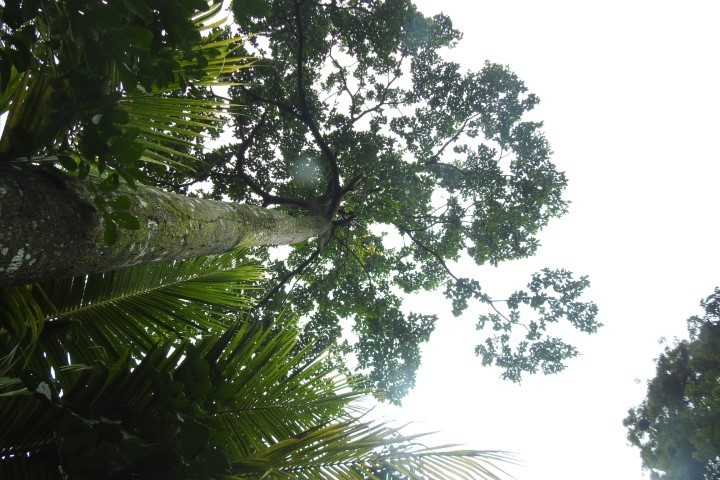
The laurel negro is the overlooked giant of the Cordia genus. While the common laurel (C. alliodora) grows in coffee plantations across Costa Rica and the muñeco (C. collococca) dominates dry Pacific forests, the laurel negro towers above them both in the wet forests of the Caribbean slope and southwest Pacific. Under optimal conditions, it can reach 60 meters tall, making it one of the largest trees in its family.
The species name tells you what makes it special: megalantha means "large flower." When this tree blooms, it produces flowers noticeably bigger than those of other Cordias. But it does not bloom every year, making the flowering events memorable for those who witness them. The tree's wood quality matches its stature, prized for furniture, cabinets, and fine joinery.
Identification
Size and Form
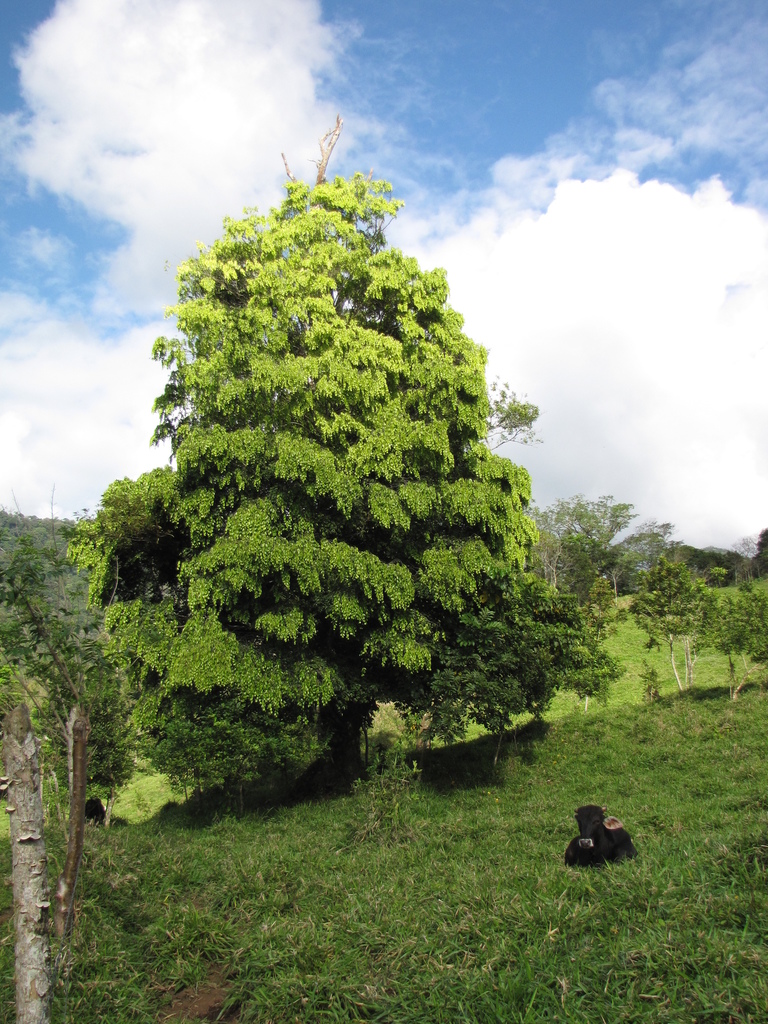
The laurel negro is the largest of the four Cordias profiled here. While the muñeco blanco rarely exceeds 20 meters and the common laurel typically reaches 25-30 meters, the laurel negro routinely grows to 30-40 meters and can exceptionally reach 60 meters. The trunk is slightly furrowed with dark, smooth bark, and larger specimens develop buttresses at the base. The crown is dense and rounded in open-grown trees.
Leaves
The leaves are obovate to elliptical with entire margins, smooth on both surfaces. This distinguishes them from the muñeco's sandpaper-textured leaves and the muñeco blanco's rough white undersides. They lack the garlic scent of the common laurel. The foliage is briefly deciduous, dropping for a short period before new leaves emerge.
Flowers and Fruits
Flowers: The large flowers that give the species its name appear in terminal panicles. They are fragrant, bisexual, with white to brown funnel-shaped corollas and five lobes. Bees and butterflies visit for pollination. Crucially, the tree does not flower every year, making flowering events unpredictable and the sight of a blooming laurel negro a notable occasion.
Fruits: The fruits are ellipsoid drupes, 8-12 mm long and 4-6 mm wide, ripening from green to brown. Unlike the fleshy fruits of the muñeco and muñeco blanco, the laurel negro's fruits have a fibrous mesocarp rather than juicy pulp. They remain enclosed by persistent brown sepals and corollas.
The Four Cordias
Four Cordia species occur in Costa Rica's wet and dry lowland forests. Each has adapted to slightly different conditions and can be distinguished by simple field tests.
| Feature | Laurel Negro | Laurel | Muñeco | M. Blanco |
|---|---|---|---|---|
| Species | megalantha | alliodora | collococca | bicolor |
| Max height | 60 m | 30 m | 35 m | 20 m |
| Leaf test | Smooth both sides | Garlic scent | Sandpaper | White underside |
| Fruit | Fibrous, brown | Wind nutlet | Red drupe | Yellow drupe |
| Habitat | Very wet forests | Versatile | Dry Pacific | Humid lowlands |
| Timber | Excellent | Excellent | Moderate | Moderate |
Ecology
The laurel negro inhabits very humid and pluvial forests near the coast, from sea level to about 1,000 meters (occasionally reaching 1,400 meters). In Costa Rica, it is found primarily on the Caribbean slope, in the northern zone, and in the southwest Pacific region including parts of the Golfo Dulce watershed. It tolerates both primary forest and disturbed areas, occurring at forest edges, in pastures, and along stream margins.
Forest gaps appear to be important for successful regeneration. Like other Cordias, the laurel negro is a pioneer that benefits from disturbance, establishing in openings where light reaches the forest floor. Its broader range extends from southern Mexico through Guatemala, Honduras, Nicaragua, and Panama.
Uses
Timber: The laurel negro produces high-quality wood comparable to the common laurel (C. alliodora). It is used for joinery, turnery, cabinets, furniture, and plywood. The wood works well and takes a good finish, making it suitable for interior applications and fine woodworking. This timber value, combined with the tree's large size, makes it a potentially important species for sustainable forestry in wet tropical regions.
Reforestation: Research at La Selva Biological Station in Costa Rica has evaluated the laurel negro among other native species with timber potential. Its fast growth, tolerance of disturbed sites, and valuable wood make it a candidate for reforestation projects in very humid zones where the common laurel may not thrive.
Conservation
The laurel negro is listed as Least Concern by the IUCN. Its wide distribution from Mexico to Panama, combined with its ability to colonize disturbed areas, ensures healthy populations across its range. No significant threats have been identified, and the species is not currently in decline.
Costa Rica's four Cordias together illustrate how closely related species can partition the landscape. The laurel thrives in coffee farms and mid-elevation slopes across the country. The muñeco claims the dry seasonal forests of the Pacific. The muñeco blanco fills the humid lowlands of both coasts. And the laurel negro towers over the wettest forests near sea level, a 60-meter giant hiding in plain sight.
Resources & Further Reading
Species Information
Encyclopedia article with taxonomy, distribution, and common names.
Comprehensive information on uses, distribution, and ecology.
Taxonomic information and native range from Kew Gardens.
Occurrence records and distribution maps from worldwide collections.
Community observations with photographs from Central America.
Species profile with Costa Rican distribution details (Spanish).
Scientific Literature
Research on seed germination strategies in tropical deciduous trees.