Laurel Geo
Ocotea leucoxylon — Known as "sweetwood" across Jamaica and the Caribbean, this shade-tolerant laurel spans from Mexico to Brazil, its aromatic leaves and pale timber earning it dozens of local names across its vast range.
When Swedish botanist Olof Swartz explored Jamaica in the 1780s, he encountered a tree the locals called "sweetwood." Its leaves, when crushed, released what one observer described as "a strong and pleasant odor." Swartz named it Laurus leucoxylon, combining the Greek leuco (white) and xylon (wood) to describe its characteristically pale timber. Nearly a century later, the species was reclassified as Ocotea leucoxylon, but the sweetwood name persisted across the Caribbean, and the tree's aromatic foliage continued to distinguish it from its many relatives in the laurel family.
Identification
Physical Characteristics
Crown & Trunk: An evergreen tree with a very dense, rounded crown that can reach 25 meters in height, though typically growing to 15-20 meters. The trunk, which can reach 60 cm in diameter (occasionally 90 cm on exceptional specimens in Martinique), develops winged buttresses on larger trees. Bark is grayish to dark brown, 4-6 mm thick, smooth when young but becoming slightly fissured with age, revealing an orange inner layer when cut.
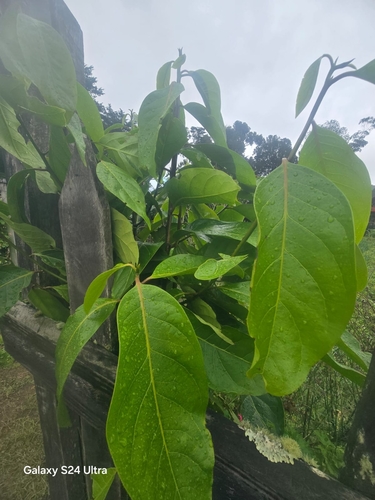
Leaves: Elliptic to oblong-lanceolate, 10-27 cm long and 4-9 cm wide, with 4-8 secondary veins per side. The upper surface is smooth and glossy while the underside bears tiny appressed hairs, particularly along the midrib. Young branches are covered with rusty-brown (ferruginous) hairs that become smooth over time. When crushed, the leaves emit a strong, pleasant aromatic odor, a characteristic that has made the species recognizable across its range.
Flowers & Fruits: The species is dioecious, meaning individual trees are either male or female. Flowers are white to yellow, small, and borne in paniculate inflorescences up to 8 cm long. Flowering occurs twice yearly, from January to April and again from August to September. Fruits are small drupes 0.8-1.5 cm long, seated in cupules 0.4-1 cm across, ripening from January through July.
A Tree of Many Names
Few Neotropical trees have accumulated as many common names as Ocotea leucoxylon. This linguistic diversity reflects both its vast geographic range and its importance to local communities from Mexico to Brazil. In Jamaica it is whitewood or loblolly sweetwood; in Trinidad, duckwood or black cedar; in Puerto Rico, cacaíllo or geo. The Dominican Republic calls it cigua laurel, cigua boba, or aguacate prieto. In the French Antilles, names proliferate further: bois doux jaune, bois-doux pimenté, laurier fine, laurier Madame. The Creole of St. Lucia knows it as lowyé mabwe.
The name "sweetwood" deserves particular attention. In Jamaica, this name is applied broadly to trees of the Lauraceae family whose wood or foliage is aromatic. The laurel family is known for its scented species, from bay laurel to cinnamon, and Ocotea leucoxylon carries this heritage in its fragrant leaves. The "loblolly" prefix refers to its preference for wet, swampy habitats, from an old English word meaning mud hole or mire.
Habitat & Distribution
Ocotea leucoxylon has one of the broadest distributions of any Ocotea species. From southern Mexico it ranges through all of Central America to South America, occurring in Brazil, Peru, Ecuador, Colombia, Venezuela, Guyana, Suriname, and French Guiana. It is equally at home in the Caribbean, found across the Greater Antilles (Cuba, Jamaica, Hispaniola, Puerto Rico) and Lesser Antilles (from Trinidad to Antigua), as well as the Virgin Islands.
In Costa Rica, documented records place the species on the Caribbean slope of the Cordilleras de Guanacaste and Central, from sea level to 1,900 meters (occasionally reaching 2,200 m), where it inhabits very humid forest, rainforest, cloud forest, and oak forest. Whether it also occurs on the Pacific slope remains unclear; the absence of records from the Osa Peninsula and Brunca region is surprising given the species' vast Neotropical range, and may reflect incomplete sampling rather than true absence. Unlike many rainforest trees that require high light levels for regeneration, O. leucoxylon is notably shade-tolerant, regenerating well in the understory of closed-canopy forests.
A distinctive feature of its habitat preference is its affinity for limestone. Throughout the Caribbean, the species frequently occurs in forests growing over calcareous substrates, particularly in coastal areas. In Puerto Rico, it is documented in at least ten state forests spanning all elevation zones, from the coastal lowlands of Dorado to the montane forests of El Yunque and the Central Cordillera.
The White Wood
The species name leucoxylon means "white wood" in Greek, and the timber lives up to this description. The heartwood is a uniform light golden-brown, lacking distinct figure and not clearly demarcated from the pale yellowish-brown sapwood. With age, the wood darkens to a richer brown. The texture is fine to medium, with grain that varies from straight to interlocked. Wood density ranges from 0.40 to 0.65 g/cm3, placing it among the lighter tropical hardwoods.
The timber is moderately soft, lightweight, and easily worked with both hand and power tools. Despite its lack of natural durability and susceptibility to dry-wood termites, it is valued across its range for applications where extreme longevity is not required. Traditional uses include shingles, staves, boxes, crates, general furniture, and interior woodwork. In some regions it serves for posts, carpentry, and construction. The wood finishes smoothly and takes paint and glue well.
Chemistry & Cancer Research
In 2000, researchers screening tropical plants for potential tumor inhibitors made an unexpected discovery. A crude extract from Ocotea leucoxylon showed selective activity against the enzyme topoisomerase I, a key target in cancer therapy. Using bioassay-directed fractionation, they isolated the active compound: dicentrinone, an aporphine alkaloid. The related alkaloid dicentrine was also present but showed no activity.
Topoisomerase I is essential for DNA replication, and inhibiting it is the mechanism behind camptothecin, a plant-derived compound used in cancer chemotherapy. Dicentrinone showed activity against repair-deficient yeast cells at concentrations of 49 micrograms per milliliter. However, colony formation studies revealed that dicentrinone's mechanism differs from camptothecin's, suggesting it may work through additional pathways. More recent research has found that both dicentrine and dicentrinone can also inhibit protein disulfide isomerase (PDI), another promising anti-cancer target, and suppress proliferation of liver cancer cells.
The discovery adds Ocotea leucoxylon to the growing list of Lauraceae species yielding compounds of pharmaceutical interest. The family is already known for producing neolignans, benzylisoquinoline alkaloids, and flavonoids with antimicrobial, anti-inflammatory, and cytotoxic properties. Whether dicentrinone will advance to clinical development remains to be seen, but the finding underscores the importance of preserving tropical forests as libraries of undiscovered biochemistry.
Ecology
As a dioecious species, Ocotea leucoxylon requires both male and female trees in proximity for successful reproduction. This has implications for forest fragmentation: isolated populations may lack adequate representation of both sexes, limiting fruit production and seed dispersal. The twice-yearly flowering pattern (January-April and August-September) followed by extended fruiting (January-July) provides resources for frugivorous animals across much of the year.
Like other Ocotea species, the fruits are likely dispersed by frugivorous birds. Research on related species has documented seed dispersal by toucans, quetzals, bellbirds, and various pigeons and doves. The small drupes seated in cupules are typical of the Lauraceae and are well-suited to avian dispersal, with birds swallowing fruits whole and regurgitating or defecating the seeds.
The shade tolerance of O. leucoxylon distinguishes it from many tropical trees that require canopy gaps for regeneration. It can establish and grow in the dim understory of closed forests, making it a component of both secondary forests recovering from disturbance and mature primary forests. This ecological strategy may contribute to its success across such a wide range of habitats, from coastal limestone forests to montane cloud forests.
Resources & Further Reading
Species Information
Overview of the Ocotea genus including distribution, ecology, and seed dispersal.
Authoritative taxonomic information and global distribution data.
Detailed information on uses, wood properties, and cultivation.
Costa Rican distribution and habitat information.
Comprehensive Caribbean data including common names, dimensions, and wood properties.
Chemistry & Pharmacology
Original research paper describing the discovery of dicentrinone as a topoisomerase I inhibitor.
Overview of dicentrine pharmacology and mechanisms of action.
Regional Distribution
Puerto Rico distribution data including state forest occurrences.
Observations and photographs from across the species range.