Laurel
Cordia alliodora — The garlic-scented timber tree that transformed Costa Rican agriculture. Growing in coffee plantations and cacao groves across the country, this fast-growing pioneer provides shade, fixes the economy when coffee prices crash, and smells like garlic when you crush its leaves.
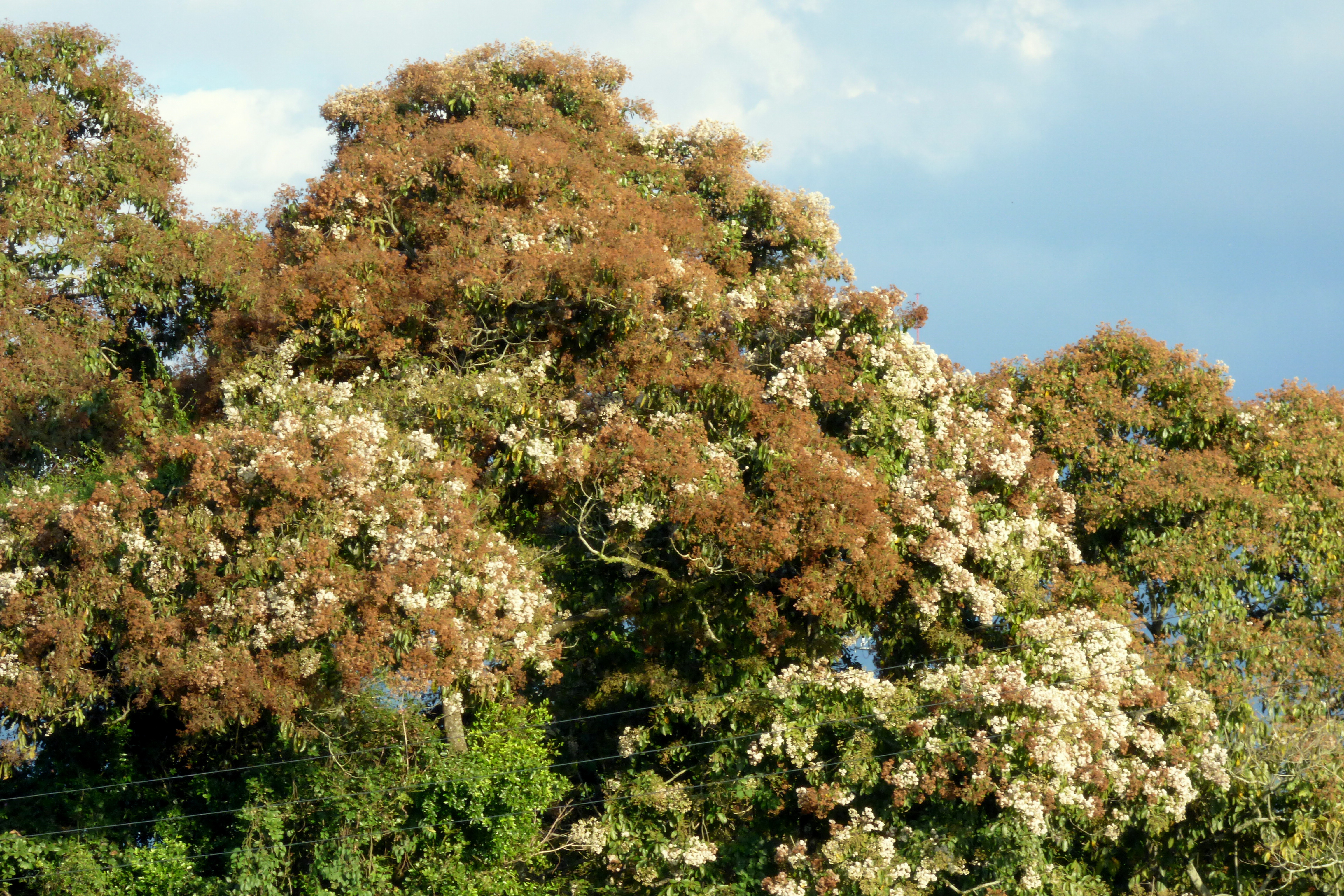
Walk through any coffee plantation in Costa Rica and you will see them: tall, straight trees rising above the coffee bushes, their whorled branches casting dappled shade. These are laurels, and they are everywhere. In pastures, along roadsides, shading cacao, towering over banana plants. The laurel is so common that it fades into the background, just another tree. But this tree built an industry.
The idea was simple: grow timber and coffee on the same land. A farmer plants laurel seedlings between rows of coffee bushes. The laurels grow fast, two meters a year in good conditions. Within a few years they tower above the coffee, their open crowns filtering just enough sunlight for the shade-loving coffee below. The coffee produces beans. The laurels produce wood. When coffee prices crash, as they periodically do, the farmer has a savings account growing overhead.
Identification

The laurel is easy to recognize once you know what to look for. The trunk is straight and cylindrical, remarkably self-pruning: even trees growing in the open shed their lower branches, leaving a clean bole for 50-60% of their height. The bark is smooth and gray-green on young trees, becoming light gray and slightly fissured with age. Lichens often colonize the bark, giving mature trees a striking pale, almost white appearance from a distance.
The branches emerge in distinctive whorls, giving the crown a layered, almost pagoda-like appearance. Look closely at where branches meet the trunk and you will see something odd: swollen nodes, like small gourds attached to the stem. These are domatia, hollow chambers that house colonies of ants. The relationship is not as tight as in Cecropia; the laurel does not feed its ants, and the ants may not provide much defense. But the swellings are a useful identification feature.
The Garlic Test
If you are still unsure, crush a leaf. The species name alliodora means "garlic-scented," and the crushed leaves and fresh bark emit a distinctive garlic or onion odor. It is not subtle. This is the tree's signature, and it works in the field when you cannot see flowers or fruit.
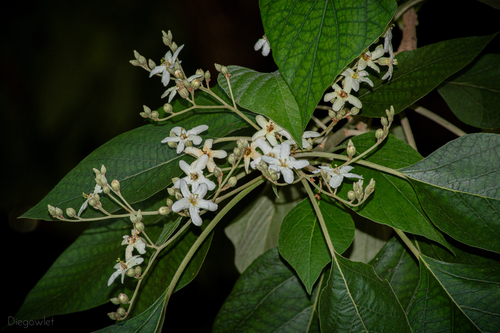
Leaves: Simple, alternate, elliptical to ovate, 10-20 cm long. The upper surface is glossy green; the underside is paler. The leaf margins are entire or slightly wavy.
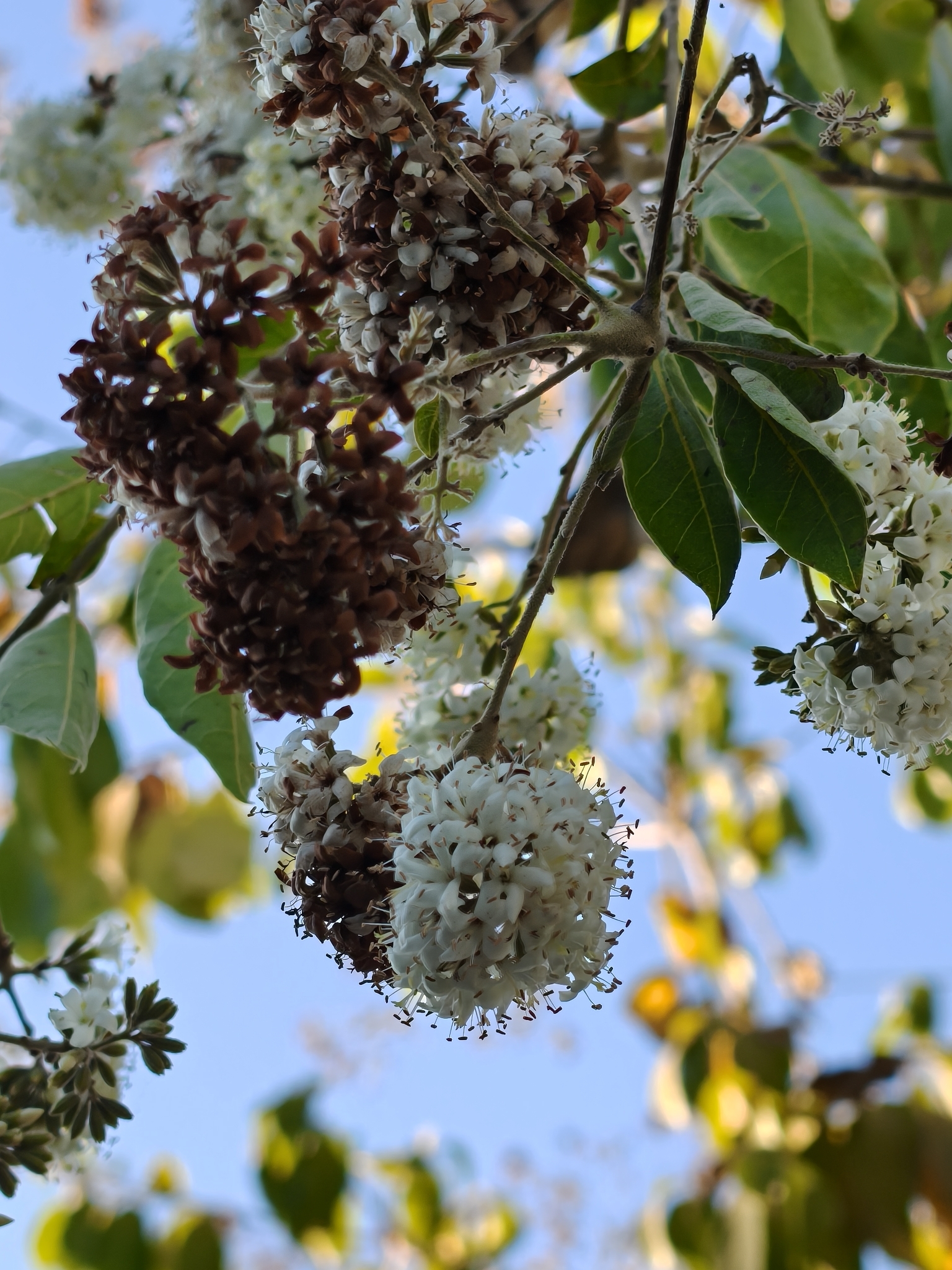
Flowers: Small, white, fragrant, crowded in terminal panicles 10-30 cm across. The corolla has five spreading lobes. Flowering begins as early as age 4-5 years and produces abundant nectar that attracts bees; laurel is valued for honey production. Flowering time varies by region: February to May in Central America, year-round in some areas.
Fruits: Small, cylindrical nutlets about 6 mm long, each containing a single seed. The dried, withered flower remains attached to the fruit and acts as a parachute during wind dispersal. A single tree can produce 2-8 kg of seed per year, or 42,000-100,000 seeds per kilogram.
The Coffee Connection
Costa Rica pioneered the integration of laurel into coffee systems. As early as 1963, farmers began using the Taungya method: planting laurel seedlings between rows of food crops, then leaving the trees in place when crops were harvested. The system worked. By the 1980s and 1990s, researchers at CATIE in Turrialba were quantifying what farmers already knew: shade-grown coffee with laurel was more stable economically than sun coffee alone.
CATIE researchers found that a coffee plantation producing 1,380 pounds per hectare under laurel shade generates higher total profits than unshaded coffee whenever the coffee price drops below $60 per 100 pounds. When prices crashed in the early 2000s, farmers with laurel had a buffer. One study in Talamanca found that the net gain from harvesting a single mature laurel was around $316. A hectare of cacao in the same region could yield $6,410 in timber over a 20-year rotation, on top of the cacao harvest. A plantation with 100-200 laurels per hectare is not just a coffee farm; it is a timber investment.
The Wood
Laurel wood is the reason the tree is planted. The heartwood ranges from pale golden-brown to tobacco-brown with darker streaks, producing an attractive finish that has been compared to mahogany or teak. The wood is moderately heavy (specific gravity 0.44-0.52), seasons quickly with little warping, works easily, and finishes smoothly. Most importantly, the heartwood resists termites, fungi, and rot.
Costa Rican woodworkers prize laurel for furniture, doors, window frames, flooring, and cabinetry. It is used for boat decking, parquet, decorative veneer, and tool handles. In other parts of Latin America, it substitutes for more expensive hardwoods. Some luthiers use related Cordia species for guitar backs and sides.
The color of the heartwood varies, and Costa Ricans distinguish between "laurel blanco" (light-colored) and "laurel negro" (dark-colored). The darker wood is considered more durable and commands a higher price. The difference may be genetic, environmental, or related to tree age; research has not fully resolved the question.
Ecology
The laurel is a pioneer species, demanding full sun and colonizing disturbed sites with aggressive success. It does not tolerate shade. In natural forests, it appears in gaps, along rivers, on landslide scars. In human-modified landscapes, it thrives in pastures, along roadsides, in abandoned fields. The combination of fast growth, prolific seeding, and wind dispersal makes it one of the most successful colonizers in the Neotropics.
Its range is enormous: from Sinaloa, Mexico to Misiones, Argentina, a span of 50 degrees of latitude. It grows from sea level to 2,000 meters, though it performs best below 1,000 meters. It tolerates annual rainfall as low as 750 mm and as high as 5,000 mm, though optimal growth occurs above 2,000 mm. The one thing it cannot tolerate is waterlogged soil. Poor drainage kills laurels.
The ant domatia deserve mention. At each branch whorl, the nodes swell into hollow, gourd-shaped chambers. Various ant species colonize these spaces, most commonly Azteca species and the phragmotic Zacryptocerus setulifer, whose soldiers have flattened heads that plug the entrance holes. Unlike Cecropia, which feeds its ants with specialized food bodies, the laurel offers only housing. The relationship appears to be facultative rather than obligate, and the benefits to the tree remain unclear.
Other Uses
Beyond timber and shade, the laurel serves multiple purposes. The abundant, fragrant flowers make it valuable for beekeeping; apiaries placed near flowering laurels produce excellent honey. The leaves have traditional medicinal uses as a stimulant and tonic, and decoctions are used to treat coughs and lung conditions. A paste of the leaves is applied topically to bruises. The bark is occasionally used as a condiment.
The tree is also planted as an urban ornamental, valued for its straight form, attractive flowers, and moderate size. In hurricane-prone areas, its deep root system and flexible wood make it resistant to wind damage. Trees that do blow over often coppice readily, sprouting new stems from the stump.
Conservation
The laurel is not threatened. Its enormous range, fast growth, prolific reproduction, and integration into agricultural systems ensure that it remains abundant throughout the Neotropics. If anything, the tree is expanding. It colonizes disturbed land so effectively that in some Pacific island nations where it was introduced, it has become invasive.
In Costa Rica, the laurel represents a conservation success of a different kind: a native tree that farmers actively want to plant because it makes economic sense. No subsidies are needed. No laws require it. The tree pays for itself. As interest in shade-grown coffee grows among environmentally conscious consumers, and as climate volatility makes income diversification more valuable, the laurel's role in Costa Rican agriculture seems likely to expand rather than contract.
Costa Rica's four Cordias together illustrate how closely related species can partition the landscape. The laurel thrives in coffee farms and mid-elevation slopes across the country. The muñeco claims the dry seasonal forests of the Pacific. The muñeco blanco fills the humid lowlands of both coasts. And the laurel negro towers over the wettest forests near sea level. Each has its place, each its leaf test, each its contribution to the forest.
The garlic tree that nobody notices is, quietly, one of the most important trees in the country.
Resources & Further Reading
Species Information
General overview of the species including taxonomy, distribution, and uses.
Detailed botanical description with photographs and information on uses.
Comprehensive silvicultural information including growth rates, site requirements, and wood properties.
Agroforestry Research
Research on laurel timber production in cacao plantations in Talamanca, Costa Rica.
Research on the ant species that inhabit laurel domatia.