Jobo
Spondias mombin — The wild plum of the Neotropics, whose tangy yellow fruits feed spider monkeys and squirrel monkeys through the late wet season. One of the few deciduous trees in the rainforest, it drops all its leaves during the dry season before bursting into fragrant white bloom.
In August, when the wet season is at its peak, yellow fruits begin dropping from jobo trees throughout the lowland forests of Costa Rica. Spider monkeys, squirrel monkeys, and coatis converge on these trees, feasting on fruits that have fallen or picking them directly from branches. The flesh is sweet, sour, and slightly bitter, rich in vitamin C, and surrounds a large fibrous seed. For forest wildlife, jobo fruits are a critical food source during a time when many other trees have finished fruiting.
The jobo belongs to the Anacardiaceae, the cashew family, which also includes mangoes, pistachios, and poison ivy. Like its relatives, the jobo produces aromatic resin that smells distinctly of mango. This family connection becomes evident when you cut into the bark or crush the leaves. The tree is one of the few deciduous species in Costa Rica's wet forests, losing all its leaves during the early dry season before covering itself in clouds of fragrant white flowers.
Identification
The Anacardiaceae family contains about 800 species, many economically important for their edible fruits and nuts. In Costa Rica, the family includes the espavel (Anacardium excelsum), a related wild cashew that shares riparian habitats with the jobo. The genus Spondias contains about 17 species of tropical fruit trees, several of which are cultivated throughout Latin America.
Physical Characteristics
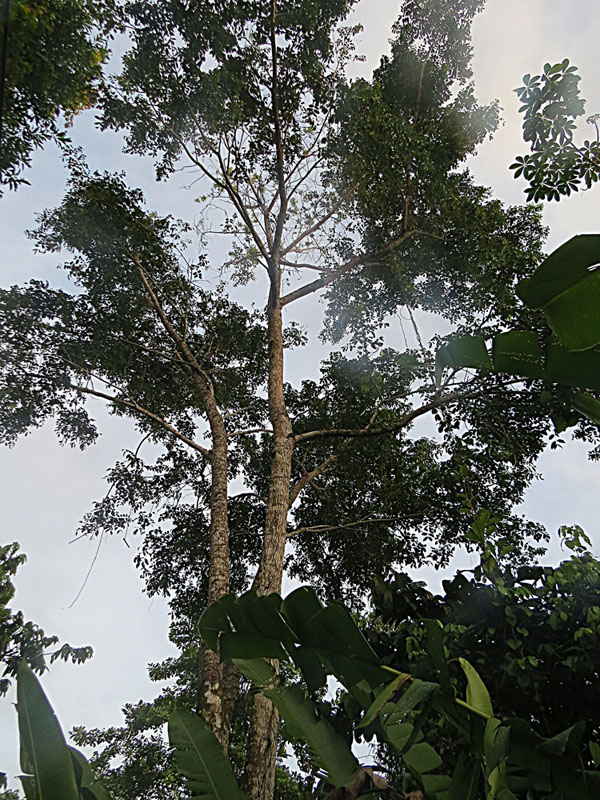
Trunk: Straight and cylindrical, with relatively few thick limbs forming a wide, spreading crown. The bark is light gray, thick, and rough, with deep vertical fissures. In older trees exceeding one meter in diameter, rounded bark plates exfoliate from the lower trunk.
Leaves: Imparipinnately compound, alternately arranged, and clustered near twig ends. Each leaf measures about 40 cm long with 11-17 narrow, somewhat curved leaflets. The leaves are shed completely during the early dry season (November-January), and regrowth begins slowly after flowering is complete in late April.
Flowers: Small (4 mm), white, and very fragrant, appearing in terminal panicles. Each flower has five petals, ten yellow stamens, and a central pistil. Flowering occurs from mid-March through mid-May, peaking in April. During peak bloom, the white crowns are conspicuous from a distance, especially since the trees are still leafless.
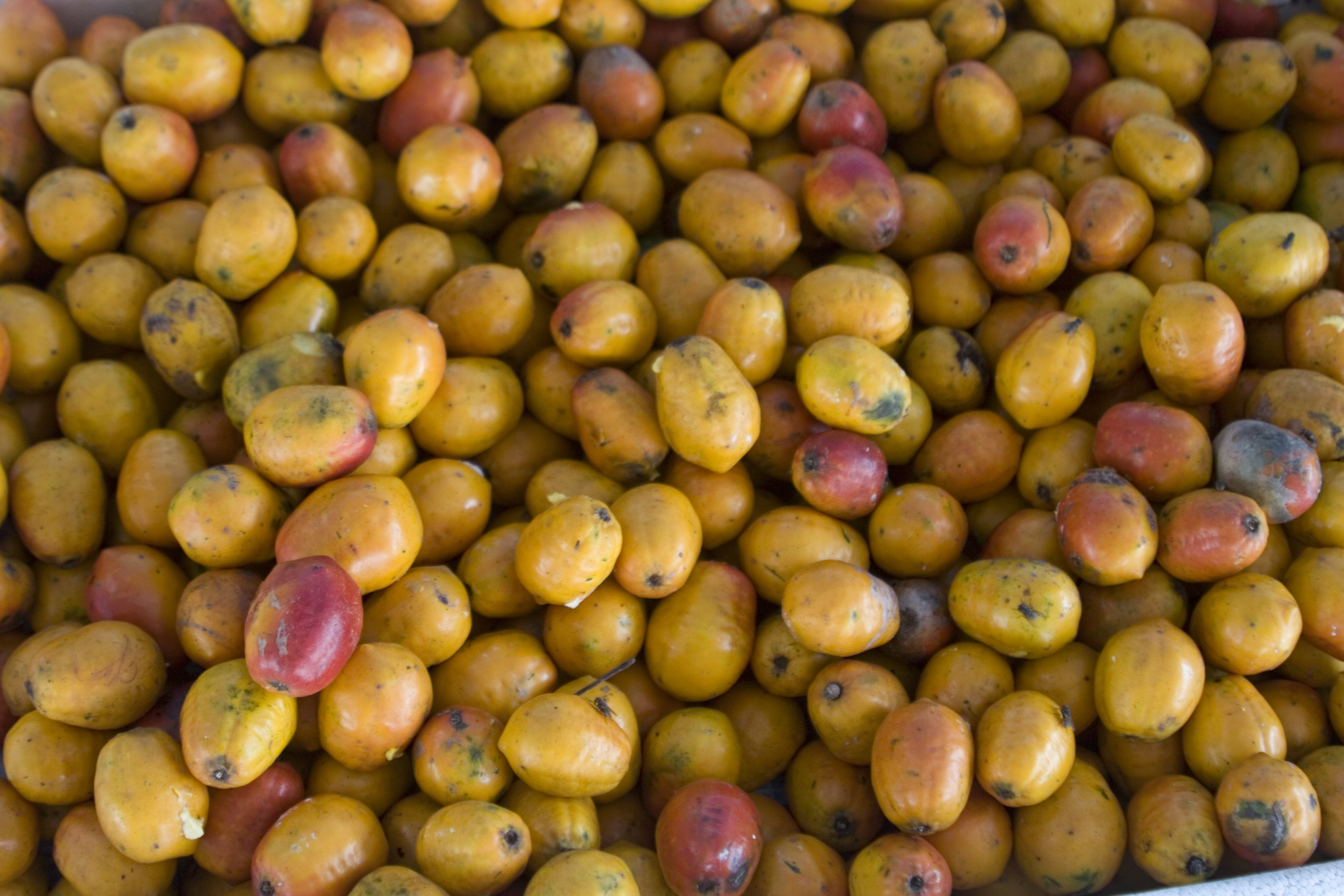
Fruits: Plum-shaped drupes, about 4 cm long and 2 cm in diameter, with thick flesh surrounding a single large fibrous seed. Green fruits ripen to yellow from August through October and fall to the ground when mature.
Ecology & Wildlife
Jobo flowers attract large numbers of bees, wasps, and other Hymenoptera during April. The fragrant blooms produce copious nectar and pollen, making the trees important for native pollinators. The timing of flowering, when the trees are still leafless, may help pollinators locate the blooms more easily.
The fruits are consumed by a wide range of wildlife. Spider monkeys (Ateles geoffroyi) eat jobo fruits in the canopy throughout their range; squirrel monkeys consume them where both species coexist. White-nosed coatis forage for fallen fruits on the forest floor. Birds and bats also feed on the fruits, though primates and coatis are the primary dispersers. Seeds germinate at the beginning of the following rainy season, about eight months after falling from the tree.
Habitat & Distribution
Jobo ranges from Mexico and the Caribbean through Central America to Peru and Brazil. In Costa Rica, it is widely distributed on both the Atlantic and Pacific slopes, occurring in dry, humid, and very humid forests. It grows in primary forest, secondary forest, riparian zones, forest edges, living fences, pastures, and along streams, rivers, beaches, and roads, from sea level to about 900 meters elevation.
The Osa Arboretum documents jobo as present throughout the Golfo Dulce region, which encompasses the Osa Peninsula. While the species is perhaps more characteristically associated with the dry tropical forests of Guanacaste, it adapts readily to wetter conditions and is common throughout the Pacific lowlands. Its tolerance of disturbed habitats, including pastures and roadsides, makes it one of the more frequently encountered large trees outside of protected areas.
Human Uses
The fruits are edible and have been consumed throughout the tree's range for millennia. The flesh has a strong, complex flavor combining sweet, sour, and bitter notes. While high in vitamin C, eating large quantities may cause stomach upset. In Brazil, jobo fruits are used to make ice cream and liqueur; throughout Latin America, the fruits are made into refreshing beverages called "refrescos."
The thick, fissured bark has been used traditionally for artisanal crafts. Local artisans carve intricate sculptures from the bark, taking advantage of its deep texture. The wood itself is white and soft, with limited timber value, though it serves for light construction. Indigenous peoples throughout the tree's range have used the water-storing roots as an emergency source of hydration during forest travel.
Conservation
The IUCN lists jobo as Least Concern due to its wide distribution and tolerance of disturbed habitats. The species is not protected under CITES. Jobo persists well in agricultural landscapes, often retained in pastures for shade and fruit, and readily colonizes secondary forests. While it benefits from forest conservation, its adaptability ensures it will remain common even in modified landscapes.
Key Sources & Resources
Species Information
Comprehensive species account including ecology, identification, and distribution in Costa Rica.
Local species information from the Osa Peninsula including phenology data.
Ethnobotanical Uses
Detailed information on cultivation, uses, and food preparation.
Comprehensive ethnobotanical database entry covering traditional medicinal uses across Latin America.
Edibility, medicinal uses, and cultivation information from the PFAF database.
Scientific Research
Comprehensive scientific review of the species' nutritional and medicinal properties.
General Reference
Overview of the species including distribution, uses, and cultivation worldwide.
Scientific database entry with distribution maps, ecology, and pest information.