Ira
Ocotea insularis — Named for Cocos Island where it was first collected, this aguacatillo thrives from sea level to cloud forest, co-dominates the forests of Costa Rica's most remote territory, and feeds the quetzals and bellbirds of the highlands.
Five hundred kilometers off the Pacific coast, Cocos Island rises from the ocean like a green fortress. This remote territory, Costa Rica's only oceanic island, harbors forests so simple in structure that just two tree species dominate the canopy. One of them is Ocotea insularis, the ira. The species name tells the story: insularis, Latin for "of the island," commemorates this place where a nineteenth-century botanist first collected the specimen that would define the species.
But the ira is no island endemic. From the humid lowlands at sea level to cloud forests at 1,800 meters, this aguacatillo occurs across a remarkable range of conditions throughout Central America and into South America. This adaptability makes it possibly the most widespread Ocotea species in the Neotropics, found from Nicaragua south to Peru and Ecuador. In Costa Rica, it grows in the Osa Peninsula lowlands and climbs into the highlands where quetzals and bellbirds depend on its fruits.
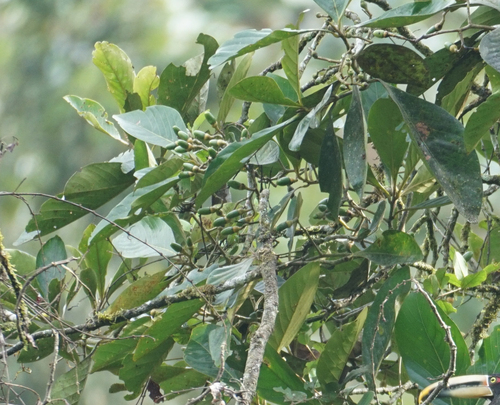
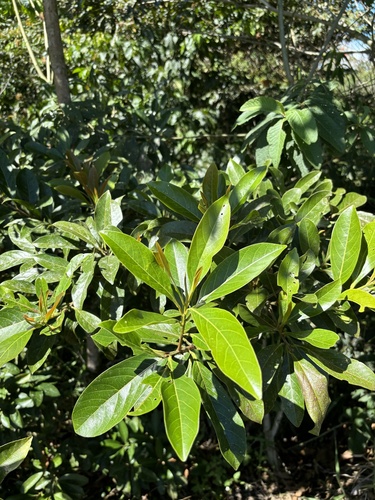
Identification
Flowers: Very small and yellowish, produced from May through December. Like other Lauraceae, the flowers are insect-pollinated.
Fruits: Small drupes with the characteristic reddish cupule typical of the genus. Fruits mature in March and April and are consumed by birds and mammals that disperse the seeds. The timing of fruiting in late dry season provides food when other sources may be scarce.
A Forest of Two Trees
Cocos Island presents one of the simplest forest structures in the Neotropics. With fewer than 40 tree species on the entire island, the canopy is dominated by just two: Sacoglottis holdridgei, an endemic ironwood that accounts for roughly 60% of canopy trees, and Ocotea insularis, which shares the remaining canopy space. The inland forests extend from 50 to 500 meters elevation, with Cecropia pittieri joining these two dominants as the third most common canopy tree.
Long-term monitoring on Cocos Island has revealed that O. insularis is the fastest-growing canopy tree in the premontane rainforest zone. Between 2006 and 2017, trees averaged 0.50 cm of diameter growth per year, accelerating to 0.57 cm per year in the most recent period measured. In the cloud forest zone, growth slows to 0.27 cm per year. The species is shade-tolerant but responds strongly to canopy openings, accelerating growth when gaps appear overhead.
Despite healthy seedling numbers (122 seedlings per hectare in monitored plots), recruitment of new adult trees appears limited. The species produces many shoots below breast height, but during the 2012-2017 monitoring period, only these shoots showed recruitment and mortality, with no new individuals reaching tree size. This pattern suggests the population may be stable but not expanding.
Ecological Range on the Mainland
Away from Cocos Island, the ira's ecological flexibility becomes apparent. The species grows from sea level to 1,800 meters, spanning humid lowland forest, very humid forest, and cloud forest zones. In the Osa Peninsula region, it occurs in coastal lowlands. In the Central and Talamanca highlands, it reaches into the cloud forest zone where it joins other Lauraceae species in feeding the specialized frugivores of the montane forest.
This elevational range may buffer the species against climate change. As temperatures rise, populations can potentially shift upslope, tracking suitable conditions. Species restricted to narrow elevation bands lack this flexibility. The ira's broad tolerance suggests it may be among the more resilient Lauraceae species in a warming world.
Birds and Seeds
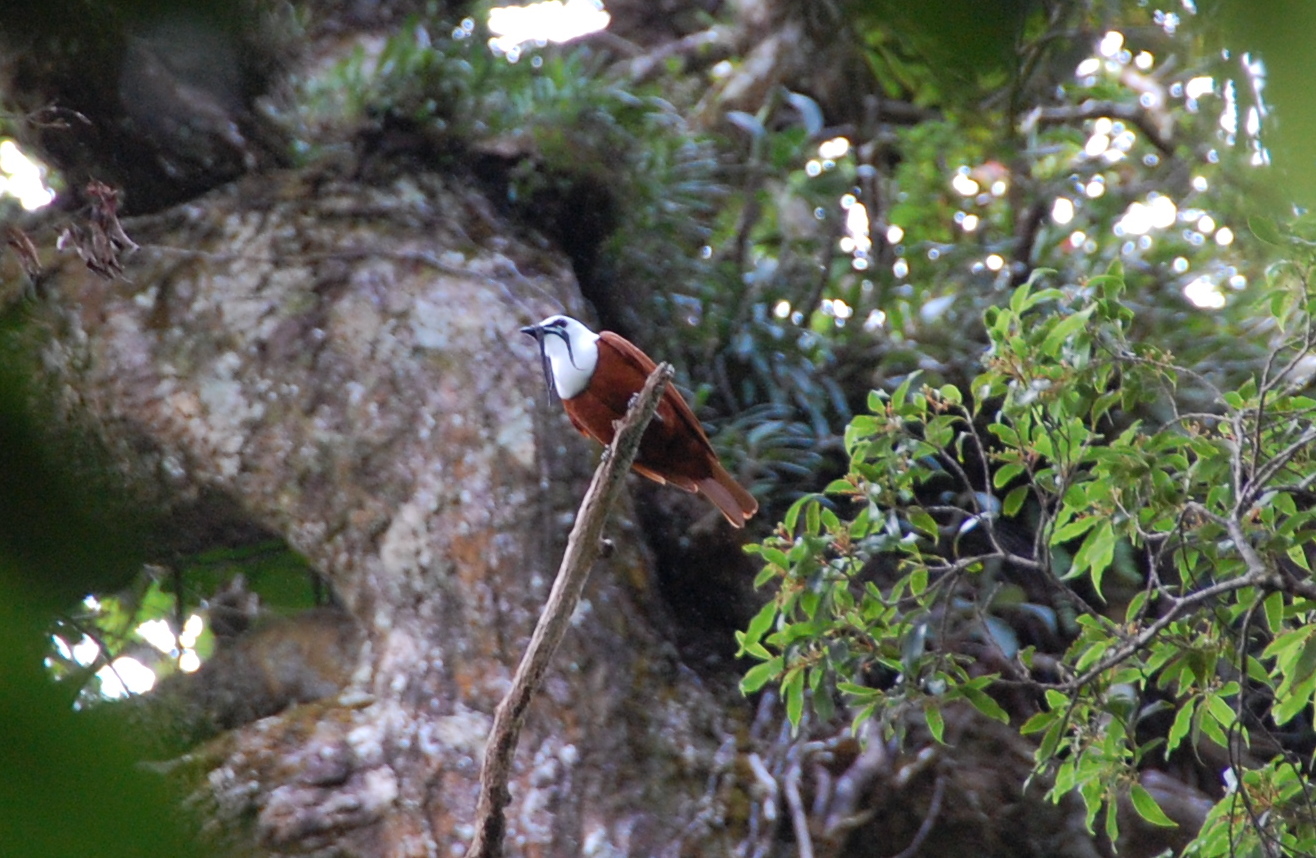
The Lauraceae family is the backbone of frugivore nutrition in Central American cloud forests. Studies in Monteverde have found that laurel family fruits make up 60 to 80 percent of all fruits consumed by Resplendent Quetzals and Three-wattled Bellbirds. With at least 96 Lauraceae species across Monteverde's five life zones, these birds must track fruiting across the landscape, moving between elevations as different species come into fruit.
The ira's late dry season fruiting (March and April) is ecologically strategic. This timing provides food when many other species have finished fruiting, filling a gap in the annual fruit calendar. Quetzals, bellbirds, emerald toucanets, black guans, and mountain robins all consume Lauraceae fruits, swallowing them whole and later regurgitating the seeds.
A Tangled Taxonomy
The scientific history of Ocotea insularis reflects the challenges of tropical plant taxonomy. The species was first described as Phoebe insularis by Meissner in 1864, based on Menzies's collection from Cocos Island. In 1889, Mez transferred it to Ocotea. But the story does not end there. In 1986, Rohwer proposed lumping numerous species into O. insularis, including O. ira (the source of the Costa Rican common name), O. floccifera, and several Aiouea species. Later taxonomists have recognized some of these as distinct, and the boundaries of the species remain debated.
The common name "ira" persists from Ocotea ira Mez & Pittier, described from specimens collected near Juan Viñas and Santa Clara at 200-1,200 meters elevation, where local people called the tree "jra" or "ira." Whether this represents a distinct species or simply a population of O. insularis remains an open question. For now, most authorities treat them as synonyms, but future molecular studies may clarify the relationship.
Resources & Further Reading
Species Information
Authoritative taxonomic information including synonyms, distribution, and type specimen data.
Species profile from the Osa Peninsula arboretum.
Observations and photographs from across the species range.
Cocos Island Ecology
Long-term forest monitoring study with growth rate data for O. insularis on Cocos Island.
Dendrochronological study evaluating the climate record potential of Cocos Island trees including O. insularis.
Lauraceae and Frugivore Ecology
Classic study on how Three-wattled Bellbirds disperse Ocotea seeds to favorable microsites in Monteverde.
Accessible overview of the relationship between Lauraceae trees and frugivorous birds in Costa Rica.
Forestry Potential
Review of the botanical, ecological, and silvicultural characteristics highlighting the species' reforestation potential in Ecuador.