Indio Desnudo
Bursera simaruba — The "naked Indian" tree, named for its peeling copper-red bark that resembles sunburned skin. A member of the frankincense family, it was sacred to the Maya and remains one of Costa Rica's most recognizable dry forest trees.
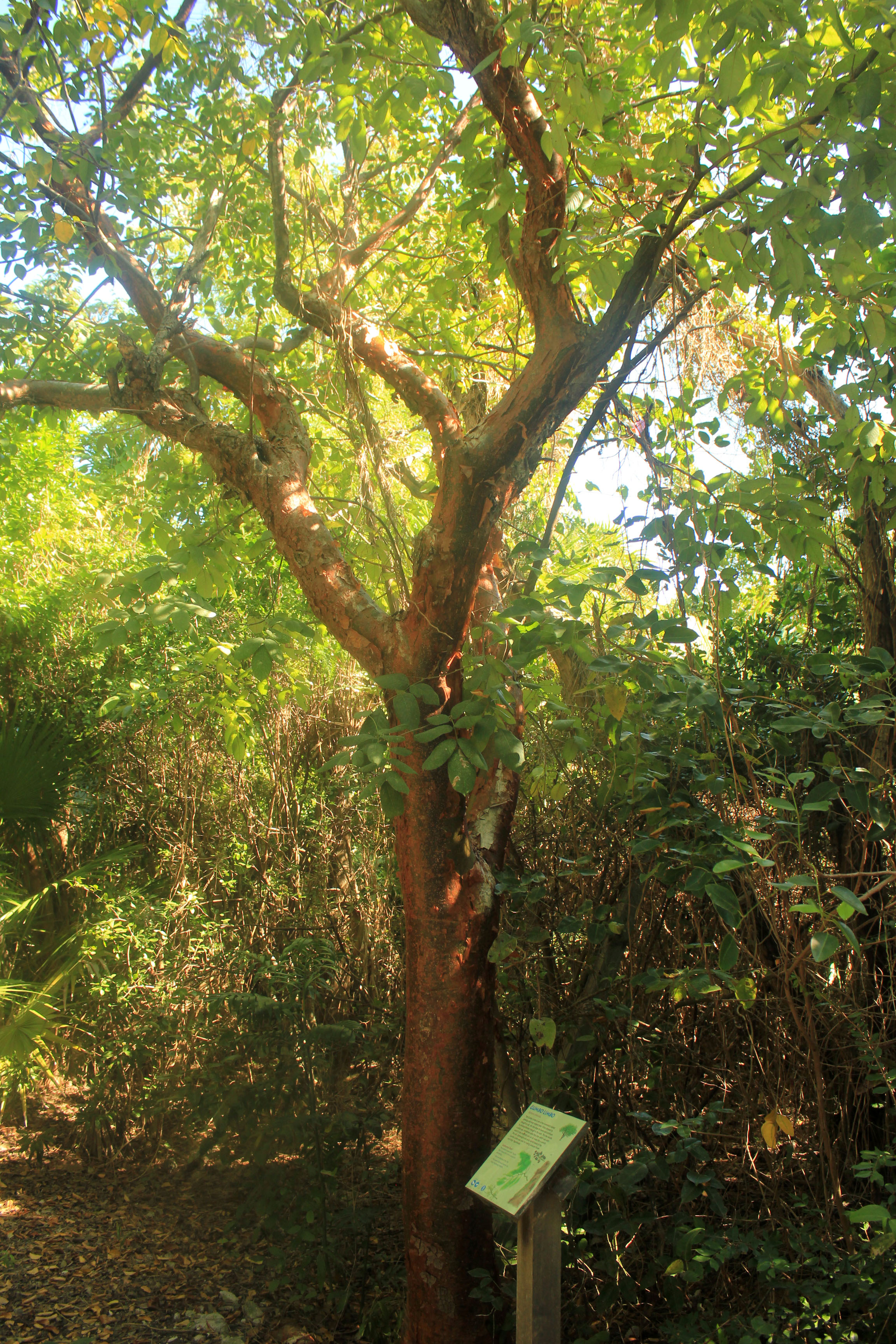
Along forest edges and roadsides throughout the Brunca region, one tree catches the eye like no other: the indio desnudo. Its smooth, copper-red bark peels away in thin papery sheets, revealing a jade-green inner layer beneath. The effect is so striking that visitors sometimes mistake it for painted wood or some tropical artifice. While this species reaches its greatest abundance in Guanacaste's dry forests to the north, it adapts to a wide range of conditions and occurs in dry, humid, and very humid forests alike. This living sculpture belongs to the same botanical family that gave the ancient world frankincense and myrrh.
The name "indio desnudo" translates to "naked Indian," a reference to the tree's burnished, skin-like bark. In English-speaking regions, it goes by equally evocative names: "tourist tree" in Florida (because it's red and peeling, like sunburned visitors) and "gumbo limbo" in the Caribbean. The Maya called it chaca and considered it sacred, using its aromatic resin for incense in ceremonies that still echo through Mesoamerican tradition.
Identification
The Burseraceae family is known as the frankincense and myrrh family, comprising about 700 species of resinous trees and shrubs. While the famous incense-producing species grow in Africa and Arabia, the New World Burseraceae evolved their own aromatic traditions. The genus name Bursera honors Joachim Burser, a 17th-century German botanist, while simaruba derives from a Caribbean indigenous name.
Physical Characteristics
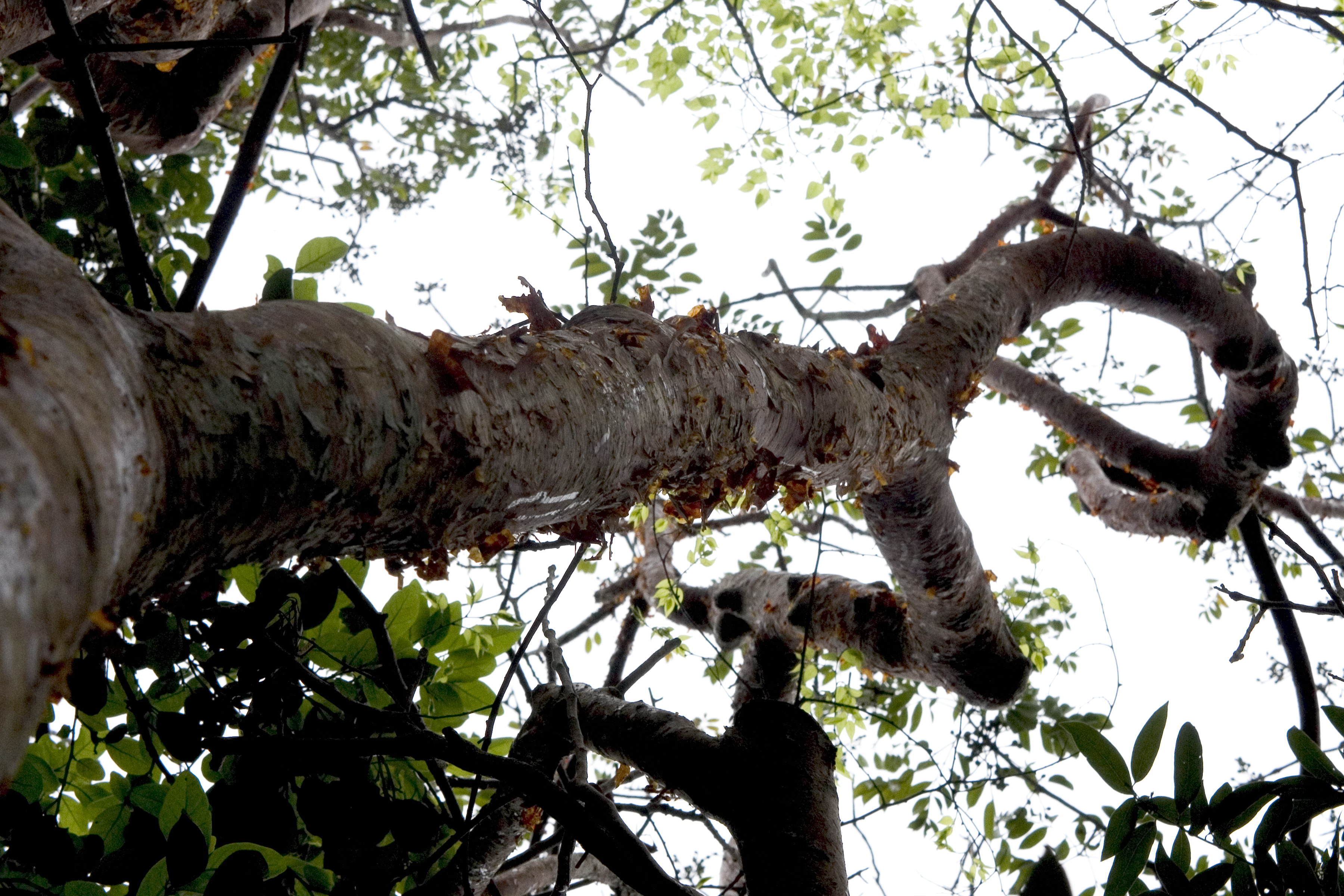
Trunk: The bark is the tree's most distinctive feature. The outer layer is smooth, reddish-copper to bronze, and peels away in tissue-thin, papery sheets. Beneath lies a waxy, bright green layer capable of photosynthesis. When cut, the bark exudes a gray-white aromatic resin with a turpentine-like scent. Mature trunks can reach 1 meter in diameter.
Leaves: Pinnately compound, 15-20 cm long, with 5-7 (occasionally 3-9) oval leaflets. The leaves have an alternate arrangement and drop during the dry season, making the tree semi-deciduous. New leaves emerge pale green in April, anticipating the rainy season.
Flowers: Small and inconspicuous, greenish-white to cream colored, borne in clusters at branch tips. The tree is dioecious, with male and female flowers on separate individuals. Flowers appear from January to April and attract bees and butterflies with their subtle fragrance.
Fruit: A small three-valved capsule, 8-12 mm in diameter, that splits at maturity to reveal a single seed covered in a red, fatty aril. The fruit ripens from March to May, providing an important food source for birds during the dry season.
Habitat & Distribution
The indio desnudo ranges from southern Florida and the Caribbean through Mexico and Central America to northern South America. In Costa Rica, it is most abundant in the dry forests of Guanacaste but occurs throughout the Pacific slopes, including the Osa Peninsula and Golfo Dulce region. The Vascular Plants of the Osa Peninsula project documents the species at Los Charcos de Osa, and iNaturalist records confirm its presence near Puerto Jiménez. It grows from sea level to about 1,000 meters elevation.
Ecosystem: Tropical dry forest, secondary forests, forest edges, pastures, and coastal areas. The tree thrives in seasonally dry conditions with 1,000-2,500 mm of annual rainfall and a pronounced dry season of 4-6 months.
Succession stage: Pioneer species. The indio desnudo is among the first trees to colonize disturbed areas and abandoned pastures. Its rapid growth and tolerance of poor soils make it ideal for early-succession restoration.
Abundance: Common. Unlike many tropical hardwoods, the indio desnudo remains abundant throughout its range, thanks to its adaptability and widespread use in living fences.
Ecological Importance
Despite its relatively modest size, the indio desnudo plays an outsized role in dry forest ecology. Its flowers provide nectar for bees and butterflies during the dry season when few other trees bloom. The lipid-rich fruits feed a variety of birds that disperse seeds throughout the landscape. And its rapid growth rate makes it a critical pioneer species in forest regeneration.
Wildlife Interactions
Birds are the primary consumers of indio desnudo fruits. Parrots, toucans, and various songbirds feed on the red arils, inadvertently dispersing the seeds. The tree also hosts the dingy purplewing butterfly (Eunica monima), whose caterpillars feed on the leaves. The shallow, extensive root system provides shelter for small mammals and reptiles.
The tree's extensive surface root system serves an important ecological function beyond wildlife habitat. These roots stabilize soil and prevent erosion on rocky slopes and degraded lands where few other trees can grow. This makes the indio desnudo particularly valuable in watershed protection and hillside restoration projects.
Traditional Uses
For the ancient Maya, the indio desnudo was both sacred and medicinal. They burned its aromatic resin as incense in religious ceremonies, a tradition that continues in some Mesoamerican communities today. Maya legend tells of two brothers, one reborn as the poisonous chechen tree and the other as the healing chaca (indio desnudo), which neutralizes the chechen's venom. The trees often grow together, and indigenous healers use the indio desnudo bark to treat chechen-caused skin irritation.
The tree's remarkable ability to propagate from cuttings has made it one of the most important "living fence post" species in Latin America. Farmers simply cut branches, stick them in the ground, and they sprout into new trees. These living fences serve as property boundaries, provide shade for cattle, and create wildlife corridors connecting forest fragments. A landscape of living fences can maintain surprisingly high biodiversity even in agricultural areas.
Conservation Status
Unlike many tropical trees featured in this series, the indio desnudo is not threatened. Its adaptability, rapid growth, and widespread use in living fences have ensured its continued abundance. The IUCN lists it as Least Concern. However, the dry forests where it is most abundant have themselves become one of the most threatened ecosystems in Central America, with less than 2% of original cover remaining in many areas.
The tree's value for restoration lies precisely in its toughness. On degraded lands where slow-growing hardwoods would struggle, the indio desnudo establishes quickly, stabilizes soil, and provides shade that allows later-successional species to establish beneath it. Reforestation projects throughout Costa Rica's Pacific slope use it as one of their primary pioneer species.
Key Sources & Resources
Species Information
-
Bursera simaruba. Trees of Costa Rica's Pacific Slope.
Detailed species account with photographs and distribution information for Costa Rica.
-
Bursera simaruba. Useful Tropical Plants Database.
Botanical information including uses, wood characteristics, and medicinal properties.
-
Bursera simaruba. Área de Conservación Guanacaste.
Species profile from Costa Rica's Guanacaste Conservation Area dry forest virtual guide.
Ecology & Conservation
-
Tree of the Month: Nude Indian. Titi Conservation Alliance.
Conservation perspective on the indio desnudo from Costa Rica's Pacific coast.
-
Bursera simaruba: Gumbo limbo. University of Florida IFAS Extension.
Detailed fact sheet covering identification, cultivation, and ecological characteristics.
Traditional Knowledge
-
Bursera simaruba. Wikipedia.
Overview of traditional uses, etymology, and cultural significance across the Americas.
-
Burseraceae. Wikipedia.
Family overview explaining the connection to frankincense and myrrh.