Twin-flowered Hernandia
A rare lowland rainforest tree whose fruits hide inside leathery cups, named for its paired flowers and collected by a Swiss geographer on Costa Rica's wild Caribbean coast.
Sometime in the late 1890s, the Swiss geographer Henri Pittier stood at Punta Mona, a headland on Costa Rica's southern Caribbean coast where lowland rainforest presses against the sea. Pittier had arrived in Costa Rica in 1887 to direct the newly created Physical Geographic Institute, and over the following decade he and his colleague Adolphe Tonduz methodically catalogued the country's flora, amassing some 18,000 specimens. Among the trees at Punta Mona, Pittier collected a Hernandia with oblong leaves and unusually paired flowers. He pressed it as number 12682 and sent duplicates to the United States and Geneva. The specimen sat unstudied until John Donnell Smith, a retired Baltimore lawyer who had reinvented himself as Central America's foremost armchair botanist, recognized it as new. In the February 1901 issue of the Botanical Gazette, Smith named it Hernandia didymantha, the "twin-flowered hernandia," for the two-flowered clusters that distinguish it from every other species in the genus.
More than a century later, H. didymantha remains one of the least known trees in the Central American lowlands. It belongs to the Hernandiaceae, a small pantropical family whose deep Gondwanan origins trace back over 120 million years and whose members produce a striking fruit structure: a fleshy drupe nearly enclosed inside a leathery cup, like a lantern with its opening almost sealed shut. The family also harbors an unusual wealth of bioactive alkaloids, some of which have yielded precursors to modern anticancer drugs. In Costa Rica, the only other species in the genus is H. stenura, which is more frequently collected, and the Flora Costaricensis (1990) raised the possibility that the two may be growth forms of one variable species rather than distinct taxa. Whether H. didymantha is genuinely rare or simply overlooked remains an open question.
Identification
Habit
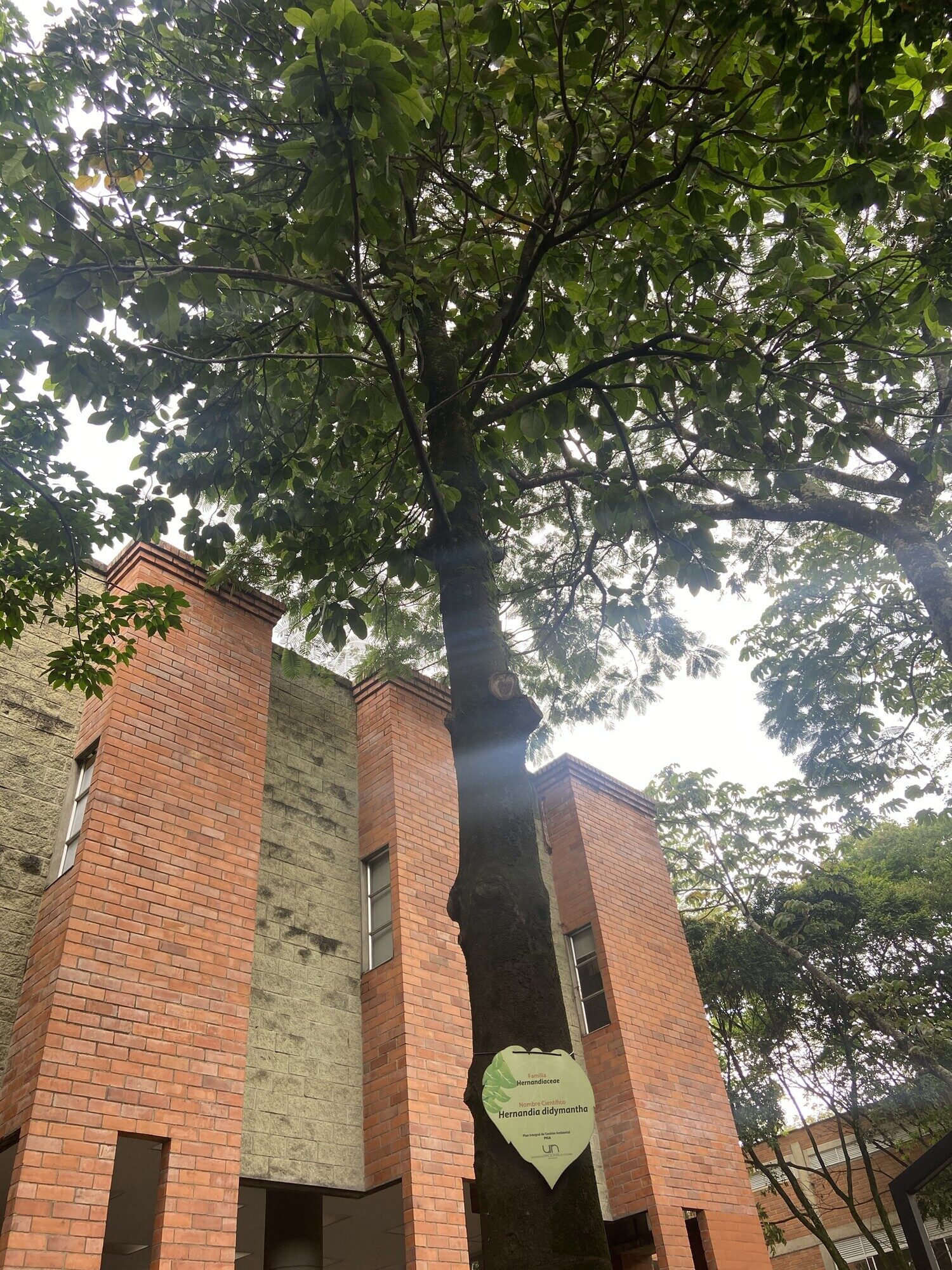
Hernandia didymantha is an evergreen tree reaching over 15 m in height, with some individuals in Panama recorded at 10 to 25 m. The lower branches descend noticeably, giving the crown a layered, somewhat drooping silhouette. Stems are thick with soft, lightweight wood, gray on the exterior. The wood is so light that in related species it has been compared to balsa and used as a substitute in local construction for boxes, crates, matchsticks, and plywood cores. This combination of soft wood, thick stems, and rapid growth suggests a mid-canopy species that exploits light gaps within mature wet forest, though it does not appear to be a primary colonizer of open ground. The bark of the closely related H. stenura is gray and lenticellate (dotted with small raised pores), with smooth inner bark that carries a faint cinnamon scent, and H. didymantha likely shares these characteristics.
Leaves
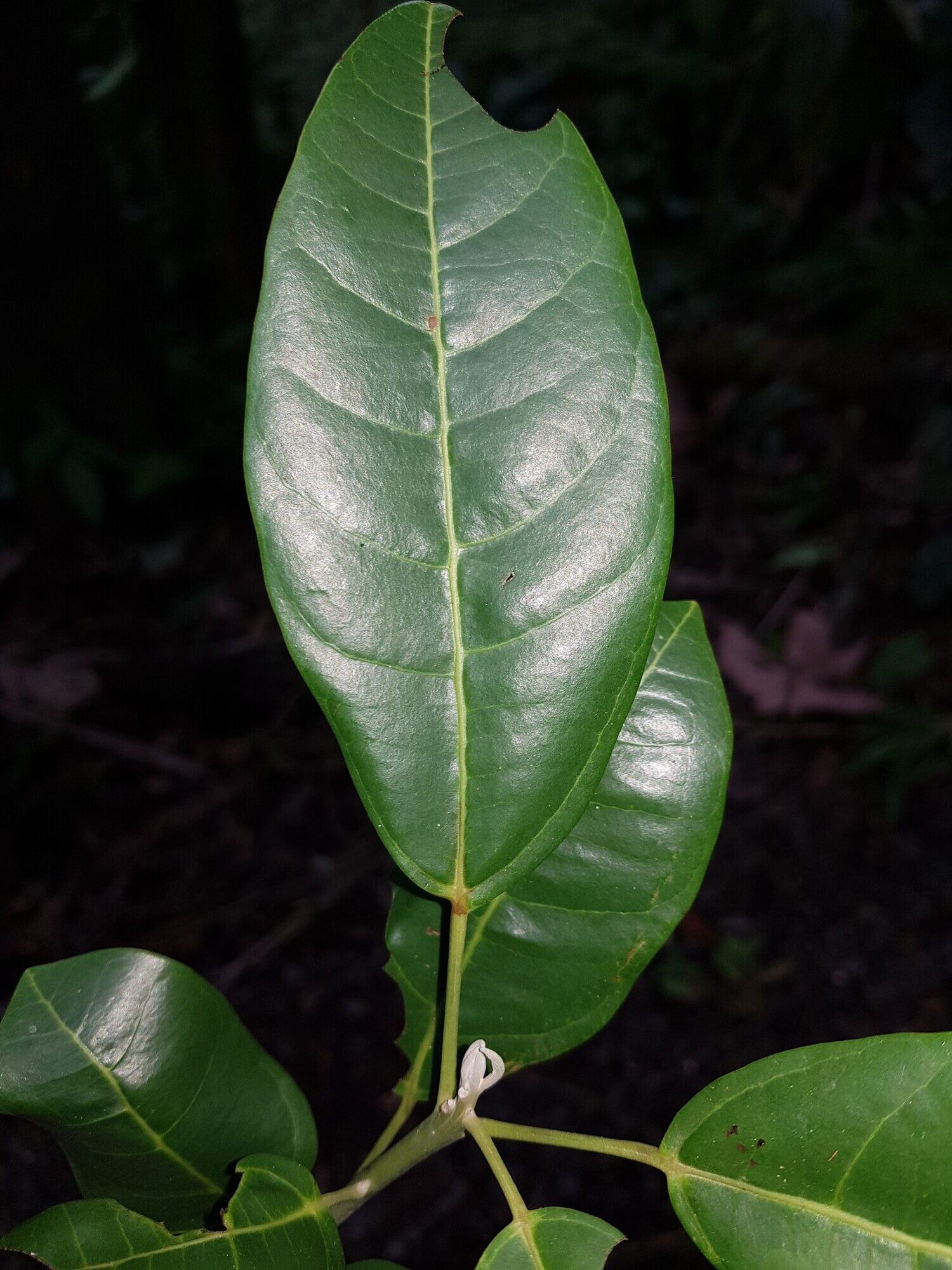
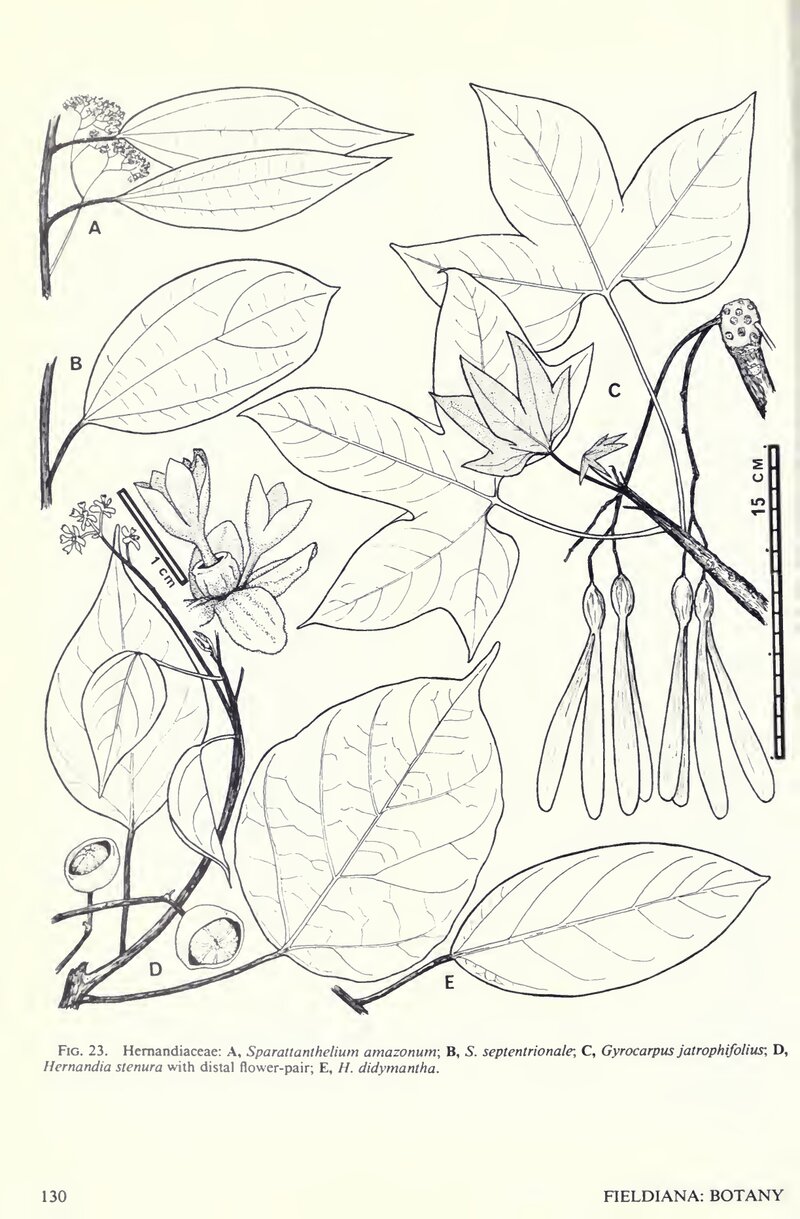
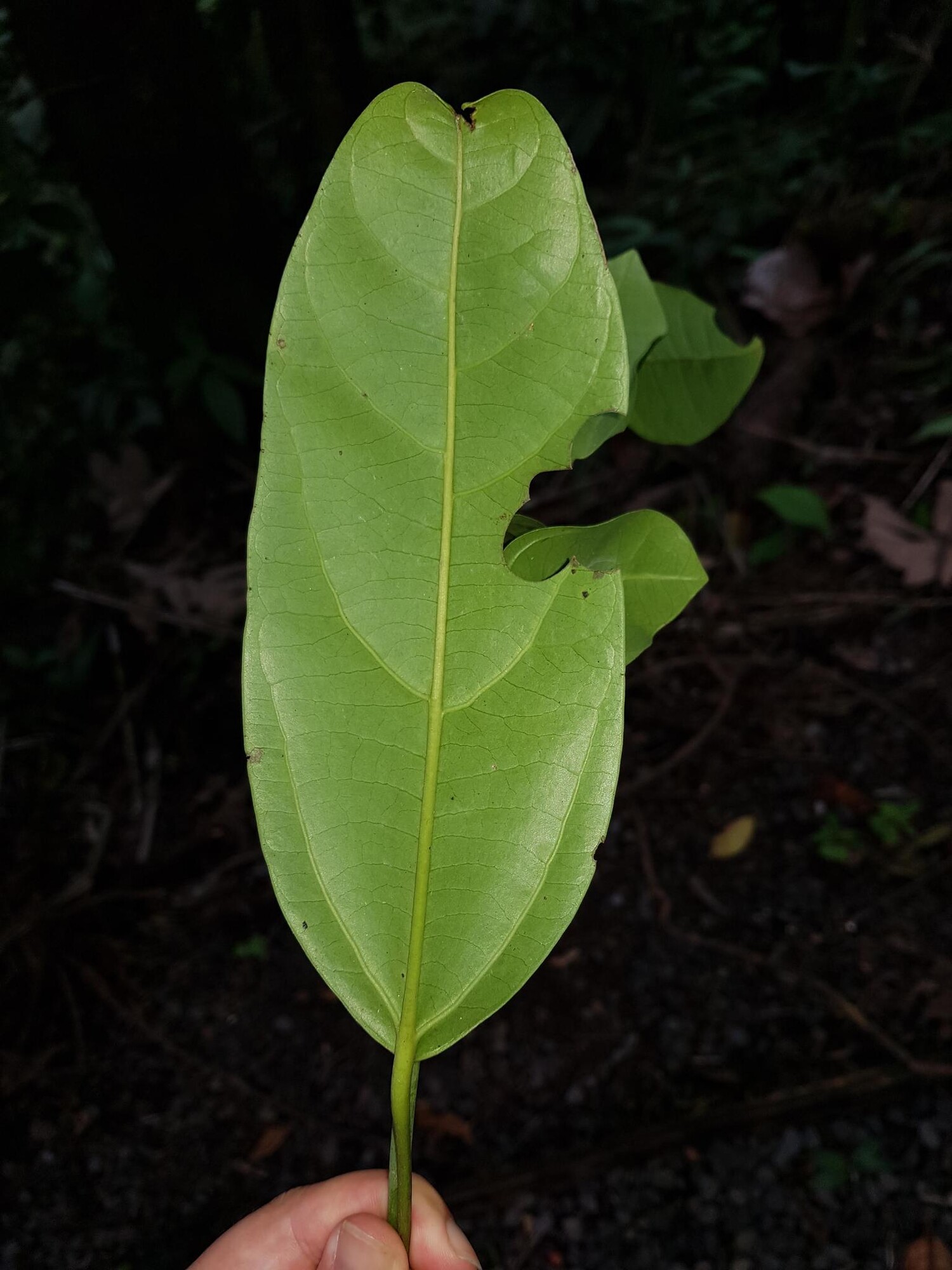
The leaves are simple, alternate, and unlobed, borne on petioles (1.5-)3 to 7(-9) cm long that are channeled on the upper surface (canaliculate) and swollen at the base (pulvinate). The blade measures 9 to 18(-21) cm long and 3.5 to 7 cm broad, oblong to ovate-oblong or slightly obovate in shape, bluntly acute to short-acuminate at the apex and obtuse or rounded at the base. Margins are entire and the texture dries subcoriaceous (somewhat leathery). Both surfaces are glabrous (hairless). The most diagnostic leaf character is the venation: pinnate, with (4-)6 to 8 pairs of major secondary veins in which the basal pair is no more prominent than the distal ones. This separates H. didymantha from its congener H. stenura, whose leaves have subpalmate venation with strongly developed basal secondary veins, broader blades (up to 18 cm wide), and often abruptly long-acuminate tips. The Flora Costaricensis noted that Hernandia species produce leaves in "flushes" of new growth, and that conditions during the flush may determine leaf size and shape, potentially accounting for much of the variation within and between collections.
Flowers
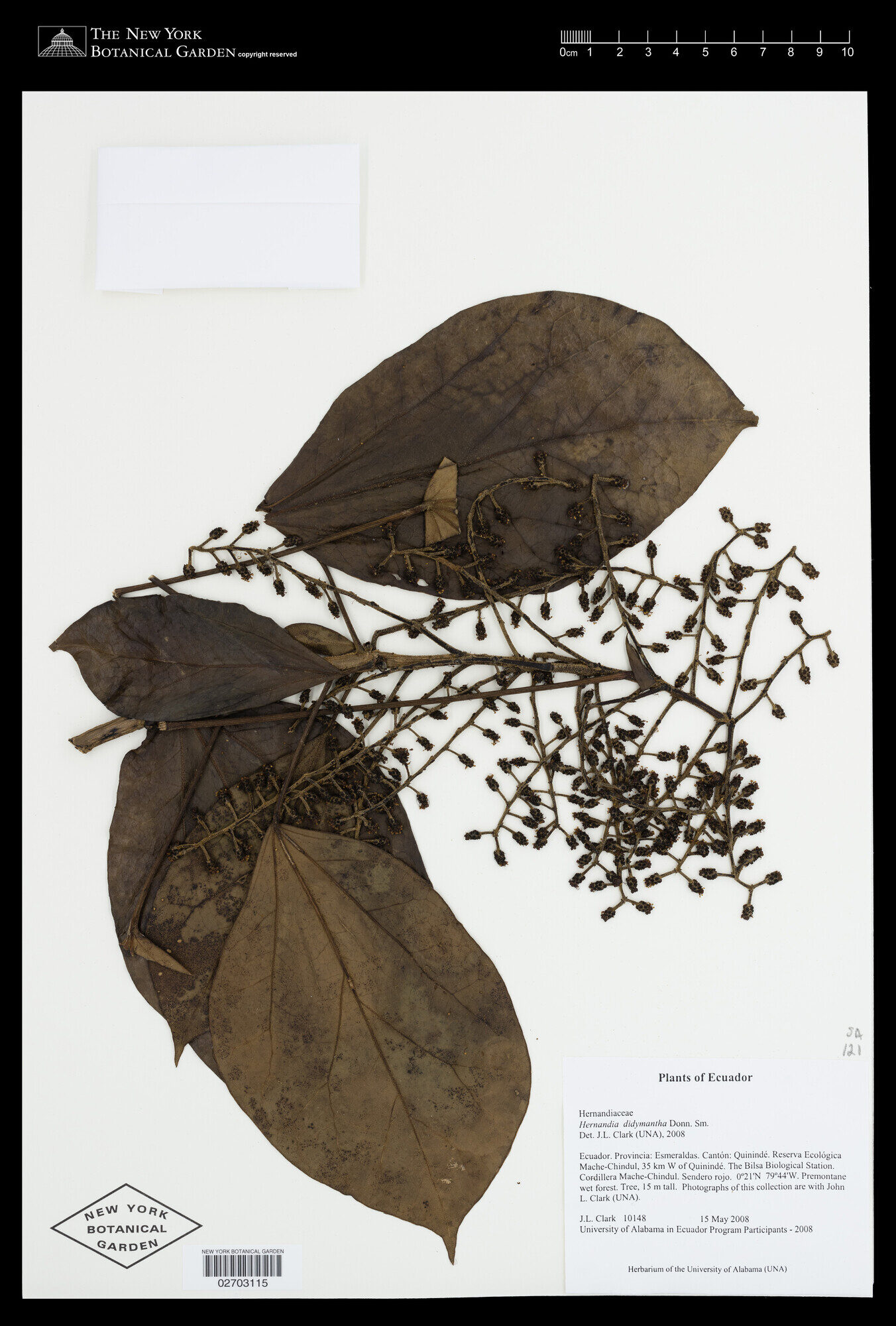
The species is monoecious, bearing both male and female flowers on the same tree. Inflorescences are terminal or axillary panicles, their distal clusters subtended by a whorl of four sepaloid bracts approximately 8 mm long and 3.5 mm broad that become reflexed at maturity. Each cluster typically contains only two flowers, the character that gives the species its name and its most reliable field distinction from H. stenura, which usually bears three-flowered clusters. The single male flower sits on a relatively long pedicel (about 5 mm), with its parts arranged in whorls of three: three outer perianth segments, three inner ones, and three stamens whose anthers open by hinged flaps rather than lengthwise slits. The female flower is solitary, very short-stalked, and four-parted, with four stipitate glands (small stalked structures) at the base of the style. Flowers are greenish-yellow, and in H. stenura the inflorescences are described as sweet-scented. Costa Rican flowering collections come from January through April and November, while STRI records from Panama indicate flowering from May to September, perhaps suggesting near year-round bloom across the species' range.
Fruits
The fruit is the most distinctive structure in any Hernandia. It is a subglobose drupe, 1.8 to 2.5 cm in diameter, conical at the apex, that matures from green to black. What makes it distinctive is the enclosing cupule (cup-like structure): a coriaceous (leathery) receptacle 2 to 3 cm in diameter that nearly surrounds the fruit, leaving only a narrow distal opening 3 to 6 mm wide. A fruiting collection by Gary Hartshorn from La Virgen de Sarapiqui (Hartshorn 1281) in August shows this structure particularly well, with the fruits almost entirely enclosed. The overall effect resembles a small lantern or balloon. At Cahuita National Park, the fruiting season runs from September to November. The black drupes inside their fleshy cupules are consistent with animal dispersal, likely by birds or bats, though no specific dispersal agents have been documented for this species. In the related coastal species H. nymphaeifolia, Marianas flying foxes eat the fruits and ocean currents carry the buoyant drupes across Pacific islands. For the inland H. didymantha, frugivorous birds are the more probable vector.
Herbarium Specimens
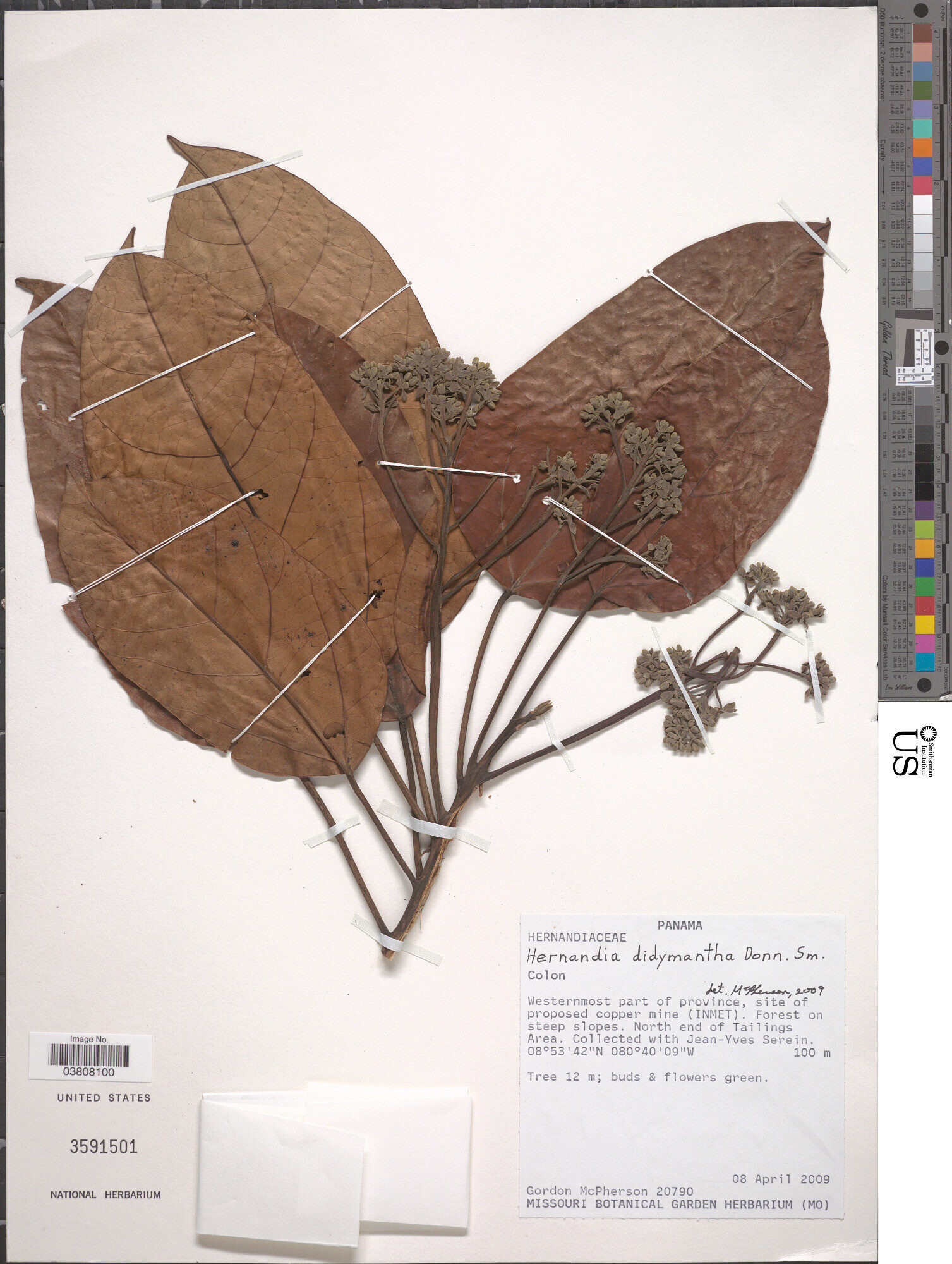
Distribution
Hernandia didymantha ranges from Chiapas in southern Mexico through Guatemala, Honduras, Nicaragua, Costa Rica, and Panama into Colombia and Ecuador. GBIF holds 336 records across 10 countries, with Costa Rica accounting for 40% (135 records), followed by Colombia (68), Panama (60), and Ecuador (42). The remaining records are scattered across Nicaragua (12), Mexico (7), Honduras (4), and Guatemala (1). The elevation range spans from near sea level (4 m) to 1,200 m, though the great majority of collections come from below 500 m. It is strictly a tree of lowland evergreen wet forest and very wet forest formations.
Within Costa Rica, the species occurs on both the Caribbean and Pacific slopes. The densest cluster of records comes from Heredia province, where 41 localities center on La Selva Biological Station and the Sarapiqui lowlands. Key collections from La Selva include those by Barry Hammel (Hammel 11656), Gary Hartshorn (Hartshorn 802, 1026), and Tim McDowell (McDowell 606). On the Caribbean coast, it occurs at Cahuita National Park (documented in the park's florula by P.E. Sanchez in 1983), Parque Nacional Barbilla, and near Manzanillo, close to the type locality of Punta Mona. On the Pacific side, the Brunca region holds 16 known localities: Corcovado National Park (Sendero Espaveles, Laguna Sirena, the confluence of the Sirena and Pavo rivers), Piedras Blancas National Park (the trail from La Gamba to Valle Bonito), the Reserva Forestal Golfo Dulce around Rincon de Osa, and the Refugio de Vida Silvestre Golfito. Paul H. Allen collected it in the Golfo Dulce region (Allen 598), and Q. Jimenez documented it in the same area (Jimenez 644). Outlying records extend to Alajuela (Boca Tapada, the Alberto Manuel Brenes Biological Reserve at 1,150 m), Cartago (Parque Nacional Barbilla at 850 m), and San Jose (Mastatal de Puriscal at 300 m). Collection years span from 1898 to 2016, with 64 unique collectors contributing records.
Ecology
In Panama, the Smithsonian Tropical Research Institute records bees, wasps, and butterflies as pollinators of H. didymantha. The sweet scent of the inflorescences (documented for H. stenura) is consistent with insect pollination, and the small greenish-yellow flowers with accessible nectar reward a generalist suite of visitors. The genus Hernandia exhibits a reproductive mechanism called heterodichogamy: individual trees function as either protogynous (female-first) or protandrous (male-first), with the two types occurring at a roughly 1:1 ratio in the population. This synchronized, reciprocal flowering ensures outcrossing between individuals and represents an evolutionary link between the bisexual-flowered heterodichogamy of the closely related Lauraceae and the unisexual-flowered system of the Hernandiaceae.
The connection between Hernandia and swallowtail butterflies (Papilionidae) is one of the more intriguing ecological relationships in the Laurales. Swallowtail caterpillars feed on plants in the Lauraceae, Annonaceae, and Hernandiaceae, families linked by shared defensive chemistry. In Costa Rica, caterpillars of the swallowtail Pterourus menatius vulneratus have been documented feeding on H. stenura. In Jamaica, the relationship is more dramatic: the endangered giant swallowtail Papilio homerus, the largest butterfly in the Western Hemisphere, depends entirely on endemic Hernandia species as larval host plants. The eastern population feeds on H. catalpifolia and the western on H. jamaicensis. Whether H. didymantha serves as a host for swallowtails in Central America has not been confirmed, but the phylogenetic pattern suggests it is likely.
Chemistry
No phytochemical studies have been conducted on H. didymantha specifically, but the Hernandiaceae as a family is remarkably rich in bioactive compounds. A 2025 review by Wang and colleagues documented more than 270 natural products from the family, including 128 alkaloids of 17 structural types, dominated by aporphines and bisbenzylisoquinolines. The genus Hernandia is particularly notable for its lignans: seeds of the related H. sonora yield podophyllotoxin and its analogs, compounds that serve as precursors to the anticancer drugs etoposide, which is on the World Health Organization's List of Essential Medicines, and teniposide. Hernandonine, an aporphine alkaloid found across multiple Hernandia species, shows significant cytotoxic activity against several cancer cell lines. In Madagascar, the critically endangered H. voyronii produces hervelines, dimeric alkaloids with antimalarial activity that local healers use as an adjuvant to chloroquine. Whether H. didymantha harbors similar compounds awaits investigation.
Uses
In Panama, where the tree is known as "zopilote" (a word that primarily refers to the black vulture, Coragyps atratus, perhaps alluding to the tree's black fruits), the bark is traditionally prepared as a remedy for snakebites. This use is recorded in STRI databases, though it does not appear in systematic reviews of Central American antivenin plants, suggesting the practice may be localized. In El Salvador and Nicaragua, Hernandia species go by "volador" (flyer), "volatin" (tumbler), and "caballitos" (little horses), names whose origins are unclear but may relate to the inflated fruiting cupules that catch the wind. The wood of H. didymantha is used for boxes, crates, matchsticks, plywood, and paper pulp. Grayish-white with faint olive streaks, it is very lightweight and easy to work with sharp tools, though not durable. In the broader genus, bark and seeds have mild purgative properties, leaf juice serves as a painless depilatory, and the oily seeds can be burned as makeshift candles.
Taxonomic History
John Donnell Smith (1829-1928) described Hernandia didymantha in the Botanical Gazette 31(2): 120-121, published 23 February 1901, as part of installment XXII of his long-running series "Undescribed Plants from Guatemala and Other Central American Republics." Smith was an unlikely botanist. Born in Baltimore to a prominent Maryland family, he graduated from Yale in 1847, practiced law, fought as a Confederate artillery officer (he was wounded during the war), and spent decades in business before turning to tropical botany in the 1880s. He never became a field collector in the conventional sense. Instead, he built relationships with collectors across Central America, among them Henri Pittier, and described new species from specimens shipped to his Baltimore home. Over three decades he published 39 installments of Central American plant descriptions, amassing a herbarium of over 100,000 specimens and a botanical library of 1,600 volumes, both of which he donated to the Smithsonian Institution in 1905.
The type specimen, Pittier 12682, was collected at Punta Mona on the southern Caribbean coast of Limon Province. The holotype is deposited at CR (the Costa Rica National Herbarium), with isotypes at US (three sheets: US-931667, US-931668, US-931666) and G (Geneva). Henri Francois Pittier (1857-1950) was a Swiss-born scientist who moved to Costa Rica in 1887 and founded the country's Physical Geographic Institute. He collected plants systematically across Costa Rica before departing for the United States at the end of 1904 to join the USDA. By the time he left, he and Tonduz had assembled 18,000 specimens. Pittier's legacy endures in Costa Rica: the national park bearing his name protects Caribbean mangroves and rainforest in the same province where he collected the type of H. didymantha.
The species epithet "didymantha" derives from Greek didymos (twin) and anthos (flower), referring to the characteristically two-flowered partial inflorescences. The genus name "Hernandia" was established by Charles Plumier in 1703, in his Nova Plantarum Americanarum Genera, honoring Francisco Hernandez de Toledo (c. 1515-1587). Hernandez was a Spanish court physician to Philip II who led the first major scientific expedition to the New World between 1570 and 1577, during which he documented approximately 3,000 plant species in Mexico. His original manuscripts were largely destroyed in a fire at the Escorial library in 1671 and had to be reconstructed from copies and summaries. Linnaeus accepted Plumier's genus in 1753. The major modern revision of the family is Kubitzki's 1969 "Monographie der Hernandiaceen."
The species has no synonyms and has been taxonomically stable since its description. This stability is unusual for a tropical tree described over a century ago, but it reflects how few specimens were available for comparison. The more significant taxonomic question, raised by William Burger in the Flora Costaricensis (1990), is whether H. didymantha, H. stenura Standl. (1938), and H. hammelii D'Arcy (1981) are truly separate species or represent growth forms of a single variable taxon. Burger noted that leaf size varies considerably even on the same branch, that conditions during leaf flushes may determine leaf dimensions, and that H. hammelii from Panama may be nothing more than a small-leaved growth form. If future molecular work collapses these species, H. didymantha, as the earliest name, would take priority. As of 2025, all three remain accepted by Plants of the World Online.
Similar Species
In Costa Rica, the only congener is Hernandia stenura Standl., and the two require care to distinguish. The most reliable vegetative character is leaf venation: H. didymantha has pinnate venation with the basal secondaries no more prominent than the rest, while H. stenura has subpalmate venation with strongly developed basal secondary veins. H. stenura also differs in its broader leaves (7 to 18 cm wide vs. 3.5 to 7 cm), abruptly long-acuminate tips (vs. short-acuminate to acute), and leaves that are sometimes peltate (the petiole attaching up to 1 cm from the blade margin). In flower, the two-flowered clusters of H. didymantha contrast with the typically three-flowered clusters of H. stenura. H. stenura also grows taller (over 25 m vs. over 15 m for H. didymantha). In Panama, H. didymantha can be confused with Dendropanax arboreus (Araliaceae), which shares variable petioles and similar stature, but the fruits of Dendropanax are smaller and lack the distinctive basal cupule.
Biogeography
The Hernandiaceae is a small family of about 60 species in four to five genera, scattered across the tropics in a pattern that initially suggested ancient Gondwanan origins. Molecular clock analysis by Michalak and colleagues estimated the family's crown age at approximately 122 million years (110 to 134 Ma), and its deepest split separates a predominantly African-Madagascan-Malesian lineage from an African-Neotropical one. The pantropical distribution, however, owes more to Oligocene and Miocene transoceanic dispersal than to continental drift. Hernandia itself shows a trans-Pacific disjunction, with molecular evidence supporting dispersal from tropical Australia to the Neotropics during the Miocene. This means that the Neotropical species, including H. didymantha, are relatively recent arrivals rather than Gondwanan relicts. The genus comprises 26 accepted species and is best represented in the southwestern Pacific and the West Indies, with only a handful of species in continental Central and South America.
Conservation Outlook
Hernandia didymantha is classified as Least Concern by the IUCN, a designation that reflects its broad range rather than local abundance. The Flora Costaricensis described it as "rarely collected" in 1990, and three and a half decades later it remains poorly known, with only eight iNaturalist observations and 336 GBIF records spread thinly across its range. Its dependence on intact lowland evergreen wet forest makes it vulnerable to the ongoing conversion of these habitats. Lowland tropical wet forest is among the most threatened forest types in Central America, subject to agricultural expansion, cattle ranching, and infrastructure development.
The species does occur in several well-protected areas: La Selva Biological Station (Sarapiqui), Cahuita National Park (Caribbean coast), Corcovado National Park, Piedras Blancas National Park, and the Golfo Dulce Forest Reserve in the Brunca region. The Punta Mona area, where the type was collected, lies near the Gandoca-Manzanillo Wildlife Refuge. These protected populations provide some insurance, though the species' natural rarity and low population density mean that even localized disturbances could eliminate populations. No population estimates exist, no molecular phylogenetic study has placed H. didymantha within the genus with precision, and no conservation management plan addresses the species directly. It remains one of many Neotropical trees that are technically protected by virtue of occurring inside parks, yet whose actual population status and trajectory are unknown.
Resources & Further Reading
Taxonomy & Nomenclature
Nomenclatural data, type specimens, and publication details from the Missouri Botanical Garden.
Plants of the World Online entry with accepted name, distribution, and conservation status.
Biographical sketch and specimen records of the Baltimore botanist who described H. didymantha.
The work in which Charles Plumier established the genus Hernandia, honoring Francisco Hernandez de Toledo.
Species Information
Global occurrence records (336+), specimen images, and distribution maps.
Species account with habitat, pollinators, uses, and field observations from the Smithsonian Tropical Research Institute.
Community observations with photographs and distribution records.
Species account for the closely related H. stenura, including common names, swallowtail butterfly associations, and Costa Rica distribution.
Burger (1990). Fieldiana Botany n.s. no. 23, pp. 131-145. Field Museum. The key, description, and discussion of Costa Rican Hernandia species.
Scientific Literature
The first comprehensive review of Hernandiaceae chemistry, documenting 270+ natural products. Chemistry & Biodiversity.
Molecular phylogeography showing Oligocene-Miocene transoceanic dispersal rather than pure Gondwanan vicariance.
Discusses the evolution of heterodichogamy in Laurales, including the transition from bisexual to unisexual flowers in Hernandiaceae.
Documents the dependence of the Western Hemisphere's largest butterfly on endemic Hernandia species as larval hosts.
Isolation of podophyllotoxin and related lignans, precursors to the anticancer drugs etoposide and teniposide.
Related Reading
Biography of the Swiss geographer-botanist who collected the type specimen at Punta Mona in the late 1890s.
The Spanish naturalist honored in the genus name, who led the first scientific expedition to the New World (1570-1577).
Wikipedia article with range and basic taxonomic information.
Detailed species account for the related H. sonora, with information on wood properties, traditional uses, and chemistry applicable to the genus.