Guanacaste
Enterolobium cyclocarpum — Costa Rica's national tree, an iconic shade giant of the dry tropics whose ear-shaped pods once fed Pleistocene megafauna and now symbolize an entire province and nation.
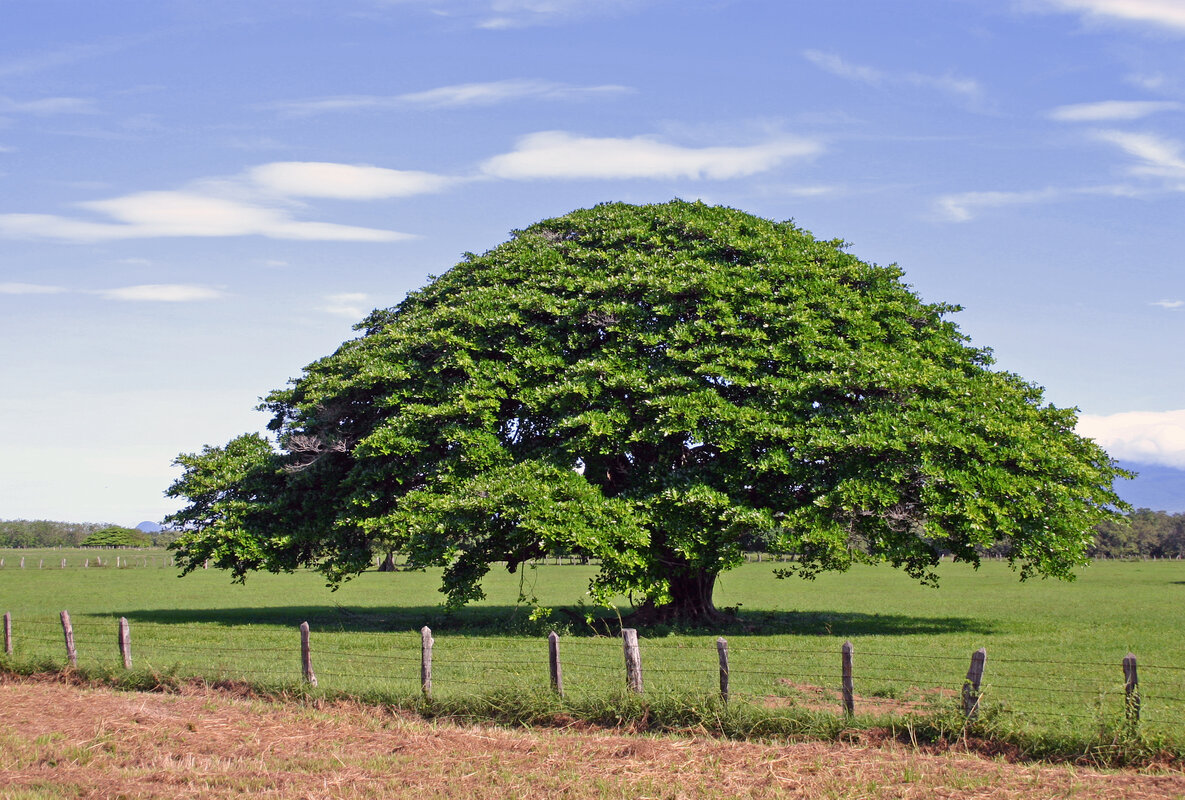
In the dry forests of northwestern Costa Rica, where the sun can be relentless during the six-month dry season, one tree dominates the landscape. The guanacaste spreads its massive hemispherical crown across 40 meters or more, creating islands of shade on the sun-baked savannas. Ranchers have long prized it as shelter for their cattle. Villages have grown up around particularly grand specimens. The tree is so interwoven with the identity of Costa Rica's northwestern province that the province itself bears its name.
On August 31, 1959, the government of President Mario Echandi Jiménez declared Enterolobium cyclocarpum the national tree of Costa Rica. The choice honored the people of Guanacaste Province for their historic decision in 1824 to join Costa Rica rather than remain with Nicaragua. The tree's expansive shade became a metaphor for the protection the nation offered its citizens.
Identification
Name Origin
The name "Guanacaste" comes from the Nahuatl language of the Aztecs, combining guautil (tree) and nacaztli (ear). The compound word perfectly describes what makes this tree instantly recognizable: its large, spiraling seed pods that curl into shapes resembling human ears. This distinctive feature has given rise to common names across its range, from "elephant ear tree" to "orejón" (big ear) to "monkey-ear tree."
Physical Characteristics
Trunk: Cylindrical and generally straight, reaching one to three meters in diameter in mature specimens. The tree lacks buttresses, unusual for a tropical giant of its proportions. The bark is light gray with prominent dark vertical fissures that reveal a reddish-brown color on close inspection.

Crown: The guanacaste's crown is its most striking feature. Fully grown trees develop an expansive, nearly spherical canopy that can spread 40 to 50 meters wide. This broad, umbrella-like structure provides exceptional shade, a quality that has made the tree invaluable in the hot savannas of the dry Pacific lowlands.
Leaves: Bipinnately compound, measuring approximately 20 by 17 centimeters. Each leaf contains about 11 pairs of pinnae (secondary stems), with each pinna bearing roughly 36 pairs of tiny leaflets just 8 by 2 millimeters each. The tree is briefly deciduous, dropping most foliage in December at the onset of the dry season and remaining bare for about two months before new leaves emerge in late February or March.
Flowers: Globular white flower heads appear in the axils of new leaves from late February through early April. Each spherical head, about 3 centimeters across, contains roughly 50 individual flowers bearing thousands of thin, filamentous stamens. The flowers are intensely fragrant, their scent permeating the air for many meters during peak bloom. Bees are the primary pollinators.

Fruit: The distinctive ear-shaped pods develop slowly. Green pods first appear in the crown around December, nine months after flowering. They reach full size by February and ripen from March to April, turning from green to glossy dark brown before dropping. Each pod measures 7 to 12 centimeters in diameter and contains roughly 20 seeds arranged radially. The seeds are extremely hard, with distinctive light brown or orange rings, requiring scarification for germination.

Habitat & Distribution
The guanacaste ranges from central Mexico (latitude 23°N) south through Central America to northern Brazil and Venezuela (latitude 7°N). In Costa Rica, it reaches its greatest abundance in the northwestern lowlands of Guanacaste Province, where it defines the character of the dry forest landscape.
Ecosystem: Tropical dry forest and seasonal forest. The guanacaste thrives where rainfall is strongly seasonal, with a pronounced dry season lasting four to six months. Annual precipitation typically ranges from 750 to 2,500 mm, concentrated in a wet season from May through November.
Elevation: Sea level to approximately 900 meters, though most common in lowland areas below 500 meters.
Soil tolerance: Adaptable to a wide range of soil conditions, from heavy clays to sandy soils. Tolerates both acidic and alkaline conditions and can establish on degraded pastureland.
Growth rate: Rapid. Seedlings demonstrate germination rates approaching 100% and can exceed one meter in height during their first year. This fast growth, combined with the tree's tolerance for disturbed habitats, makes guanacaste suitable for reforestation projects.
Ecological Importance
Nitrogen Fixation
As a member of the legume family (Fabaceae), the guanacaste harbors nitrogen-fixing bacteria in nodules on its roots. These bacteria convert atmospheric nitrogen into forms plants can use, enriching the soil beneath and around the tree. This makes guanacaste valuable for improving degraded soils and supporting agricultural systems. Coffee plantations traditionally used guanacaste as shade trees, benefiting both from the canopy protection and the soil enrichment.
Wildlife Habitat
The massive crown of a mature guanacaste provides habitat and food for numerous species. Howler monkeys move through the branches feeding on leaves and resting in the shade. Scarlet macaws and other parrots nest in cavities and feed on flowers and developing pods. The yigüirro (clay-colored thrush), Costa Rica's national bird, feeds on guanacaste seeds. Squirrels, bats, and numerous insects also depend on this tree throughout the year.
An Evolutionary Anachronism
One of the most intriguing aspects of the guanacaste is what happens beneath the tree during fruiting season: the heavy pods fall and accumulate on the forest floor, largely ignored by native wildlife. No animal currently living in the guanacaste's range effectively disperses its seeds. Tapirs occasionally eat the pods but are too rare to serve as primary dispersers. Agoutis and other rodents largely avoid them.
In 1982, ecologist Daniel Janzen and paleoecologist Paul Martin proposed an explanation. In their landmark paper "Neotropical Anachronisms: The Fruits the Gomphotheres Ate," they argued that the guanacaste and similar trees evolved their large, nutritious fruits for dispersal by Pleistocene megafauna: giant ground sloths, gomphotheres (elephant-like animals), and other large herbivores that went extinct roughly 10,000 years ago.
Evidence supports this theory. The pods are tough enough to survive passage through a large herbivore's gut. Scarification, as would occur during digestion, dramatically improves germination rates. The pods are highly nutritious, rich in sugars and proteins, suggesting they evolved to attract large seed dispersers. Today, introduced horses and cattle have partially filled the ecological role of the extinct megafauna, eating the pods and dispersing viable seeds in their dung.
Human Uses
Timber
Guanacaste wood is reddish-brown with a grain pattern sometimes compared to walnut. It is lightweight (density 0.34-0.6 g/cm³) yet durable, with good resistance to decay fungi and dry-wood termites. The wood works easily with both hand and machine tools, though it can produce dust that causes respiratory irritation.
Traditional uses include furniture, doors, windows, cabinets, and interior trim. The wood's resistance to water made it valuable for boat construction and dugout canoes. Today, large slabs of guanacaste are prized for live-edge tables and custom furniture pieces.
Shade and Fodder
The guanacaste's value as a shade tree cannot be overstated in the hot dry tropics. A single mature tree can shelter an entire herd of cattle from the midday sun. The fallen leaves and pods also serve as fodder, providing supplemental nutrition for livestock during the dry season when other forage is scarce.
Traditional Medicine and Crafts
Indigenous peoples and rural communities have used bark extracts to treat colds and bronchitis. Tannins from the pods and bark have been used in soap-making. The attractive seeds, with their distinctive orange-brown rings, are polished and strung into jewelry and decorative items sold throughout Costa Rica.
Cultural Significance
The guanacaste stands as one of Costa Rica's oldest national symbols, following only the national anthem, flag, coat of arms, and the guaria morada orchid. Its selection as the national tree in 1959 was not arbitrary but carried deep political and cultural meaning.
In 1824, when Central America was fragmenting after independence from Spain, the Partido de Nicoya (a region comprising what is now Guanacaste Province) faced a choice: remain part of Nicaragua or join the newly forming nation of Costa Rica. On July 25, 1824, the communities of Nicoya, Santa Cruz, and Guanacaste voted to annex themselves to Costa Rica. This date, known as the Annexation of Guanacaste Day, remains a national holiday.
When the government sought a national tree during campaigns promoting natural resource conservation in the late 1950s, choosing the guanacaste honored this history. The tree that had sheltered Guanacaste's people through centuries of sun now symbolized the unity of the nation.

Conservation and Reforestation
The guanacaste is not currently considered threatened. Its fast growth, high seed germination rates, and tolerance for disturbed habitats have allowed it to persist even as dry forests around it have been converted to pasture and agriculture. The tree's value for shade has protected many individuals on private lands.
However, the dry forest ecosystem it inhabits has not fared as well. Less than 2% of Costa Rica's original dry forest remains intact. Guanacaste National Park and Santa Rosa National Park protect some of the best remaining examples, where wild guanacaste trees still form part of the forest mosaic.
The tree's characteristics make it excellent for reforestation. Its ability to fix nitrogen improves degraded soils. Its rapid growth provides quick canopy cover. Its extensive root system stabilizes hillsides and riverbanks. Conservation programs across its range use guanacaste for forest restoration and the establishment of living fences and windbreaks.
Key Sources & Resources
Species Information
Detailed species account including phenology, identification features, and distribution in Costa Rica.
Overview of the species including taxonomy, description, ecology, and cultural significance.
Comprehensive botanical and ethnobotanical information including uses, cultivation, and ecology.
Wood Properties
Technical specifications for guanacaste wood including density, hardness, workability, and durability.
Technical data sheet with mechanical properties, processing characteristics, and recommended uses.
Megafauna Dispersal Theory
The landmark paper proposing that many Neotropical trees evolved their large fruits for dispersal by now-extinct Pleistocene megafauna.
Accessible overview of the evolutionary anachronism concept and its implications for forest ecology.
Cultural and Historical Context
Cultural context and interesting facts about Costa Rica's national tree.
Overview of the tree's significance as a national symbol and its connection to Guanacaste Province.
Agroforestry and Reforestation
Detailed profile of the tree's potential for agroforestry systems and sustainable land management.