Garrocho
Hirtella triandra — A graceful understory tree with brick-red inner bark and aromatic white flowers adorned with three purple stamens. Though modest in size, it dominates certain tropical forests and feeds dozens of bird and monkey species with its purple-black fruits.
In the shaded understory of Costa Rica's wet forests grows a tree that few casual visitors notice but many forest animals depend upon. Hirtella triandra, known as garrocho or camarón, rarely reaches the canopy, yet its ecological importance belies its modest stature. When its small purple-black fruits ripen, the tree becomes a magnet for wildlife: spider monkeys, howler monkeys, and numerous species of birds visit to feed.
Slice through the bark and you discover one of garrocho's signatures: brilliant brick-red inner bark that contrasts sharply with the pale wood beneath. The flowers, too, are distinctive. Each bears exactly three stamens tipped with purple anthers, a trait so consistent that Swedish botanist Olof Swartz chose it for the species name when he first described the tree in 1788. Swartz had spent years exploring Jamaica, Puerto Rico, Haiti, and Cuba, amassing 6,000 botanical specimens. His 1788 publication Nova genera et species plantarum cataloged hundreds of Caribbean species, and garrocho was among them.
Identification
Garrocho is typically a small to medium-sized tree, reaching 5-15 meters in most forests, though exceptional specimens can grow to 20 meters. The trunk is usually slender, rarely exceeding 20 cm in diameter, often crooked or leaning. The bark is smooth to slightly furrowed, grayish-brown on the outside, but the inner bark is immediately diagnostic: cut it and you reveal a striking brick-red or deep orange-red layer beneath.
The wood is light brown, hard, and heavy, with a specific gravity of 0.73 and a fine grain that makes it useful for construction despite the tree's modest size. Foresters report the wood is durable and resistant to decay, qualities that have made garrocho a traditional source of fence posts and tool handles in rural areas. The high density reflects a trait shared across the Chrysobalanaceae: their tissues accumulate silica, which strengthens cell walls and makes the wood exceptionally resistant to decay, though it also quickly dulls saw blades.
Leaves
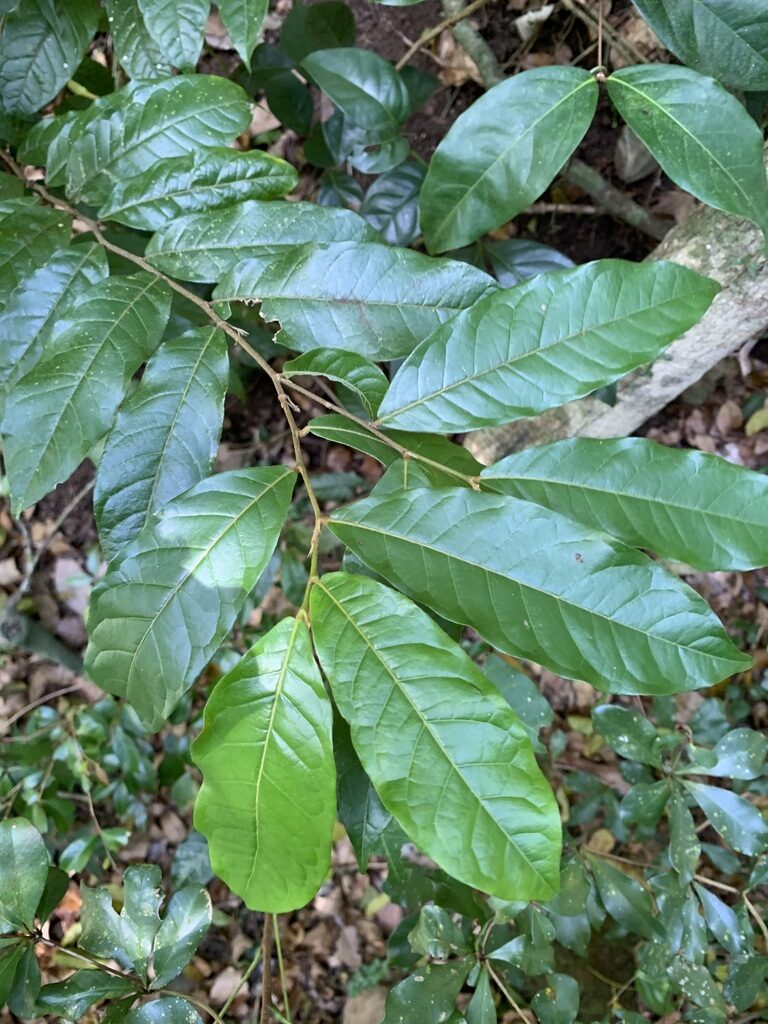
The leaves are simple and alternate, arranged along the branches in a single plane that maximizes light capture in the forest understory. Each leaf is elliptic to oblong, typically 5-15 cm long and 2-6 cm wide, with an entire margin. The upper surface is dark green and glossy; the lower surface is paler and may bear fine hairs, especially along the midrib and veins. The genus name Hirtella comes from the Latin hirtus meaning "hairy," referring to the pubescence found on various parts of plants in this group.
A distinctive feature is the pair of glands at the leaf base or along the petiole, characteristic of the Chrysobalanaceae family. These glands secrete nectar that attracts ants, forming mutualistic relationships that may protect the tree from herbivorous insects.
Flowers and Fruits
The flowers are the most distinctive feature of this species. Small but showy, they grow in terminal panicles or racemes, opening white to pale pink with a sweet, penetrating fragrance. Each flower has five petals and, crucially, exactly three stamens with dark purple anthers. This consistent stamen count gives the species its name: triandra means "three stamens" in Latin. The flowers appear primarily from November to May, though garrocho can bloom sporadically throughout the year. Research from Panama suggests the tree may flower up to three times annually, an unusual trait that helps ensure a reliable food supply for pollinators. Bees and butterflies are the primary pollinators, drawn by the aromatic compounds in the flowers.

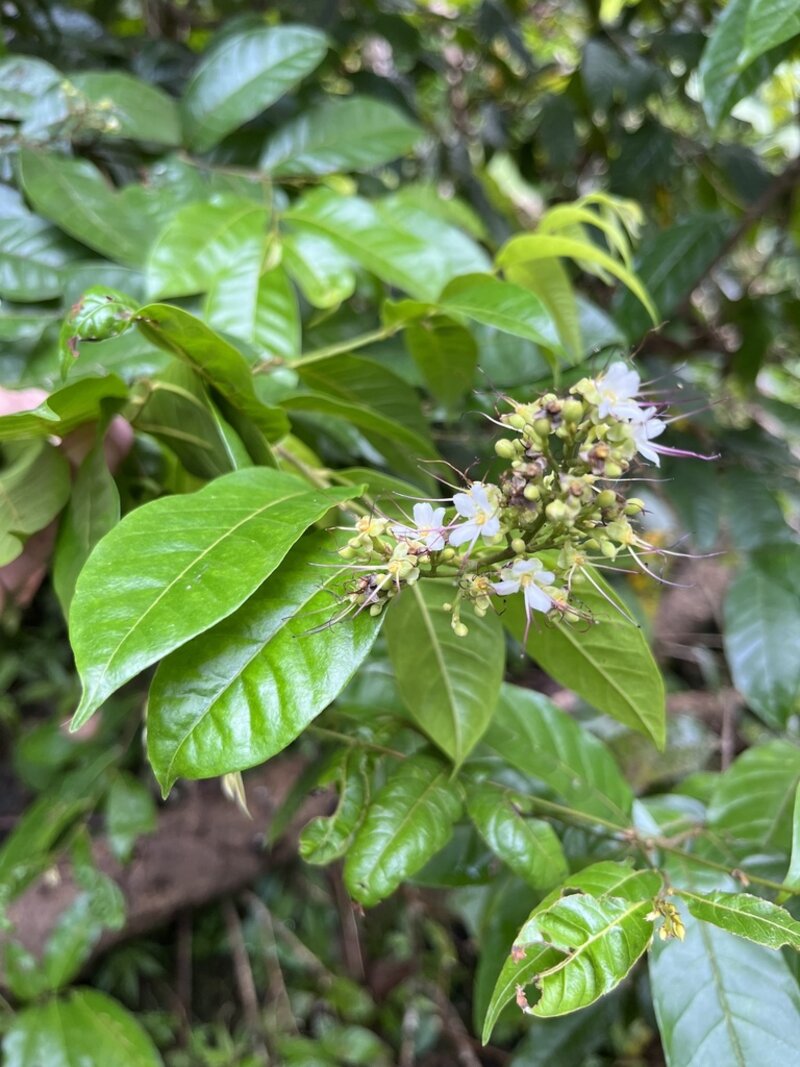
The fruits are small drupes, about 1-2 cm in diameter, ripening from green through red to purple-black. The flesh is thin but sweet, surrounding a single hard stone. Fruits mature primarily from June to August, though fruiting can occur year-round with secondary peaks in different seasons. The fruits are edible to humans, with a slightly astringent sweetness, and are sometimes collected locally as "pigeon berries."
Name Origins
The genus name Hirtella derives from the Latin hirtus, meaning "hairy" or "rough," with the diminutive suffix -ella. This refers to the fine pubescence found on the leaves, stems, and flowers of plants in this group. The species epithet triandra combines the Greek tri- (three) with andros (male, referring to stamens), describing the flower's three stamens.
The common name "garrocho" is used in Costa Rica and parts of Central America. "Camarón" and "camaroncillo" (shrimp and little shrimp) likely refer to the curved flower buds or young fruits. In the Caribbean and parts of South America, the tree is known as "pigeon berry" because of the birds that feed on its fruits.
Habitat and Distribution
Garrocho grows in wet and moist tropical forests from sea level to about 1,500 meters elevation. It thrives in the forest understory and along forest edges, tolerating deep shade better than most trees. The species is remarkably widespread, ranging from southern Mexico through all of Central America, into South America as far south as Brazil, and throughout the Caribbean islands including Puerto Rico, Jamaica, and Hispaniola.
In Costa Rica, garrocho occurs on both the Atlantic and Pacific slopes wherever wet forest persists. It is common in the Osa Peninsula, the Caribbean lowlands, and lower mountain slopes. The species shows considerable adaptability, growing in primary forest, secondary growth, and even disturbed areas, though it achieves its largest size in mature forest conditions.
Ecological Importance
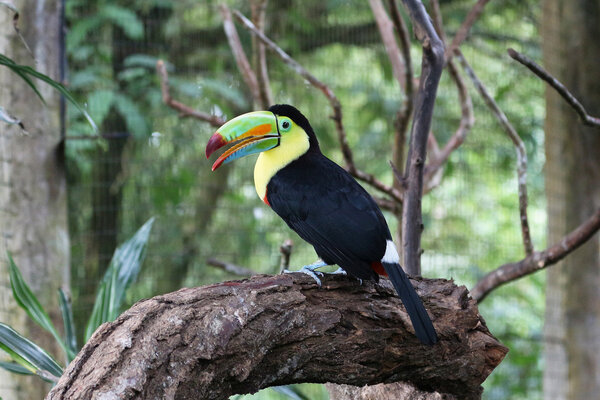
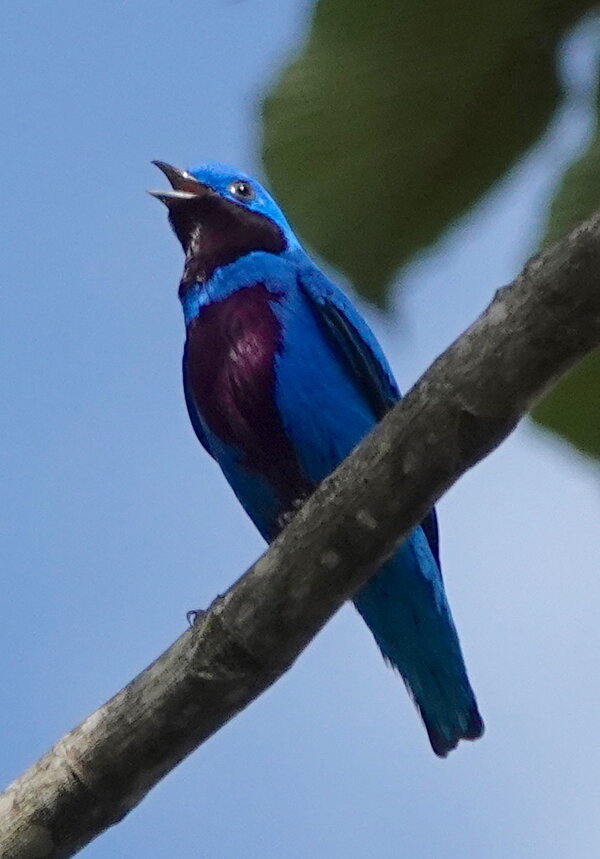
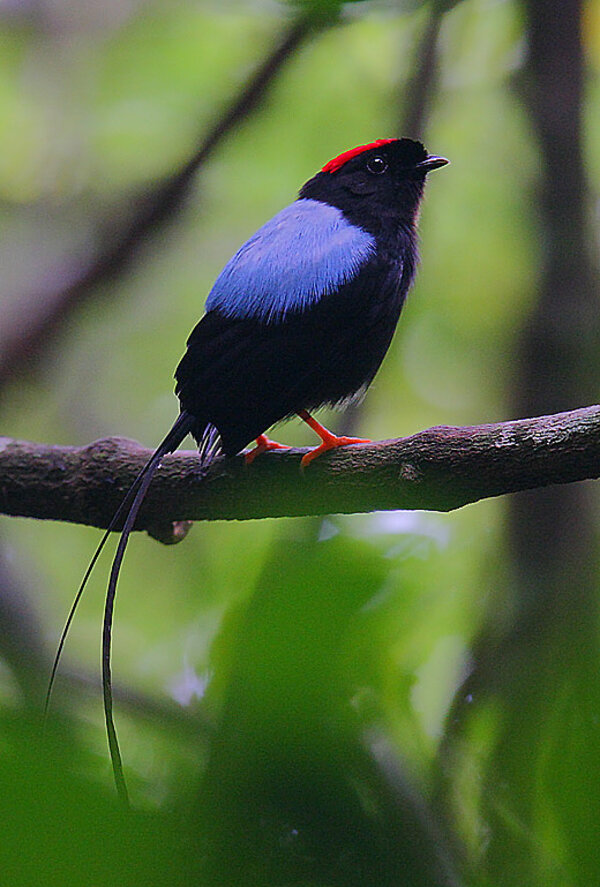
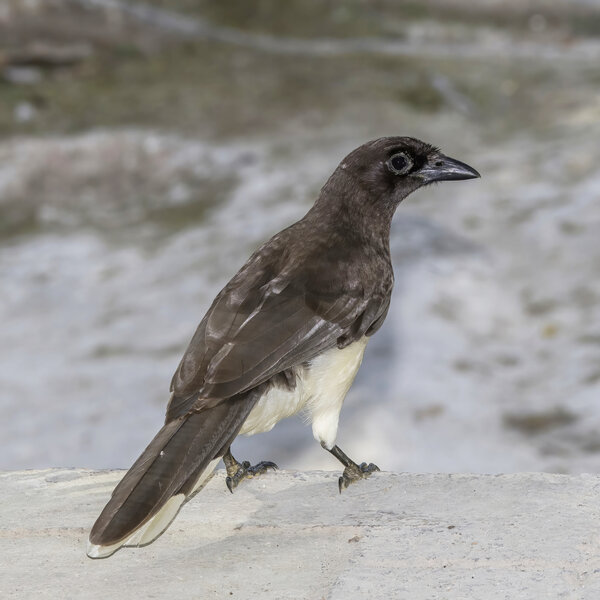
Despite its modest size, garrocho plays a disproportionate role in forest food webs. Its fruits are consumed by an impressive array of wildlife. Spider monkeys and howler monkeys feed on the ripe drupes, as do squirrel monkeys. On Barro Colorado Island, researchers have documented white-faced capuchins (Cebus capucinus) specifically seeking out garrocho fruits in June and July, when the trees bear their heaviest crop. Capuchins eat fruits from over 90 different species in some areas, and their habit of traveling long distances through the forest canopy spreads seeds far from parent trees. Numerous bird species also feed on garrocho fruits, including toucans, cotingas, manakins, and the Brown Jay (Psilorhinus morio), which swallows the fruits whole and disperses the seeds.
The nectar glands on garrocho's leaves attract ants, which may provide defense against herbivorous insects. While Hirtella triandra itself is not a true myrmecophyte (ant-plant), some of its relatives in the genus have evolved specialized hollow stems called domatia that house ant colonies. This relationship hints at the evolutionary trajectory within the genus, where some species have developed more elaborate ant partnerships.
The flowers provide nectar and pollen to a variety of insects, particularly bees and butterflies. The aromatic compounds in the flowers attract pollinators from considerable distances through the forest understory.
Traditional Uses
Rural communities across Central America have long made use of garrocho. The hard, durable wood serves for fence posts, tool handles, construction poles, and flooring. Because the tree is often abundant and its wood resists decay, it provides a reliable local timber source even though individual trees are rarely large enough for major construction.
The bark has been used in traditional medicine, though specific applications vary by region. The ripe fruits are edible and sometimes collected for local consumption, prized for their sweet-tart flavor despite their small size. In some areas, children gather the purple-black fruits as a forest snack.
The Chrysobalanaceae Family
Garrocho belongs to the Chrysobalanaceae, a tropical family of approximately 500-530 species in 17-18 genera with a center of diversity in the Amazon basin. The family takes its name from the Greek chrysos (gold) and balanos (acorn), referring to the golden hairs on fruits of some species. The family includes the icaco or cocoa plum (Chrysobalanus icaco), which produces edible fruits commercially harvested in some regions.
One of the Chrysobalanaceae's most distinctive traits is their accumulation of silica. Throughout the family, plants deposit silicon dioxide in their leaves, wood, and bark. In the leaves, silica forms microscopic bodies (phytoliths) that make the tissue abrasive to herbivore mouthparts. In the wood, nearly every ray cell contains a globular silica inclusion. This defense has consequences for humans too: Chrysobalanaceae wood is notoriously hard on tools, reportedly dulling even tungsten-tipped saw blades.
The genus Hirtella itself contains about 105-110 species, primarily Neotropical with a few species in Africa and Madagascar. Of these, seven species have evolved into true myrmecophytes, developing specialized hollow structures called domatia that house ant colonies. The most studied is Hirtella physophora, a small understory tree of the Amazon that can live up to 350 years. While garrocho has not developed such specialized structures, the extrafloral nectaries on its leaves hint at the evolutionary trajectory that led some of its relatives toward more elaborate ant partnerships.
Resources and Further Reading
Species Information
Comprehensive database entry covering uses, distribution, and botanical description.
Kew's authoritative database with taxonomic information and distribution map.
Global Biodiversity Information Facility page with occurrence records and distribution data.
Overview of the genus including its relationship with ants and distribution.
Ecology and Research
Species account with phenology, ecological notes, and distribution in Panama from the Smithsonian Tropical Research Institute.
Information about the 50-hectare permanent forest dynamics plot where Hirtella triandra is among the most abundant species.
Species profile with phenology data for Costa Rica's Osa Peninsula.
Community observations with photographs from across the species' range.
Scientific Research
Research on the tripartite mutualism in Hirtella physophora demonstrating fungus-mediated nitrogen transfer from ants to the plant.
Comprehensive review of all known biological interactions involving Hirtella physophora and its ant associates.
Study revealing that domatia evolved at least 158 times over the last 19 million years, including in the Hirtella lineage.
Comprehensive review of the Chrysobalanaceae family covering taxonomy, silica accumulation, and ecological significance.
Chrysobalanaceae Family
Overview of the cocoa plum family, its genera, and evolutionary relationships.
Biography of the Swedish botanist who first described Hirtella triandra in 1788 after exploring the Caribbean.