Fruta Dorada
Virola koschnyi — A pillar of the primary rainforest, this nutmeg relative rises with an arrow-straight trunk through the understory into the canopy, where it produces golden capsules that split open to reveal scarlet-wrapped seeds eagerly sought by toucans and guans.
Walk through the old-growth forests of the Golfo Dulce region and you will notice certain trees that seem engineered for perfection. Their trunks rise without a branch, straight and cylindrical as columns, climbing 25 meters or more before the first limbs spread. This architectural precision belongs to the Fruta Dorada, one of the most easily recognizable trees of Costa Rica's Pacific lowland rainforests. Its common name means "golden fruit," a reference to the spectacular bright yellow capsules it produces in abundance each year.
The tree belongs to the Myristicaceae, the nutmeg family, a pantropical group that ranks among the most ecologically important tree families in lowland moist forests worldwide. When the bark is cut, it bleeds a watery sap that quickly turns blood-red, giving the tree its other common names: "Sangre" in Honduras and Guatemala. This red resin hints at the tree's kinship with other Virola species that indigenous Amazonian peoples have used for millennia to prepare powerful hallucinogenic snuffs. While V. koschnyi itself is not typically used this way, it carries the biochemical heritage of a genus that has shaped human ritual and medicine across the Neotropics.
Identification
Physical Characteristics
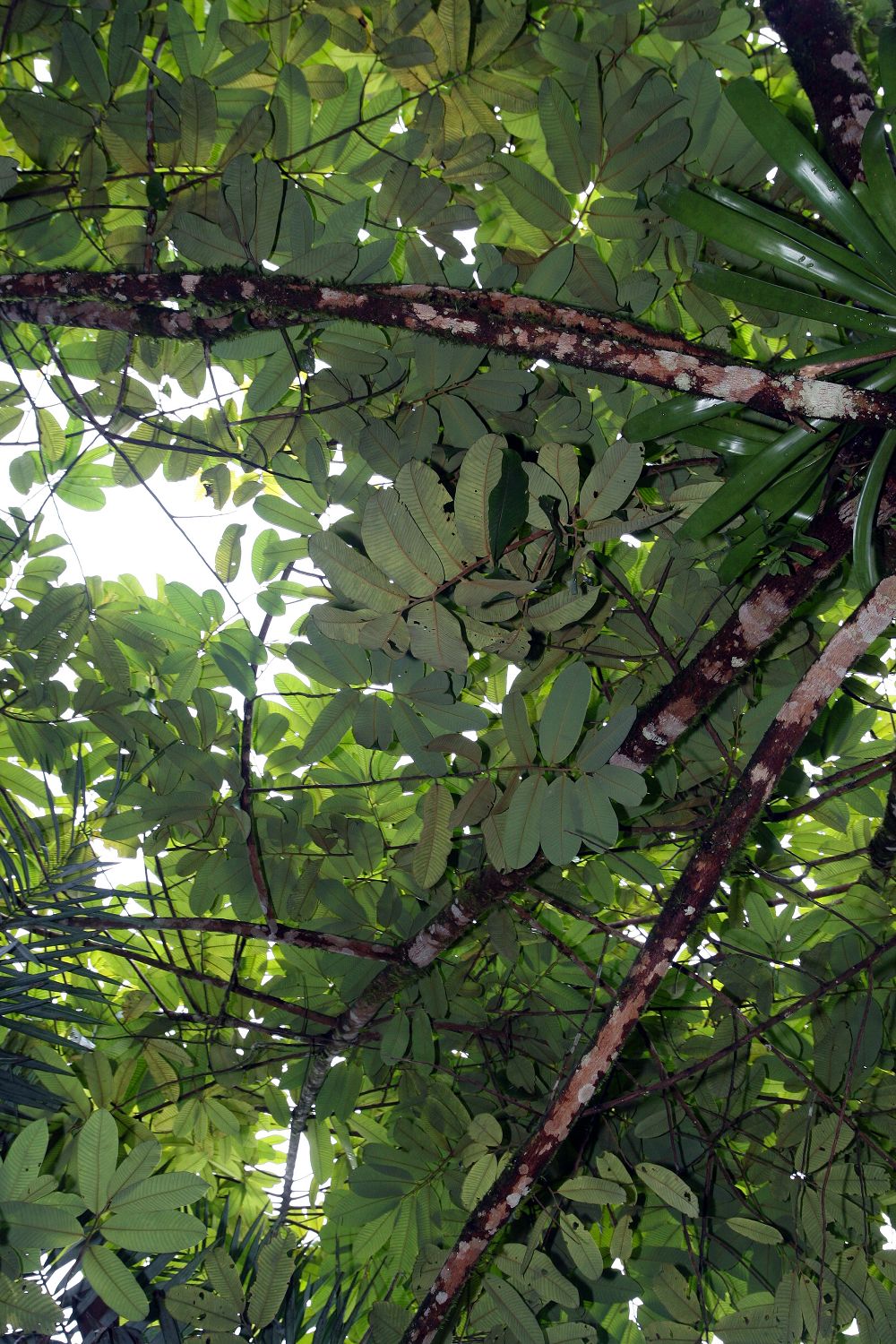
Crown: The Fruta Dorada displays what botanists call "monopodial growth," a distinctive pattern where a single dominant trunk grows straight upward like an arrow. Branches emerge only in the upper fifth of the tree, spreading perpendicularly from the main trunk to create an open, pyramidal crown. This growth habit gives the tree its pillar-like appearance, with an unbranched bole that rises through the lower and middle forest layers before flowering into the canopy.
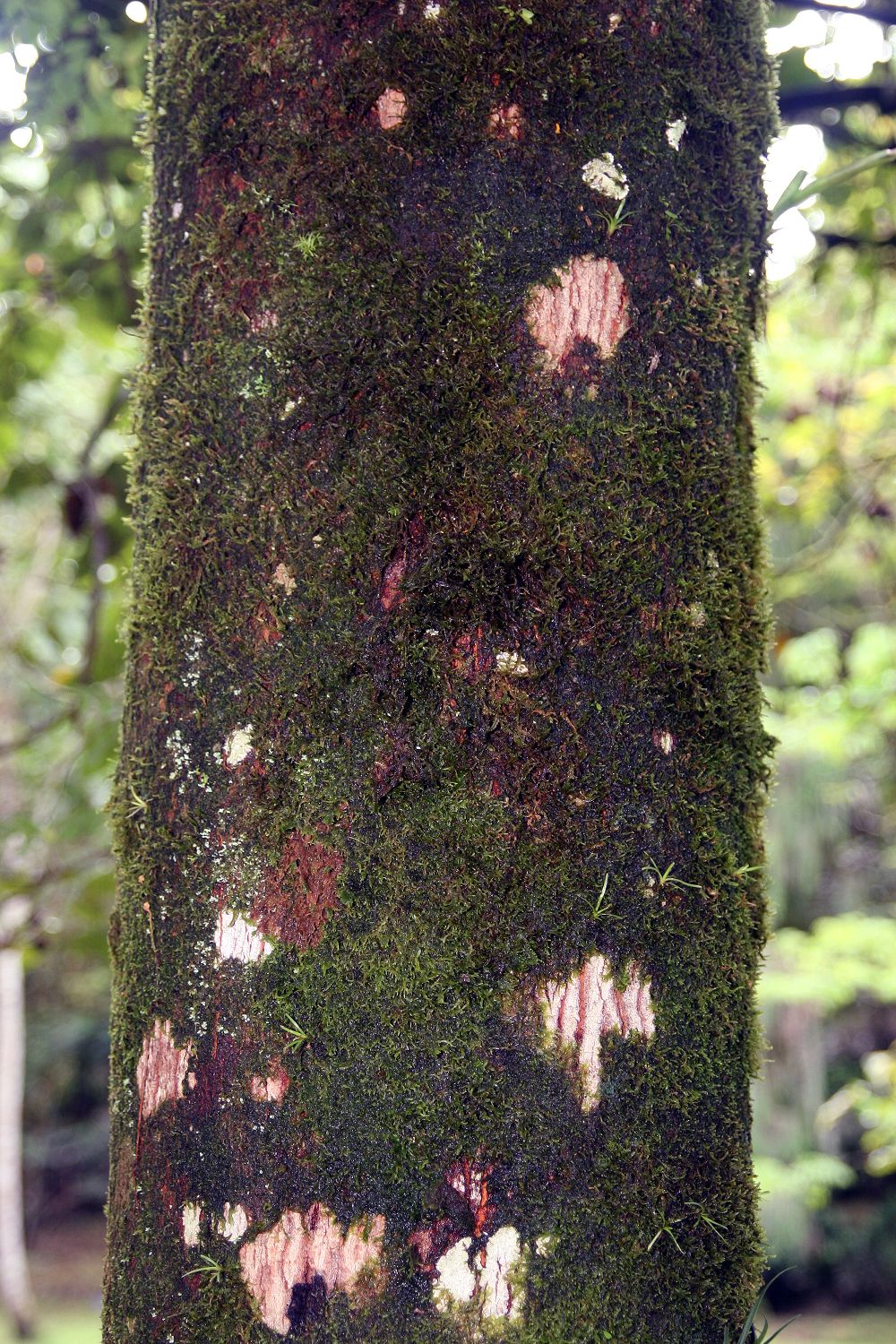
Trunk: Exceptionally straight and perfectly cylindrical, the trunk can reach 85 cm in diameter. The bark is smooth, gray to brown, often marked by fine vertical cracks running parallel up the trunk. Flat, straight buttresses extend about one meter above ground level, anchoring the tree in the forest soil. When cut or damaged, the bark exudes a watery clear sap that rapidly oxidizes to a distinctive blood-red color.
Leaves: Simple and alternate, the dark green leaves measure about 16 by 5.5 cm. They are long and narrow, mostly lanceolate but with a distinctive characteristic: they are slightly wider toward the tip than toward the base, giving them a somewhat spatulate shape. This feature, subtle but consistent, distinguishes V. koschnyi from the other four or five Virola species found in southwestern Costa Rica. The prominent petiole connects to a well-formed drip tip, and the pinnate venation is clearly visible. Both the twigs and leaf surfaces are covered in soft, yellow-brown, velveteen pubescence.
Flowers: Long, mustard-brown flower panicles measuring 10-15 cm emerge from the leaf axils. The individual blossoms are small and petalless, somewhat fleshy, with three yellowish sepals. The species is dioecious, meaning individual trees are either male or female. Flowering occurs from October through February, with pollination carried out by insects and small nectar-gathering birds.
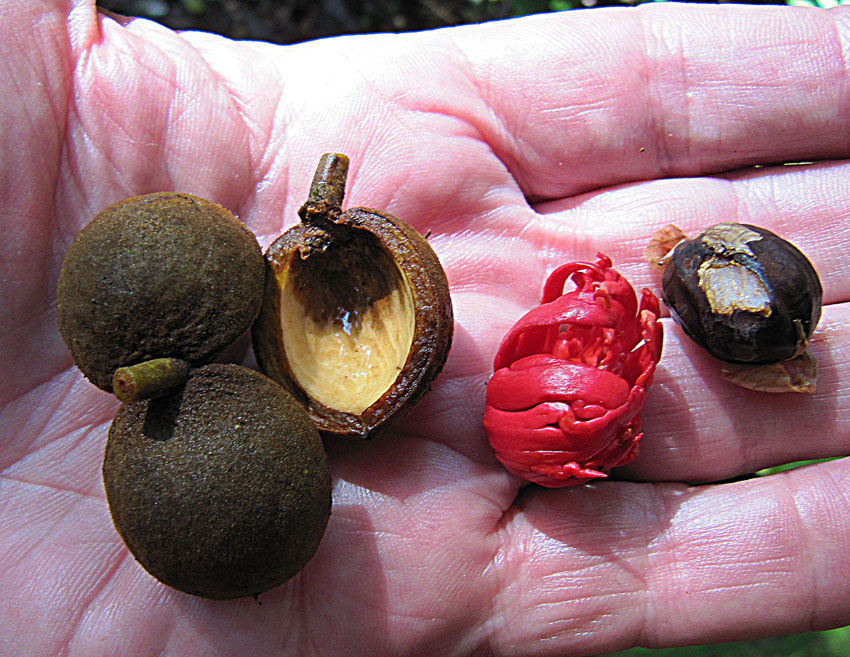
Fruit: The capsules that give the tree its name are bright yellow when ripe, measuring about 3.5 by 3 cm. This vivid golden color distinguishes V. koschnyi from all other Virola species in the region, which produce fruits that remain green even when mature. Each capsule contains a single large seed wrapped in a distinctive scarlet-red aril composed of finger-like shreds. This aril is rich in lipids and represents the nutritional reward that attracts dispersing birds. Seeds mature in approximately four months after pollination, with harvest occurring primarily from February through June.
Ecology
Habitat and Distribution
The Fruta Dorada is the most geographically widespread Virola species in Mesoamerica, occurring from Mexico through Guatemala, Belize, Honduras, Nicaragua, Costa Rica, and Panama. It grows on both the Caribbean and Pacific slopes, though it is mainly found on the Caribbean side in most countries. In Costa Rica's Golfo Dulce region, it is one of the most numerous tree species in the Golfo Dulce Forest Reserve, where population studies have recorded 0-4 individuals per hectare for trees above 30 cm diameter.
The species prefers the better-drained soils of hills and ridges rather than waterlogged bottomlands. It is a true resident of primary tropical forest, distributed thinly but evenly throughout varied habitats from near sea level up to 1,000 meters elevation, occasionally reaching 1,700 m. While it tolerates a range of soil types, it avoids the immediate sandy coastal zone. In the Osa Peninsula, it grows alongside other canopy giants like Brosimum utile, Dipteryx panamensis, and Carapa guianensis.
The Birds That Plant Forests
The Fruta Dorada has evolved a partnership with large frugivorous birds that is both elegant and increasingly fragile. When the golden capsules split open to reveal their scarlet-wrapped seeds, Chestnut-mandibled Toucans arrive to feed on the lipid-rich arils. Crested Guans, large turkey-like birds that were once common throughout Costa Rica's forests, also consume the fruits eagerly. These birds swallow the seeds whole, digest the nutritious aril, and deposit the seeds far from the parent tree in their droppings.
This dispersal system has consequences for forest regeneration. In areas where toucans and guans have been hunted out or driven away by habitat destruction, seed dispersal suffers dramatically. Studies in Manuel Antonio National Park found that most seedlings concentrated in a dense mat directly below female Virola canopies, with relatively few appearing at locations distant from parent trees. The loss of primary seed dispersers means that even common trees may struggle to colonize new areas or regenerate after disturbance.
Some tropical fish also disperse Virola fruits that fall into rivers, adding another dimension to the tree's colonization strategy. And in the related species Virola sebifera, researchers have documented white-faced capuchins, howler monkeys, spider monkeys, trogons, and motmots all feeding on the seed arils, suggesting the Fruta Dorada may have a similarly diverse dispersal network where these animals still exist.
Annual Rhythms
The Fruta Dorada displays a distinctive phenological pattern. Beginning in September, the tree sheds its leaves rapidly, but unlike deciduous trees that remain bare through a dry season, the Fruta Dorada immediately re-foliates. This rapid leaf turnover likely serves to eliminate accumulated herbivore damage and parasites while maintaining the tree's photosynthetic capacity. Flowering follows from October through February, with fruit development taking approximately six months. The primary fruit ripening occurs in February and March, with a smaller secondary crop in June.
The Nutmeg Family
The Myristicaceae comprises 21 genera and nearly 500 species of woody trees distributed across the world's tropical regions. The most famous member is Myristica fragrans, the tree that produces nutmeg and mace, spices that once drove European exploration and colonization of the East Indies. The family has its greatest diversity in Southeast Asia and New Guinea, but the genus Virola, with approximately 60 species, represents the largest American member and the fourth largest in the family worldwide.
Ecologically, the Myristicaceae rank among the top five to ten most common and important tree families throughout the majority of the world's lowland moist tropical forests. The lipid-rich arils surrounding their seeds make Myristicaceae fruits crucial food sources for frugivorous birds and primates. In Neotropical forests, species like the Fruta Dorada help sustain populations of toucans, guans, and monkeys that in turn disperse hundreds of other plant species.
Uses and Conservation
Timber
The Fruta Dorada produces a light, reddish-brown wood of modest quality. The heartwood is cream to tan when freshly cut, darkening on exposure to pinkish, golden-brown, or deep reddish-brown. It weighs 430-580 kg/m when dried, with straight grain, medium to coarse texture, and low luster. The wood works easily and satisfactorily but lacks durability, making it unsuitable for exterior use or ground contact.
Historical uses include rough construction, boxes, concrete forms, and plywood corestock. The wood has been marketed under the names "light virola" and "banak" in the international timber trade. However, the tree's greater value may lie in its ecological role rather than its timber. As a common canopy tree with fruits that sustain threatened bird populations, standing Fruta Dorada trees contribute more to forest health than their modest lumber would suggest.
Conservation Concerns
The Fruta Dorada faces a subtle but significant threat: it is often harvested under the same vernacular name as the related Virola surinamensis, despite the two species having different population densities and reproductive patterns. Studies in the Osa Peninsula found that V. surinamensis occurs at twice the density of V. koschnyi, meaning that undifferentiated harvesting of "virola" timber will disproportionately impact the less common species.
Because the Fruta Dorada is dioecious, with separate male and female trees, logging can disrupt the sex ratios needed for successful reproduction. Researchers have recommended that selective logging regulations for dioecious species should require proper species identification and limit the proportion of individuals harvested from any given population. The tree is not currently listed on the IUCN Red List, but local populations in heavily logged areas may face reproductive challenges that do not yet register at the species level.
Key Sources & Resources
Species Information
Comprehensive species account with identification features, ecology, and natural history for Costa Rica's Pacific lowlands.
Kew's authoritative taxonomic database with accepted name, synonyms, and distribution data.
Ecology and Conservation
Scientific study of V. koschnyi and V. surinamensis populations in the Osa Peninsula, with implications for sustainable harvesting.
Comprehensive taxonomic treatment of all Mesoamerican Virola species, including six newly described species.
Ethnobotany and Family Context
Review of traditional uses, phytochemistry, and biological activity across the genus Virola.
Overview of the nutmeg family's ecological importance, distribution, and role in tropical forest ecosystems.