Hicatee Fig
Ficus maxima — A free-standing fig of riverbanks and disturbed forests, this species supports more insect diversity on a single tree than almost any other in the Neotropics. Unlike its strangling cousins, it grows from the ground up, but it feeds the same howler monkeys and bats.
In a 1997 study of insect diversity in Panamanian dry forest, Norwegian biologist Frode Ødegaard climbed 24 different tree species and catalogued every plant-eating insect he could find. One species stood out: Ficus maxima supported 78 species of phytophagous insects on a single tree, including the second-largest wood-feeding insect fauna and the fourth-most specialized herbivore community in the study.
Unlike the strangler figs that begin life in the canopy and descend to strangle their hosts, Ficus maxima is a free-standing tree. It germinates in the soil and grows upward like any conventional tree. It belongs to the fig subgenus Pharmacosycea, which includes most of the Neotropical free-standing figs. But it shares the family trait that makes all figs ecological keystones: asynchronous fruiting, where different trees in a population fruit at different times, ensuring that figs are available somewhere in the forest even when other fruit is scarce.
Identification
Ficus maxima is one of approximately 60 fig species found in Costa Rica. The species name maxima means "largest," referring to the large leaves of young seedlings, which can reach 30 cm long and 19 cm wide. Scottish botanist Philip Miller first described the species in 1768, citing earlier illustrations from Jamaica.
Physical Characteristics
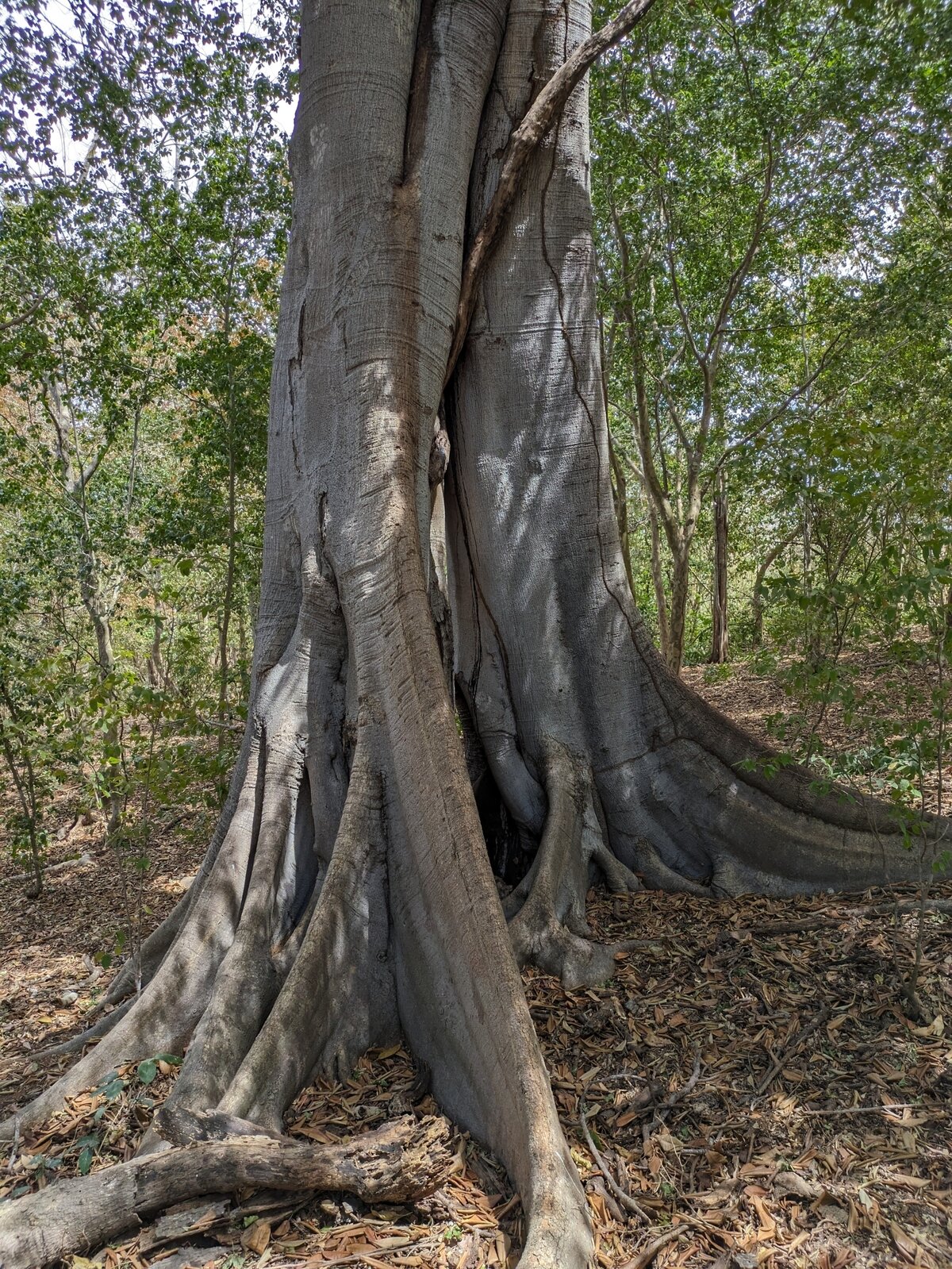
Trunk: Unlike strangler figs, F. maxima has a conventional solid trunk. The bark is smooth and grayish-brown. Like all figs, it exudes copious white latex when cut.
Leaves: Large, thick, and leathery with a pronounced central vein. Adult leaves are typically 10-20 cm long, but seedling leaves can be much larger. The leaf shape is elliptical to oblong with a rounded or slightly pointed tip.
Figs (Syconia): Spherical, 1-2.5 cm in diameter, borne singly in the leaf axils. This solitary fig arrangement is characteristic of subgenus Pharmacosycea and distinguishes F. maxima from strangler figs like F. obtusifolia, which bear figs in pairs. The figs ripen from green to yellowish or reddish.
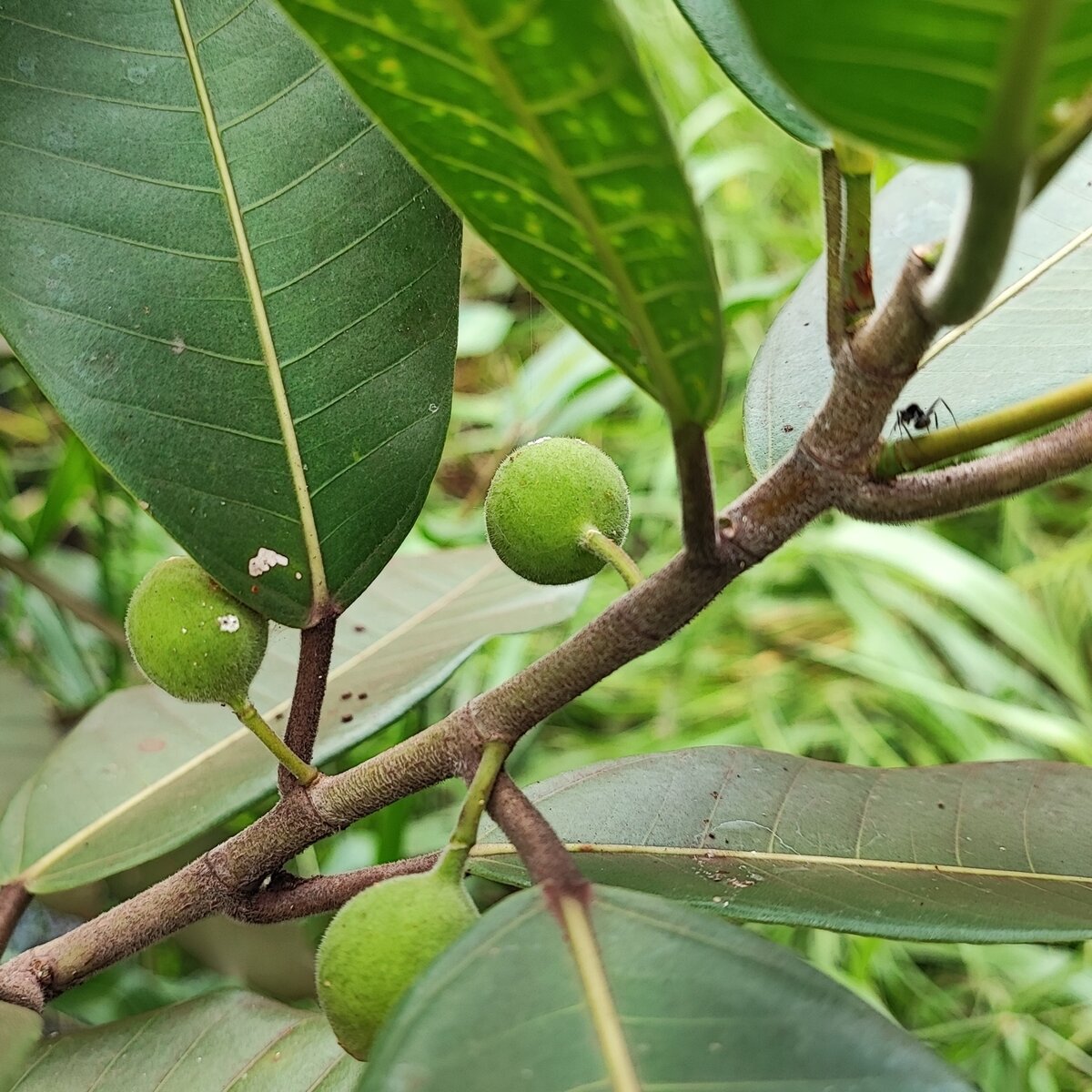
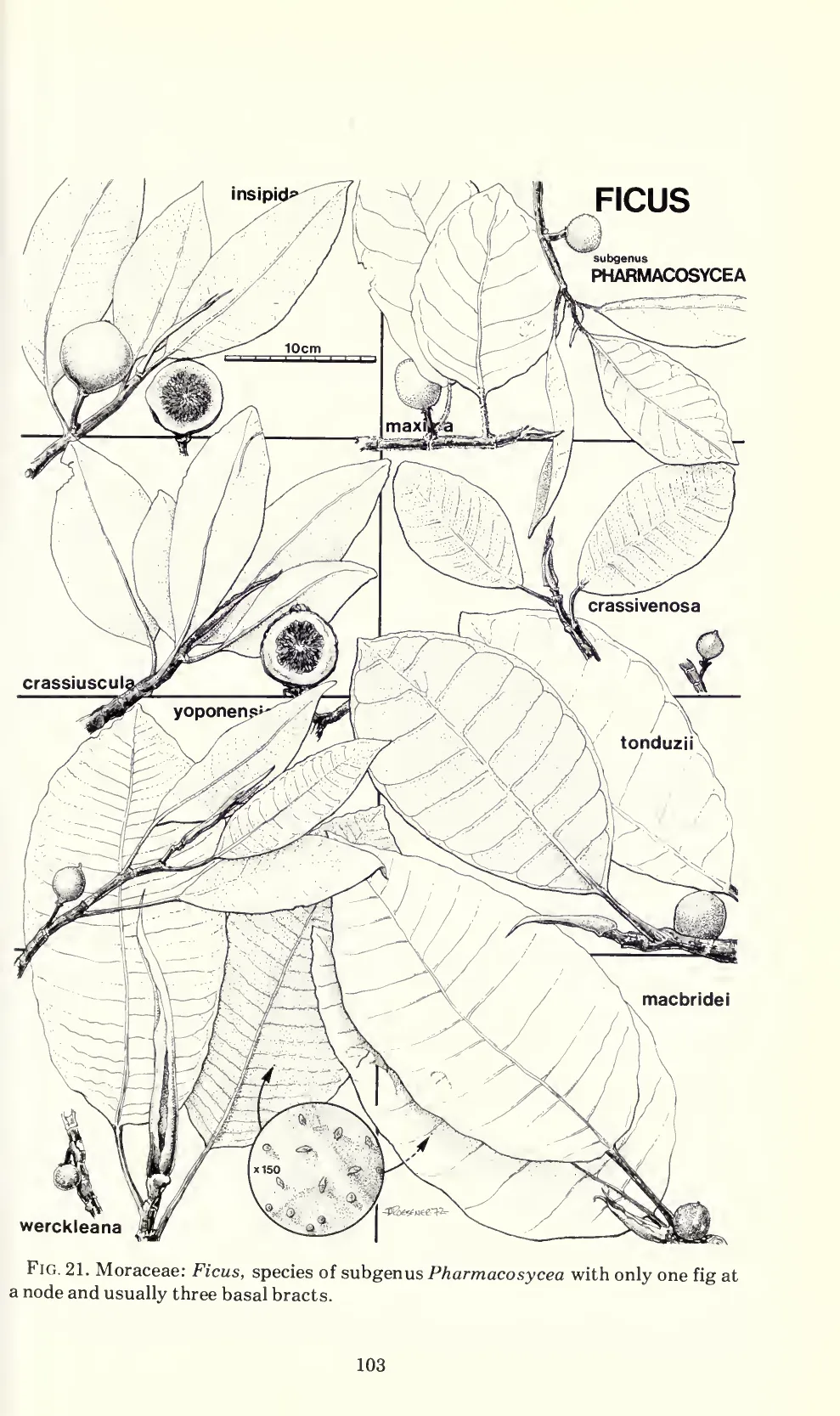
Free-Standing vs. Strangler Figs
The genus Ficus contains approximately 850 species worldwide, roughly split between hemiepiphytic (strangling) species and free-standing species. In Costa Rica, you encounter both types among about 60 native figs. The strangler figs, such as Ficus obtusifolia (higuerón), belong to subgenus Urostigma. They germinate in the canopy, send roots down, and eventually kill their host trees. The free-standing figs, such as Ficus maxima and Ficus insipida (chilamate), belong to subgenus Pharmacosycea. They germinate in the soil and grow upward like conventional trees.
The Pollinator Wasp
Every fig species has its own pollinator wasp, and for Ficus maxima, that partner is Tetrapus americanus. Recent genetic work suggests that T. americanus is actually a cryptic species complex of at least two species that are not even closely related to each other, suggesting that the fig-wasp relationship is more complicated than it appears.
Ficus maxima is passively pollinated, meaning the female wasp does not actively collect and deposit pollen. Instead, pollen simply adheres to her body and rubs off inside the next fig she enters. About one-third of all fig species use passive pollination. This contrasts with actively pollinated figs, where the wasp has specialized pollen pockets and deliberately packs pollen into them.
The wasp lifecycle follows the same pattern as in all figs. The female enters through the ostiole, lays eggs in some flowers, pollinates others, and dies inside. Her offspring develop within the fig. Males emerge first, mate with females, and chew exit holes. Females emerge laden with pollen and fly off to find another receptive fig. The timing is critical: a fig population must be large enough that some trees are always in the receptive stage, or the wasps will have nowhere to go and the cycle breaks.
Habitat & Distribution
Ficus maxima has one of the widest ranges of any Neotropical fig, extending from Mexico through Central America and the Caribbean to Paraguay and Bolivia in South America. In Costa Rica, it occurs on both Pacific and Caribbean slopes from sea level to about 1,000 meters.
Unlike many forest trees, F. maxima tolerates disturbance well. It is frequently found along streams and riverbanks, in pastures, along roadsides, and at forest edges. It is more common in seasonally dry areas than in the wettest forests. This tolerance of open, disturbed habitats means you often see it standing alone in cleared landscapes where other forest trees have been cut.
Wildlife Relationships
Like all figs, Ficus maxima is a keystone species. Because different trees in a population fruit at different times, figs are available somewhere in the forest even when other fruit is scarce. F. maxima figs have been found to have relatively high protein content and low water-soluble carbohydrates compared to other fig species, making them particularly nutritious for frugivores.
The remarkable insect diversity on F. maxima deserves emphasis. In Ødegaard's Panamanian study, this species supported the fourth-most specialized phytophagous insect community and the second-largest wood-feeding insect fauna among 24 tree species sampled. The smooth bark, abundant latex, and year-round leaf production create microhabitats for beetles, caterpillars, and countless other arthropods.
Traditional Uses
Throughout its range, Ficus maxima has been used for medicine and materials. The white latex, like that of other figs, contains proteolytic enzymes with anti-parasitic properties.
The Survivor
Ficus maxima is not the most dramatic of figs. It does not strangle hosts or form hollow cathedrals of fused roots. It simply grows, fruits, and persists. It survives in cleared pastures, along dusty roadsides, at the edges of forests that have retreated. In these marginal spaces, it continues to feed howler monkeys and bats, to support specialized insect communities, to maintain the fig-wasp mutualism that has persisted for 75 million years.
In a landscape of fragments, the trees that tolerate edges and disturbance become the bridges. F. maxima standing alone in a pasture is a wildlife refuge, a seed source for forest regeneration, a node in the network that connects what remains. It may lack the strangler's architectural drama, but it shares the strangler's essential role: feeding the forest, year after year, through every season.
Key Sources & Resources
Species Information
Overview of the species with information on taxonomy, distribution, and pollinator wasp.
Comprehensive information on uses, cultivation, and ecology of the species.
Fig Ecology & Evolution
Detailed explanation of the fig-wasp mutualism and passive vs. active pollination.
Research revealing the cryptic species complexity within fig wasp populations, including Tetrapus americanus.
Scientific review of strangler vs. free-standing fig ecology and the evolution of hemiepiphytism.
Insect Diversity Research
Study documenting 78 phytophagous insect species on a single F. maxima tree in Panamanian dry forest.