Huesito
Faramea occidentalis is a shade-loving understory tree of tropical wet forests from Mexico to Brazil. Its research history on Barro Colorado Island has made it one of the most intensively studied trees in the Neotropics. In the Brunca region of Costa Rica, it grows in the primary forests of the Osa Peninsula and the Golfo Dulce lowlands.
In the shaded understory of Costa Rica's Pacific lowland forests, where light filters through in scattered fragments, the slender stems of Faramea occidentalis rise toward the canopy gaps above. This patient tree, known locally as huesito ("little bone") for its hard wood and stone-hard seed, may wait decades in near-darkness before a treefall opens space for growth. When it finally flowers, the white, trumpet-shaped blooms release a candy-sweet fragrance that draws moths and butterflies through the humid night air.
The species ranges from northeastern Mexico through Central America and the Caribbean to Brazil, growing from sea level to 1,500 meters in tropical moist and premontane wet forests. In Costa Rica, it favors the Pacific slope, occurring in primary forests on well-drained hillsides. It has been recorded from Manuel Antonio National Park, the Osa Peninsula, and throughout the Golfo Dulce lowlands. The Brunca region alone has yielded over 70 documented localities, from Palmar Norte to the remote forests of the Peninsula de Burica.
Identification
Habit
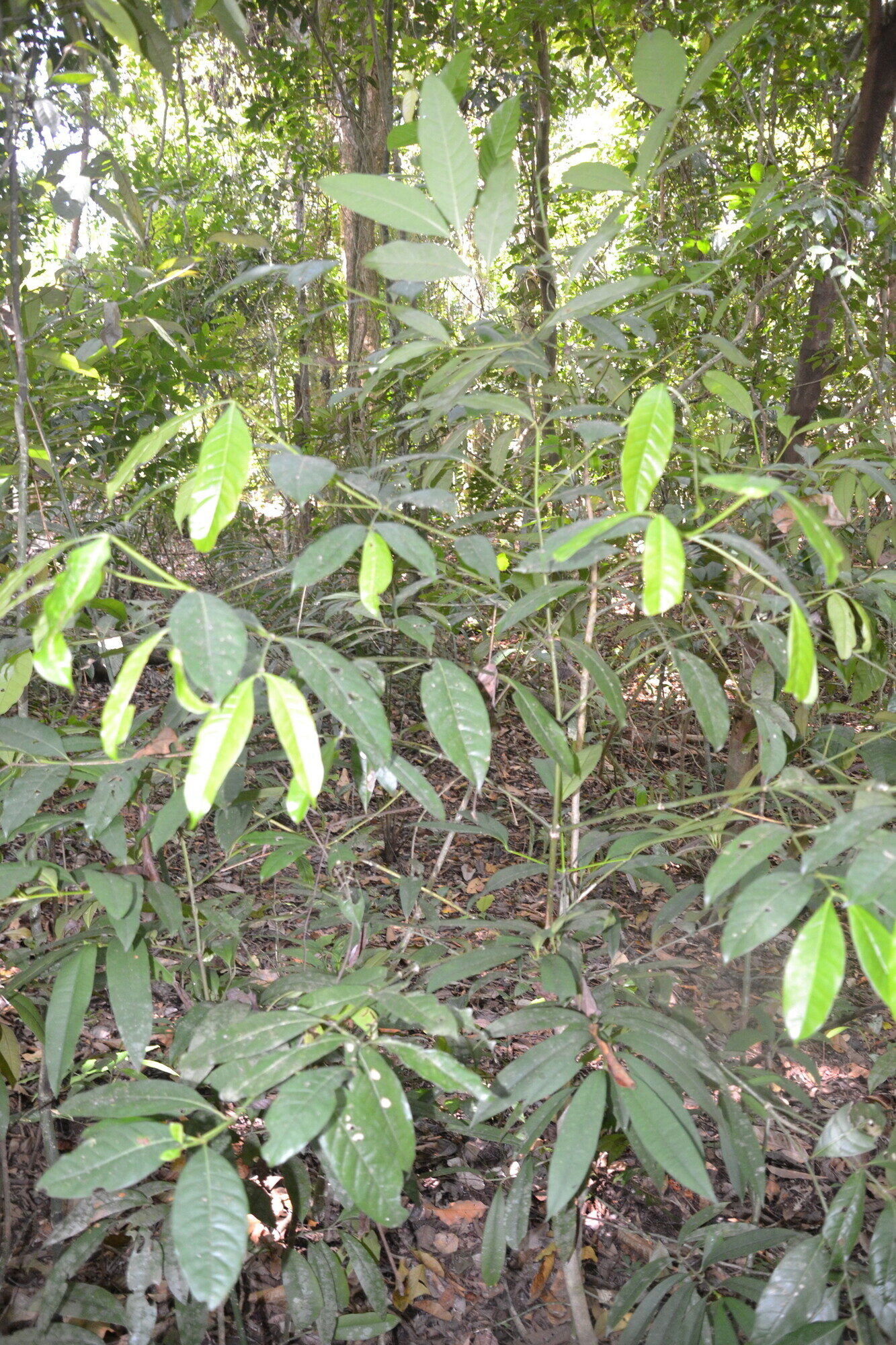
Faramea occidentalis is a slow-growing evergreen tree that typically reaches 4-6 meters in the Costa Rican understory, occasionally growing to 8-12 meters in optimal conditions and rarely exceeding 20 meters. The trunk is straight and slender, rarely surpassing 20 cm in diameter, supporting a thin, pyramidal crown formed by slightly horizontal branches. In larger individuals, shallow folds and creases texture the bole, sometimes extending to form small buttresses at the base.
Bark
The bark is smooth, dull, and gray-green in color. On older trees, the lower trunk develops shallow vertical folds that may extend to the base, occasionally forming low buttresses.
Leaves
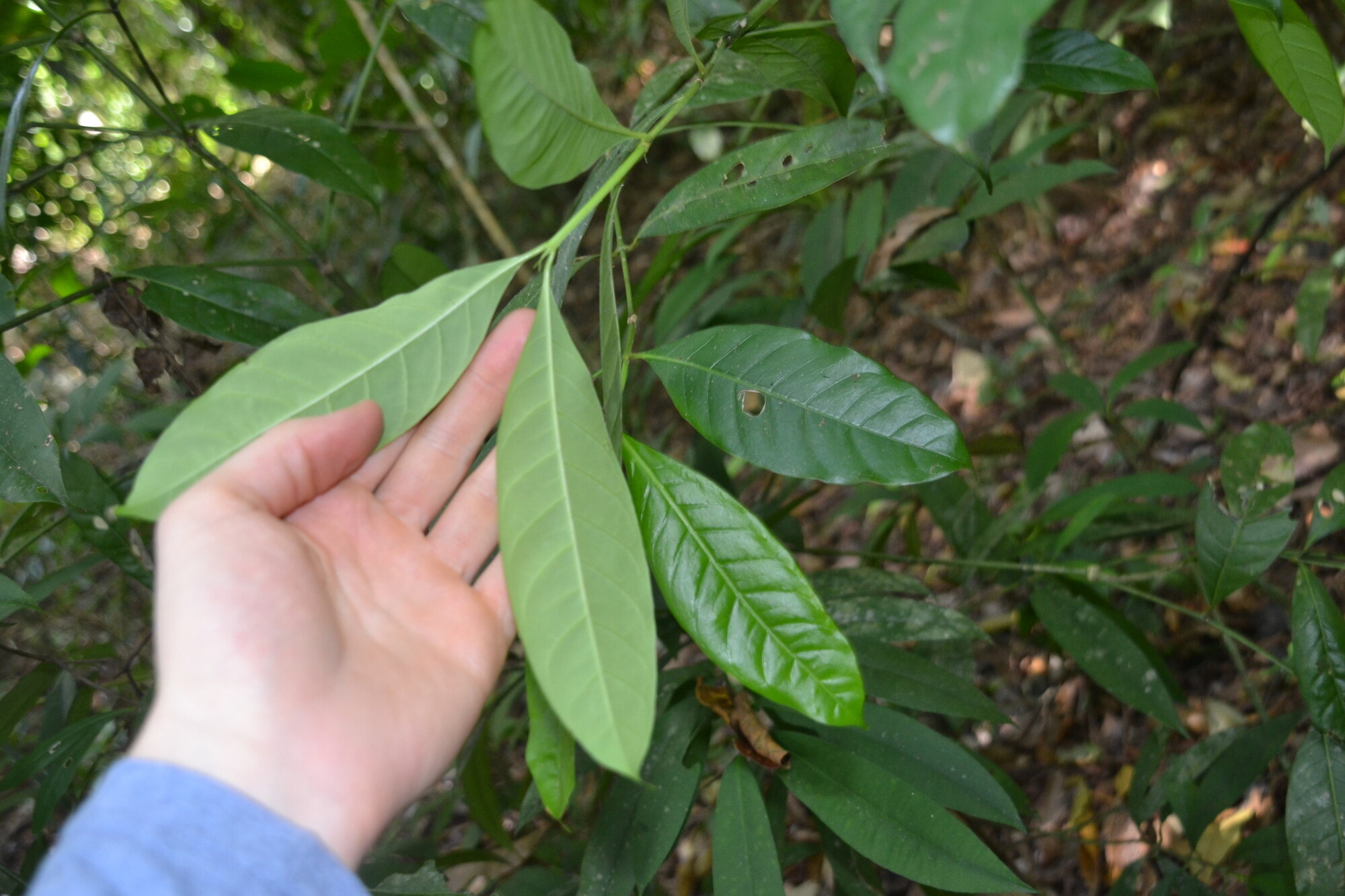
The leaves are simple, opposite, and elliptic, measuring 7-20 cm long by 4-10 cm wide. They are rigidly chartaceous (stiffly papery), hairless, with a smooth, glossy surface and impressed venation. The apex ends in an abrupt, tail-like drip tip (acumen) up to 1 cm long, an adaptation for shedding water in the wet forest environment. The base is acute to obtuse, and petioles measure 5-12 mm. The stipules provide a useful field character: broadly triangular at the base with a long, tail-like tip, the terminal pair crossing each other "like a tiny pair of scissors." The relatively narrow leaves help distinguish this species from similar understory trees with broader, more rounded foliage.
Flowers
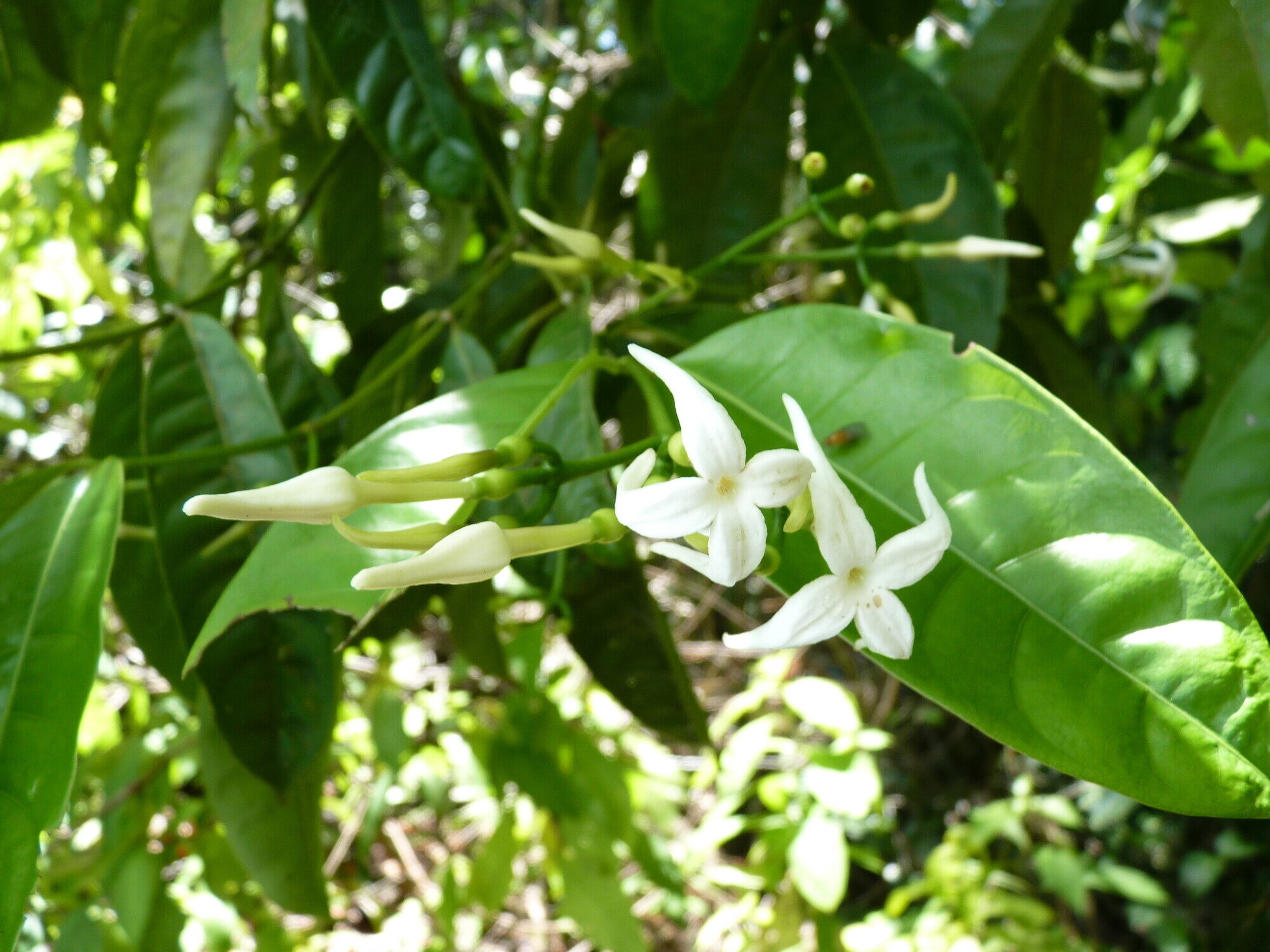
The flowers are arranged in terminal or axillary compound cymes 5-10 cm long. Each flower has a white, tubular corolla 7-12 mm long with four reflexed, lance-shaped lobes 4-8 mm long, giving the open flower a spidery appearance. The flowers release a strong, sweet, candy-like fragrance, particularly at night. Flowering is brief and synchronized, typically confined to a two-week period around May in Panama, though the timing may vary across the species' range.
Fruits
The fruit is a spherical drupe 8-15 mm in diameter, resembling a blueberry. It progresses from pale green through pink to deep purple-black when ripe, crowned by a short cylindrical calyx cup up to 2 mm long. Each fruit contains a single stone pit 5-7 mm in diameter, surrounded by juicy pulp. Ripe fruits are present from late September through December, with large crops occurring every two years in a biennial masting pattern.
Ecology
As a shade-tolerant understory specialist, Faramea occidentalis thrives in the dim light beneath the forest canopy. It recruits equally well in canopy gaps and closed understory, though seed survival is actually higher in shade than in the bright light of treefall gaps. Established seedlings are drought-tolerant, an important trait for surviving the dry season in seasonal forests. The species is much less common in secondary forest than in primary forest, suggesting it requires mature forest conditions to flourish.
The fragrant white flowers attract a diverse array of pollinators. Butterflies and long-tongued moths are the primary visitors, drawn by the sweet scent and tubular corollas that suit their proboscises. Hummingbirds also visit, though the flower morphology better matches insect visitors. The tendency for flowers to be shed by morning suggests nocturnal moths may be particularly important pollinators.
The purple-black drupes are eaten and dispersed by frugivorous birds and arboreal mammals. White-faced capuchins have been documented feeding on the fruits, dropping seeds throughout their home ranges. The juicy, berry-like fruits with their small stones are typical of bird-dispersed species in the coffee family.
Distribution
Faramea occidentalis has one of the broadest distributions in its genus, ranging from northeastern Mexico through Central America, throughout the Greater Antilles (Jamaica, Cuba, Puerto Rico), and south through Colombia, Venezuela, and Ecuador to Brazil. It grows in tropical moist forest, premontane moist forest, and premontane wet forest, from sea level to approximately 1,600 meters elevation. The species is most abundant on the Pacific slope of Central America.
In Costa Rica, the species is widespread but described as "occasional" rather than dominant, in contrast to its extreme abundance in Panama. It favors primary forests on well-drained hillsides and avoids wet, low-lying valleys and dry, sandy coastlines. GBIF records show 426 occurrences from Costa Rica, with 70 documented localities in the Brunca region alone, including sites throughout the Osa Peninsula, the Golfo Dulce lowlands, Palmar Norte, Rancho Quemado, and the Peninsula de Burica.
Taxonomic History
The botanical documentation of Faramea occidentalis begins with Irish physician Patrick Browne, who settled in Jamaica in 1746 and spent a decade studying the island's flora. In 1756, he published The Civil and Natural History of Jamaica, the first English botanical work to use Linnaeus's binomial system. Among its 104 new generic names was an illustration of this species, rendered by the renowned botanical artist Georg Dionysius Ehret. Three years later, Linnaeus formally described the species as Ixora occidentalis in the tenth edition of Systema Naturae (1759), basing his work on Browne's Jamaica material.
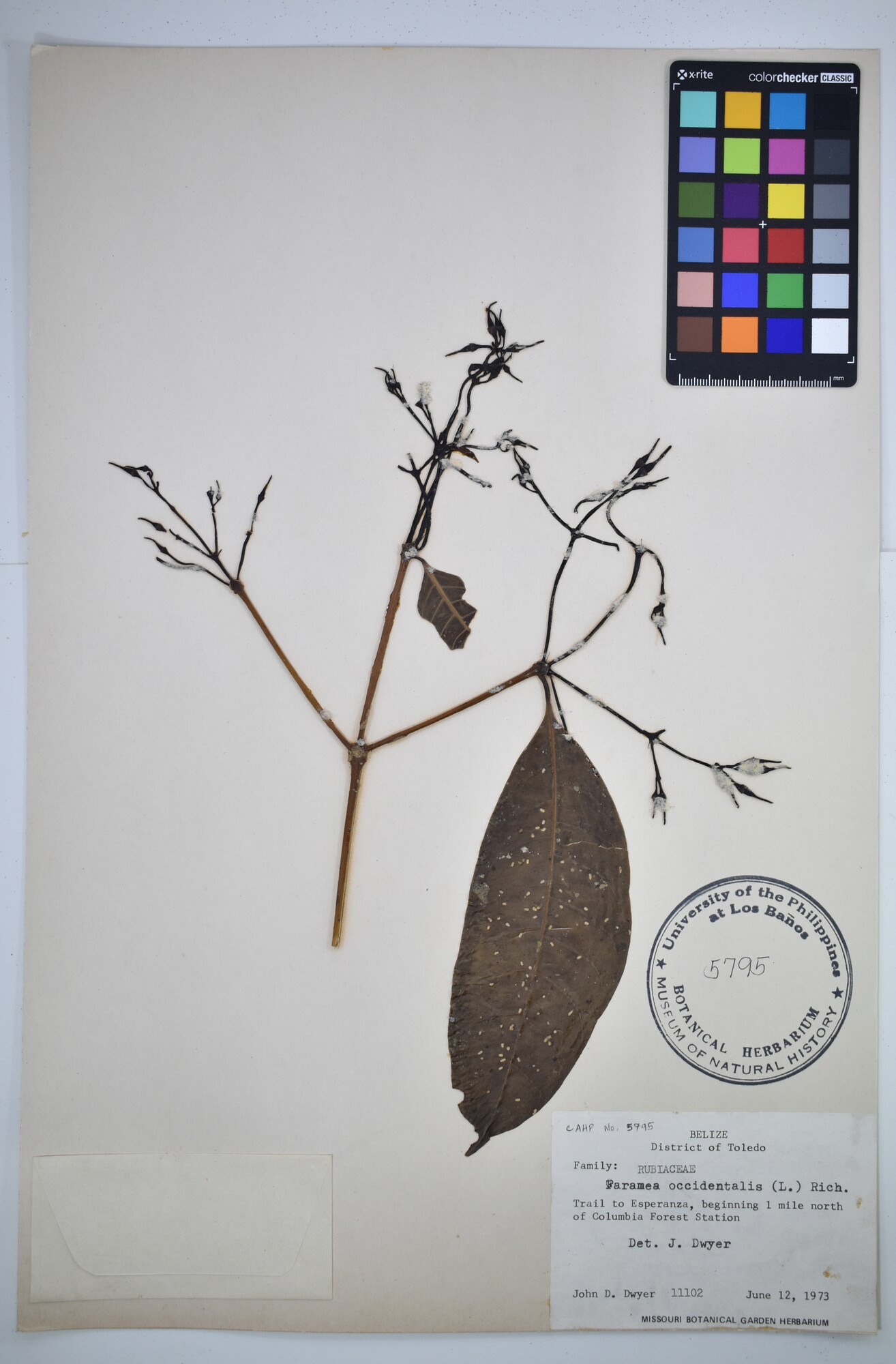
In 1830, French botanist Achille Richard transferred the species to Faramea, recognizing its closer affinity to that genus than to Ixora. Richard (1794-1852) was a physician and botanical illustrator who became Professor of Botany at the Faculty of Medicine in Paris and a member of the Paris Academy of Sciences. The combination Faramea occidentalis (L.) A. Rich. was published in A.P. de Candolle's Prodromus Systematis Naturalis (1830), based on Richard's work, and remains in use today.
The epithet "occidentalis" means "western" in Latin, referring to the species' occurrence in the Western Hemisphere rather than the Old World tropics. The genus name Faramea was established by French botanist Jean-Baptiste Aublet in 1775 from French Guiana; its etymology is uncertain but may derive from an indigenous name used in the Guianas. The genus comprises approximately 170 species of shrubs and small trees exclusive to the Neotropics.
Similar Species
In Costa Rican forests, Faramea occidentalis may be confused with other understory trees of similar stature, including Eugenia acapulcensis, Posoqueria latifolia, and Chione sylvicola. The relatively narrow, elliptic leaves of Faramea distinguish it from these species, which tend to have broader, more rounded foliage. The distinctive stipules, with their terminal pair crossing like tiny scissors, provide another reliable field character. Within its own genus, F. occidentalis is morphologically variable across its range, leading to confusion with regional species, though modern taxonomic treatments maintain it as a distinct, widespread species.
Uses
In Cuba, where the species is known as "nabaco," traditional medicine employs the leaves as an antiseptic and astringent, particularly for bathing newborns with skin conditions. It has also been used as a galactogogue to promote milk production in nursing mothers. Phytochemical screening has validated these traditional uses by detecting alkaloids and coumarins in root, stem, and leaf extracts, compounds that may account for the plant's antiseptic properties.
The wood is hard, moderately heavy (density 0.58 g/cm3), strong, and very tough, taking a good polish. The straight stems are used in house construction, general carpentry, and for making tool handles, cutting boards, and other small objects. The heartwood is brownish-white tinged with yellow, with a thin band of nearly white sapwood.
A Model for Tropical Forest Science
Few tropical trees have contributed as much to ecological understanding as Faramea occidentalis. On Barro Colorado Island in Panama, where the species is hyperdominant in the understory, researchers have followed its entire life cycle from flowering through seed dispersal, germination, and seedling establishment. Studies here have documented density-dependent effects on growth (small stems grow 23.5% more slowly when large conspecifics are nearby), the complexity of mycorrhizal associations, pollen performance under environmental stress, and the factors affecting seed survival. The species is included as the "faramea" dataset in the BiodiversityR package for ecological analysis, making its data available to researchers worldwide.
Conservation Outlook
Faramea occidentalis has not been formally assessed by the IUCN, but predictive models suggest it is not threatened. Its broad distribution from Mexico to Brazil, occurrence across multiple countries and ecosystems, and presence in numerous protected areas all indicate a species of low conservation concern. It is known from Manuel Antonio National Park, the Barro Colorado Island Nature Monument in Panama, and the protected forests of the Osa Peninsula. The species' preference for primary forest, combined with its relative scarcity in secondary growth, suggests that forest conversion and fragmentation pose the greatest long-term risks. Maintaining connectivity between mature forest patches in regions like the Osa Peninsula will help ensure the species' continued presence in Costa Rica's biological corridor.
Resources & Further Reading
Species Information
Detailed species account for Costa Rica's Pacific slope forests.
Comprehensive information on uses, properties, and cultivation.
Plants of the World Online entry with distribution and synonymy.
Global occurrence records and specimen data.
Taxonomy & Nomenclature
Nomenclatural data and specimen records from Missouri Botanical Garden.
2021 study on infrageneric classification and species limits in the genus.
Research
Smithsonian chapter on this model species for tropical forest ecology.
Molecular study revealing 30 AM fungal types associated with this species.
Species account from the Smithsonian Tropical Research Institute.