Poeppig's Faramea
Faramea glandulosa is a shade-tolerant understory tree of lowland wet forests from Mexico to Peru. Its striking blue flowers on white inflorescence branches distinguish it from its more common white-flowered relatives. In Costa Rica, the species thrives in the primary forests of Corcovado and Piedras Blancas National Parks, where its fleshy fruits sustain monkeys and forest birds.
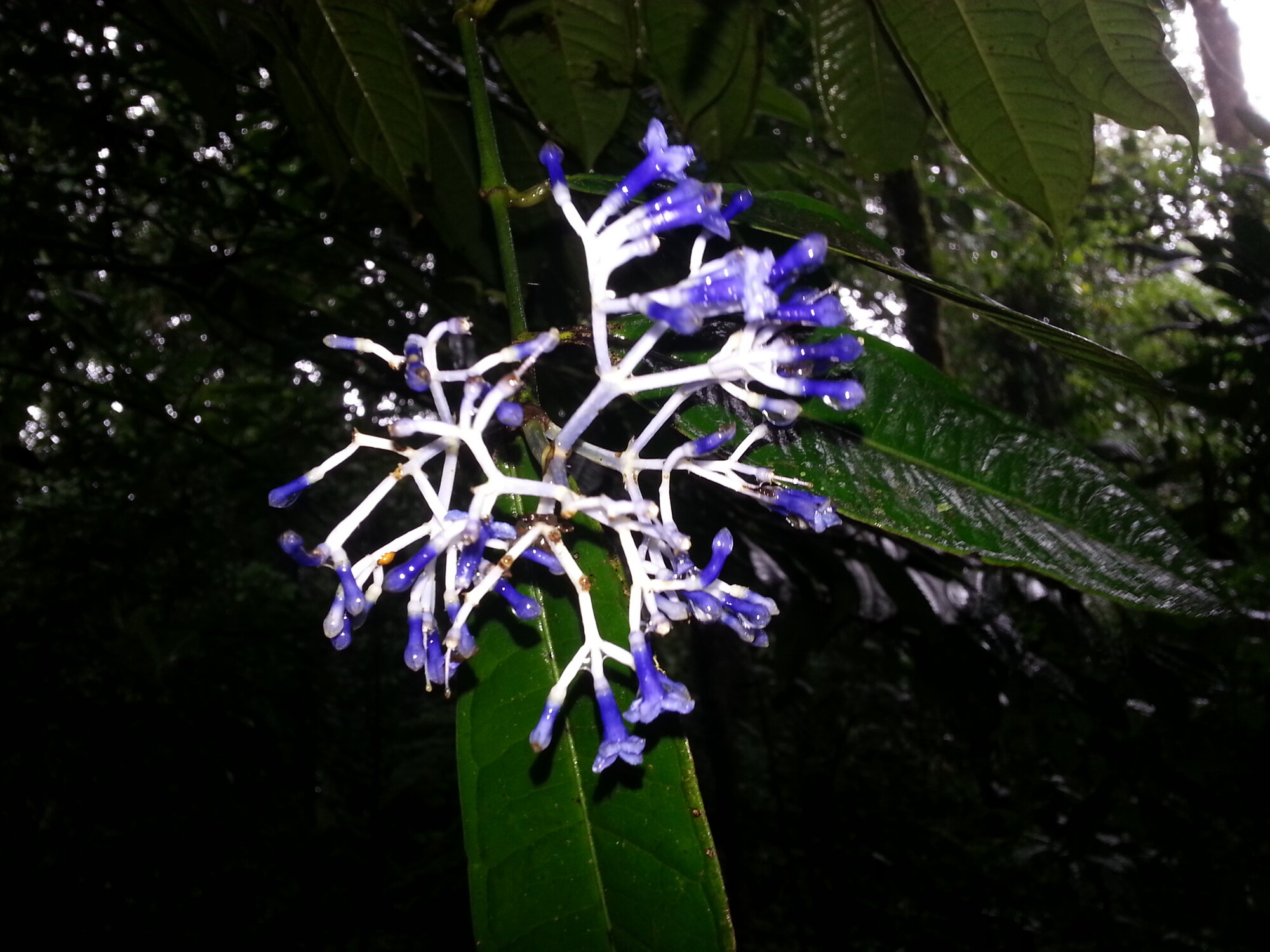
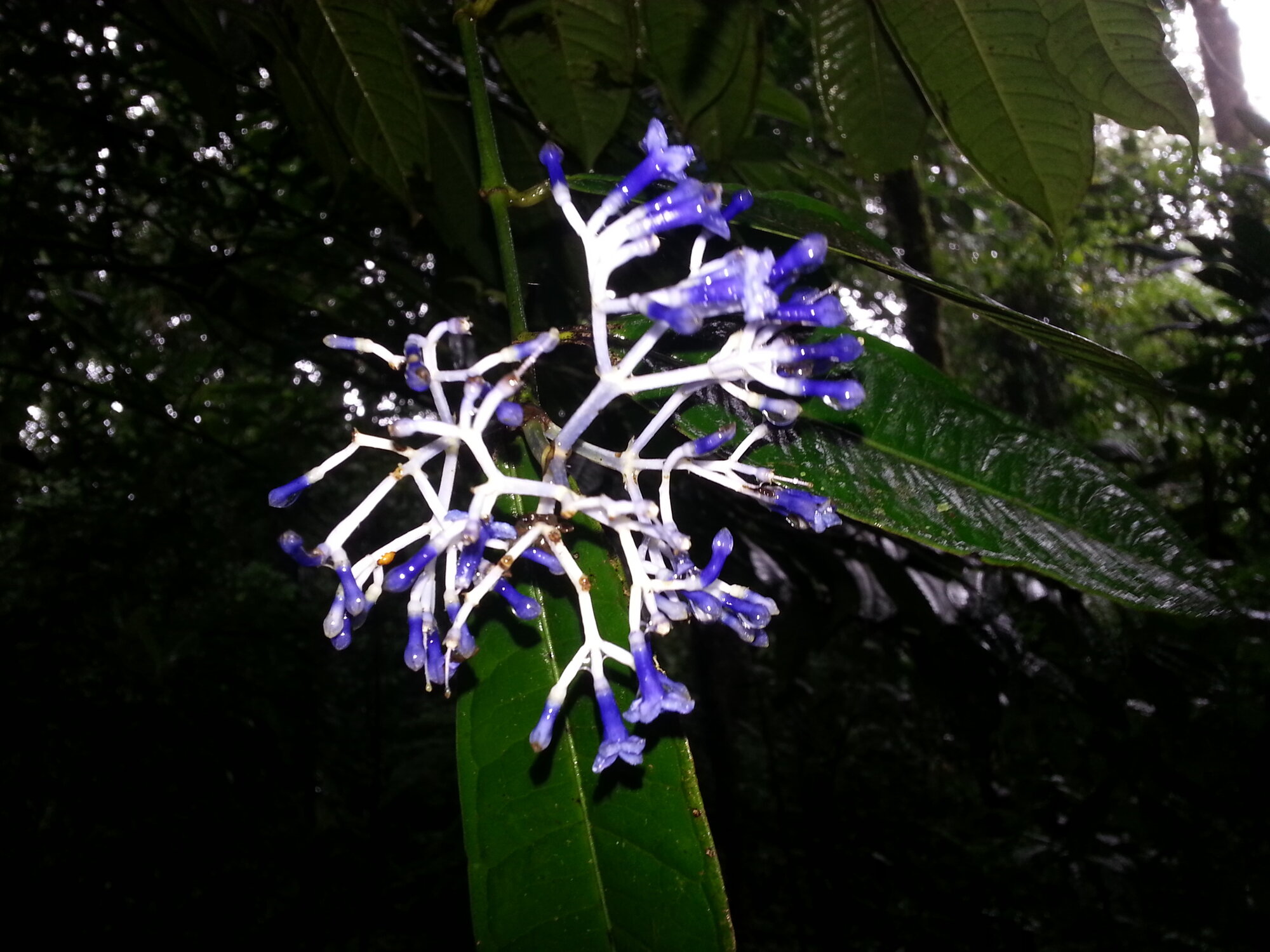
In the dim understory of Costa Rica's wettest forests, where light filters through multiple canopy layers and epiphytes drape every branch, a slender tree blooms with unexpected brilliance. Faramea glandulosa produces flowers of deep blue to purple on starkly white inflorescence branches, a display that seems almost luminous against the forest's green backdrop. This color combination is unusual among the Rubiaceae, a family that includes coffee and cinchona but whose members typically bear white or cream-colored flowers.
German botanist Eduard Poeppig first collected this species during his 1827-1832 expedition through the Amazon, one of the most ambitious botanical journeys of the nineteenth century. Traveling the entire length of the Amazon River, Poeppig documented hundreds of new species, including this blue-flowered understory tree that would later prove to range far beyond Peru into the forests of Central America. In Costa Rica's Corcovado and Piedras Blancas National Parks, Faramea glandulosa grows beneath towering canopy trees like Brosimum utile and Carapa guianensis, its presence an indicator of intact primary forest.
Identification
Habit
Faramea glandulosa grows as a shrub or small tree of variable stature, ranging from 1.5 meters in exposed sites to 10 meters in favorable primary forest conditions. Most individuals in Costa Rica reach 3 to 6 meters. The plant develops long, drooping branches that give it a graceful, weeping appearance. Young branchlets dry greenish, and the stems are glabrous (hairless) throughout.
Leaves
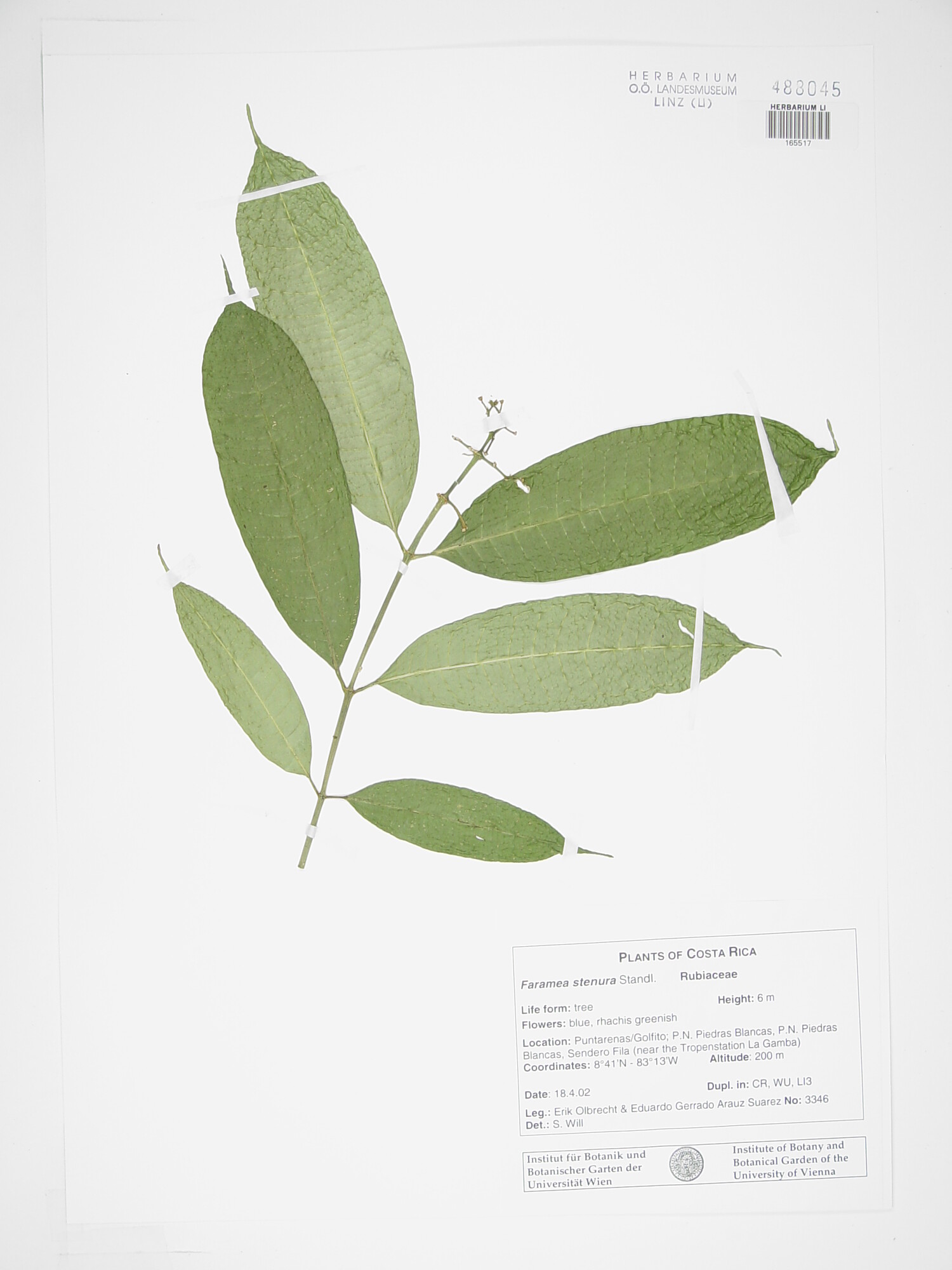
The leaves are opposite and narrowly oblong to narrowly elliptic, measuring 9 to 19 cm long and 2.5 to 5.5 cm wide. Each leaf tapers to a long acuminate tip (the "drip tip" common in rainforest plants), typically 5 to 23 mm long, which helps shed water in the wet forest environment. The base is acute to cuneate. Leaves are chartaceous (papery) in texture and dry to a dark grayish-green color on the upper surface. Secondary veins number 9 to 12 per side, arising at nearly right angles and weakly loop-connected near the margin. The stipules are deciduous (caducous), a key feature distinguishing this species from the similar F. multiflora.
Flowers
The flowers are the most distinctive feature of this species. They are salverform (with a narrow tube and spreading lobes), pale to deep blue or purple in color, and arranged in terminal (branch-tip) pyramidal panicles (branched flower clusters) measuring 3 to 5.5 cm long and 4 to 7 cm broad. The corolla tube (the fused petals forming the narrow throat) is 5 to 8 mm long with 4 lobes (petal-like segments) of 3 to 5 mm. The inflorescence (flower cluster) branches themselves are purplish to white, creating a striking contrast with the blue flowers. Collectors have noted the flowers as "very aromatic." The flowers are tetramerous (4-parted) and distylous (occurring in two forms with reciprocal placement of stamens and stigmas), a pollination system that promotes outcrossing (cross-pollination between different plants).
Fruits
The fruits are transversely reniform (kidney-shaped) to subglobose (nearly spherical) drupes (fleshy fruits with a hard stone inside), 4 to 8 mm high and 12 to 15 mm broad. A key diagnostic feature is that young fruits have longitudinal ribs (lengthwise ridges), which distinguishes F. glandulosa from the smooth-fruited F. multiflora. The fruits transition from green when immature to purple when ripe, finally drying to a greenish or blackish color. Each fruit contains a single large seed surrounded by fleshy pulp. Some specimens have been noted to exude purple-colored sap when cut.
Distribution
Faramea glandulosa has a broad Neotropical distribution, ranging from southern Mexico through Central America to Colombia, Ecuador, Peru, and Brazil. In Costa Rica, it occurs on both Caribbean and Pacific slopes in wet lowland forests. GBIF records show the species in the Brunca region at localities including Corcovado National Park, Piedras Blancas National Park, and the Golfo Dulce Forest Reserve, typically at elevations from sea level to about 1,000 meters.
The species is a characteristic understory component of primary wet forest, showing a strong preference for shaded conditions. Research on the related F. occidentalis has shown that Faramea seed survival is significantly lower in treefall gaps than in the forest understory, indicating these are shade-tolerant, late-successional species dependent on intact forest cover. Collectors at Corcovado have described F. glandulosa as "common" in primary forest habitats.
Ecology
The aromatic blue flowers of Faramea glandulosa suggest a pollination syndrome different from its white-flowered relatives. While white-flowered Faramea species with narrow tubular corollas are often pollinated by nocturnal moths, the blue color of F. glandulosa likely attracts diurnal pollinators such as butterflies and long-tongued bees. Studies on the congener F. cyanea have documented a mixed pollination system involving both daytime and nighttime visitors. The distylous breeding system, with two flower morphs that can only fertilize each other, ensures genetic diversity through obligate outcrossing.
The fleshy, blue-black fruits are dispersed by forest vertebrates. White-faced capuchin monkeys (Cebus capucinus) are documented dispersers of related Faramea species, and the high water content and soft pulp of the fruits also attract frugivorous birds such as tanagers and manakins. Like many understory trees in wet tropical forests, Faramea species may exhibit mast fruiting, with research on F. occidentalis on Barro Colorado Island showing variable annual fruit production that creates important periodic food pulses for forest fauna.
Taxonomic History
Faramea glandulosa was described by the German botanist Eduard Friedrich Poeppig and Austrian botanist Stephan Ladislaus Endlicher in their monumental work Nova Genera ac Species Plantarum, published in fascicles from 1835 to 1845. Poeppig was one of the great botanical explorers of South America, spending 1827 to 1832 collecting in Chile, Peru, and Brazil. He traveled the entire length of the Amazon River and described 31 new genera and 477 new species. The type specimen of F. glandulosa was almost certainly collected during his Amazonian travels in Peru.
The species epithet "glandulosa" means "glandular" in Latin, referring to glandular structures present on some part of the plant. The genus name Faramea was established by Jean Baptiste Christophore Fusee Aublet in 1775, possibly from an indigenous name used in French Guiana, though the etymology has never been confirmed. The genus belongs to the tribe Coussareeae and is exclusively Neotropical, with fossil pollen from the Eocene epoch (approximately 40 million years ago) found in Panama, demonstrating that Faramea was present in Central America long before the completion of the Isthmus.
Similar Species
Faramea glandulosa is most easily confused with F. multiflora, which shares the same wet forest habitats and similar leaf shape. The two species can be distinguished by examining the stipules and young fruits: F. glandulosa has deciduous stipules that fall early, leaving scars, while F. multiflora has persistent stipules. Additionally, the young fruits of F. glandulosa have longitudinal ribs, whereas those of F. multiflora are smooth. Where the two species co-occur, they may partition microhabitats: at La Selva Biological Station, researchers noted that F. stenura (a synonym of F. glandulosa) grows preferentially in low swales, while F. multiflora occupies the ridgetops. The species has historically been confused with F. multiflora in herbaria, and specimens identified as Faramea stenura are now considered synonyms of F. glandulosa.
Taxonomic questions remain in the highlands of western Panama. A collection from Chiriqui at 1,380 to 1,500 meters elevation differs from typical F. glandulosa in having persistent stipules, a character usually diagnostic of F. multiflora. Flora Costaricensis authors note this population "may represent an undescribed taxon," a reminder that even widespread species can harbor cryptic diversity at the edges of their range.
Chemistry
The genus Faramea has attracted attention from pharmaceutical researchers for its alkaloid chemistry. Studies on F. salicifolia and other species have isolated indole alkaloids with demonstrated activity against dengue virus, including compounds that inhibit viral replication at micromolar concentrations. While F. glandulosa itself has not been specifically screened, the presence of these compounds across the genus suggests it may share similar chemical properties, representing another reason why preserving this forest understory species matters for potential future drug discovery.
Conservation Outlook
Faramea glandulosa has not been evaluated by the IUCN Red List. Given its broad distribution from Mexico to Brazil and its presence in multiple protected areas, the species would likely qualify as Least Concern if assessed. However, as a shade-tolerant species dependent on primary forest, it remains vulnerable to deforestation and forest degradation.
In Costa Rica, the species occurs within the boundaries of Corcovado National Park, Piedras Blancas National Park, the Golfo Dulce Forest Reserve, and Guanacaste National Park. The connectivity of these protected areas through biological corridors is essential for maintaining gene flow among populations. As an understory species that requires intact canopy cover, F. glandulosa cannot persist in heavily logged forests or agricultural landscapes, making primary forest conservation the key to its long-term survival.
Resources & Further Reading
Species Information
Plants of the World Online entry with distribution and synonymy.
Global occurrence records and specimen data.
Taxonomic treatment with diagnostic characters and synonymy.
Taxonomy & Nomenclature
Nomenclatural data and specimen records from Missouri Botanical Garden.
Related Reading
Burger & Taylor (1993). Fieldiana Botany n.s. no.33. Comprehensive treatment of Costa Rican Rubiaceae including Faramea.
Botanical Journal of the Linnean Society study on genus phylogeny and ancient Eocene origins.
Biography of the German botanist who described this species during his 1827-1832 South American expedition.
Oecologia study documenting seed dispersal, predation, and mast fruiting in related Faramea species on Barro Colorado Island.
Missouri Botanical Garden's online flora treatment with keys and descriptions for regional Rubiaceae.