Espavel
Anacardium excelsum — The wild cashew, a riverside giant of the Pacific lowlands whose fruits feed monkeys, peccaries, and bats across the Neotropics.
Along the rivers and streams of Costa Rica's Pacific slope, the espavel rises above the surrounding canopy. Its straight, rose-hued trunk lifts a broad crown over the water, and in the floodplain forests of the Osa Peninsula a single species can dominate the stand. In the dry season the bare branches flush with new leaves and then with panicles of small, clove-scented flowers; by the first rains, curious fruits hang from the twigs, each a kidney-shaped nut slung beneath a swollen, fleshy stalk. Monkeys, peccaries, and fruit-eating bats converge to feed, dropping the nuts along the riverbanks where new giants take root.
The espavel belongs to the Anacardiaceae, the cashew family, alongside the mango, the pistachio, and the poison ivy that makes hikers miserable. Like its cultivated cousin the cashew (Anacardium occidentale), it carries the structure that defines the genus: a nut suspended below a swollen, edible pseudofruit. The cashew was domesticated and carried around the world; the espavel stayed in its native forests and grew into one of the largest trees of the Pacific lowlands.
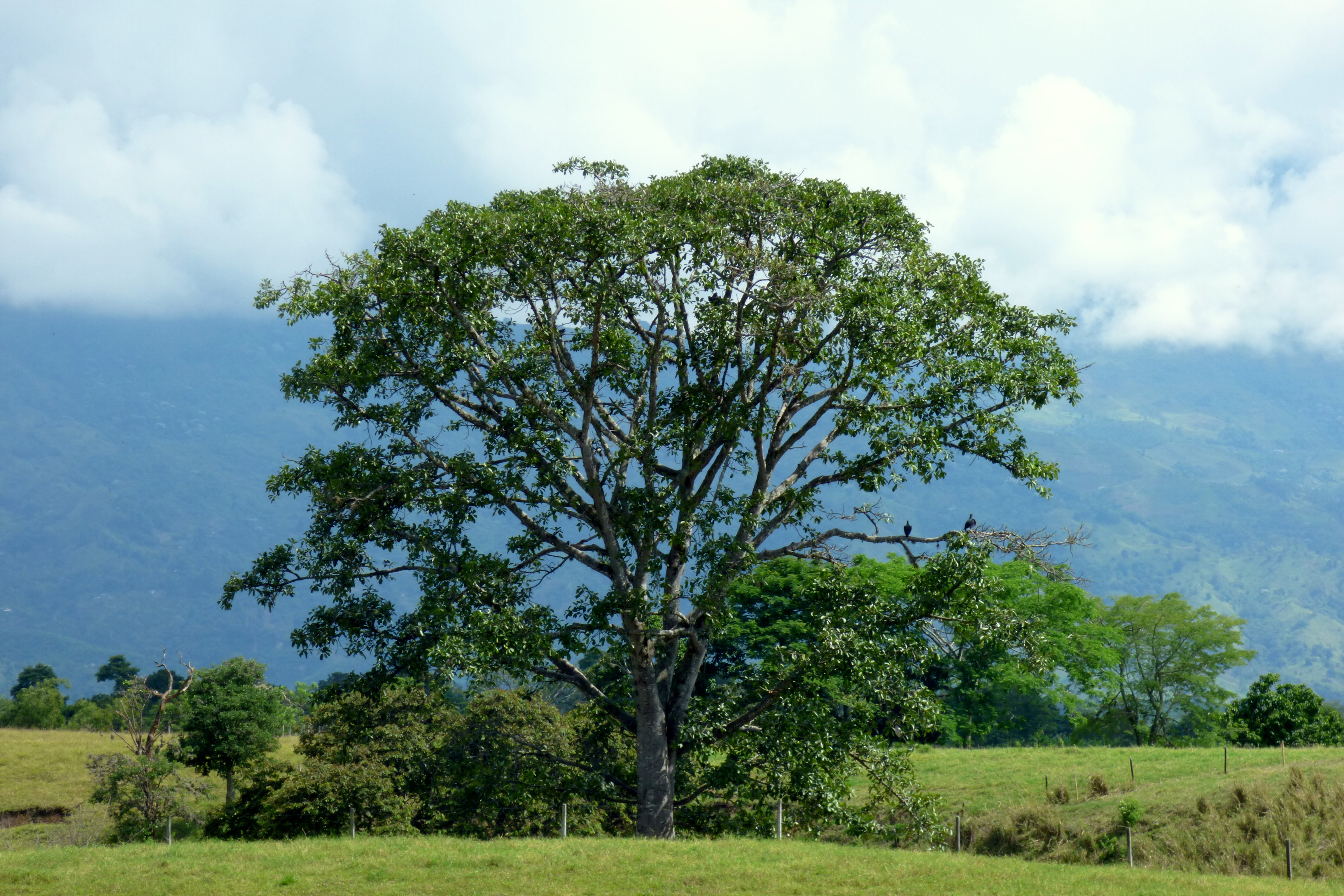
Identification
The common name espavel (sometimes spelled espavé) is used throughout Costa Rica and Panama. In Colombia the tree is caracolí, and in Venezuela mijao. Across its range it is a tree of large stature with a distinctive fruit, and a handful of field characters separate it from the other forest giants it grows among.
Habit
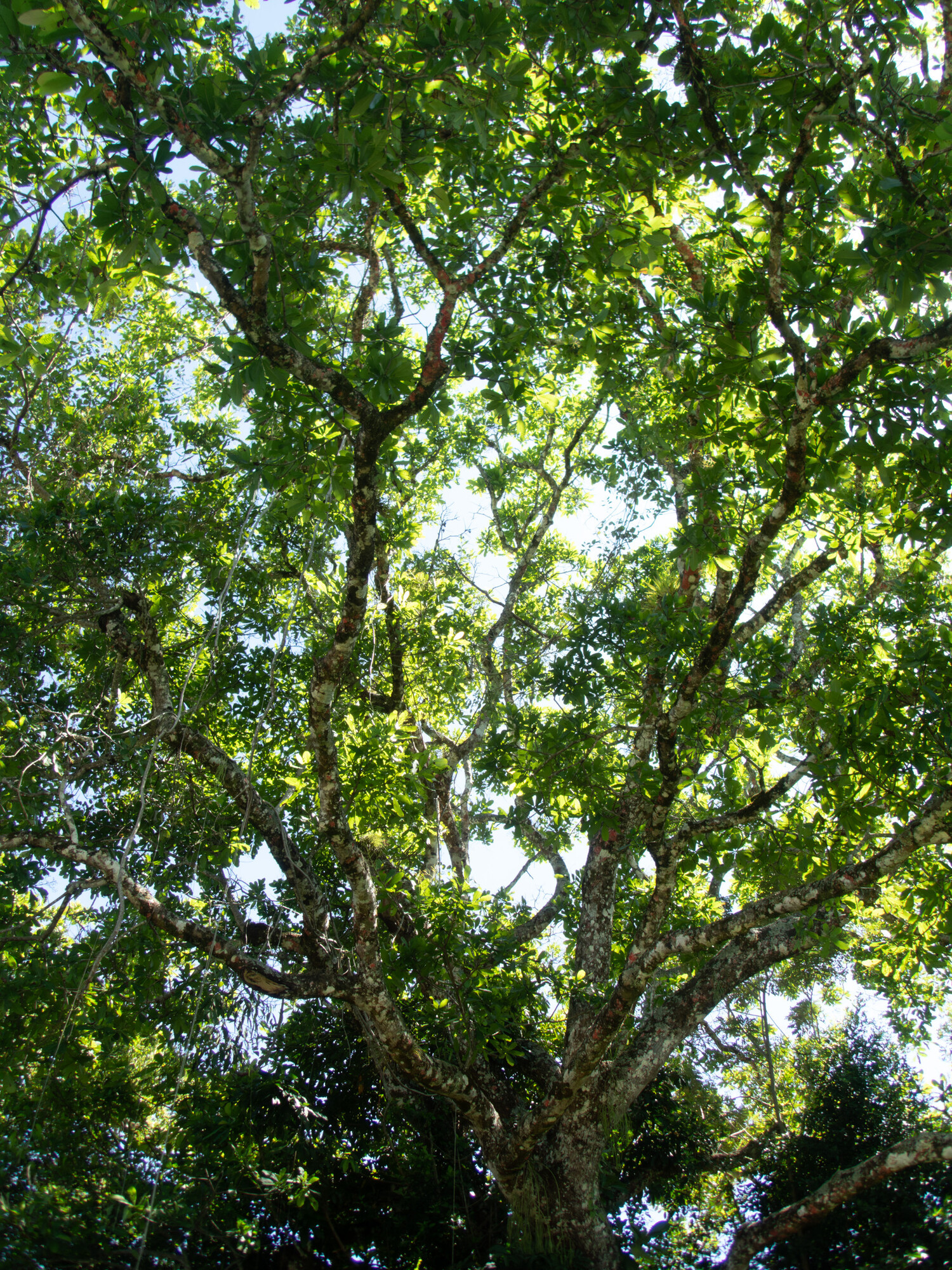
A very large evergreen tree, generally reaching 30 meters, with the largest individuals attaining 40 meters or more. The crown is broadly rounded or elongated and spreads wide over the canopy. The dense branching casts heavy shade, which makes the espavel a landmark in open pastures, where farmers leave it standing for cattle shelter.
Trunk & Bark
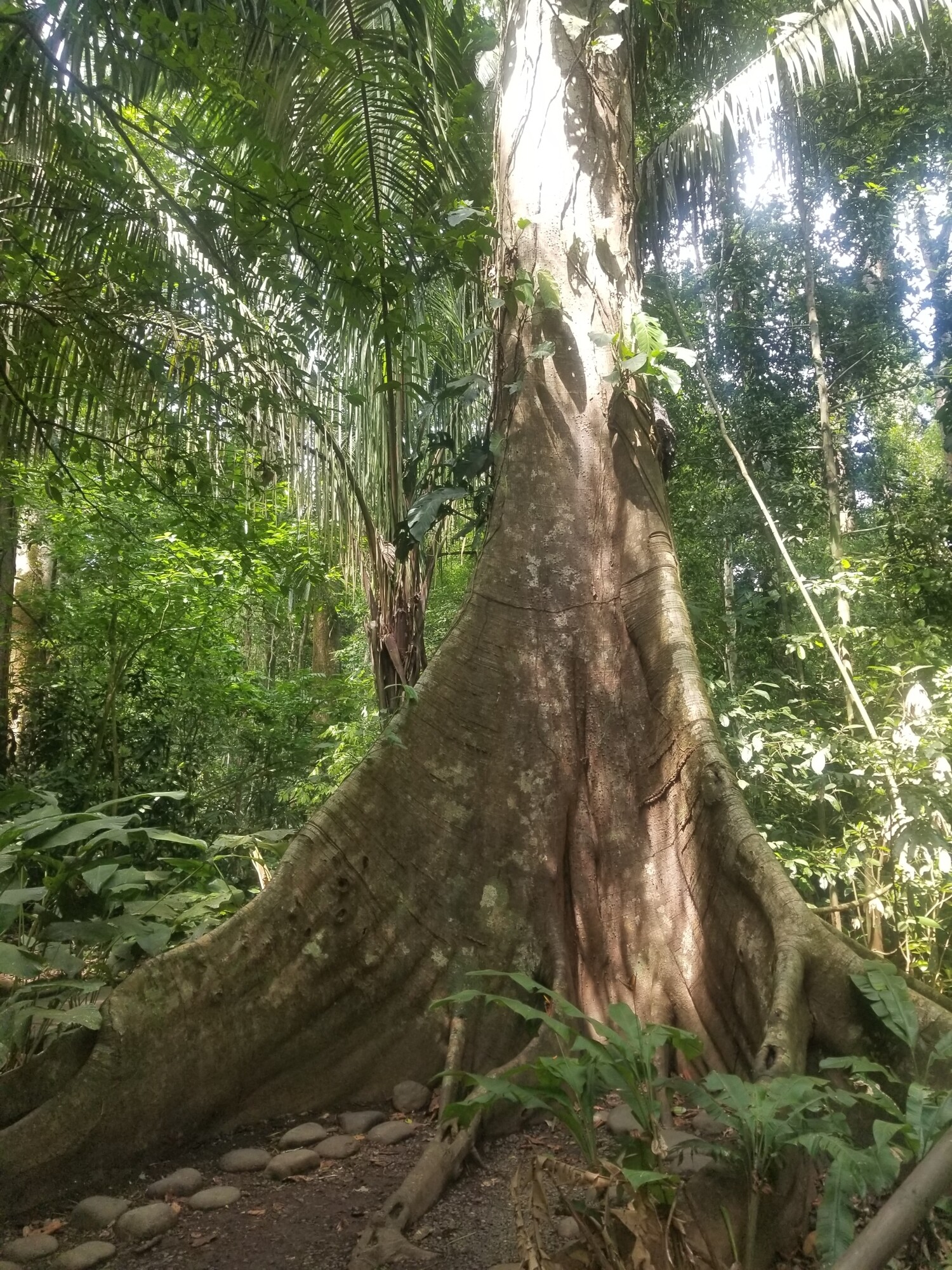
Massive and cylindrical, the trunk rises straight and free of branches for up to 18 meters before the first limbs. It commonly reaches about 2 meters in diameter, exceptionally to 3 meters, and shows a distinctive rose-hued or pinkish-brown color. Unlike the ceiba with its dramatic plank buttresses, the espavel develops only minor basal swellings, relying on sheer girth for stability.
Leaves
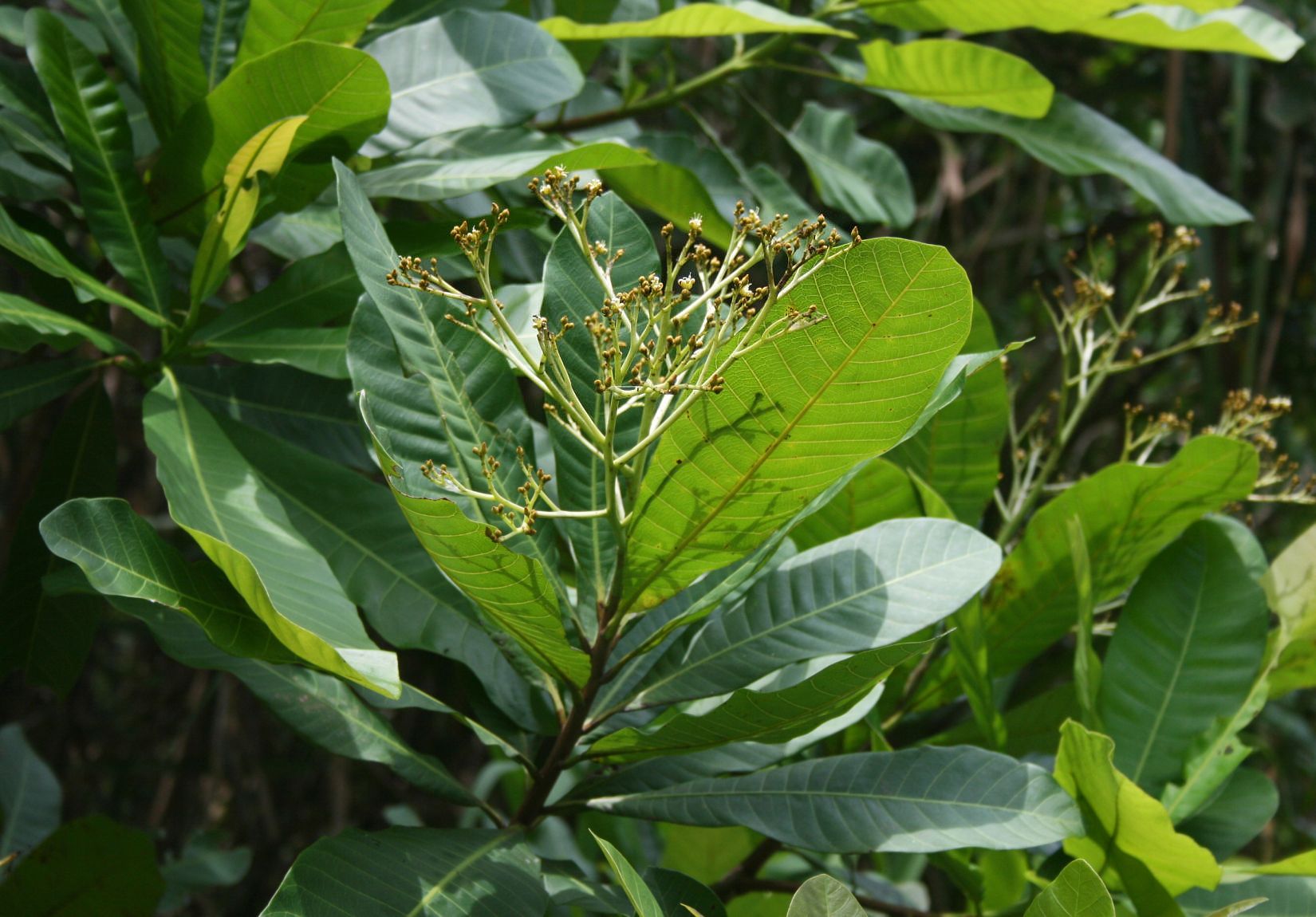
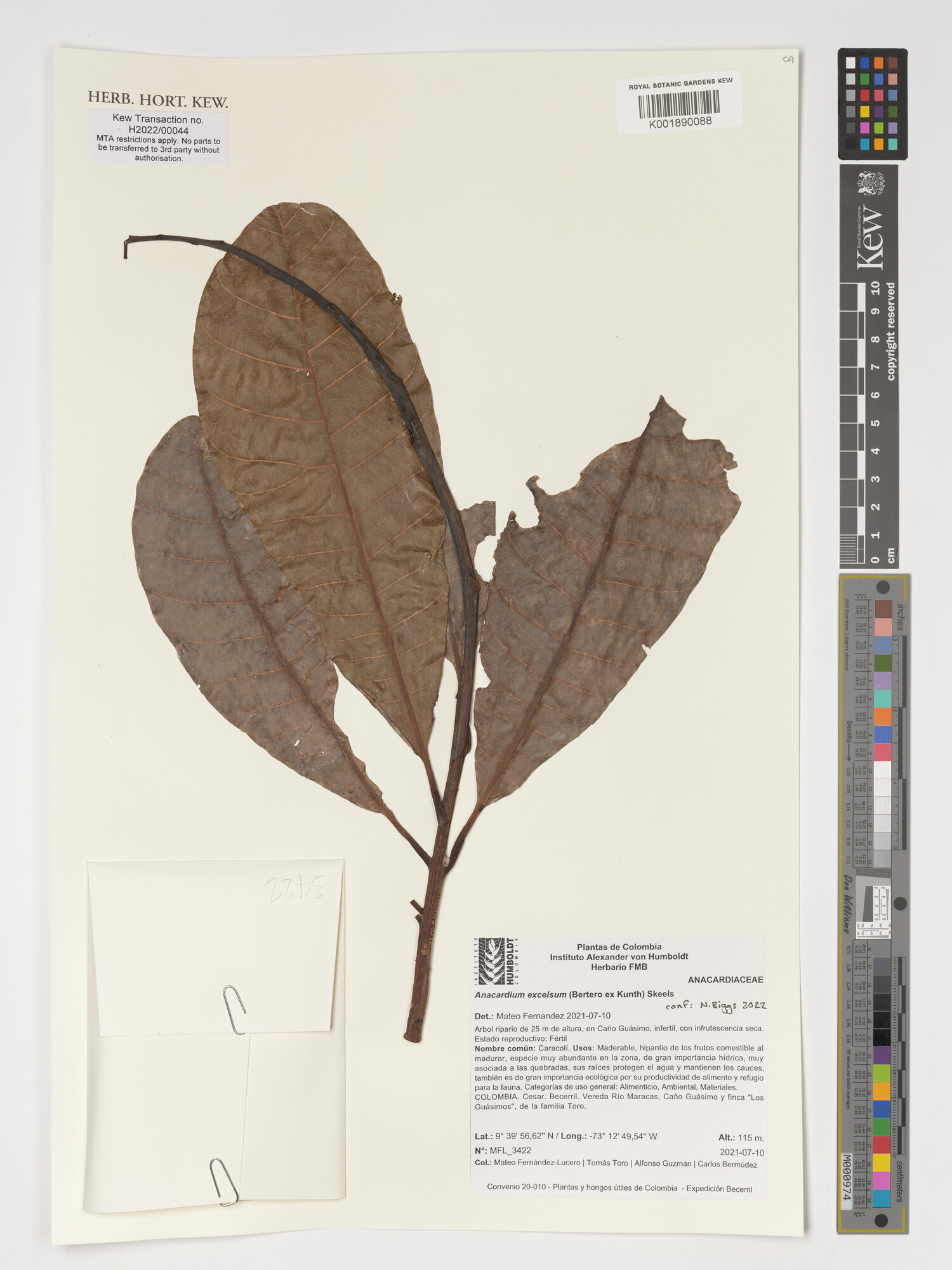
Large, simple, and leathery, the leaves are clustered at the tips of the twigs. They are oblong to obovate, with smooth margins and prominent veins. When crushed they release a mild resinous scent, faintly of mango or turpentine, that betrays the family connection. New foliage flushes bright green in the early dry season, just before the tree flowers.
Flowers
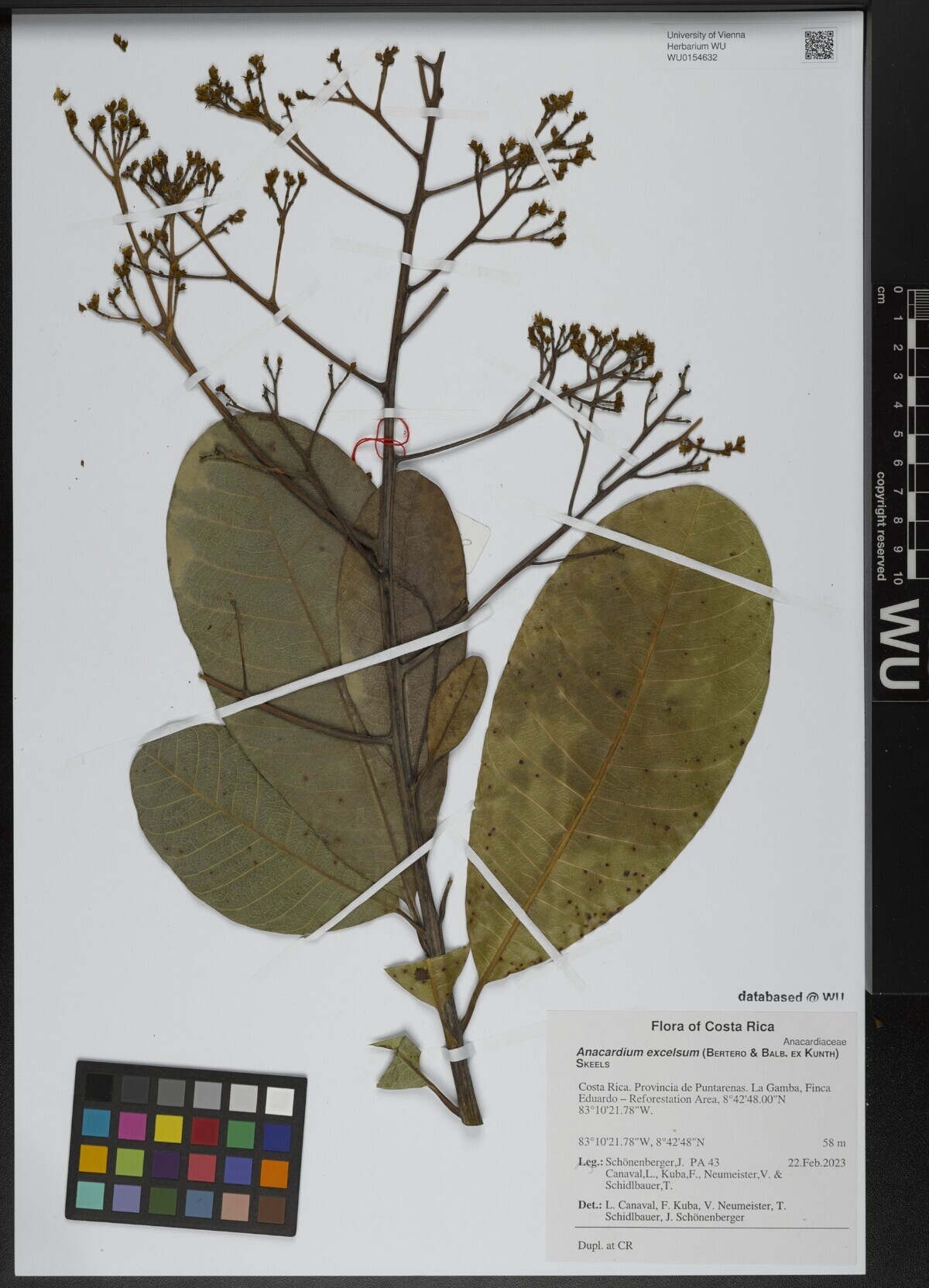
The flowers are small and inconspicuous, borne in large, pale greenish-white terminal panicles during the dry season, from December through April. Individual flowers darken to pink with age and carry a strong, clove-like fragrance that, in Paul Allen's words, "permeates the forest." They are visited by a range of insects, primarily bees, which move pollen between blooms.
Fruits
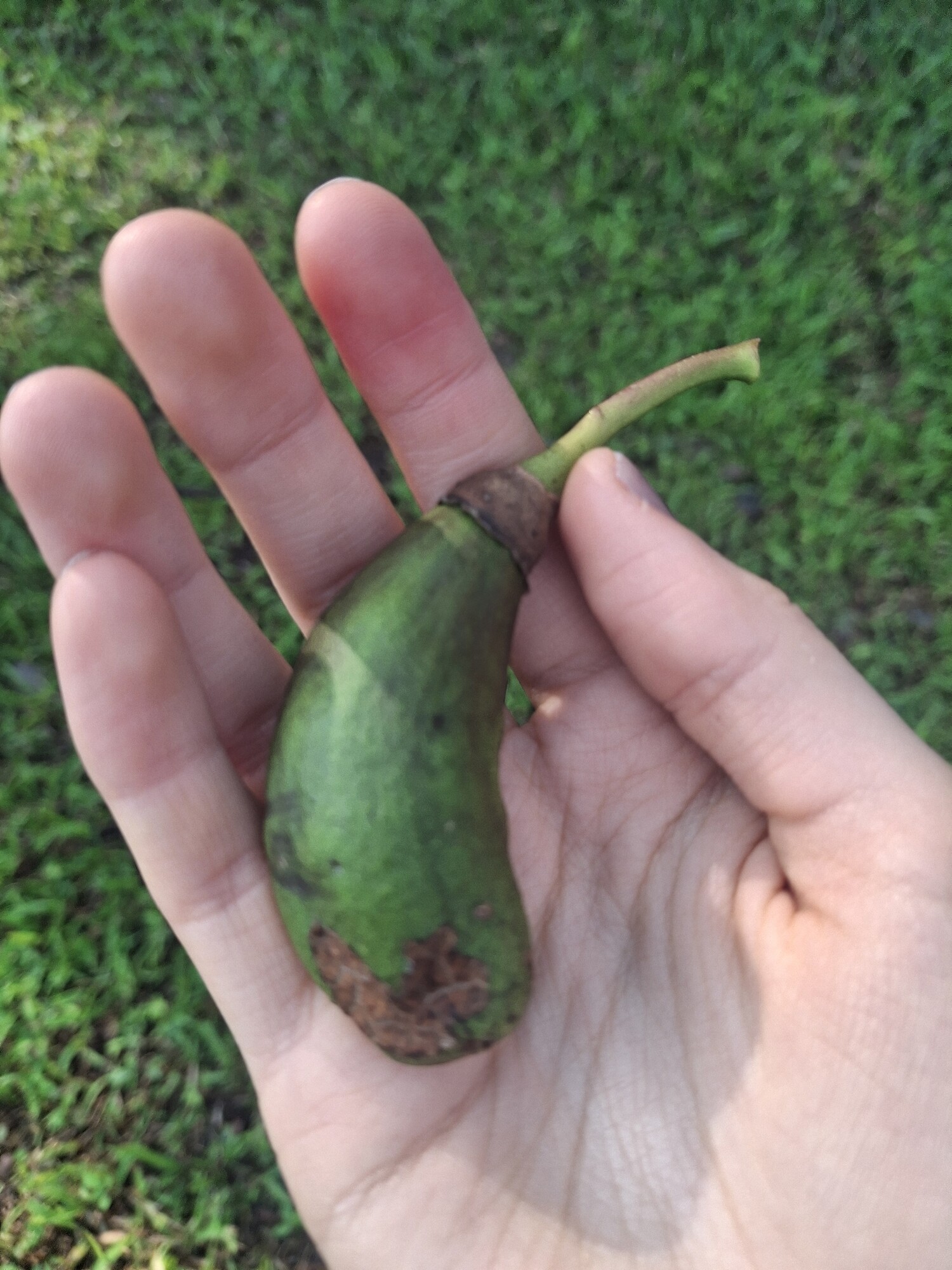
The cashew-type fruit consists of two parts. The true fruit is a kidney-shaped nut (a drupe) about 2-3 cm long, containing a single seed. Slung below it is a swollen, fleshy receptacle, the pseudofruit, S-shaped and 5-20 mm long. The pseudofruit is edible, with a hint of strawberry in the flavor; the nut is edible only when roasted, because the raw seed contains toxic, caustic oils like those of the cashew and poison ivy. The whole fruit hangs from a slender, strongly twisted stalk.
Distribution
The native range of the espavel runs from Central America south to Venezuela and Ecuador, with records also from Cuba. Plants of the World Online lists it as native to Colombia, Costa Rica, Cuba, Ecuador, Honduras, Nicaragua, Panama, and Venezuela. Of the roughly 5,500 occurrence records held by the Global Biodiversity Information Facility, the large majority are from Colombia, with Costa Rica and Panama the next most numerous. In Costa Rica it grows on the Pacific slope, from the dry forests of Guanacaste to the wet forests of the Osa Peninsula, and is essentially absent from the Caribbean lowlands.
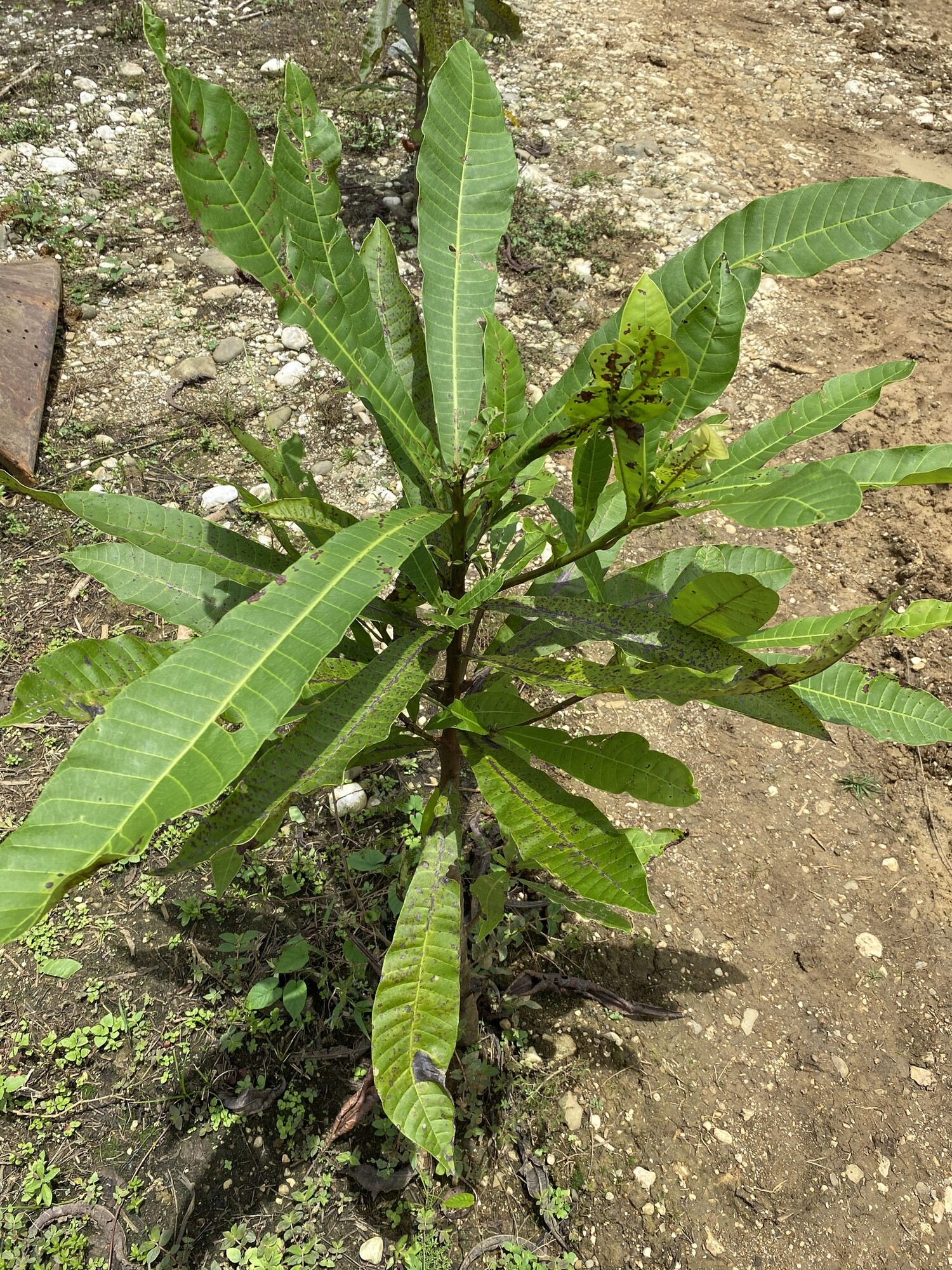
The espavel is quintessentially a riparian species, most abundant along rivers, streams, and seasonally flooded ground, where it sometimes forms nearly pure stands and creates gallery forests that thread through otherwise open landscapes. It tolerates an unusually wide range of rainfall, from about 1,200 to 4,500 mm a year, succeeding with or without a distinct dry season. It grows from sea level to roughly 1,000 meters in Costa Rica, and occasionally to 1,300 meters elsewhere in its range. It thrives on light clay, loam, and sandy soils with good access to water, tolerating seasonal flooding and waterlogged ground, an adaptation that explains its preference for riverbanks where roots can reach groundwater through the dry months.
Ecology
Few lowland trees shape their forests as plainly as the espavel. In the rain forests of the Golfo Dulce, the botanist Paul Allen found it to be the dominant canopy element, in places accounting for "as much as 50% of the total stand," with the largest trees rising 100 to 140 feet on the floodplains near Tinoco and Jalaca. Around Panama City it forms nearly pure stands. Because the seed does not germinate in shade, juveniles are scarce inside mature forest, and the giant trees stand sparsely but widely, recruiting instead along open, disturbed riverbanks.
That fruit crop feeds a broad guild of animals. The fleshy pseudofruit and nutritious nuts draw monkeys, collared peccaries, white-lipped peccaries, fruit-eating bats, and many birds. In Corcovado National Park, a study of white-lipped peccary diet found Anacardium excelsum among the fruits most available to the herds in the dry season, when peccaries spent most of their feeding time on fallen fruit in the primary forest. Fruit-eating bats carry the fruit to feeding roosts, eat only the fleshy part, and drop the nuts into the leaf litter, where they later germinate. As these animals move along the rivers, they spread the seed through the landscape.
Riparian Corridors
Its preference for riverbanks gives the espavel an outsized role in maintaining biological corridors. Rivers and streams already serve as natural pathways for wildlife, and a strip of riparian forest carrying espavel provides food and shelter along the route. In fragmented agricultural landscapes, those gallery strips can connect isolated forest patches, letting animals move between habitats that would otherwise be cut off from one another.
Restoration Potential
Conservation organizations on the Osa Peninsula plant espavel in restoration projects. Its tolerance of disturbed conditions, its importance for wildlife, and its natural role as a pioneer make it well suited to reforesting degraded riparian zones. As a pioneer that establishes in light gaps and secondary forest, the espavel helps initiate succession, eventually creating the shaded conditions that slower-growing, shade-tolerant species need. Its growth is moderate, not fast, so a planted tree takes decades to reach full size.
Taxonomic History
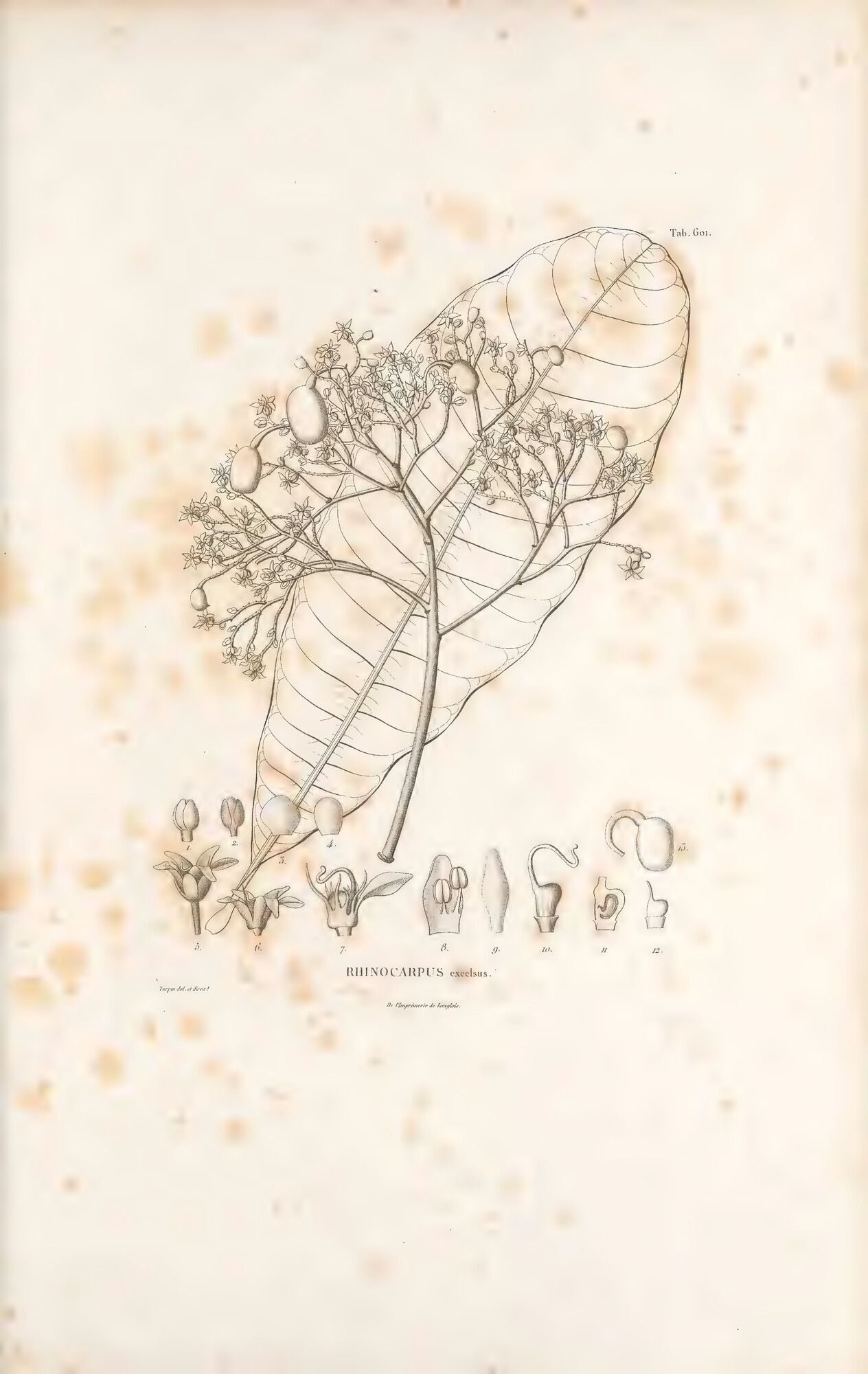
The espavel entered formal botany under a different name. The Italian botanists Carlo Bertero and Giovanni Battista Balbis had labeled herbarium material as Rhinocarpus excelsus, and Karl Sigismund Kunth validated that name in 1824 in the seventh volume of Humboldt, Bonpland, and Kunth's Nova Genera et Species Plantarum, the great flora that came out of Alexander von Humboldt's American expedition. The account was based on a specimen from near Turbaco, in the Caribbean lowlands of present-day Colombia.
The name jumped genera over the following century. In 1825 Augustin Pyramus de Candolle published the combination Anacardium rhinocarpus, but as a later, superfluous name it is illegitimate. The accepted combination dates to 1912, when the American botanist Homer Collar Skeels transferred the species to Anacardium as Anacardium excelsum, in the Bulletin of the Bureau of Plant Industry of the U.S. Department of Agriculture. Plants of the World Online today treats Rhinocarpus excelsus and Anacardium rhinocarpus as the two homotypic synonyms of the accepted name.
Both genus names point at the fruit. Anacardium joins the Greek ana (up, upon) and kardia (heart), for the heart shape of the nut and its stalk; the older Rhinocarpus joins rhinos (nose) and karpos (fruit), for the same curved, nose- or kidney-shaped nut. The species epithet excelsum is Latin for "tall" or "lofty," an apt word for one of the largest trees of the Central American lowlands.
Uses
Timber
The espavel produces a brown to dark-brown or reddish-tinged heartwood, clearly demarcated from a band of light brown sapwood. The grain is typically interlocked and the texture medium-coarse. It is a lightweight, low-density wood, with an average dried weight near 500 kg per cubic meter (specific gravity about 0.41 to 0.50). It is moderately durable, with some resistance to fungi and dry-wood termites, though reports vary and it is susceptible to general insect attack. Because the tree is abundant and large, its timber is frequently sold in markets in Panama and is sometimes exported; some sources note it can substitute for mahogany in certain applications. Historically it has been used for construction, tools, furniture, boxes, dugout canoes, and, in the Golfo Dulce, for bridge boards, fence posts, and concrete forms.
Food
Like its cultivated cousin the cashew, the espavel produces edible nuts when properly prepared. The seeds must be roasted to destroy the toxic oils before they can be eaten, and the roasted nuts taste similar to cashews; local people have long gathered and toasted them. The fleshy pseudofruit is also edible raw, with a slightly tart, strawberry-like flavor, though it is not consumed commercially on any scale.
Traditional Uses
Beyond food and timber, the espavel has served other traditional purposes. The macerated bark contains compounds reportedly used as a barbasco, a fish poison that stunned fish in quiet pools for easy catching. The non-toxic leaves may be browsed by livestock, and the wood has gone into buildings, fences, and canoes. The tree's shade has preserved many individuals in pastures, where cattle shelter beneath the broad crowns through the heat of the day.
Conservation Outlook
The espavel has not been assessed on the global IUCN Red List, and it is not listed on CITES. (An IUCN assessment sometimes cited for the species in fact belongs to the cultivated cashew, Anacardium occidentale, a different species rated Least Concern.) A 2024 model of extinction risk across the world's flowering plants predicts the espavel is "not threatened," and Colombia's national Red List lists it as Near Threatened. The absence of strict global protection reflects the species' wide range and tolerance of disturbed habitats rather than any guarantee of safety.
Like many riparian trees, the espavel faces ongoing pressure from habitat conversion, particularly where river valleys are cleared for agriculture or development. On the Osa Peninsula it benefits from protected areas including Corcovado National Park and the Golfo Dulce Forest Reserve, and its growing place in local restoration plantings suggests rising recognition of its ecological value. As climate change alters rainfall patterns across the Neotropics, the espavel's tolerance of variable moisture may prove an advantage, potentially letting it persist where more specialized trees cannot.
Key Sources & Resources
Species Information
Local information from the Osa Peninsula including phenology, ecology, and photographs.
Comprehensive botanical information including uses, wood characteristics, and propagation.
Costa Rica species account: national distribution, elevation to about 1,000 meters, and riparian habit.
Horticultural and silvicultural profile including climate, soil, rainfall, and growth rate.
General overview of the species including taxonomy, distribution, and ecological relationships.
Species page with over 1,600 observations, photographs, and distribution maps.
Botanical References
Authoritative taxonomy, synonymy, and native range from the Royal Botanic Gardens, Kew.
Backbone taxonomy, vernacular names, and aggregated occurrence and distribution data.
Timber database with the full multilingual common-name set, size, range, and wood anatomy.
The 1824 flora in which Kunth published the basionym Rhinocarpus excelsus, with Turpin's plate 601.
Independent reference for wood color, grain, density, and durability rating.
Technical wood properties and timber characteristics from the U.S. Forest Service.
Ecology & Conservation
Documents espavel fruit as a dry-season food source for white-lipped peccaries on the Osa Peninsula.
Conservation data including Colombia's national Red List status (Near Threatened) and modeled extinction risk.
Overview of the espavel as a pioneer species, with notes on threats and conservation.
Information about espavel planting in Osa Peninsula restoration projects.