Encino Hojas de Zapote
Quercus sapotifolia — A montane oak of Central America's cloud forests, where its acorns feed wildlife and its dense wood has fueled charcoal production for generations.
In the cloud forests of Costa Rica's central highlands, where mist drifts through the canopy and epiphytes blanket every branch, oaks dominate the landscape. Quercus sapotifolia, known locally as encino hojas de zapote or simply encino, is among the most widespread of these montane oaks. It ranges from Mexico's Sierra Madre through Guatemala, Honduras, El Salvador, Nicaragua, and Costa Rica to central Panama, threading through the mountain chains that form Central America's backbone.
The species epithet sapotifolia translates as "sapote-leaved," evidently for the resemblance between this oak's leaves and those of the sapote fruit trees. The leaves are thick and leathery, an adaptation to the cool, moist conditions of cloud forest environments where they must resist both fungal attack and the desiccating effects of constant wind.
Identification
Physical Characteristics
Form: Quercus sapotifolia grows as a small to medium-sized tree, typically reaching 6 to 20 meters in height, though large individuals can attain 30 meters. The crown is rounded to spreading, becoming broader with age. In exposed locations or at higher elevations, trees may remain shrubby.
Bark: The bark is dark gray to blackish, and roughens with age. This dark bark helps distinguish it from the paler-barked oaks that share the same highland forests.
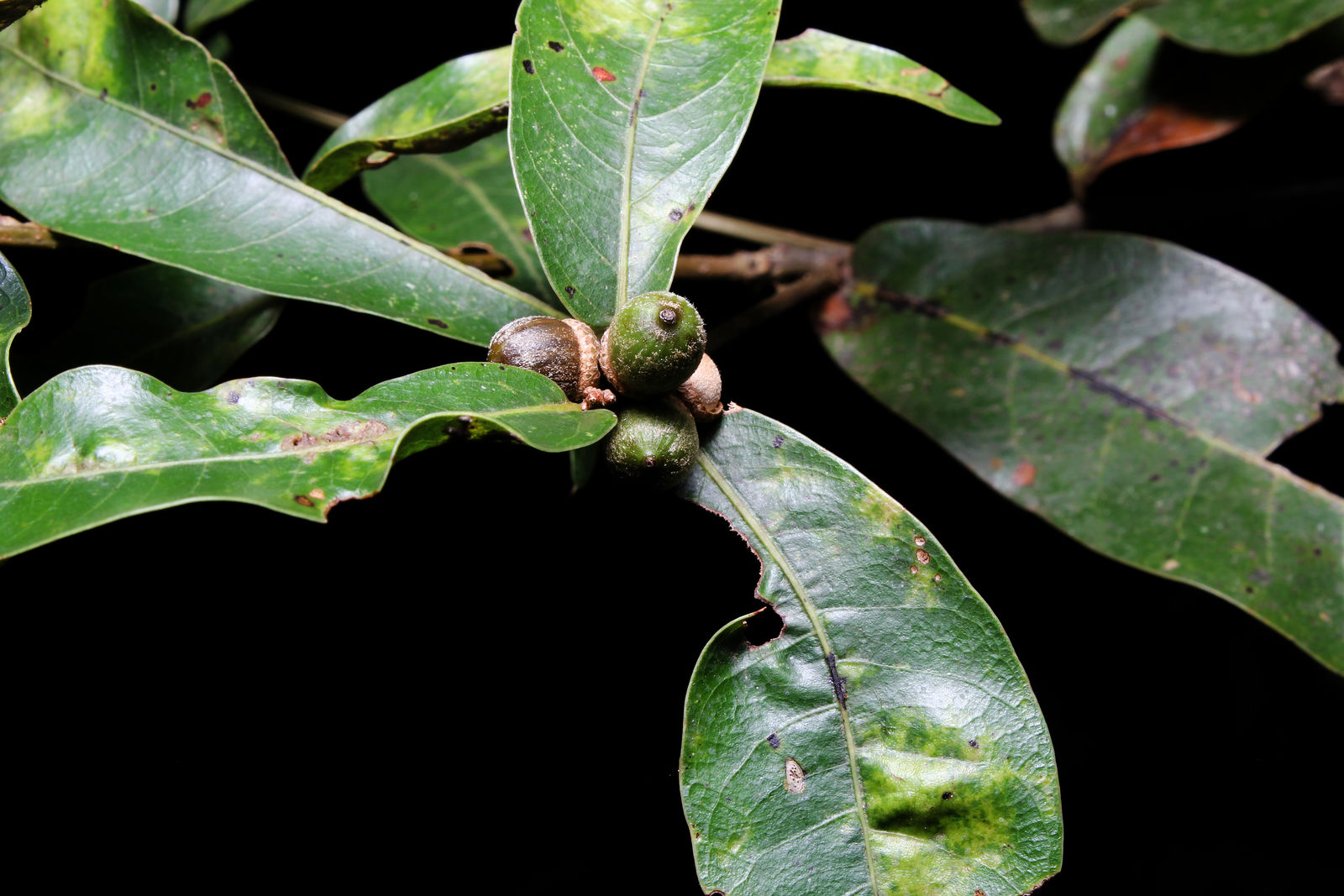
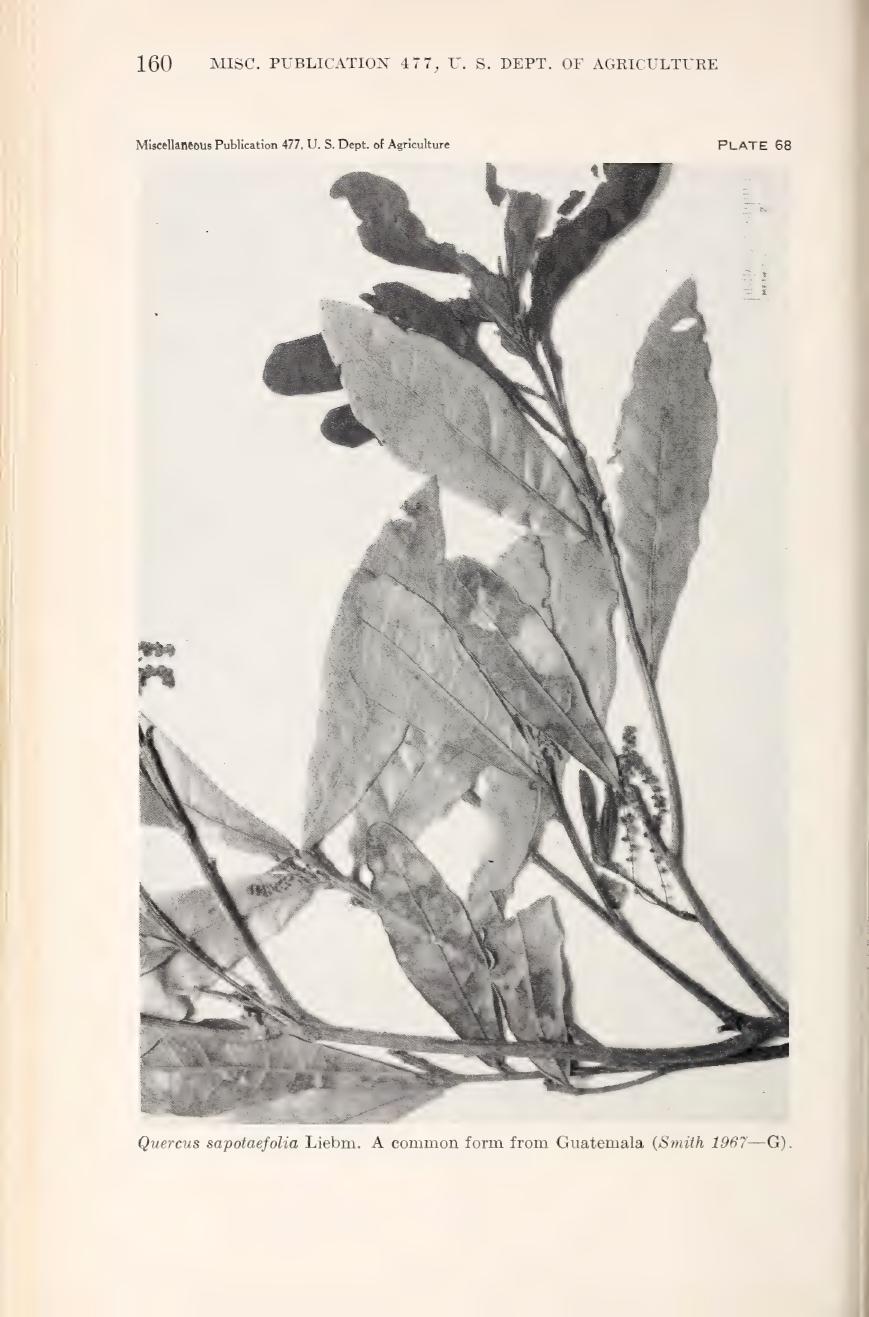
Leaves: The leaves are simple, alternate, and obovate to oblong-elliptic, broadest above the middle and rounded at the apex, measuring about 4 to 12 centimeters long. They are thick and leathery (coriaceous), with entire or slightly wavy margins. The upper surface is green and often glossy; the lower surface is paler, sometimes with sparse hairs. Leaves persist for more than one year, giving the tree an evergreen appearance, though some leaf drop occurs during the dry season.

Acorns: Like all oaks, Q. sapotifolia produces acorns. The nuts are small to medium-sized, oval, and partially enclosed by a shallow, scaly cup that covers about a quarter of the nut. The acorns mature within a single year after pollination and provide food for acorn-caching rodents and other seed-eating wildlife.
Ecology and Distribution
Quercus sapotifolia occupies a broad elevational range, from as low as 250 meters in Mexico to more than 2,000 meters in the highlands of Costa Rica, where it reaches about 2,400 meters. It grows in cloud forests, montane oak forests, and pine-oak woodlands, often on coarse, rapidly-draining soils derived from sandstone, igneous rock, and rhyolite.
In Costa Rica, the species is found primarily in the Cordillera de Talamanca and the Central Volcanic Range, where it forms part of the montane oak forest community. These forests are characterized by high humidity, frequent cloud immersion, and abundant epiphytic growth. Oaks in these forests often support heavy loads of mosses, ferns, bromeliads, and orchids on their branches.
Mesoamerica is the global center of oak diversity, with over 160 species described from Mexico alone. Quercus sapotifolia belongs to the red oak group (section Lobatae), which is distinguished by leaves with bristle-tipped lobes (though this species has entire margins) and acorns that typically take two years to mature, although Q. sapotifolia itself fruits annually. The species has accumulated numerous synonyms over its taxonomic history, including Q. parviglans and Q. persiifolia, reflecting the difficulty botanists have faced in delimiting oak species across their variable populations. Some authorities also treat the large Costa Rican highland oak Q. bumelioides as a synonym of Q. sapotifolia, while others keep it as a distinct species; it is under this broader circumscription that the species attains its greatest size.
Uses
Timber and Construction: Oak wood is valued throughout Central America for its strength, hardness, and durability. The heartwood is yellowish-brown to reddish-brown with prominent rays that give it an attractive figure when quarter-sawn. The wood is difficult to dry and work, prone to checking (surface cracks from uneven drying) and warping, but once seasoned it performs well in demanding applications. Documented uses include flooring, railroad ties, construction and mine timbers, tight cooperage, and decorative veneer.
Charcoal: Throughout its range, this oak has been heavily exploited for charcoal production. The dense, hard wood produces high-quality charcoal that burns hot and long. In Costa Rica's Savegre Valley and other highland areas, charcoal making from oaks has been a traditional livelihood, though the practice has declined as land use shifted toward ecotourism and as conservation measures limited harvesting.
Ecological Services: Montane oak forests provide critical ecosystem services including watershed protection, carbon storage, and habitat for endemic wildlife. The forests regulate water flow to lower elevations, capturing moisture from clouds and releasing it gradually to streams. Many cloud forest species depend on oaks for food and shelter, from the resplendent quetzal that nests in rotting tree cavities to the countless invertebrates that feed on oak leaves and acorns.
Conservation
Quercus sapotifolia is listed as Least Concern by the IUCN, reflecting its wide distribution and relatively stable populations across its range. However, the species faces ongoing pressure from habitat conversion and selective logging. In Costa Rica, montane oak forests have been reduced by agricultural expansion, particularly for dairy farming and vegetable production in the highlands of the Cordillera de Talamanca (the Los Santos region) and the Central Volcanic Range.
While Q. sapotifolia itself is not threatened, several of Costa Rica's other oak species face greater conservation concern. Quercus insignis, which shares some of the same montane habitats, is listed as Endangered. The conservation of oak forests benefits all species in these communities, maintaining the ecological integrity of Central America's cloud forest ecosystems.
Resources & Further Reading
Species Information
Overview of the species including distribution, taxonomy, and basic characteristics.
Authoritative taxonomic information including synonyms, distribution, and herbarium specimens.
Citizen science observations with photographs from across the species' range.
Authoritative conservation assessment (Least Concern), and the source of the species' elevation range and soil descriptions.
Concise botanical description of the tree, its coriaceous leaves, and its acorns (Universidad Francisco Marroquín, Guatemala).
The definitive Costa Rican treatment of the family, and the source for this species' dark bark, leaf and acorn dimensions, its 1,300 to 2,400+ m elevation range, and its distinction from Q. bumelioides.
Accepted name and full heterotypic synonymy for the species, including the contested placement of Q. bumelioides.
Oak Forests and Ecology
Scientific chapter on the ecology of Costa Rica's montane oak forests.
Technical information on wood properties and uses of Central American oaks.
Complete monograph with 124 botanical plates illustrating Central American oaks. USDA Miscellaneous Publication No. 477.
Peer-reviewed inventory of 161 native Mexican oak species across sections Lobatae, Quercus, and Protobalanus. Botanical Sciences 75: 33-53.
Peer-reviewed chapter documenting the traditional oak-charcoal industry of Costa Rica's highland (Talamanca and Savegre) oak forests.
Measures the mosses, liverworts and ferns that Costa Rican highland oaks carry on their branches.
Places about 40 percent of the world's oak species in Mexico and Central America, the basis for calling the region the global center of oak diversity.
Conservation
The Endangered assessment for Q. insignis, the oak of these same montane forests that is at far greater risk than Q. sapotifolia.
Botanic Gardens Conservation International's species record, with range, threats and ex-situ holdings.