Costa Rican Duroia
Duroia costaricensis is a dioecious shrub or small tree endemic to the rainforests around Golfo Dulce in southernmost Costa Rica. Unlike its famous Amazonian relative that cultivates "devil's gardens" through ant partnerships, this species lives independently in the forest understory, its identity tied entirely to one small corner of the planet.
In the lowland rainforests between Sierpe and Rincón de Osa, where annual rainfall exceeds four meters and the canopy closes overhead like a green cathedral, grows a tree that exists nowhere else on Earth. Duroia costaricensis inhabits the dim understory of these wet forests, its large hairy leaves clustered at branch tips like parasols waiting for stray beams of light. The species represents a quiet counterpoint to the dramatic ecology that made its genus famous.
The genus Duroia gained international attention through D. hirsuta of the Amazon, which partners with Myrmelachista ants that systematically poison neighboring plants with formic acid, creating eerie monospecific clearings called "devil's gardens." But D. costaricensis shows none of these associations. It grows alongside dozens of other species in species-rich forest, lacking the specialized stem chambers that house ant colonies in its South American relatives. This Central American species tells a different story, one of isolation and endemism rather than mutualistic warfare.
Identification
Habit
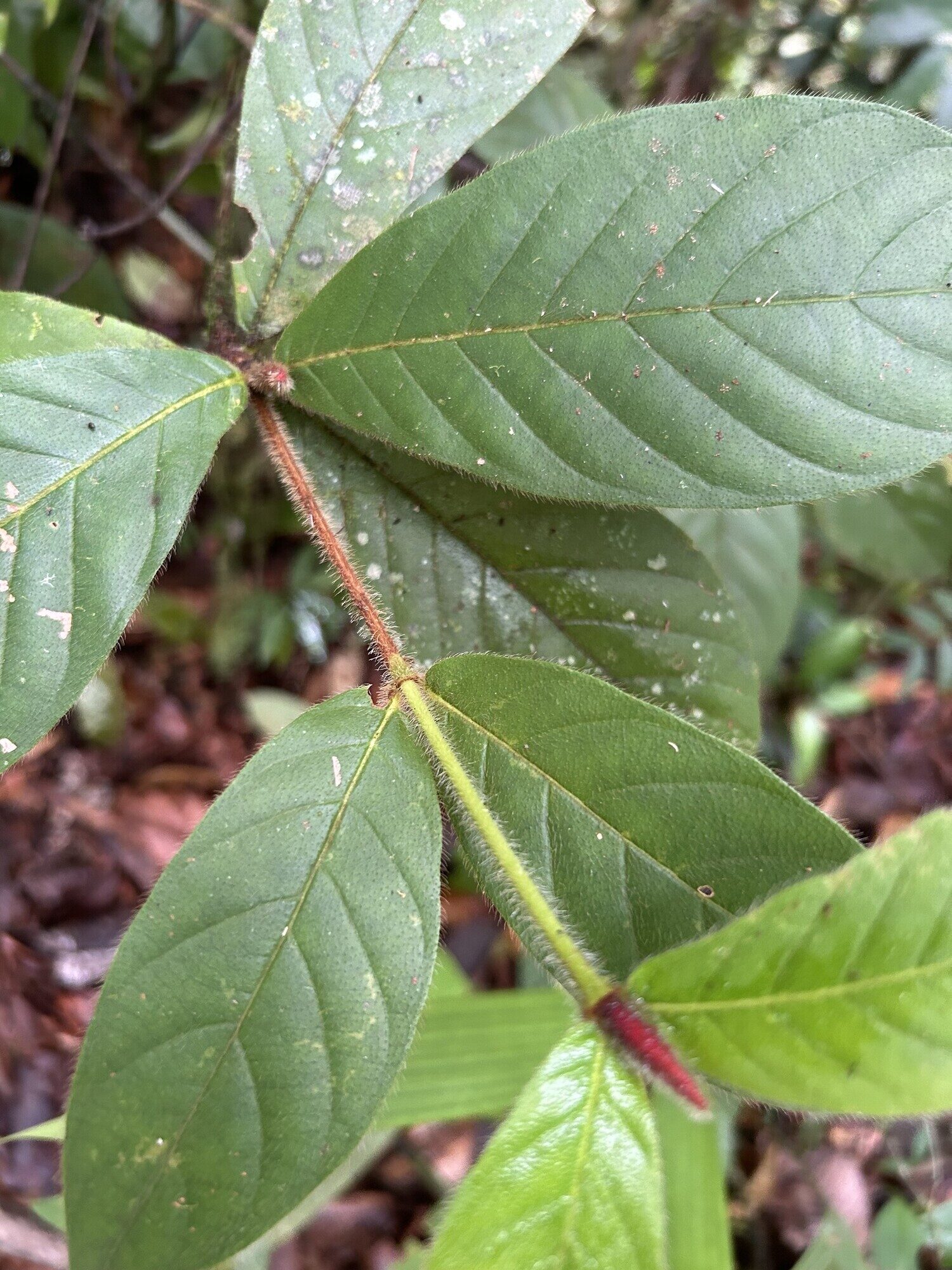
Duroia costaricensis grows as a shrub or small tree reaching 5 to 10 meters tall. The leafy branchlets measure 2 to 6 mm thick and bear ascending hairs approximately 2 mm long, giving young growth a distinctly fuzzy appearance. These hairs turn reddish-brown and eventually fall away as stems mature. The plant occupies the forest understory, rarely emerging into the canopy.
Leaves
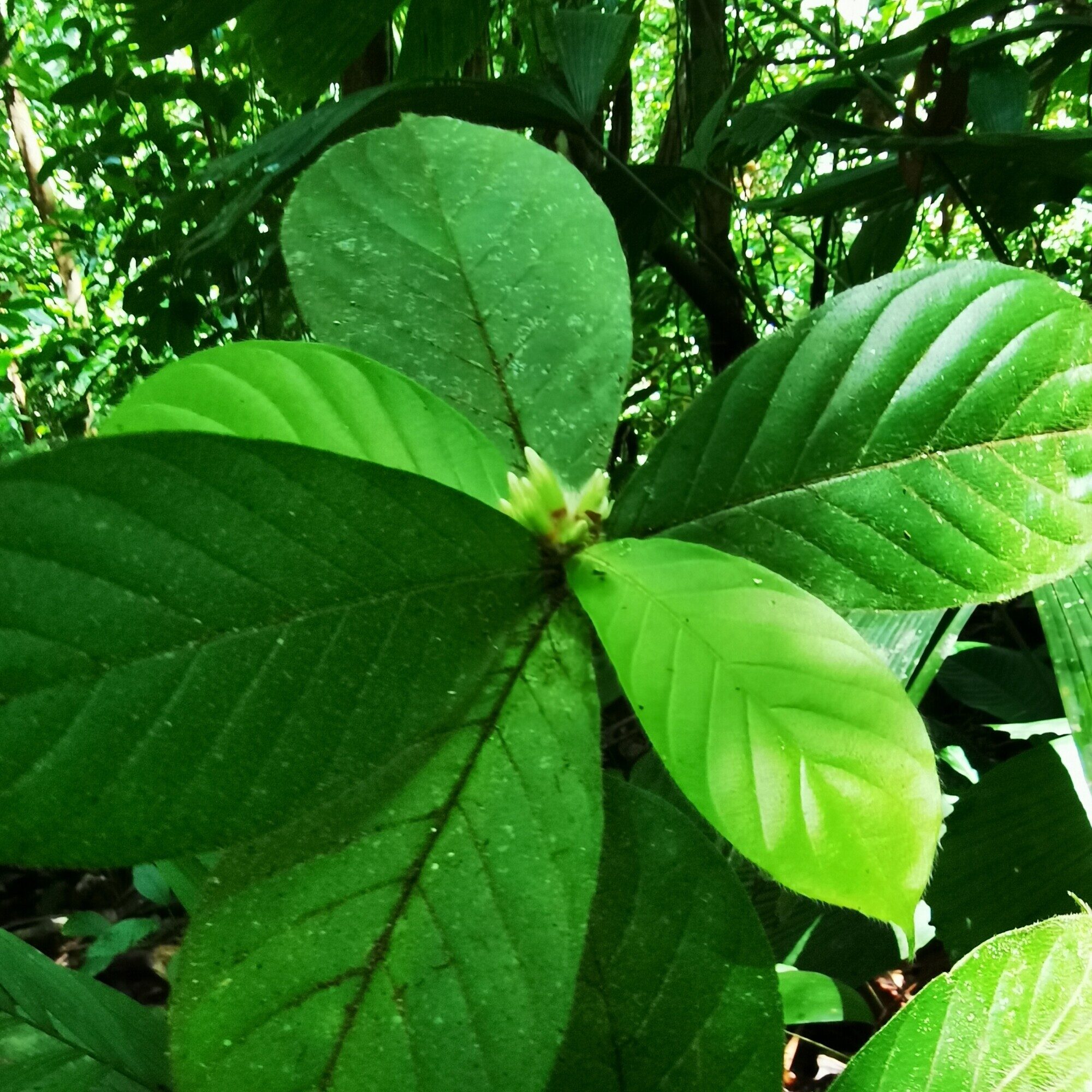
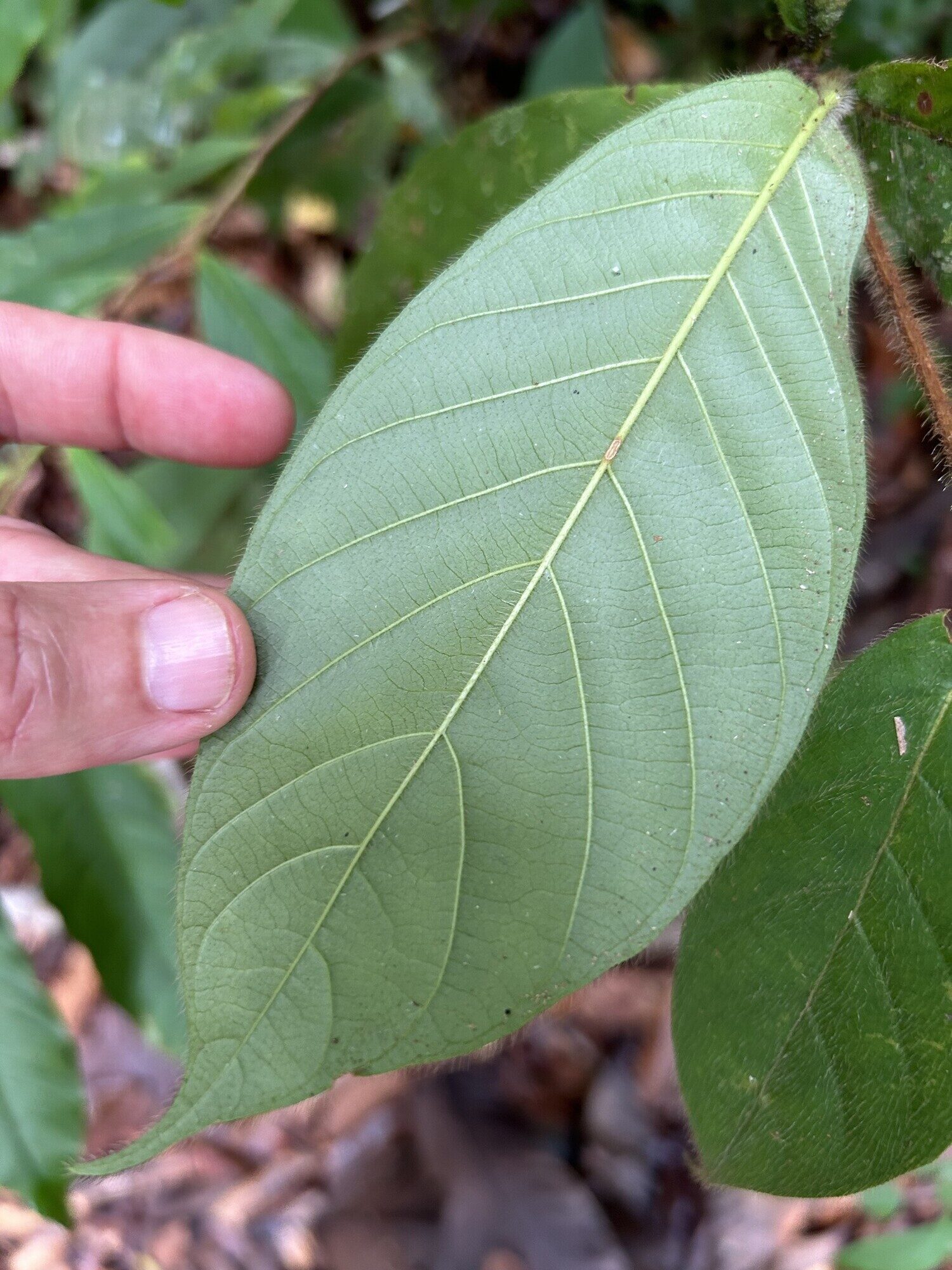
The leaves are closely crowded at branch tips, creating distinctive whorls of foliage. Each leaf is nearly stalkless (subsessile), with petioles (leaf stalks) only 2 to 6 mm long. The blades measure 9 to 19 cm long and 4 to 7.5 cm wide, oblong-obovate to narrowly obovate (egg-shaped with the wider end toward the tip) in shape, widest at or above the middle. The apex tapers abruptly to a slender point (acuminate to caudate-acuminate, meaning tail-like), while the base narrows gradually to a wedge shape. Both surfaces bear long, thin, straight or slightly crooked hairs measuring 1.5 to 2.5 mm. Secondary veins (the main branches off the midrib) number 5 to 8 per side, with tertiary veins (smaller cross-veins) running parallel between them.
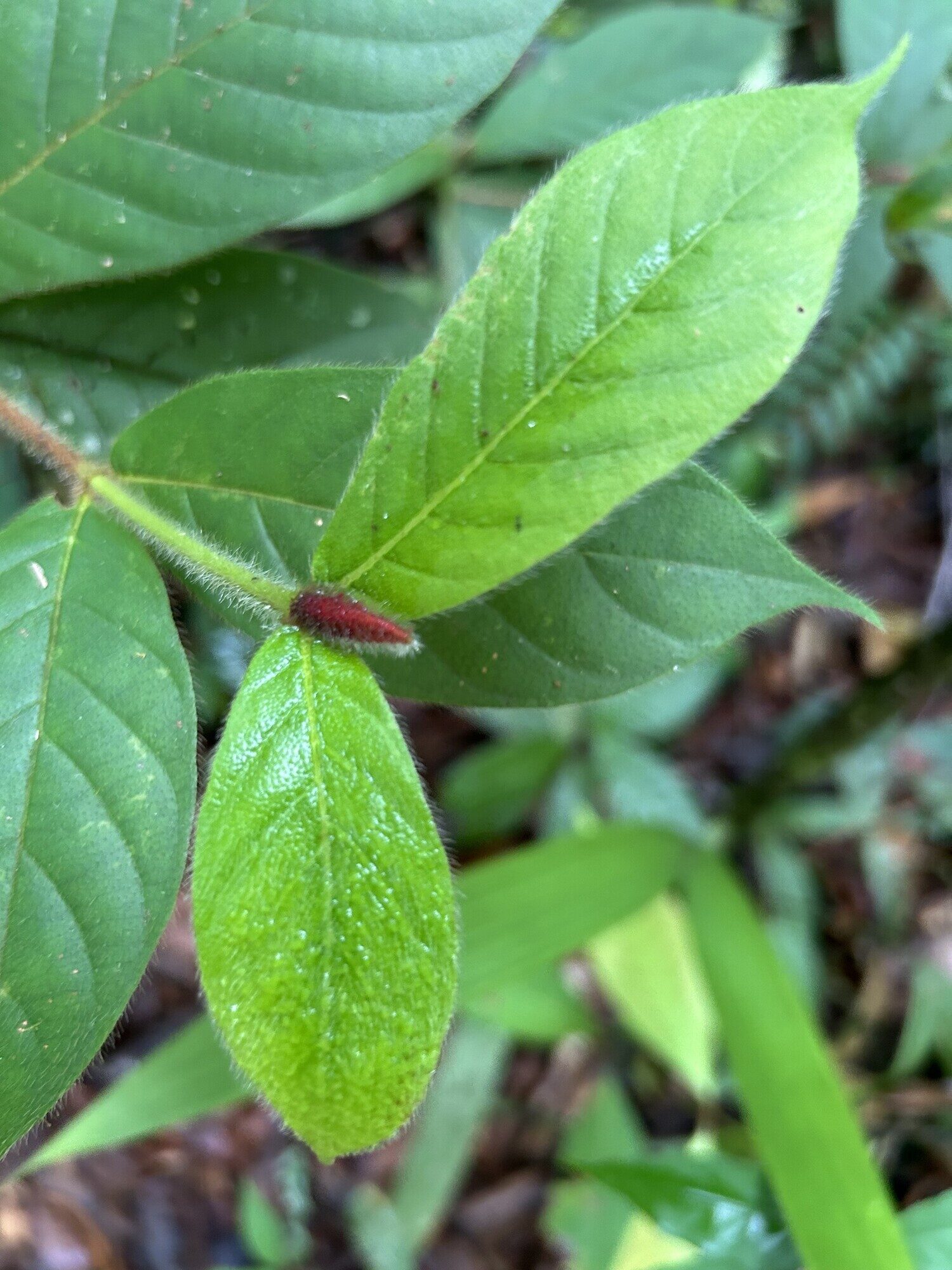
The stipules are large and conspicuous, measuring 15 to 45 mm long. They form a protective cap over the shoot apex, densely covered with silky hairs on their outer surfaces, then fall away as the leaves expand (circumscissile and deciduous).
Flowers
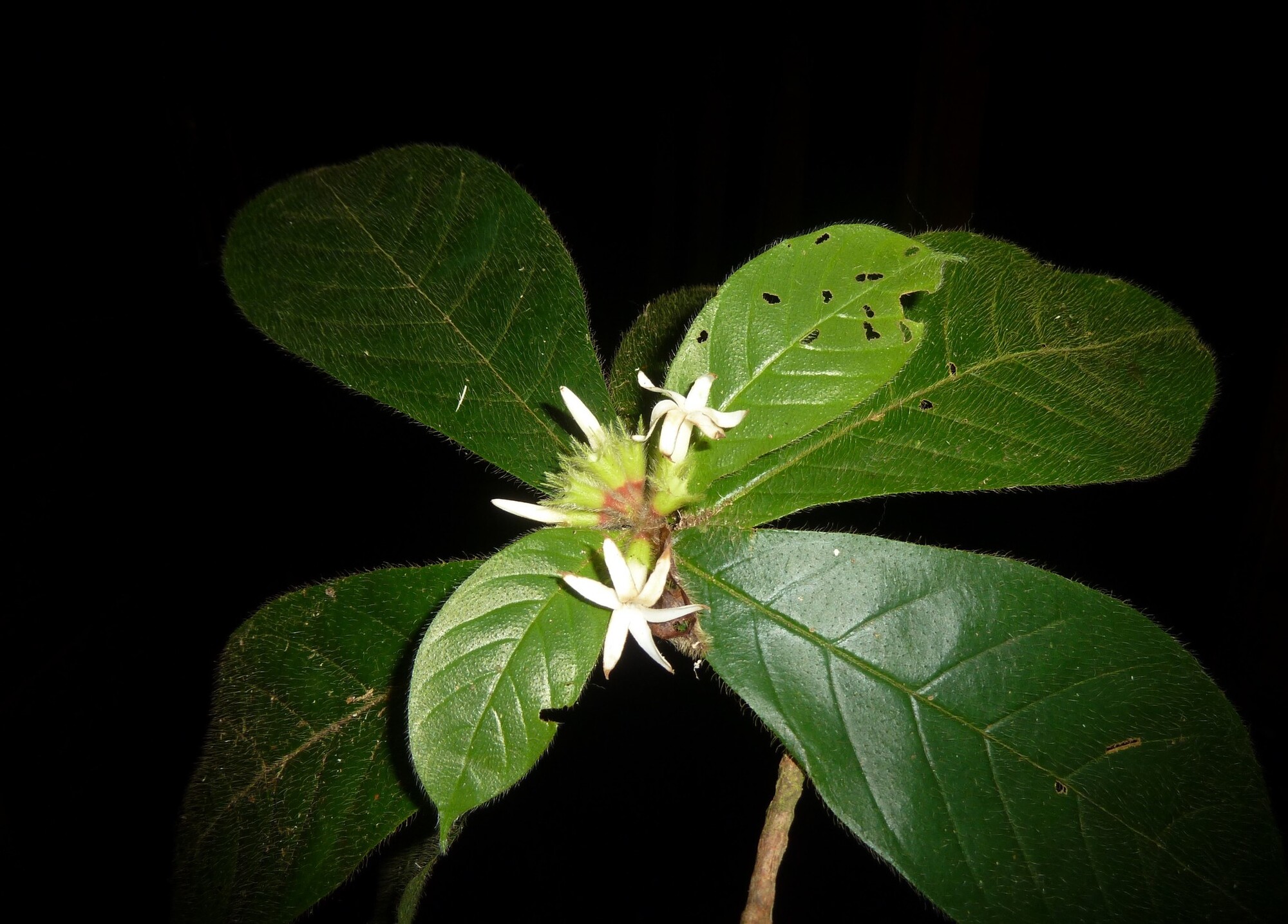
As a dioecious species, individual plants bear either male or female flowers. Male flowers cluster in groups of 8 to 15 at branch tips, tightly packed (subcapitate to fasciculate-cymose). Each flower measures 15 to 20 mm long with dense silky hairs covering the calyx and corolla. The calyx measures 4 to 5 mm long with 6 to 7 lobes equaling the tube length. The white corolla has 6 to 8 lobes, 5 to 8 mm long, equaling or exceeding the tube. Female flowers appear 1 to 3 at branch tips, nearly sessile, with the hypanthium (floral tube) about 8 mm long and densely covered in hairs 2 to 3 mm long.
Flowering occurs primarily in March and from May through June. The pollinators remain unknown, though the white tubular flowers suggest nocturnal visitors such as moths may play a role.
Fruits
Fruits develop singly or in clusters of up to 3 at branch tips, nearly sessile. Each berry measures approximately 22 mm long and 12 mm in diameter, oblong to ovoid in shape. The surface is covered with long hairs, though the skin remains visible beneath them. Inside, the fleshy pulp contains numerous seeds. Fruiting occurs from July through August and again in October. The dispersal agents remain undocumented, though the fleshy fruits suggest bird or mammal dispersal.
Stem Pubescence
Distribution
Duroia costaricensis is known only from southernmost Costa Rica, in the Golfo Dulce region of Puntarenas Province. The type specimen came from Sierpe, and most subsequent collections originate from near Rincón de Osa. GBIF records show approximately 240 occurrences, with the majority in the Brunca region, concentrated in the lowlands surrounding Golfo Dulce including localities near Bahía Chal, Aguabuena, the Golfito National Wildlife Refuge, and the trail between Rancho Quemado and Drake Bay.
The species occupies lowland wet forest formations at elevations from 10 to 200 meters. This extremely restricted range makes it one of Costa Rica's narrow endemics, tied to the unique conditions of the Golfo Dulce lowlands where high rainfall, warm temperatures, and wet soils create one of the most biodiverse forest ecosystems in Central America.
Ecology
The ecological relationships of Duroia costaricensis remain poorly studied. The white, tubular flowers with their nocturnal appearance suggest moth pollination, a pattern common in dioecious understory Rubiaceae. The fleshy berries likely attract frugivorous birds or small mammals that disperse the seeds through the forest.
What sets this species apart ecologically is what it lacks. While several Amazonian Duroia species, particularly D. hirsuta, are famous for their mutualistic relationships with Myrmelachista ants, D. costaricensis shows no such associations. It lacks the swollen hollow stems (domatia) that house ant colonies in its South American relatives. The Flora Costaricensis treatment explicitly notes that "our species have no such structures and are not known to have an association with ants."
Taxonomic History
Paul Carpenter Standley described Duroia costaricensis in 1919, publishing the species in Contributions from the U.S. National Herbarium (volume 20, page 208). Standley based his description on a specimen collected by Henri Pittier (collection number 6803) from Sierpe in the Osa region. Pittier, a Swiss botanist who founded Costa Rica's Physical Geographic Institute and national herbarium, collected extensively in the Sierpe and Osa region during the late 19th and early 20th centuries, documenting many species new to science.
The specific epithet costaricensis means "of Costa Rica," reflecting the species' restriction to this country. No synonyms have been published, and the species has remained stable in Duroia since its original description. The genus itself contains approximately 34 to 37 species ranging from Central America through the Amazon Basin. Molecular phylogenetic work by Claes Persson in 2000 showed that Duroia is paraphyletic with Amaioua nested within it. If the genera are eventually merged, Amaioua would have nomenclatural priority. However, no formal transfers have been made, and D. costaricensis remains accepted under its original name.
Similar Species
Costa Rica hosts only one other Duroia species: D. utleyorum, which John Dwyer described in 1993 from specimens collected near Rincón de Osa. The two species can be distinguished by their leaves and pubescence. Duroia costaricensis has subsessile leaves with long hairs approximately 2 mm, while D. utleyorum has clearly petiolate leaves with shorter hairs about 0.5 mm. D. costaricensis also has smaller flowers (male corolla lobes 5-8 mm) compared to D. utleyorum (male corolla lobes about 10 mm). Both species may also resemble Hippotis, another Rubiaceae genus occurring in the region.
Conservation Outlook
Duroia costaricensis has not been formally assessed for the IUCN Red List. Given its extremely restricted range in the Golfo Dulce lowlands and its occurrence in only a small area of southern Costa Rica, a formal assessment would likely place it in a threatened category. The species is known from fewer than 250 documented occurrences, all within a single region.
The good news is that much of its habitat falls within protected areas. Piedras Blancas National Park, covering over 14,000 hectares, protects significant lowland wet forest around Golfo Dulce. The Golfito National Wildlife Refuge and the broader Osa Conservation Area provide additional protection. These parks are connected by biological corridors to Corcovado National Park and ultimately to the La Amistad UNESCO World Heritage Site.
The primary threat to the species is habitat loss outside protected areas, as agricultural expansion and development continue in the Golfo Dulce lowlands. Climate change poses additional uncertainty, as changes in rainfall patterns could affect the wet forest conditions on which this species depends. Population surveys and long-term monitoring would help clarify the conservation status of this narrow endemic.
Resources & Further Reading
Species Information
Global occurrence records and specimen data showing the species' restricted distribution.
Nomenclatural data and specimen records from Missouri Botanical Garden.
Taxonomy & Nomenclature
Burger & Taylor (1993). Fieldiana Botany n.s. no.33. The definitive treatment of Costa Rican Rubiaceae including the key to Duroia species.
Related Reading
Frederickson et al. (2005). The landmark study revealing how Myrmelachista ants create devil's gardens through chemical herbicide, a phenomenon notably absent in Costa Rica's Duroia species.
Persson (2000). Molecular phylogeny showing the relationships within Rubiaceae, including findings that Duroia is paraphyletic with Amaioua.