Panicled Coussarea
Coussarea paniculata is a neotropical tree reaching 12 meters that spans an exceptional elevation range from sea level to 2,400 meters, from Costa Rica to Trinidad. Its jasmine-scented white flowers open at night, and phytochemical research has isolated novel compounds with cytotoxic properties from its twigs. The genus name honors the Kusari people of French Guiana.
In the humid lowland forests of the Brunca region, where the green canopy rises layer upon layer toward the tropical sky, Coussarea paniculata occupies the understory and midstory, its branching white inflorescences glowing faintly in the filtered light. The species belongs to a genus of about 120 species distributed from southern Mexico to South America, named for the Kusari (Coussari) people of French Guiana by the pioneering French botanist Jean Baptiste Christophe Fusee Aublet in 1775. Aublet deliberately chose indigenous names for his genera, defying Linnaeus' preference for Greek and Latin, and in doing so preserved fragments of the knowledge systems of the Galibi and other peoples of colonial French Guiana.
The species epithet "paniculata" refers to the paniculate inflorescence structure, the branching pyramidal clusters of flowers that give this tree its distinctive appearance. First described under an illegitimate name by the Danish-Norwegian botanist Martin Vahl in 1797, the species passed through nomenclatural limbo for over a century before Paul Carpenter Standley established the current combination in 1928. Today, the species is recognized across a vast range from Costa Rica to Bolivia, Brazil, and Trinidad, with GBIF documenting over 1,300 occurrence records.
Identification
Leaves
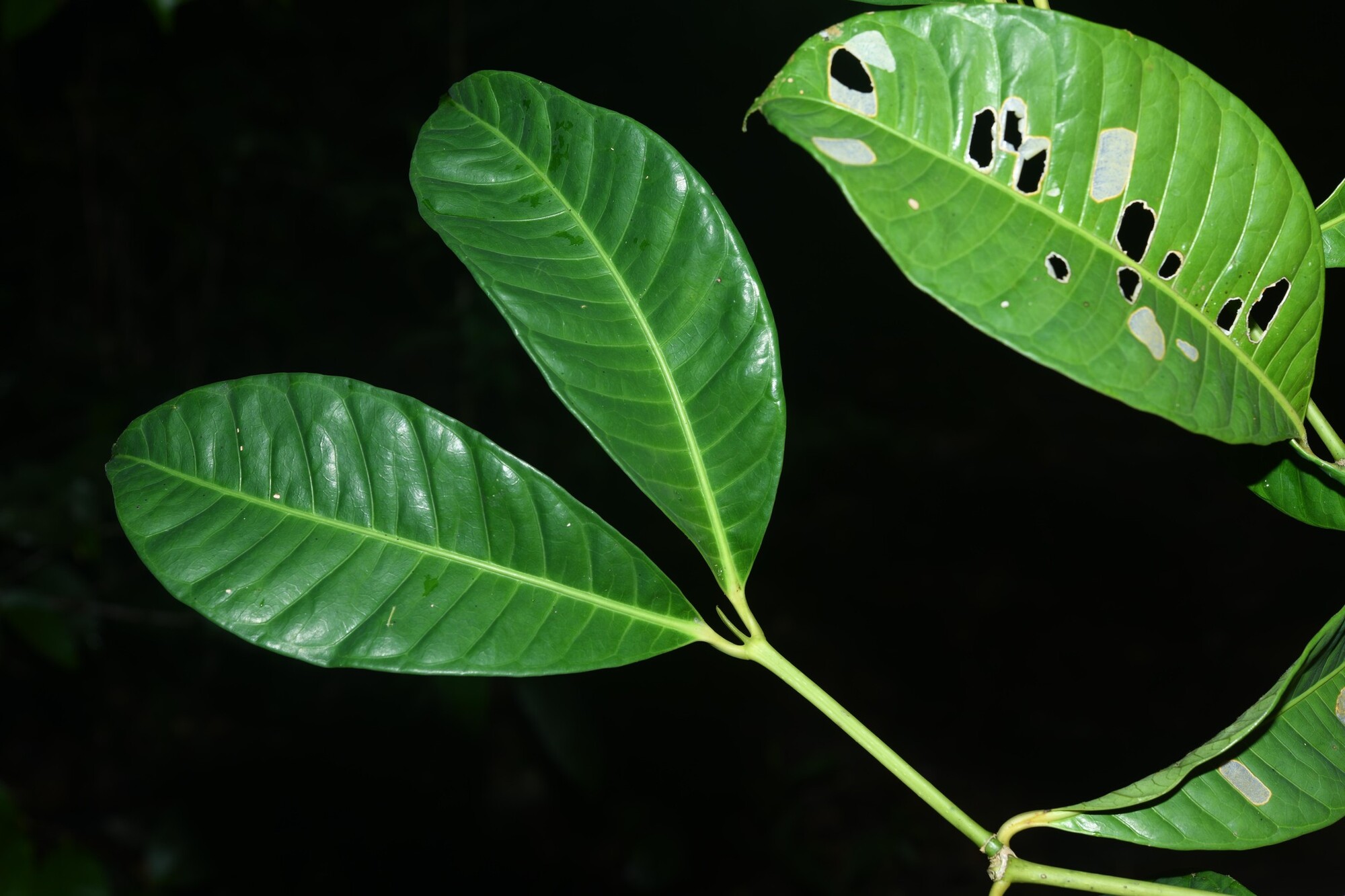
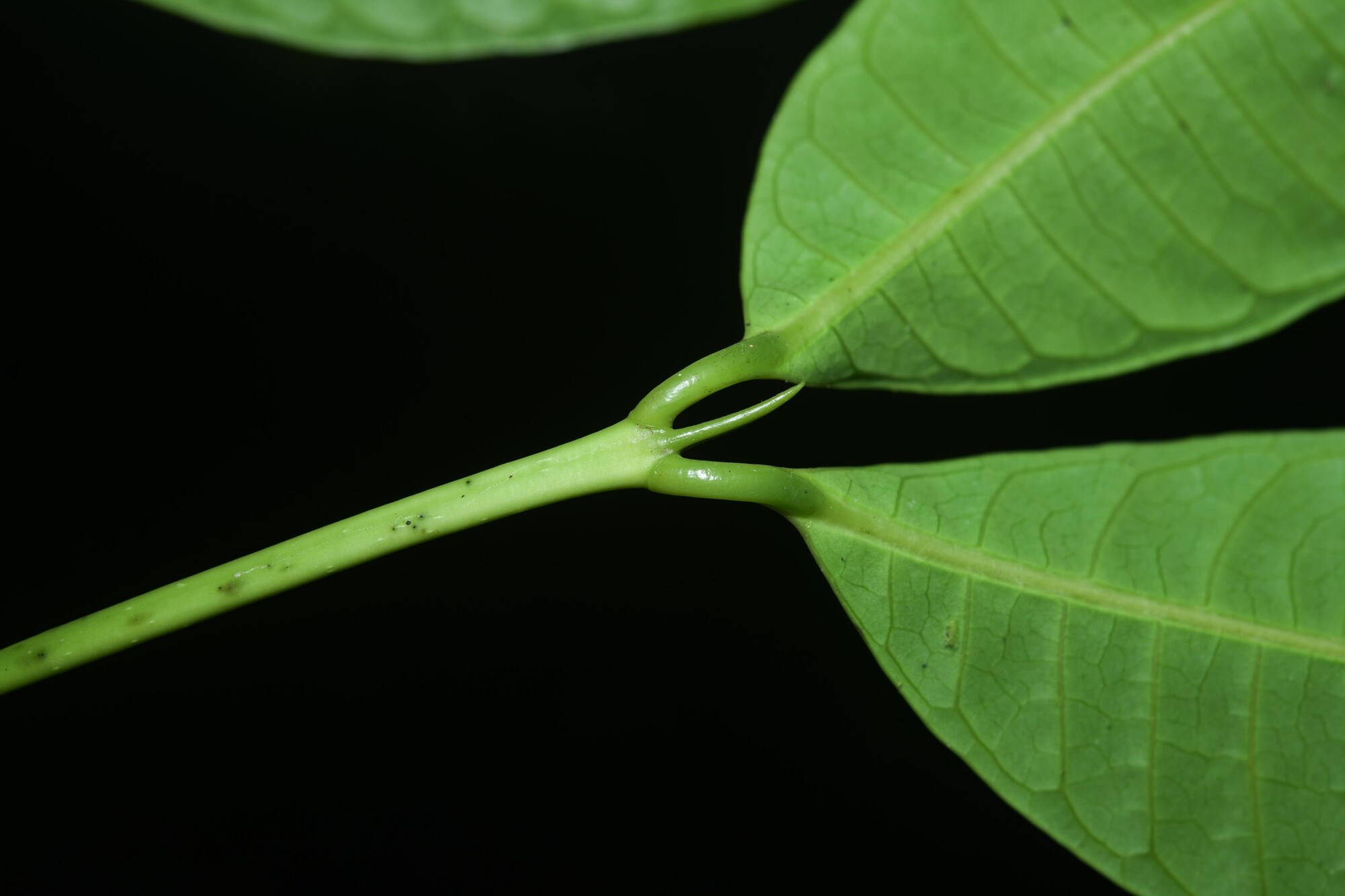
Leaves are simple, opposite, and broadly elliptic, arranged in decussate pairs along the stem as is diagnostic for Rubiaceae. The blades are relatively large with entire margins and show prominent pinnate venation, with parallel secondary veins curving toward the apex and connecting near the margins. The leaf surface is glabrous (hairless) with a glossy dark green upper surface. Interpetiolar stipules, the hallmark of the coffee family, are present at each node and form a sheath encircling the stem.
Flowers
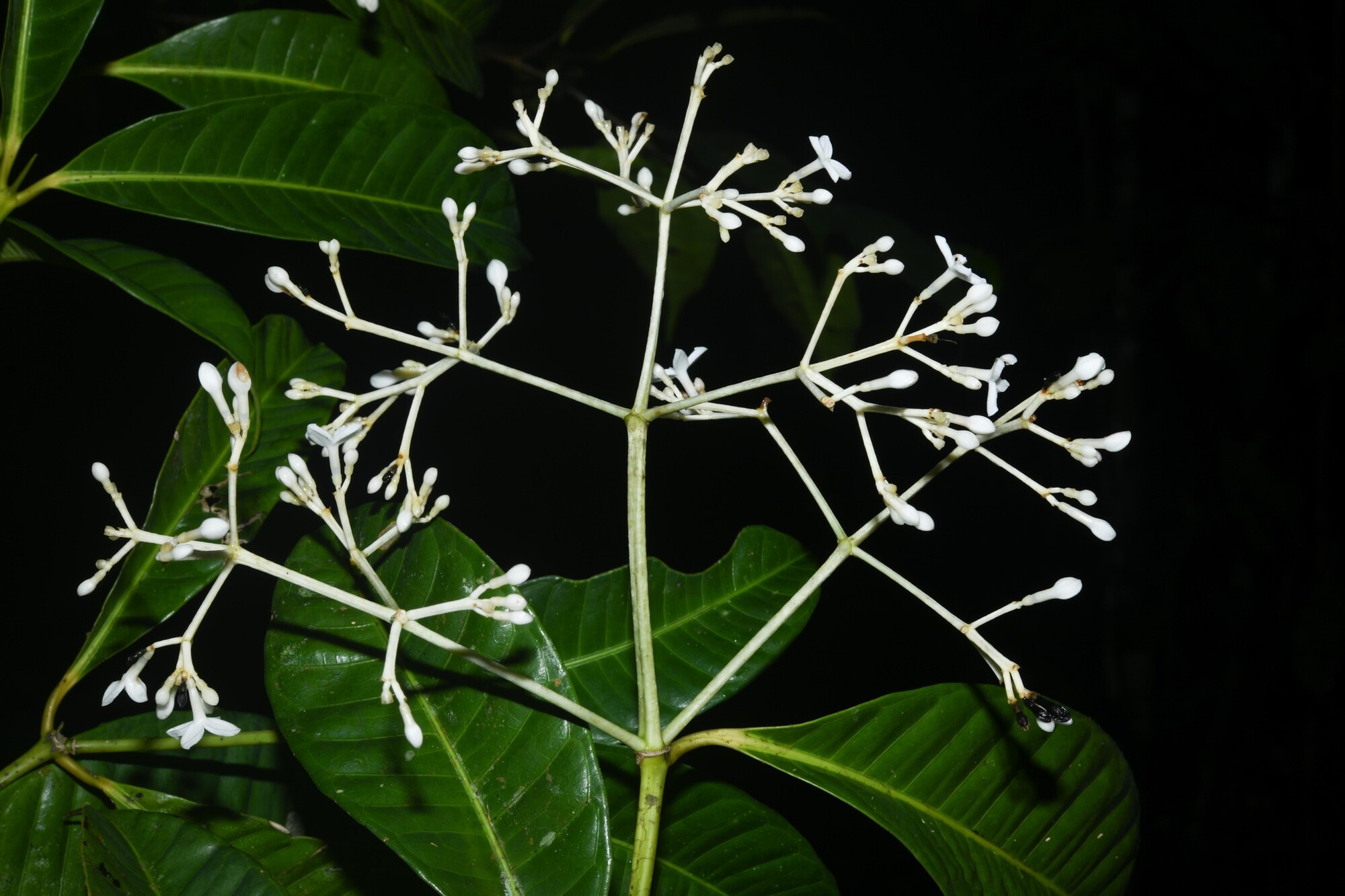
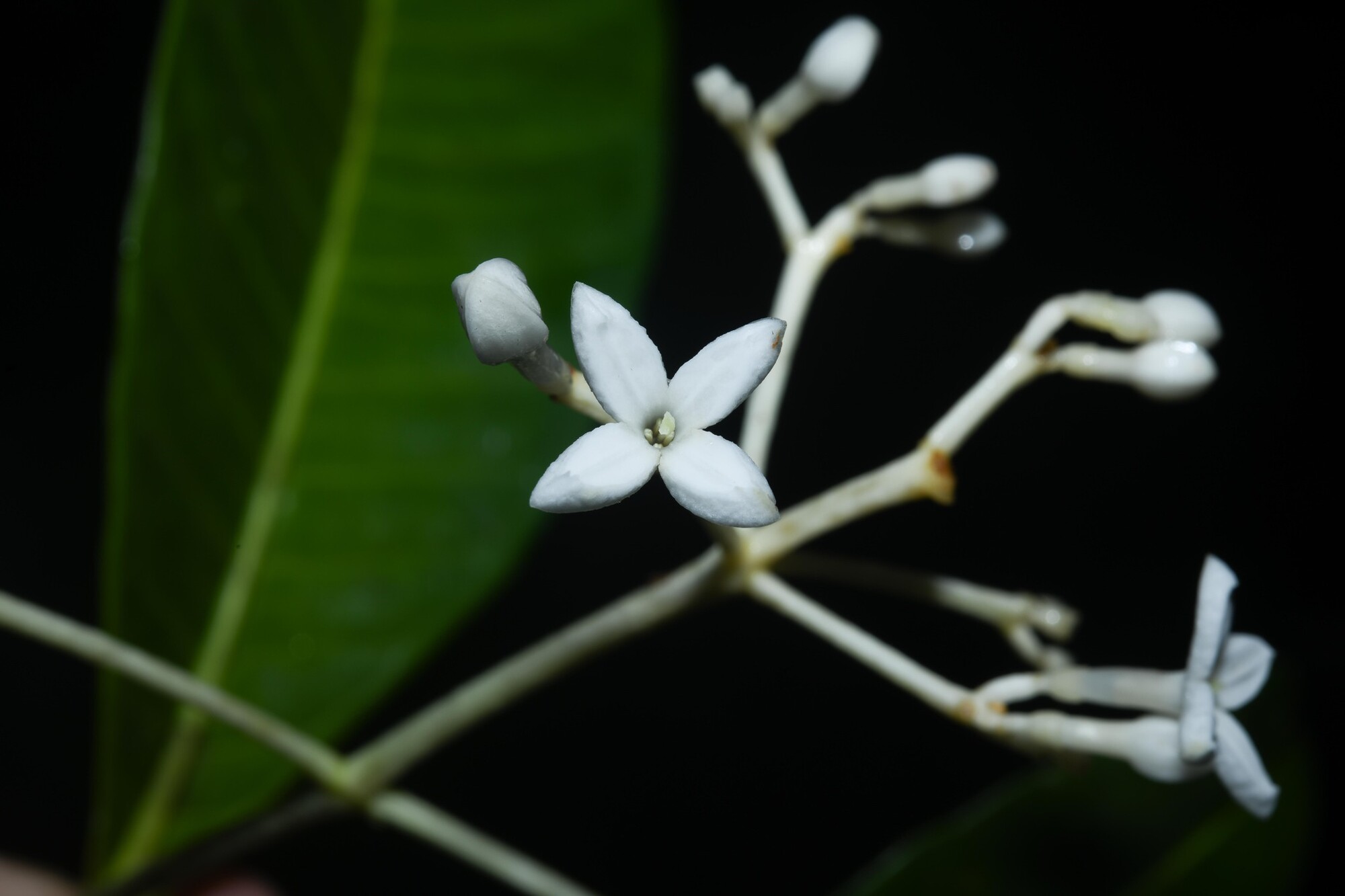
Coussarea paniculata produces 4-merous flowers (with parts in fours), arranged in terminal panicles that give the species its name. The corolla is white, tubular at the base, and opens into four spreading lobes. Historical specimen notes from the Royal Botanic Gardens, Kew record that "les fleurs exhalant une odeur de jasmin" (the flowers exhale a jasmine-like scent). This combination of white color, tubular form, and nocturnal fragrance suggests the flowers are adapted for moth pollination, a syndrome known as sphingophily. Many Coussarea species appear to have evolved for nocturnal or crepuscular pollination.
Fruits
Fruits are small drupes with fleshy outer layers surrounding two plano-convex pyrenes (seed-containing structures). The fruit morphology is typical of the genus and is adapted for bird dispersal. In the sister genus Faramea, fruits ripen to blue-black, and Coussarea fruits are similarly adapted for avian frugivores. Fleshy fruits have evolved independently at least 12 times in Rubiaceae, with most of these evolutionary origins occurring during the Eocene to Oligocene, coinciding with the radiation of modern bird families.
Herbarium Specimens
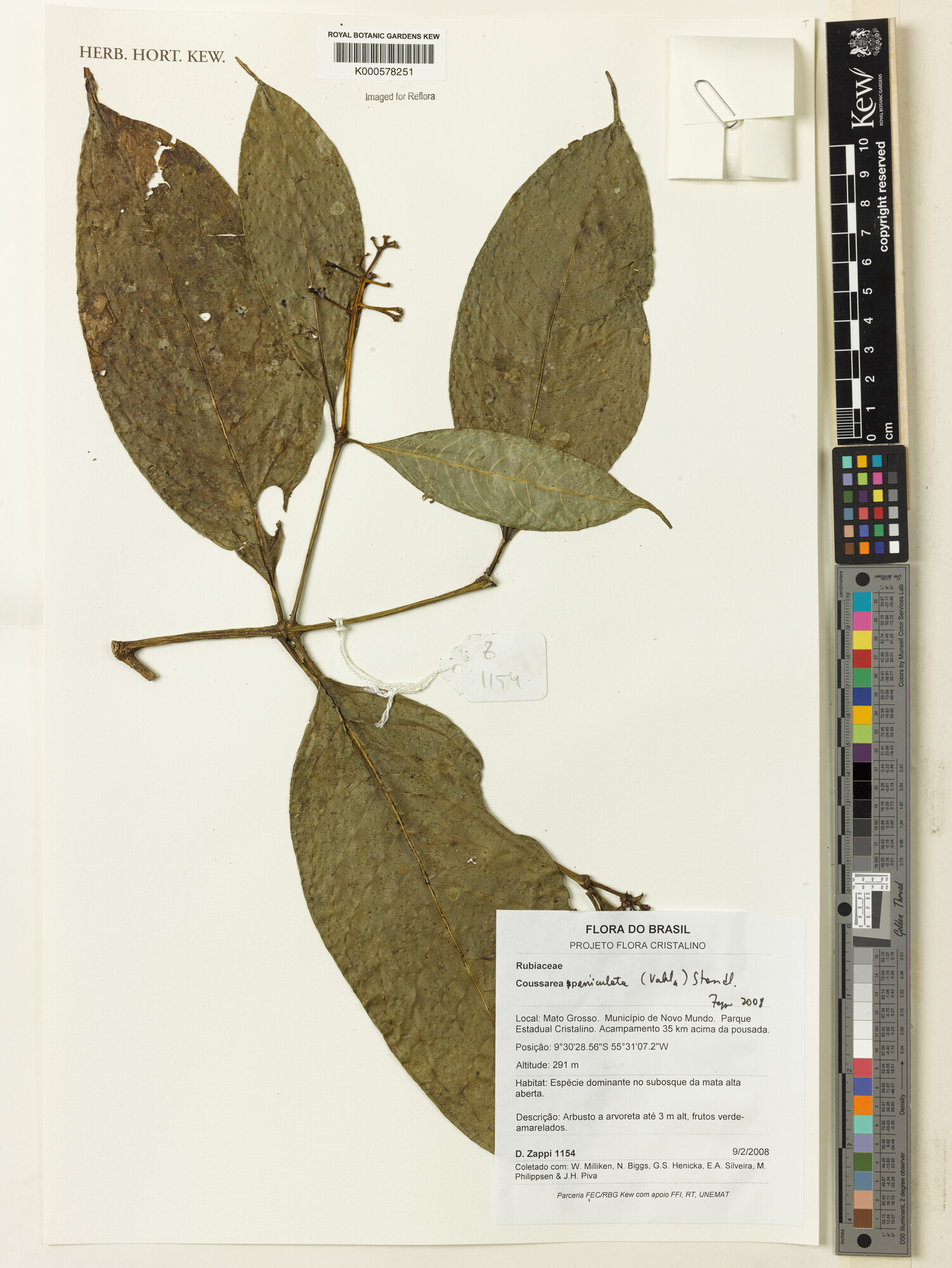
Distribution
Coussarea paniculata has one of the broadest distributions in its genus, ranging from Costa Rica through Panama and across South America to Bolivia, Brazil, Colombia, Ecuador, French Guiana, Guyana, Peru, Suriname, Trinidad-Tobago, and Venezuela. In Costa Rica, the species reaches its northern range limit and occurs in the wet forests of the Brunca region. In Colombia, the species has been documented from sea level to 2,400 meters, spanning habitats from Amazonian lowlands through the Andes to the Caribbean Plain and Magdalena Valley.
This exceptional elevation range suggests either unusual ecological plasticity or possible cryptic species diversity that has not yet been resolved taxonomically. In Brazil, the species is native to many Amazonian states including Acre, Amapa, Amazonas, Para, and Roraima, as well as Cerrado regions including Goias, Mato Grosso, and Tocantins. The broad distribution has likely contributed to the species' Least Concern conservation status.
Ecology

As a subcanopy tree reaching up to 12 meters, Coussarea paniculata occupies the shaded layers of wet tropical forests. Studies on the congener Coussarea racemosa in Amazonian forests have shown that these understory trees are adapted to low-light conditions, receiving only about 5% of the sunlight that reaches the canopy. The subcanopy position places them below the main forest canopy but above the shrub layer, in a zone where filtered light and high humidity create a distinctive microclimate.
The white, jasmine-scented flowers suggest nocturnal or crepuscular pollination by moths. While no direct studies exist for this species, related Coussarea species have been documented opening their flowers at dusk, when sphinx moths and other nocturnal pollinators become active. The fleshy drupes are almost certainly dispersed by frugivorous birds, as is common in understory Rubiaceae throughout the Neotropics.
Chemistry and Research
Coussarea paniculata is one of the few species in its genus to have been studied phytochemically. In 2003, researchers at Virginia Polytechnic Institute published findings in the Journal of Natural Products describing the isolation of three new lupane triterpenoids from the twigs of this species, along with eight known triterpenoids including lupeol, betulin, betulinic acid, and oleanolic acid. The compounds were isolated using a yeast-based assay for potential DNA-damaging agents and showed cytotoxic properties in tumor cell culture assays.
Despite Rubiaceae being famous for alkaloid production (the family includes coffee with its caffeine, and Cinchona with its quinine), no alkaloids have been reported from C. paniculata. This may reflect the focus of existing research rather than a true absence of these compounds. The discovery of cytotoxic triterpenoids suggests the species warrants further investigation for bioactive compounds.
Taxonomic History
The nomenclatural history of Coussarea paniculata reflects the complexity of 18th and 19th century botanical taxonomy. The species was first described by Martin Vahl, a Danish-Norwegian botanist who studied under Linnaeus at Uppsala, in his Eclogae Americanae (1797). However, Vahl placed it in the genus Billardiera, a name already occupied by an Australian genus in the Pittosporaceae. The German botanist Carl Ludwig Willdenow subsequently described it as Froelichia paniculata in 1798, but this name was also illegitimate because Froelichia had already been used for a genus in Amaranthaceae. This nomenclatural chaos persisted until 1928, when Paul Carpenter Standley transferred the species to Coussarea, establishing the current accepted name.
The species has accumulated eight synonyms over its taxonomic history, including Coussarea darienensis Steyerm. from Panama, Coussarea morii Dwyer, and Faramea martini DC. This synonymy reflects both the historical confusion between Coussarea and its sister genus Faramea, and the tendency of early botanists to describe new species from fragmentary material. Modern molecular phylogenetics has confirmed that Coussarea and Faramea are sister genera within the tribe Coussareeae, a group of about 330 species that represents one of the early-diverging lineages within subfamily Rubioideae.
The type specimen was collected by Pierre Antoine Poiteau, a French botanist who worked in French Guiana from 1818 to 1822 as "botanist to the king." The specimen is now housed at the Royal Botanic Gardens, Kew, where it was verified by the Dutch botanist C.E.B. Bremekamp. Poiteau, who earlier documented over 1,200 plant species during his time in Haiti (1796-1801), later became head gardener at Fontainebleau and directed the influential Revue horticole.
Conservation Outlook
Coussarea paniculata is assessed as Least Concern on the IUCN Red List, a status supported by its broad geographic distribution across 12 countries and wide elevation range. The species occurs in numerous protected areas throughout its range, from national parks in Costa Rica and Panama to extensive conservation units in the Amazon basin. The 40 specimens held at Kew alone, collected between 1851 and 2008, attest to the species' persistence across more than 150 years of botanical collecting.
Despite its secure conservation status, the species remains poorly studied ecologically. No phenological data exist for flowering and fruiting seasons, pollination has not been directly observed, and specific interactions with seed dispersers are undocumented. As an understory species dependent on intact forest structure, C. paniculata may be vulnerable to forest fragmentation and degradation even where populations persist. The documented sensitivity of related species to drought stress suggests climate change may pose a longer-term threat, particularly at the edges of the species' range.
Resources & Further Reading
Species Information
Kew's taxonomic database with accepted name status, distribution, and 40 herbarium specimen records.
Taxonomy & Nomenclature
Missouri Botanical Garden nomenclatural database with publication details and synonymy.
Global occurrence records with over 1,300 documented observations and specimens.
Scientific Literature
Journal of Natural Products paper describing novel lupane triterpenoids isolated from the twigs.
Molecular phylogenetic study confirming the sister relationship of Coussarea and Faramea.
Historical References
Analysis of Aublet's naming practices and the indigenous origins of Coussarea.