Carolina's Coussarea
Coussarea caroliana is an understory shrub or small tree of wet montane forests from Costa Rica to Colombia, named in 1940 by Paul Standley. Its elliptical opposite leaves and 4-merous white flowers are typical of the genus, a group of shade-tolerant Rubiaceae found throughout the Neotropics.
In the cloud-draped volcanic highlands of Costa Rica, where the forests of Cerro Cacao and Volcan Orosi harbor a rich assembly of understory plants, Coussarea caroliana grows quietly among the coffee relatives that dominate the forest floor. First described by Paul Standley in 1940 from Costa Rican material, this species remained poorly known for decades, with many collections initially identified as other Coussarea or filed under the synonym Coussarea veraguensis. Today, GBIF records reveal a species more widespread than early botanists realized, ranging from the Cordillera de Guanacaste through the Talamanca highlands and into Panama and Colombia.
The species epithet "caroliana" is puzzling given the tree's Central American distribution. Unlike species named for the Carolinas of North America, this tree has never been recorded outside the Neotropics. The name likely honors a person named Carolina, perhaps a collector or family member of the original expedition, though Standley's original publication does not clarify the etymology.
Identification
Leaves
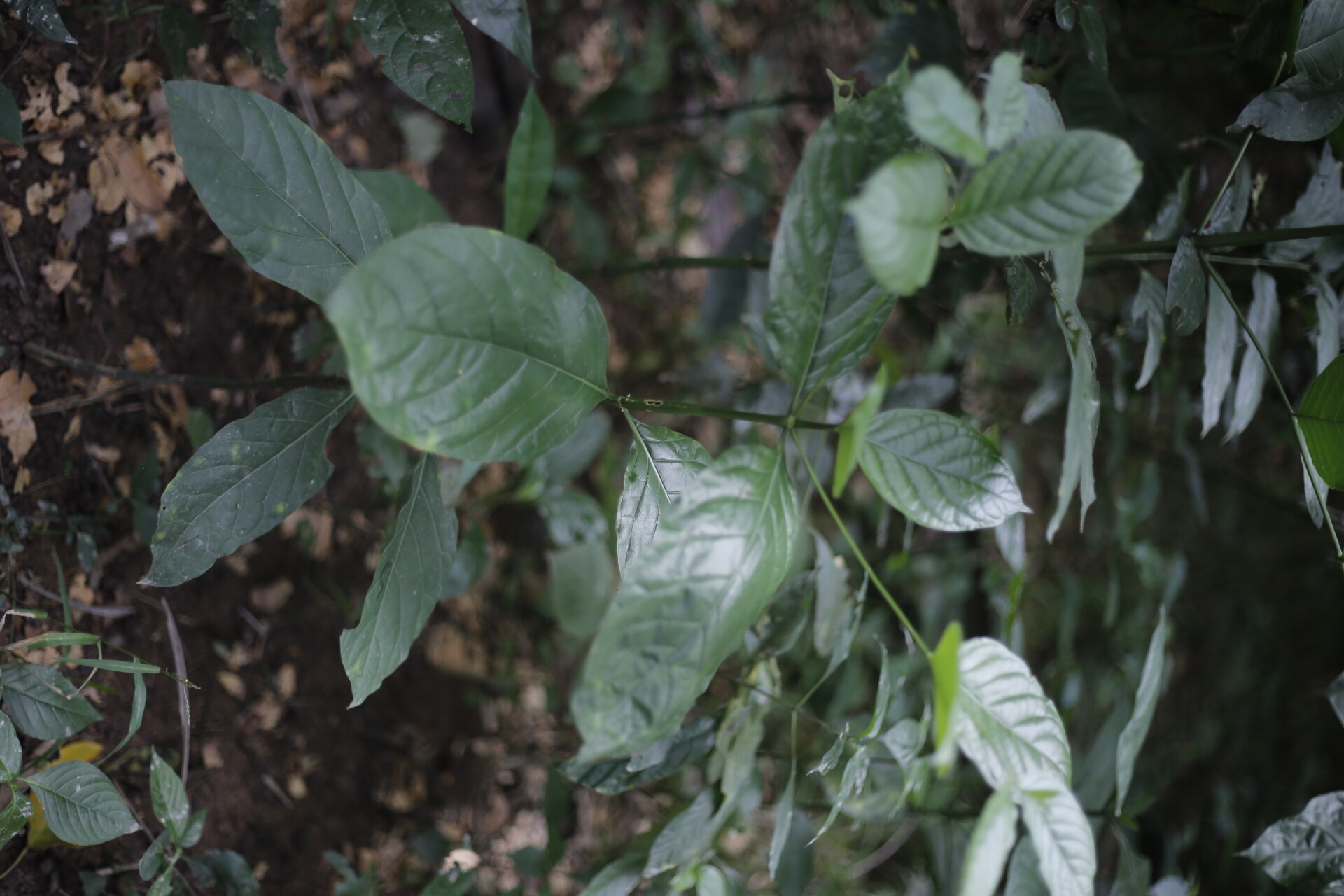
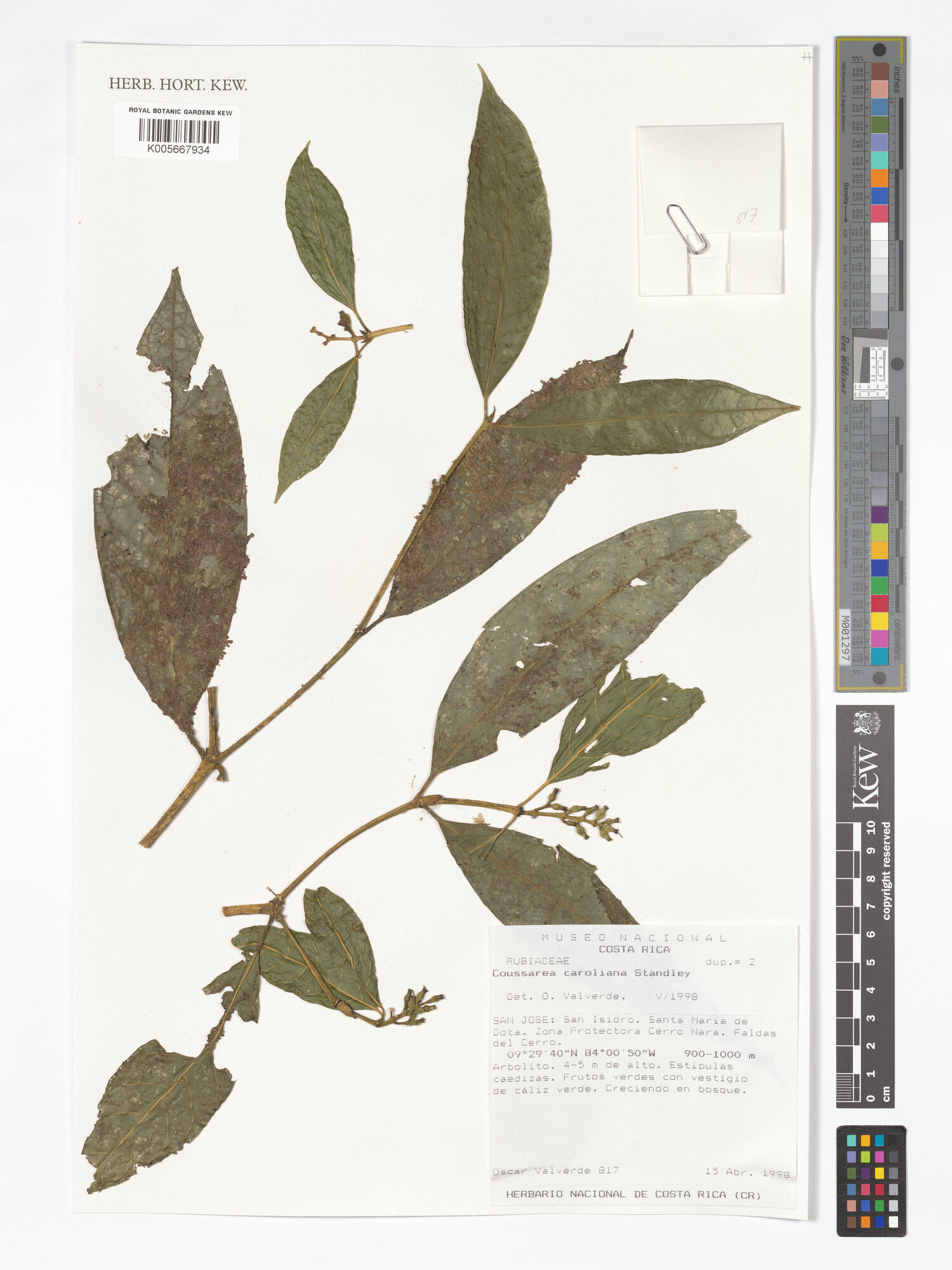
Leaves are simple, opposite, and elliptical, arranged in pairs along the stem as is typical for Rubiaceae. The blades have entire margins and show prominent pinnate venation with lateral veins curving toward the apex. The leaf surface is glabrous (hairless) to sparsely puberulent (finely hairy), with a somewhat glossy dark green upper surface. Interpetiolar stipules, a diagnostic feature of the coffee family, are present at each node.
Flowers
Like other members of the genus, Coussarea caroliana produces 4-merous flowers (with parts in fours), a key character distinguishing Coussarea from related genera. The corolla is white, tubular, and often fragrant, adapted to attract nocturnal or crepuscular pollinators. Many Coussarea species exhibit heterostyly (flowers with either long styles and short stamens, or short styles and long stamens), a breeding system that promotes outcrossing.
Fruits
Fruits are small drupes containing a single seed, another diagnostic feature of Coussarea. The pyrenes (seed-containing structures) have thin walls and are dorsally smooth or slightly angled. The fleshy fruits are likely dispersed by small frugivorous birds, a common pattern in understory Rubiaceae.
Distribution
Coussarea caroliana ranges from Costa Rica through Panama to northwestern Colombia. In Costa Rica, the species occurs primarily in the volcanic highlands of Guanacaste and the Cordillera de Talamanca. A January 2026 query of GBIF returned 438 occurrence records, with the majority from Costa Rica. Key collection localities include Estacion Cacao and Estacion Pitilla in Parque Nacional Guanacaste, the slopes of Volcan Orosi, Parque Nacional Rincon de la Vieja, and Fila Matama in the Talamanca range. Records from Parque Internacional La Amistad in Limon province confirm its presence in the Brunca region.
The tree favors the understory of wet montane forests, typically occurring at elevations between 700 and 1,500 meters where cloud cover maintains high humidity year-round. Unlike lowland Coussarea species, C. caroliana appears to be a true montane element, associated with the cloud forest belt of Costa Rica's volcanic cordilleras.
Ecology
As an understory shrub, Coussarea caroliana is adapted to the low-light conditions beneath the forest canopy. Studies on related Coussarea species in Amazonian forests have shown that these plants are sensitive to drought stress, likely due to their shallow root systems and dependence on the consistently moist conditions of closed-canopy forest. The species probably cannot persist in fragmented or degraded forest where light and humidity regimes have been altered.
The white, fragrant flowers of Coussarea species are typically pollinated by moths or other nocturnal visitors. The single-seeded drupes are dispersed by small forest birds, contributing to the understory seed rain that maintains plant diversity in tropical forests.
Taxonomic History
Paul Carpenter Standley first described Coussarea caroliana in 1940, publishing it in the Field Museum's Botanical Series (volume 22, number 3, page 178) as part of his prolific "Studies of American Plants." Standley, the undisputed authority on Mesoamerican botany during his lifetime, collected extensively in Costa Rica and had already published the Flora of Costa Rica in 1937. His work at the Field Museum from 1927 until his retirement in 1950 resulted in descriptions of thousands of new species.
The species has one synonym: Coussarea veraguensis Dwyer, published later from Panamanian material. The synonymy was established by Lorence in his 1999 "Nomenclator of Mexican and Central American Rubiaceae" and confirmed by Correa and colleagues in the 2004 "Catalogo de las Plantas Vasculares de Panama." The genus Coussarea belongs to the tribe Coussareeae, a group of about 330 species in ten genera that represents one of the early-diverging lineages within the subfamily Rubioideae.
Conservation Outlook
Coussarea caroliana has not been formally assessed by the IUCN Red List. While the species appears to have a relatively broad range across Central America, its dependence on intact montane forest makes it potentially vulnerable to habitat loss. The tree occurs within several protected areas in Costa Rica, including Parque Nacional Guanacaste, Parque Nacional Rincon de la Vieja, and Parque Internacional La Amistad, which provides some protection for existing populations.
Climate change poses a longer-term threat to montane species like C. caroliana. As temperatures rise, cloud forest species may be forced to shift their ranges upward, potentially leading to range contractions for those already at high elevations. Maintaining connectivity between protected montane forest patches will be essential for allowing species to track suitable climate conditions.
Resources & Further Reading
Species Information
Kew's taxonomic database with accepted name status and distribution information.
Taxonomy & Nomenclature
Missouri Botanical Garden nomenclatural database with publication details and synonymy.
Global occurrence records and specimen data.
Related Reading
Molecular phylogenetic study of the tribe Coussareeae, including genus Coussarea.