Madroño
Comarostaphylis arbutoides — A hardy shrub to small tree of Central American highlands, forming dense thickets in the páramo zone above timberline. This member of the heath family serves as a crucial refuge for ectomycorrhizal fungi that sustain forest regeneration.
In the windswept highlands of the Cordillera de Talamanca, where temperatures drop below freezing and clouds sweep across volcanic peaks, the madroño clings to life at the edge of the forest. Growing from dense shrubs to small trees up to 20 meters tall, Comarostaphylis arbutoides often marks the transition between the towering oak forests below and the open grasslands of the páramo above. Where forests have been disturbed, it forms extensive thickets that become nurseries for the invisible network of fungi that will one day help restore the forest canopy.
The species was first described by the English botanist John Lindley in 1843, who placed it in the genus Comarostaphylis, a name derived from the Greek words komaros (strawberry tree) and staphyle (grape cluster), referring to the clusters of berry-like fruits. The species name arbutoides means "resembling Arbutus," the strawberry tree genus of Mediterranean fame. In Costa Rica and throughout Central America, it is known simply as madroño, a name shared with its Old World relatives.
Identification
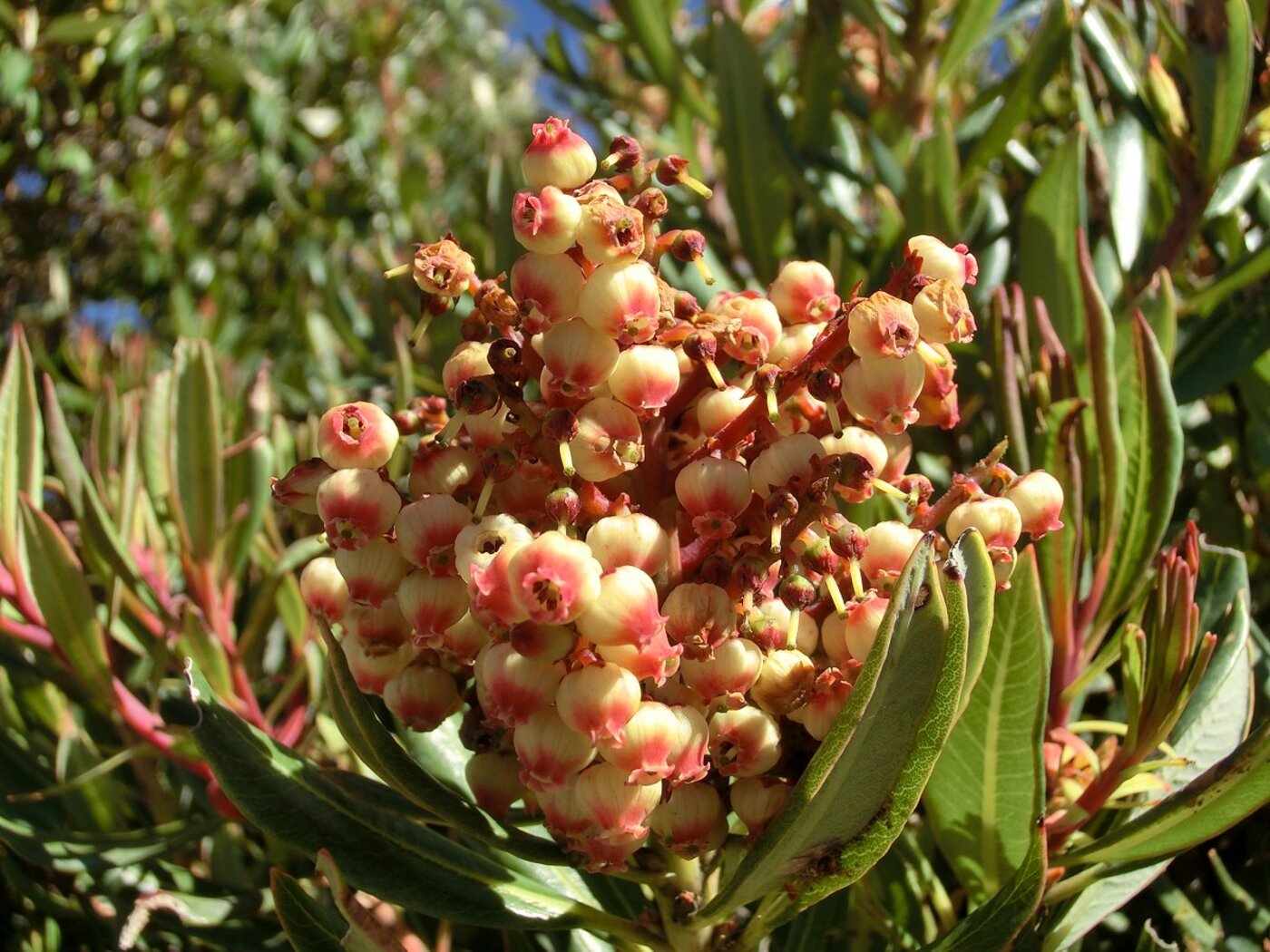
The Ericaceae, or heath family, includes familiar plants like blueberries, cranberries, rhododendrons, and azaleas. The family is particularly well-adapted to acidic, nutrient-poor soils, which explains why its members thrive in the leached volcanic soils of high mountain environments. Comarostaphylis belongs to the subfamily Arbutoideae, which also includes the manzanitas (Arctostaphylos) and the true strawberry trees (Arbutus) of Mediterranean regions.
Physical Characteristics
Form: Highly variable depending on conditions, from a dense, spreading shrub just 1 meter tall in exposed páramo sites to a small tree reaching 20 meters in protected forest. Typically multi-stemmed with a rounded crown.
Bark: One of the most distinctive features: peeling or shredding bark in shades of gray, tan, reddish-brown, or cinnamon, revealing smooth new bark beneath. This characteristic is shared with its relatives, the manzanitas and madrones.
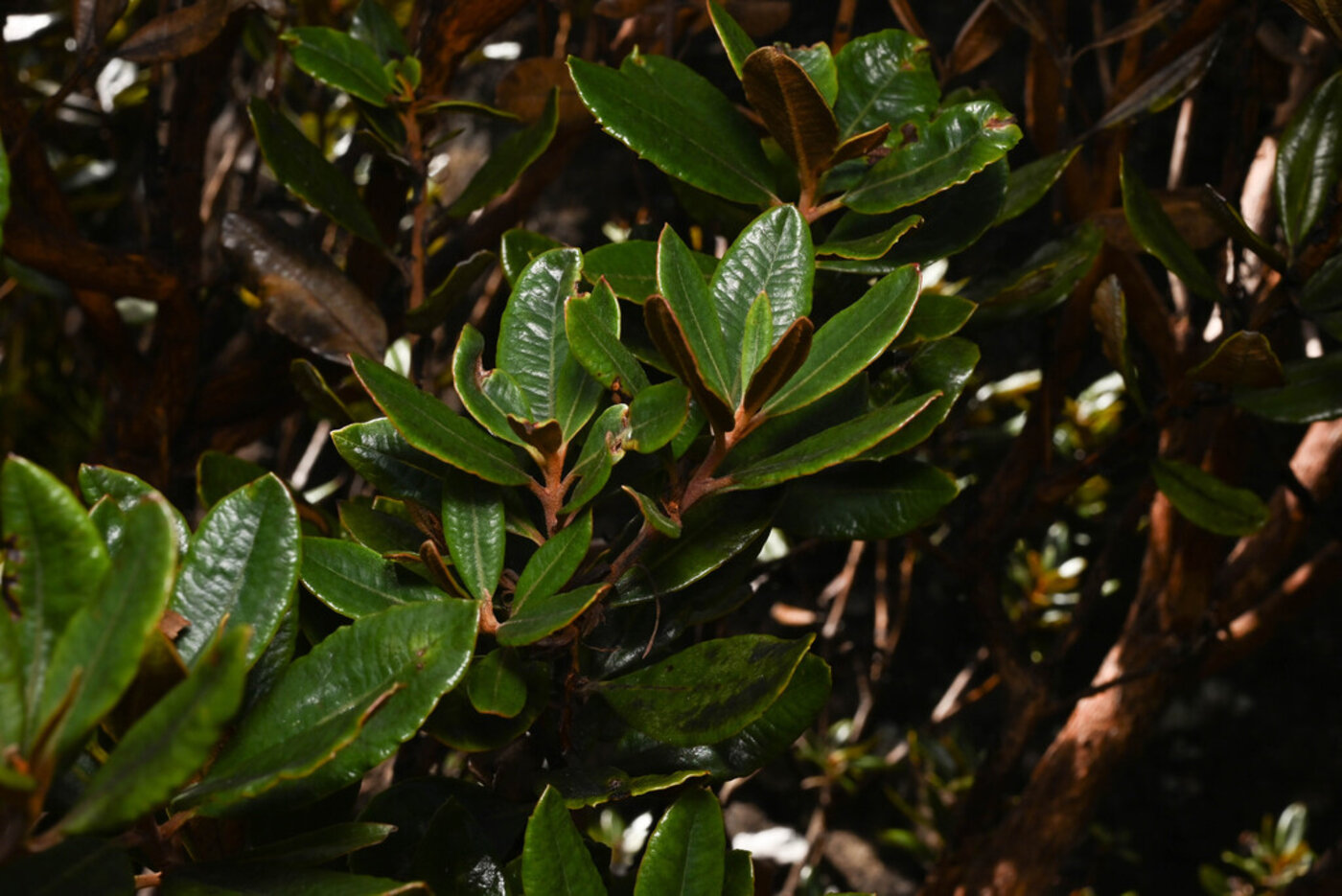
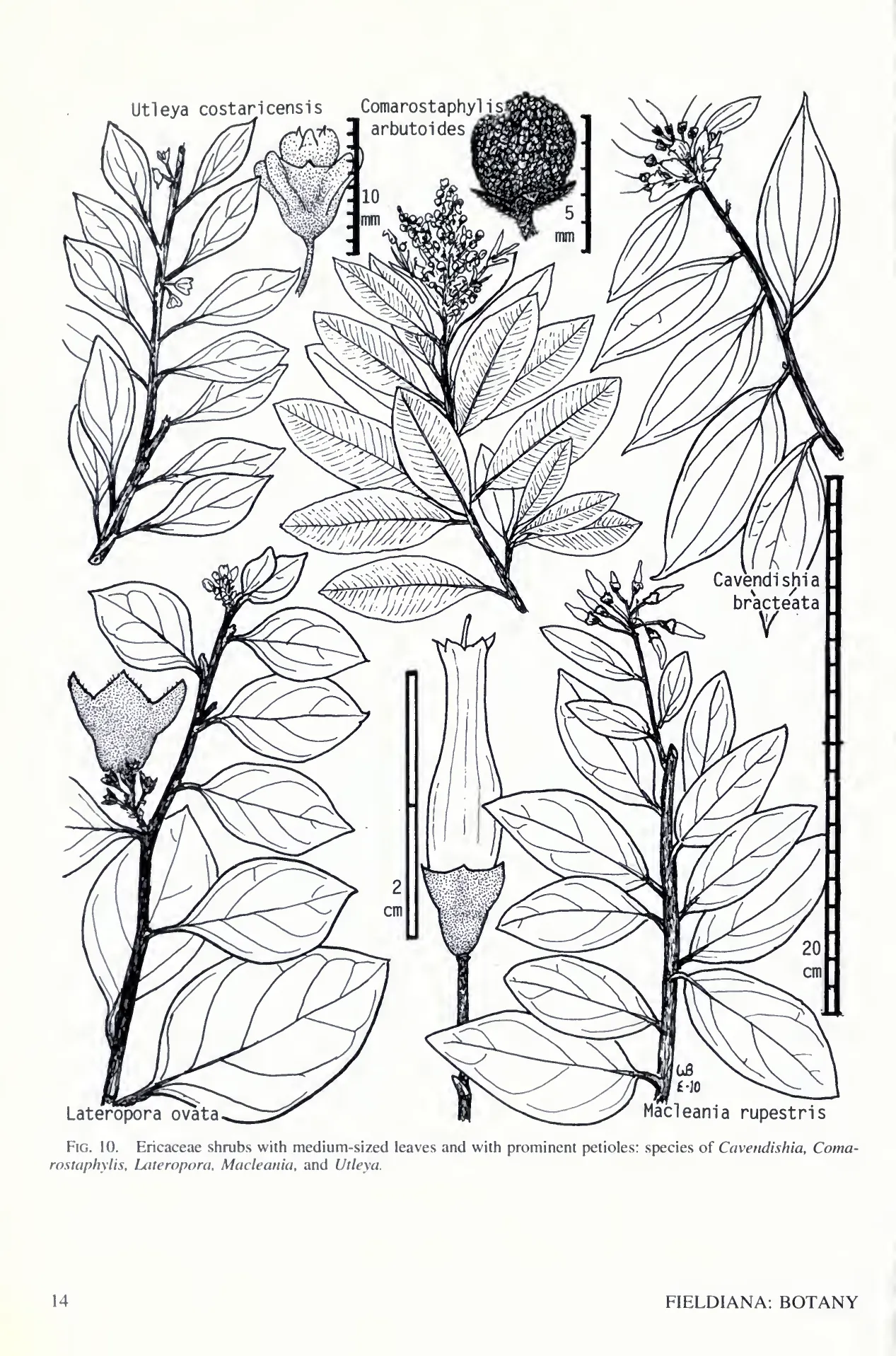
Leaves: Leathery and evergreen, 4.8-12.4 cm long and 1-4.6 cm wide, ranging from lance-shaped to elliptic or obovate. Margins are usually entire but may be slightly wavy. The upper surface is glossy dark green, while the lower surface varies by subspecies: subsp. arbutoides has a distinctive rust-colored (ferruginous) felt beneath, while subsp. costaricensis is smooth and sometimes glaucous.
Flowers: Small, urn-shaped flowers typical of the heath family, arranged in dense panicles 3.5-13 cm long at the branch tips. Corollas are greenish-white to cream, pale yellow, or white, sometimes tinged with pink, measuring 5.7-7.8 mm long. Flowering occurs throughout the year.
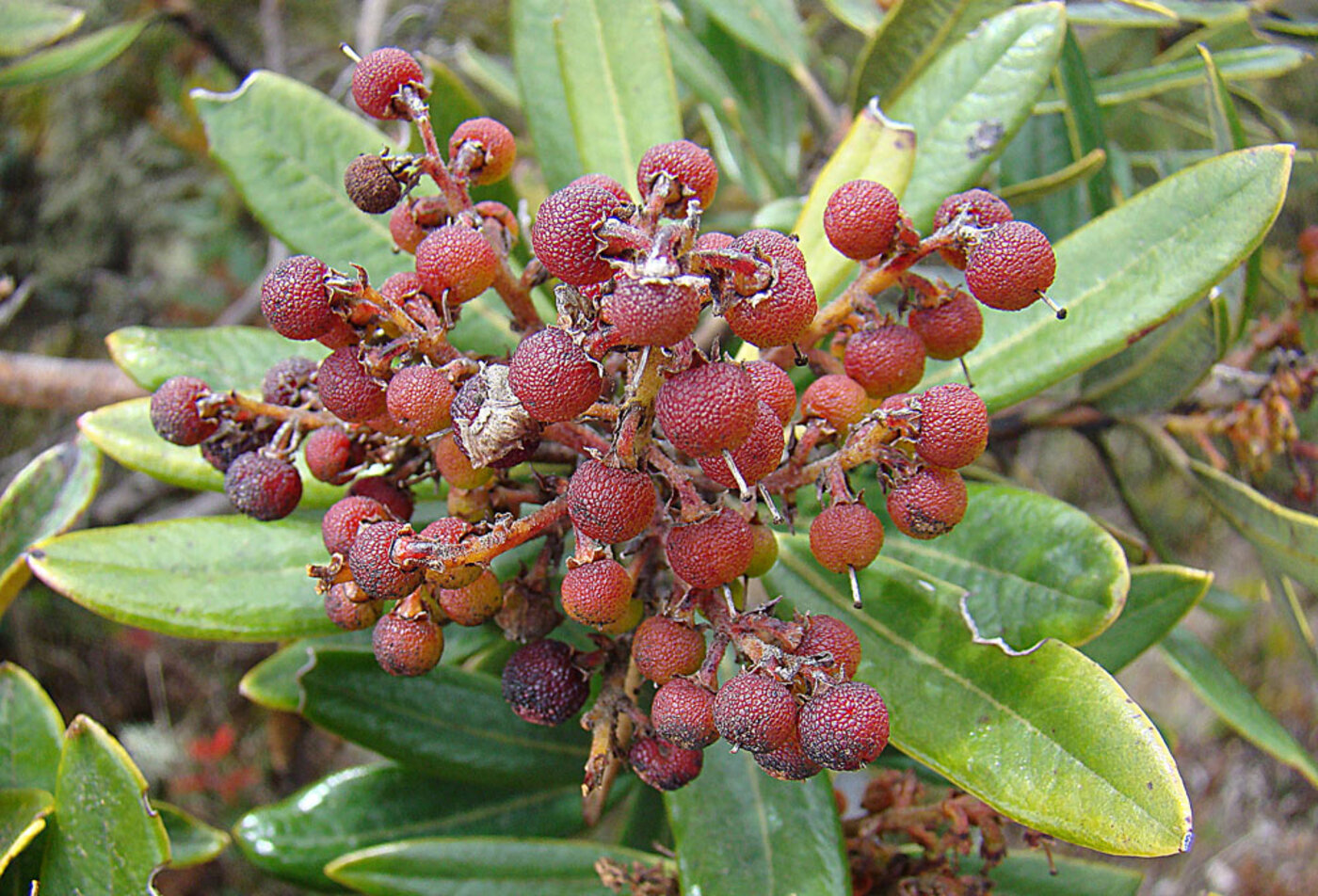
Fruit: Small round drupes, 5-7 mm in diameter. Red when immature, ripening to dark purple or black. The fleshy fruits resemble tiny berries and are eaten by birds. Fruiting occurs throughout the year.
Subspecies
Two subspecies are recognized, distinguished primarily by leaf pubescence:
- Comarostaphylis arbutoides subsp. arbutoides — The nominate subspecies, with distinctive rust-colored (ferruginous) tomentum on the leaf undersides. Distributed from Chiapas, Mexico to Panama, at elevations from 1,350 to 3,800 meters.
- Comarostaphylis arbutoides subsp. costaricensis — Described by John Kunkel Small and later revised by George M. Diggs, this subspecies has glabrous (smooth) leaves beneath, often with a glaucous bloom. Endemic to the Cordillera Central of Costa Rica, at elevations from approximately 2,500 to 3,430 meters.
Ecology & Distribution
Comarostaphylis arbutoides has a broad elevational and geographic range, occurring from central Mexico (Jalisco, Querétaro, Hidalgo) south through Guatemala, Honduras, Nicaragua, Costa Rica, to western Panama. It inhabits oak-pine forests, cloud forests, and the subalpine páramo, from 1,350 to 3,800 meters elevation. Recent botanical surveys extended its known range approximately 500 km northward from previous records in Chiapas.
In Costa Rica, the species reaches its greatest abundance in the Cordillera de Talamanca, particularly around Cerro de la Muerte (3,491 m) and in the highlands of Chirripó National Park. Here it grows alongside Quercus costaricensis in the upper montane zone and forms dense thickets in the transitional subpáramo belt between 3,100 and 3,300 meters, where dwarf bamboo (Chusquea) and shrubs replace the forest canopy.
The Páramo Ecosystem
The Costa Rican páramo represents a unique high-altitude ecosystem found only on the highest peaks of the Talamanca range, above approximately 3,000 meters. This tropical alpine grassland experiences regular nighttime frosts, with temperatures occasionally dropping to -9°C at higher elevations. The páramo is home to 416 flowering plant species, with 50 species endemic to the Talamancan highlands.
Within this harsh environment, C. arbutoides can form extensive, nearly monospecific stands. These thickets provide crucial habitat structure in an otherwise open landscape, offering shelter for birds and small mammals and serving as nucleation points for forest regeneration.
Co-occurring Species
In the upper montane oak forests, C. arbutoides grows with Quercus costaricensis, the dominant canopy tree, along with other Ericaceae members including Cavendishia, Disterigma, and Vaccinium. The understory includes Schefflera and Oreopanax (Araliaceae), Weinmannia (Cunoniaceae), and various epiphytic bromeliads, orchids, and ferns that festoon the branches in the perpetually misty cloud forest.
Wildlife Interactions
The urn-shaped flowers of C. arbutoides attract hummingbirds seeking nectar. Two highland specialists are particularly important pollinators: the fiery-throated hummingbird (Panterpe insignis), which feeds extensively on Ericaceae flowers between 2,200 and 3,200 meters, and the Talamanca hummingbird (Eugenes spectabilis), endemic to the high-altitude cloud forests of Costa Rica and Panama. Both species have evolved longer wings to hover efficiently in the thin mountain air, and their foraging creates fierce competition for nectar resources among the scattered flowering shrubs.
The berry-like fruits attract frugivorous birds that disperse the seeds. The black-billed nightingale-thrush (Catharus gracilirostris), found foraging in páramo shrubs and highland oak forest understory between 2,150 and 3,500 meters, feeds on a wide range of berries. The sooty thrush (Turdus nigrescens), a large thrush endemic to the Costa Rican and Panamanian highlands, frequents forest edges and open areas above 2,200 meters where C. arbutoides thickets provide both food and cover. By consuming fruits and depositing seeds in new locations, these birds help maintain genetic connectivity among fragmented populations.
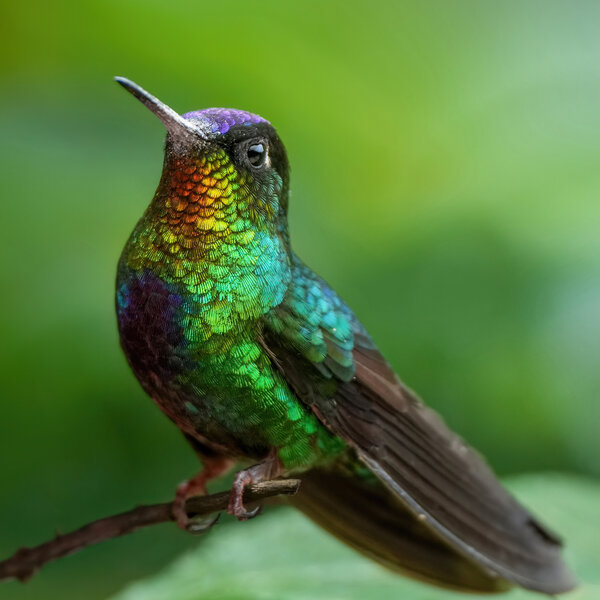
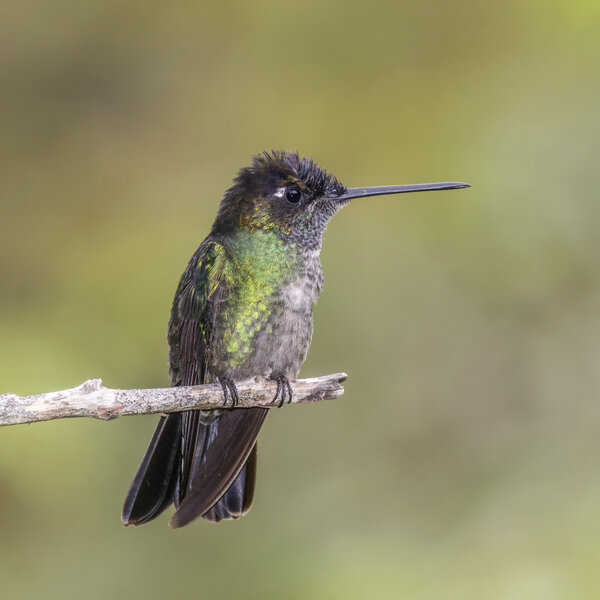
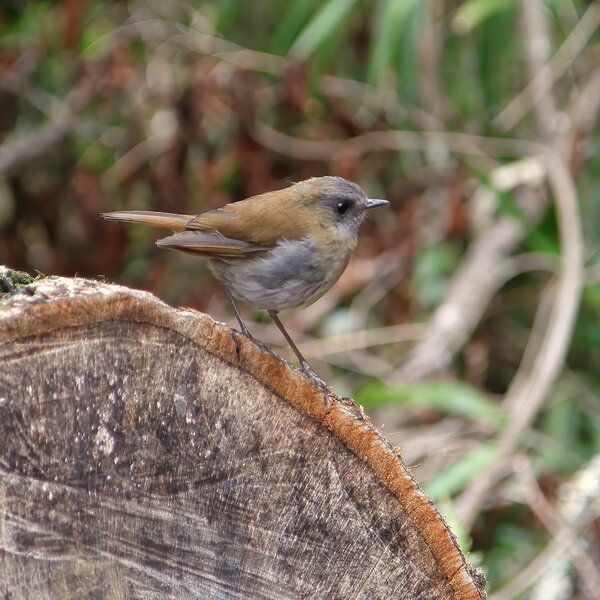
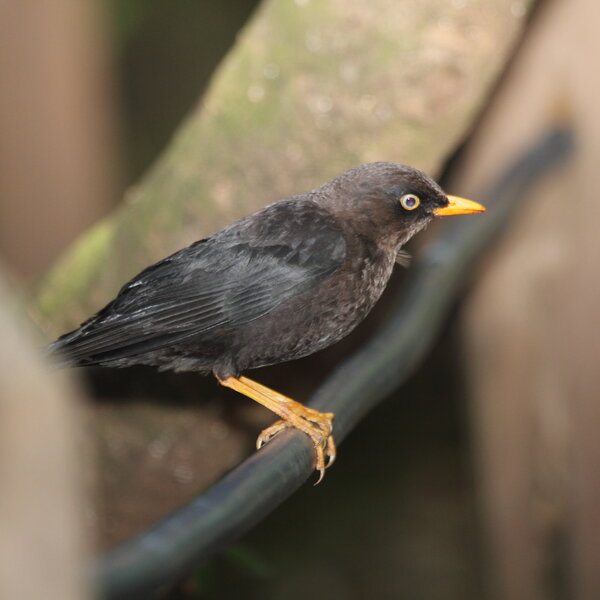
Photos: Wikimedia Commons (CC BY-SA). Top row: pollinators. Bottom row: seed dispersers.
Mycorrhizal Associations
Perhaps the most ecologically significant aspect of C. arbutoides is its role as a "refuge plant" for ectomycorrhizal fungi. Like all members of subfamily Arbutoideae, this species forms a specialized type of mycorrhiza called "arbutoid mycorrhiza." Research at Cerro de la Muerte has documented diverse fungal communities associated with C. arbutoides roots, including species of Russula, Cortinarius, Cenococcum, Leccinum monticola, Sebacina, and Leotia.
Crucially, C. arbutoides shares many of these fungal partners with Quercus costaricensis, the dominant canopy oak. When oak forests are logged or cleared, the mycorrhizal network that sustained those trees is lost along with them. But where C. arbutoides thickets persist, they maintain viable populations of ectomycorrhizal fungi in the soil. When oak seedlings eventually establish in these areas, they can tap into this existing fungal network, dramatically improving their chances of survival and growth. In this way, the unassuming madroño serves as a living bridge between disturbed and restored forest.
Uses
The fruits of C. arbutoides are edible, though their specific traditional uses are not well documented. The closely related Mediterranean madroño (Arbutus unedo) has been used for millennia to make alcoholic beverages, and Pacific madrone berries (Arbutus menziesii) were eaten by Indigenous peoples of western North America. Given this family tradition of edible fruits, it is likely that the berries of C. arbutoides were similarly consumed, though they may be somewhat astringent.
The peeling, attractive bark and evergreen foliage give the species ornamental potential in highland gardens within its native range. As awareness grows of its ecological role in maintaining mycorrhizal networks, C. arbutoides may become increasingly valuable in forest restoration projects in the Talamanca highlands.
Conservation
Comarostaphylis arbutoides was previously listed as Vulnerable on the IUCN Red List, though it was not included in the 2013 revision. The species is cited among vulnerable plants for cloud forests (bosques mesófilos) in Mexico and for protected areas like El Triunfo Biosphere Reserve.
In Costa Rica, all páramo ecosystems where C. arbutoides reaches its greatest abundance are legally protected within three national parks: Chirripó National Park, La Amistad International Park (shared with Panama), and Tapantí-Macizo de la Muerte National Park. These protections help ensure the survival of both the species and the fungal communities it harbors.
Climate change poses a potential long-term threat to this highland species. As temperatures rise, the páramo ecosystem may contract upward, eventually running out of mountaintop to occupy. Species like C. arbutoides that are already at the upper limits of tree growth may find themselves squeezed between rising temperatures below and the summit above.
Resources & Further Reading
Species Information
Overview of the species including taxonomy, distribution, and subspecies.
Detailed botanical description including morphology and subspecies characteristics.
Global occurrence records and distribution data.
Species information for Panama including habitat and phenology.
Ecology & Mycorrhizae
Research documenting mycorrhizal associations at Cerro de la Muerte, Costa Rica.
Study of Cortinarius fungi forming mycorrhizae with C. arbutoides in the Talamanca highlands.
Páramo Ecosystem
Overview of the high-altitude ecosystem where C. arbutoides forms thickets.
Overview of the ecoregion including elevation zones and endemic species.
Taxonomy
Study documenting the northern range extension of the species in Mexico.