Colpachi
Croton schiedeanus — A medicinal tree of the humid lowlands whose bark smells of menthol, used for centuries to treat wounds and high blood pressure, while serving as a host plant for leafwing butterflies.
In the forests of Costa Rica, from the lowland Caribbean slopes to the edges of the Cordillera de Talamanca, grows a tree that carries its medicine in its bark. Peel away a strip from Croton schiedeanus and a sharp, penetrating odor fills the air, somewhere between menthol and pine. This distinctive scent hints at the complex chemistry within, a combination of diterpenoids and flavonoids that has made the tree valuable in traditional medicine across its range from Mexico to Brazil.
Known locally as colpachi, this understory tree thrives in secondary forests and along stream banks, places where light penetrates the canopy enough for it to flourish. Its success in disturbed habitats has made it one of the more common trees in recovering forests, where it flowers nearly year-round and provides food for the bees that pollinate it and the birds that disperse its small, tick-shaped seeds.
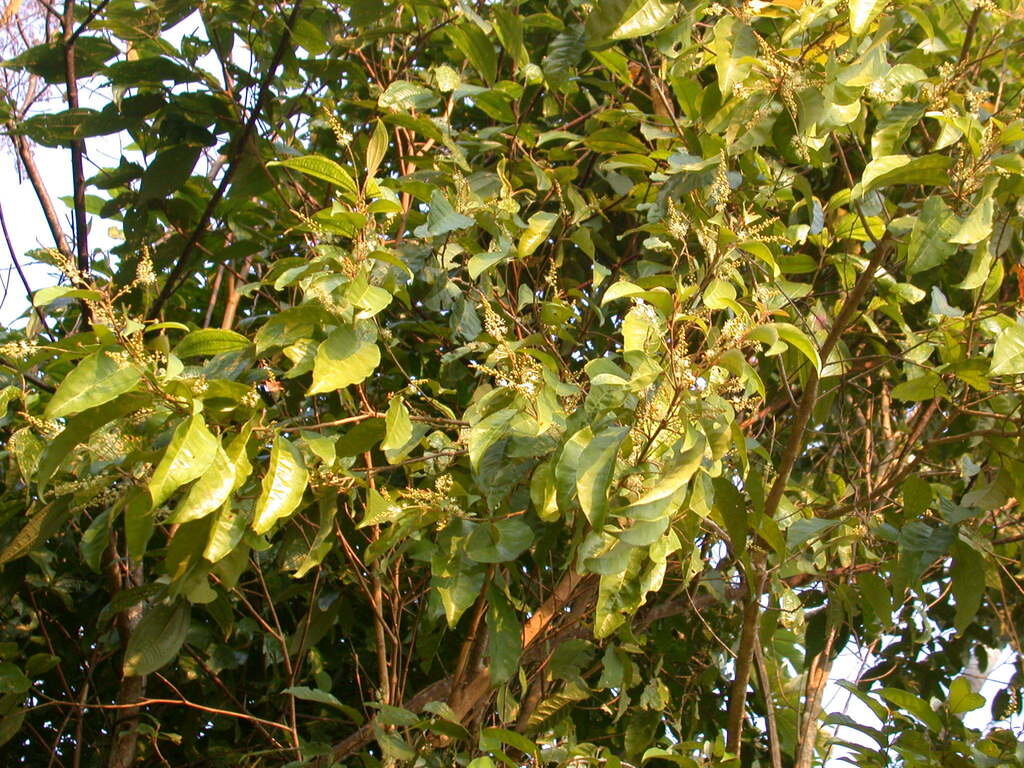
Identification
Physical Characteristics
Crown & Trunk: Croton schiedeanus typically grows as a small to medium tree, reaching 10 to 15 meters in height under favorable conditions, though exceptional specimens can attain 25 meters. The trunk is straight and cylindrical, with yellowish to grayish bark. When freshly cut or peeled, the bark releases a strong medicinal odor reminiscent of menthol or pine resin, a characteristic that makes the tree easy to identify in the field.
Leaves: The leaves are simple and alternate, broadly elliptical with pointed tips and rounded bases. They measure 7 to 25 cm long and 3 to 9 cm wide, with wavy (sinuate) margins. Both surfaces are covered with distinctive scale-like hairs (lepidote trichomes), giving the foliage a golden or silvery sheen, particularly noticeable on young growth and the undersides of mature leaves.
Flowers: Small and white, the flowers appear in axillary racemes. The species is monoecious, meaning each tree bears both male and female flowers, which simplifies reproduction compared to dioecious species that require both sexes in proximity. The flowers attract bees and other pollinators, and the tree can bloom at almost any time of year.
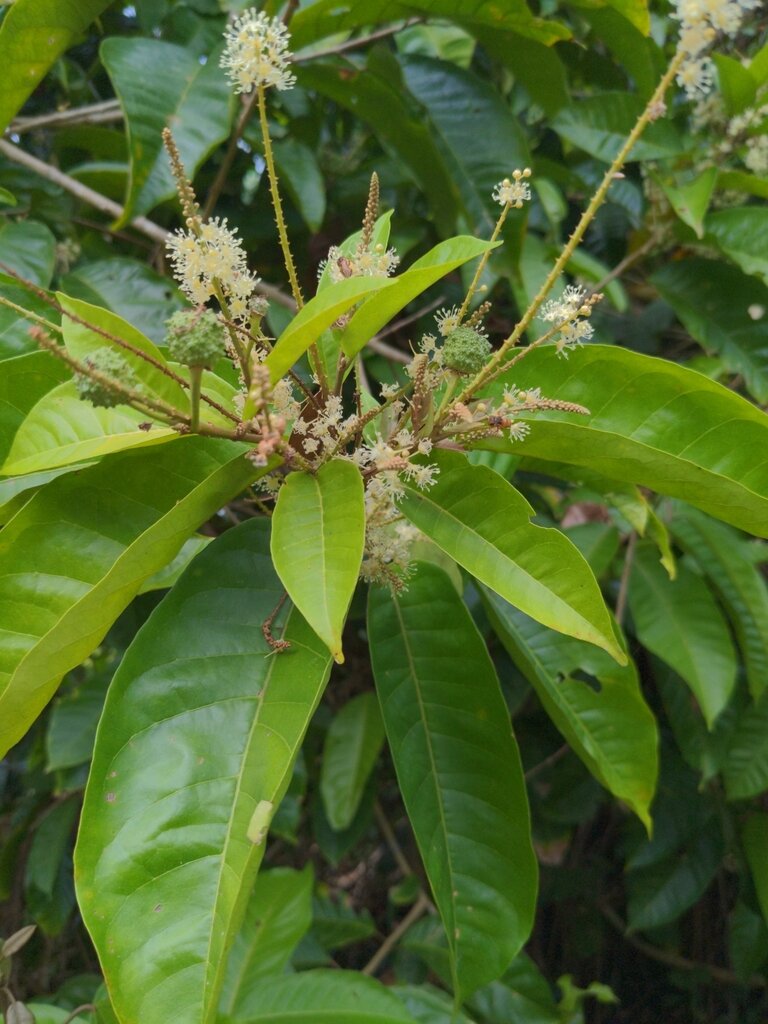
Fruits: The fruits are small capsules, 0.9 to 1.2 cm long, with a distinctly warty (verrucose) surface. They ripen to light brown and split open to release seeds that resemble tiny ticks, a shape that gives the genus Croton its name, from the Greek krotos meaning "tick." These seeds are consumed by birds and may also be dispersed by explosive dehiscence, a mechanism where the drying capsule suddenly splits and flings seeds away from the parent tree.
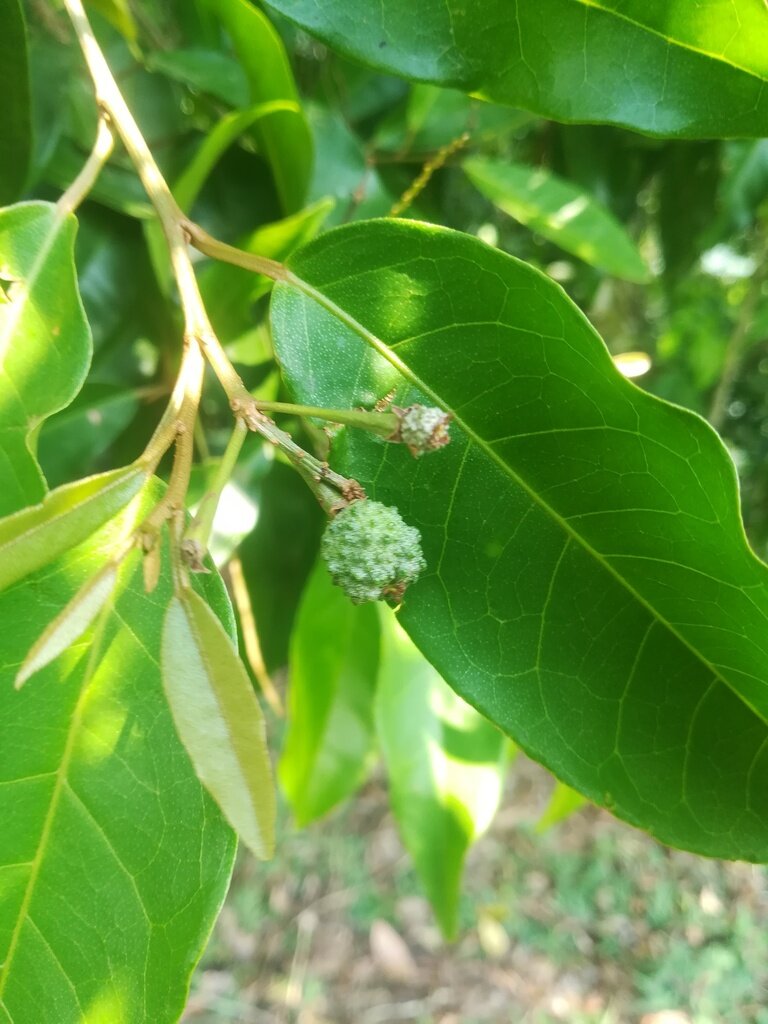
Distinguishing Features
Croton schiedeanus can be confused with the related Croton pachypodus, but can be distinguished by examining the leaf base: C. pachypodus has paired glands at the apex of the petiole where it meets the leaf blade, while C. schiedeanus lacks these glands. The strong menthol-pine odor of freshly cut bark is another reliable identification feature.
Branches often develop galls, abnormal growths caused by insect larvae or other organisms. These galls are common enough to be a field identification feature, though they do not appear to significantly harm the tree.
Habitat & Distribution
Croton schiedeanus has one of the broadest distributions in its genus, ranging from Mexico through Central America to Bolivia, Brazil, Venezuela, and the Guyanas in South America. It occurs primarily in lowland wet forests, typically below 500 meters elevation, though in Costa Rica it extends to 1,200 meters on the Caribbean slopes of the Cordilleras de Tilarán, Central, and Talamanca.
The species thrives as an understory tree where light reaches the forest floor, making it particularly common along stream banks, roadsides, and forest edges. It is abundant in secondary forests and regenerating areas, where reduced competition allows it to establish and grow. This affinity for disturbed habitats has made colpachi one of the more successful trees in landscapes shaped by human activity.
In Costa Rica, the tree is documented in the Área de Conservación Guanacaste, the Río Sapoá basin, the Caribbean lowlands, and the vicinity of Puerto Limón. It grows on a wide range of soil types and tolerates both continuously moist conditions and areas with distinct dry seasons.
Butterflies & Ecology
Croton schiedeanus serves as a host plant for the leafwing butterfly Memphis artacaena, a member of the most species-rich genus of Neotropical Charaxinae. These butterflies are named for their wing undersides, which mimic dead leaves so convincingly that they become nearly invisible when resting on the forest floor. Memphis is among the largest butterfly genera in the Americas, with caterpillars of various species feeding on Euphorbiaceae, Lauraceae, and Piperaceae.
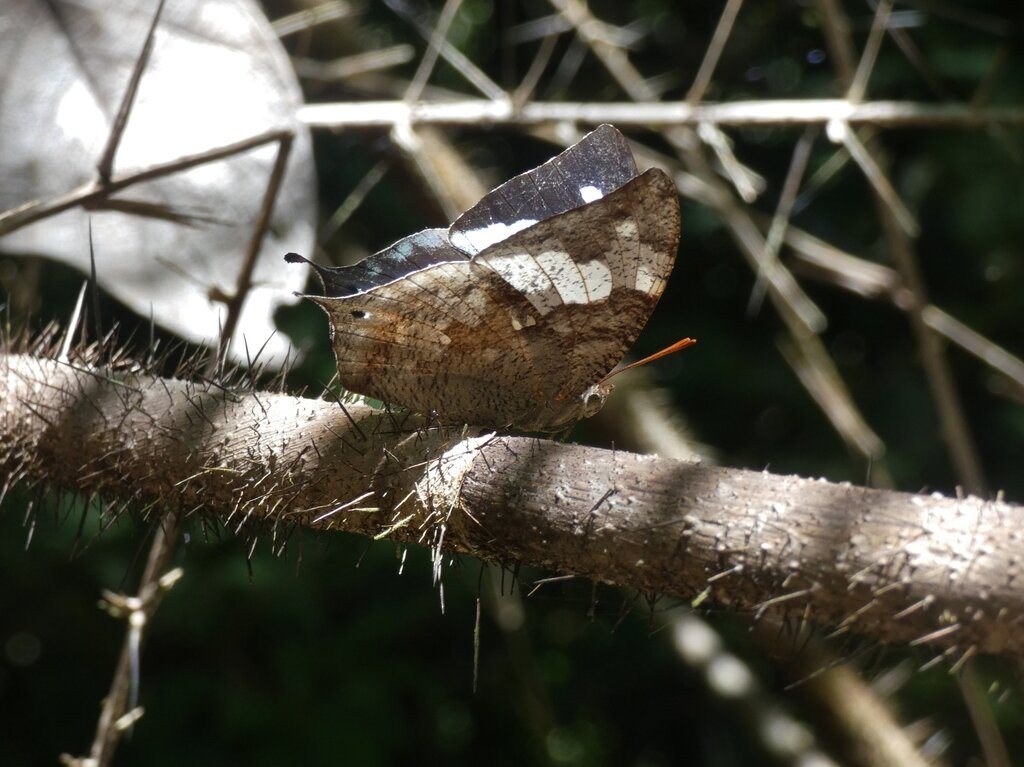
The caterpillar of Memphis artacaena is a striking creature. In its last instar, the larva has a black head marked with beige vertical bands forming inverted V shapes. The body is olive-green with black and white lateral spots, and three abdominal segments are black dorsally. Most distinctively, it bears two stubby black epicranial horns and is covered with yellow and beige knobby protuberances. The pupa is pale greenish-brown with patches of dark brown and a black cremaster. Related Memphis species in Costa Rica, such as M. perenna lankesteri, use the related Croton niveus as their host plant, with immature stages lasting about 59 days from egg to adult.
A Tale of Two Dispersal Strategies
The small white flowers attract bees, which serve as the primary pollinators. But the most remarkable aspect of colpachi's ecology may be its seed dispersal. Like many Euphorbiaceae, it employs diplochory: a two-phase dispersal system that combines explosive ejection with ant-mediated transport. When the fruit capsules dry, they suddenly split open and fling seeds several meters from the parent tree. But the journey doesn't end there.
Each seed bears a caruncle, a small, fleshy appendage rich in lipids and proteins. This structure, a type of elaiosome, has evolved independently over 100 times in flowering plants as a reward for ant dispersers. Ants locate the seeds, grasp them by the caruncle, and carry them back to their nests. There, they consume the nutritious appendage and discard the intact seed, often in nutrient-rich refuse piles where germination conditions are favorable. This ant-mediated dispersal, called myrmecochory, may be particularly important in the secondary forest habitats where colpachi thrives, helping seeds escape predation and find suitable microsites for establishment.
Traditional Medicine
Throughout its range, Croton schiedeanus has been used in traditional medicine. In Colombia, where the tree is known as almizclillo, it is among the medicinal plants traditionally used for treating hypertension. In the medicinal plant markets of Bogotá, almizclillo is sold for treating arteriosclerosis, blood cleansing, liver problems, and urinary infections. The sap, when applied to infected wounds, is said to aid healing and reduce inflammation. A gum extracted from the trunk has been used for dental hygiene, and the leaves are placed on wounds to help reduce swelling.
Pharmacology: The Science Behind the Folklore
Modern pharmacological research has validated traditional uses with remarkable precision. Studies at the University of Salamanca isolated six cis-clerodane diterpenoids from the plant's aerial parts, including two compounds new to science: cis- and trans-dehydrocrotonin, 5β-hydroxy-cis-dehydrocrotonin, and (12R)-12-hydroxycascarillone. The leaves yield two key flavonoids: ayanin (3,7,4'-tri-O-methylquercetin) and quercetin-3,7-dimethyl ether.
These compounds work through the nitric oxide/cyclic GMP (NO/cGMP) pathway, a cellular signaling system critical for blood vessel relaxation. In laboratory studies using rat aortic tissue, quercetin-3,7-dimethyl ether proved more potent than quercetin itself. The relaxant effect was significantly decreased when researchers blocked nitric oxide synthesis or inhibited guanylate cyclase, confirming the mechanism. Intriguingly, specific molecular features enhance activity: hydroxyl groups at positions 3' and 4' of the B ring, and methylation at positions 3 and 7 of the flavonoid structure.
Perhaps most striking is the interaction between the plant's compounds. When tested together, ayanin and quercetin-3,7-dimethyl ether showed a dual interaction pattern: synergistic at higher concentrations (enhancing each other's effects) but antagonistic at lower concentrations. The combined flavonoids achieved a maximum effect of 98.4% relaxation, compared to just 33.9% for the whole plant extract, suggesting that isolated compounds at proper concentrations could offer therapeutic advantages over traditional preparations.
Timber & Uses
The wood of Croton schiedeanus is harvested locally for construction, fence posts, and firewood. While not a major commercial timber species due to its relatively small trunk diameter, the tree provides useful material for rural communities throughout its range. Its tolerance for disturbed habitats and ability to grow on degraded land make it a potential candidate for restoration plantings, where it can provide early canopy cover while slower-growing timber species establish.
Naming & History
The species was described in 1846 by the German botanist Diederich Franz Leonhard von Schlechtendal, who published the name in the botanical journal Linnaea. Schlechtendal named the tree in honor of Christian Julius Wilhelm Schiede (1798-1836), a German physician and botanist whose Mexican collections revolutionized botanical knowledge of the region.
In 1828, Schiede emigrated to Mexico accompanied by Ferdinand Deppe, a German naturalist who had previously collected in the country. The two planned to make their living selling zoological and botanical specimens to European museums and dealers. They settled in Jalapa (now Xalapa) in July 1828 and made distant excursions throughout Veracruz, including ascents of Pico de Orizaba nearly to its summit, and visits to Misantla, Papantla, the port of Veracruz, and Laguna Huetulacan west of Cofre de Perote.
Their collections were sold to the museums of Berlin and Vienna, but the financial returns proved insufficient. By late 1830, they were forced to abandon their enterprise. Schiede remained in Mexico, practicing medicine, until his death in 1836 at just 38 years old. His collections formed the basis for Schlechtendal's landmark work De plantis Mexicanis, which described hundreds of new species. Today, Schiede is commemorated not only in Croton schiedeanus but in numerous other species and the botanical genera Schiedeella and Schiedea, as well as several reptile species including Deppe's arboreal alligator lizard (Abronia deppii) and the Mexican pine snake (Pituophis deppei).
A Giant Genus: Dragon's Blood and Beyond
The genus name Croton comes from the Greek word for tick (krotos), referring to the shape of the seeds in many species. But the name belies the genus's importance: Croton is the second-largest genus in the spurge family, with between 1,200 and 1,300 species ranging from herbs and shrubs to trees across tropical and subtropical regions worldwide. In the Americas alone, over 700 species have been described, with 300 occurring in Brazil.
Among the most famous of colpachi's relatives are the dragon's blood trees of the Amazon: Croton lechleri, C. draco, and several other species that produce a bright red latex known as sangre de drago or sangre de grado. Indigenous communities across the western Amazon have used this latex for centuries as a liquid bandage that dries quickly to form a protective skin-like barrier over wounds. Modern research has confirmed its healing properties; the latex contains proanthocyanidins (over 90% of its dry weight) and the alkaloid taspine, compounds with documented antibacterial, antiviral, and wound-healing activity. The pharmaceutical compound crofelemer, derived from C. lechleri latex, has been approved as an anti-diarrheal medication.
Though C. schiedeanus does not produce the dramatic red latex of its Amazonian cousins, it shares the family's rich chemistry. The clerodane diterpenoids found in colpachi occur throughout the genus Croton, which along with Ajuga, Scutellaria, and Clerodendrum represents one of the richest natural sources of these compounds.
Conservation Status
Croton schiedeanus is classified as Least Concern by the IUCN. The species has a very wide distribution, large population, and faces no currently identified major threats. Its ability to thrive in secondary forests and disturbed habitats provides a degree of resilience that many forest specialists lack. As forests regenerate on abandoned agricultural land across the Neotropics, colpachi is often among the first trees to appear, contributing to the recovery of forest structure and the ecological services that forests provide.
Resources & Further Reading
Species Information
Overview of the species including distribution, chemistry, and traditional uses.
Comprehensive information on physical characteristics, habitat, and uses.
Authoritative taxonomic information and native range data.
Costa Rican database with local distribution and ecological information.
Pharmacology & Chemistry
Key study demonstrating the NO/cGMP pathway mechanism and structure-activity relationships of the main vasorelaxant compound.
Original study validating traditional antihypertensive use in spontaneously hypertensive rats.
Study showing dual interaction (synergistic/antagonistic) between ayanin and quercetin-3,7-dimethyl ether at different concentrations.
Isolation and structural elucidation of two new neo-clerodane diterpenoids using X-ray crystallography.
Identification of six cis-clerodane diterpenoids, including two compounds new to science.
Comprehensive review of the Croton genus including vasorelaxant properties and dragon's blood species.
Case reports documenting hepatotoxicity from prolonged medicinal use in Spain.
Historical References
Biography of the German botanist for whom the species was named.
Field observations and photographs from Costa Rica's ACG conservation area.
Biography of the German naturalist who accompanied Schiede on the 1828 Mexican expedition.
Ecology & Seed Dispersal
Overview of ant-mediated seed dispersal, a strategy employed by many Euphorbiaceae including Croton.
Explanation of the lipid-rich seed appendages that attract ants, including discussion of caruncles in Euphorbiaceae.
Overview of the leafwing butterfly genus that uses Croton species as larval host plants.
The Croton Genus
Overview of the genus, the second-largest in Euphorbiaceae with 1,200-1,300 species.
The famous Amazonian dragon's blood tree, source of the pharmaceutical compound crofelemer.
Biodiversity Databases
Observations and photographs from across the species range.
Global occurrence records and distribution data.