Malacagüite
Chomelia tenuiflora — A spiny understory shrub or small tree of the coffee family, bearing elegant white tubular flowers that suggest moth pollination. Named for its "slender flowers," this species ranges from Costa Rica to Brazil through the humid forests of tropical America.
In the perpetual twilight of Costa Rica's rainforest understory, slender white flowers open on spiny branches, their narrow tubes reaching 20-25 mm long. Chomelia tenuiflora is one of the most widespread members of its genus, occurring from the Caribbean slopes of Costa Rica through Panama, Colombia, Ecuador, Peru, Bolivia, and across Brazil to Guyana and French Guiana. In the Brunca region, it has been collected from Corcovado National Park, Piedras Blancas National Park, and the Golfito Wildlife Refuge, thriving in the very humid and pluvial forests that characterize the region.
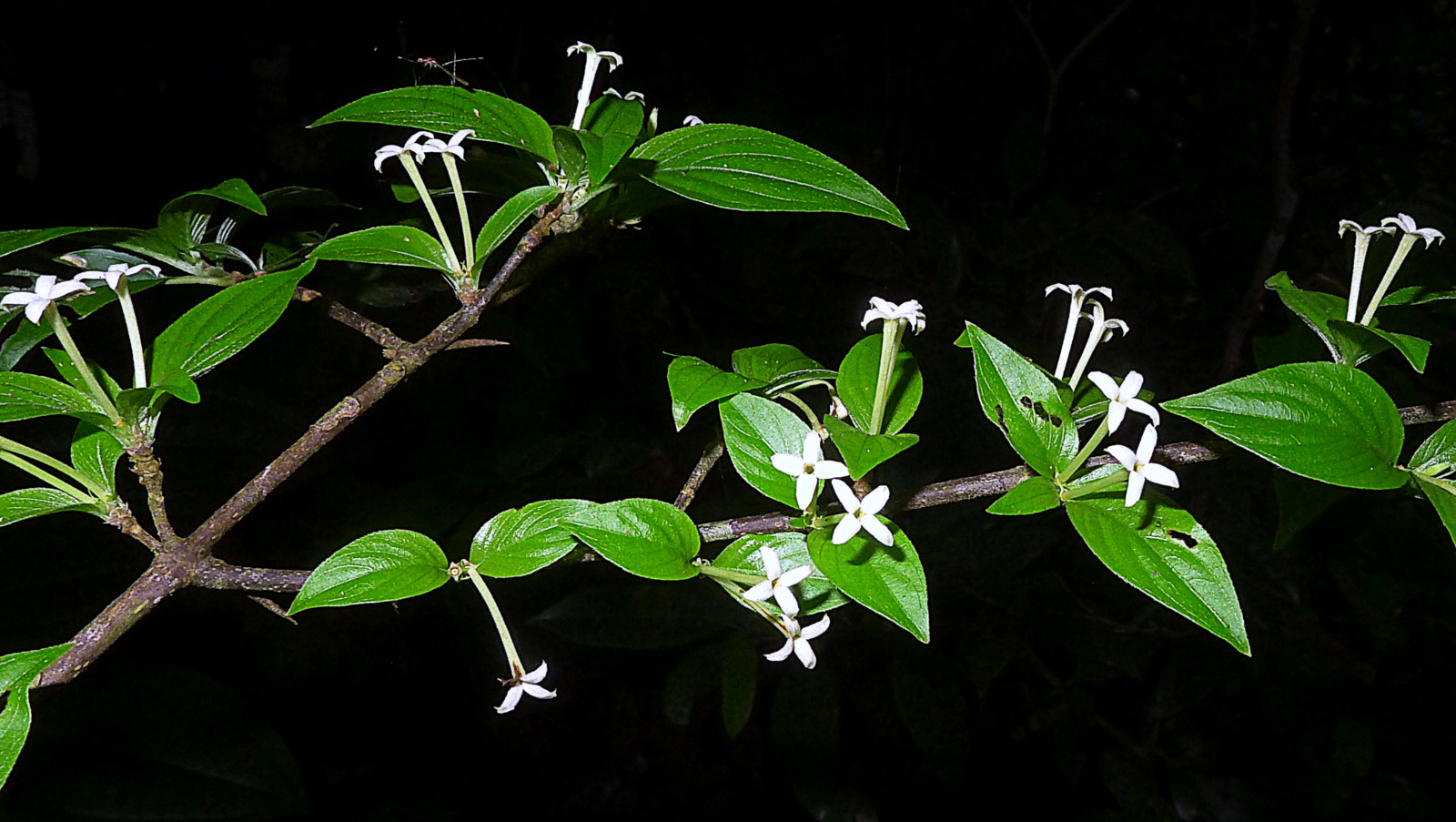
The species was first described by George Bentham in 1841 from specimens collected by Robert Schomburgk in British Guiana (present-day Guyana). Like other members of tribe Guettardeae, it produces fleshy fruits adapted for bird dispersal, though the specific dispersers have not been documented. The white, tubular flowers with their narrow corollas suggest pollination by moths or other long-tongued insects, though this too awaits formal study.
Identification
Habit
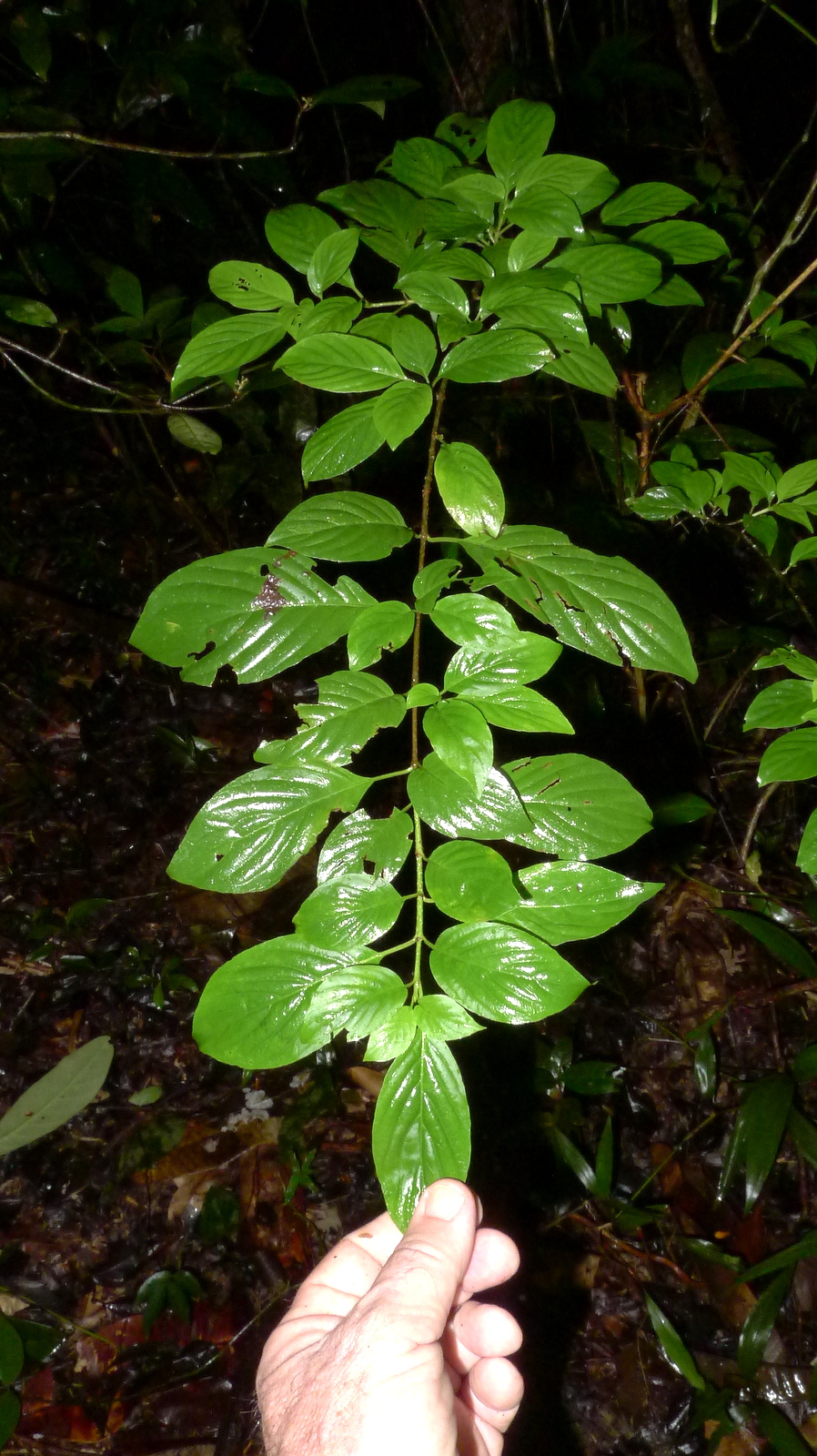
Chomelia tenuiflora grows as a shrub or small tree reaching up to 8 meters in height. The species is frequently armed with spines up to 1 cm long, a defensive adaptation common in the genus. The branches are arranged oppositely, and the branchlets are densely hirtulous (finely hairy) to strigulose (with short, appressed hairs), providing a useful identification character.
Leaves
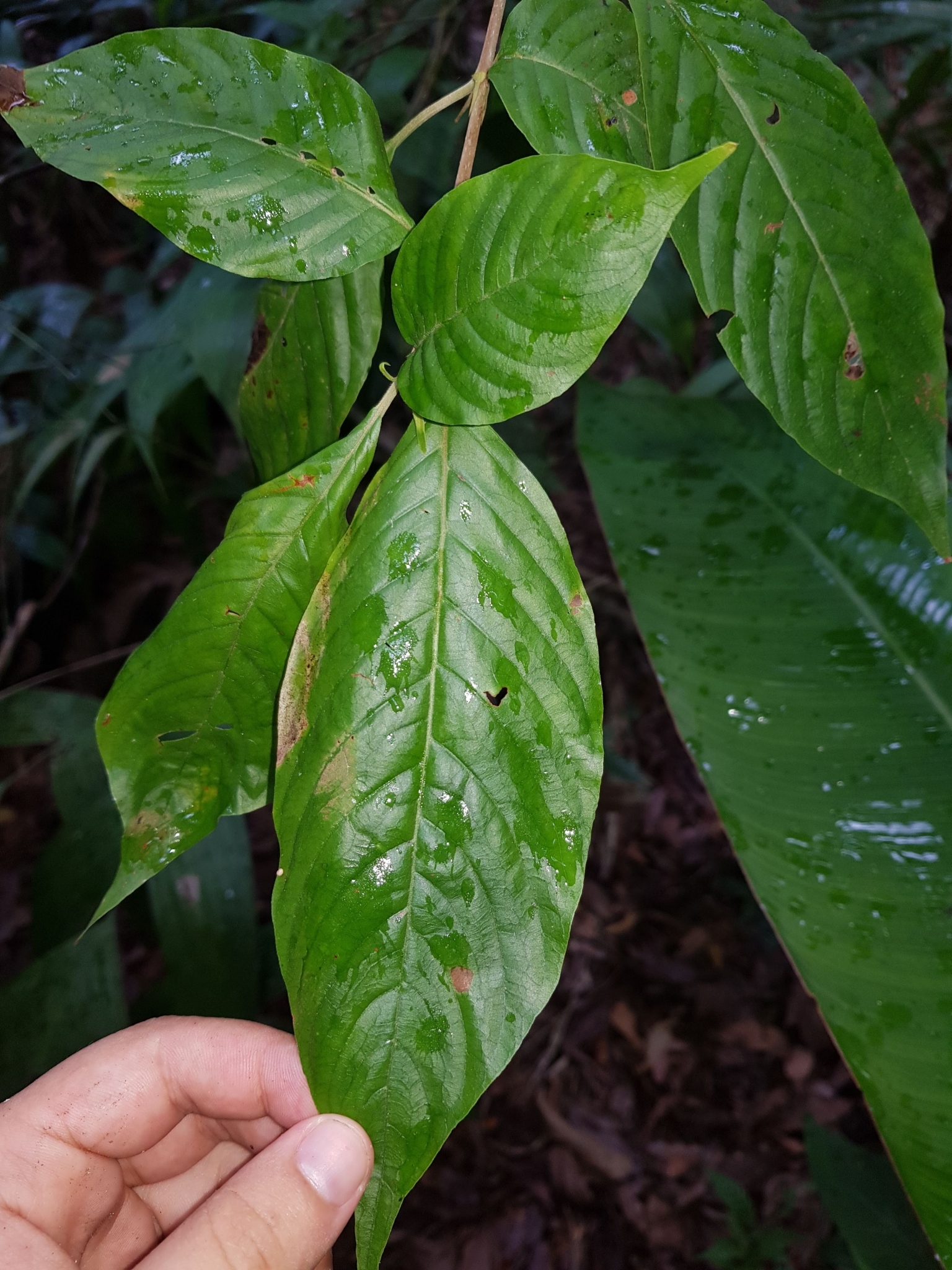
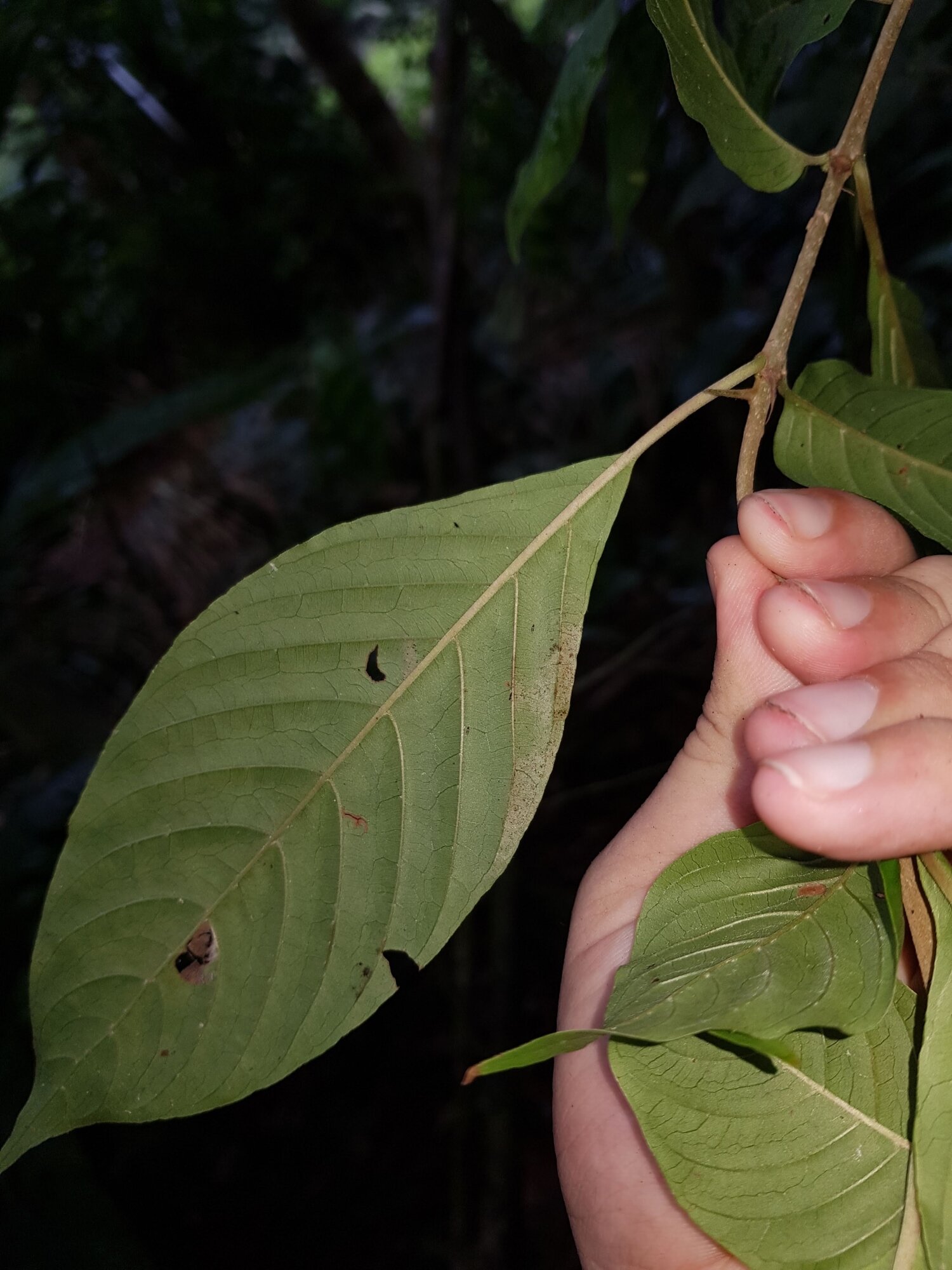
The leaves are opposite with ovate to elliptic blades, arranged in pairs along the stem with interpetiolar stipules characteristic of the Rubiaceae. The tertiary venation is parallel, visible on the leaf underside. Unlike the closely related Chomelia microloba, which has prominent domatia (small pockets harboring beneficial mites) on the leaf undersides, C. tenuiflora appears to lack this feature.
Flowers
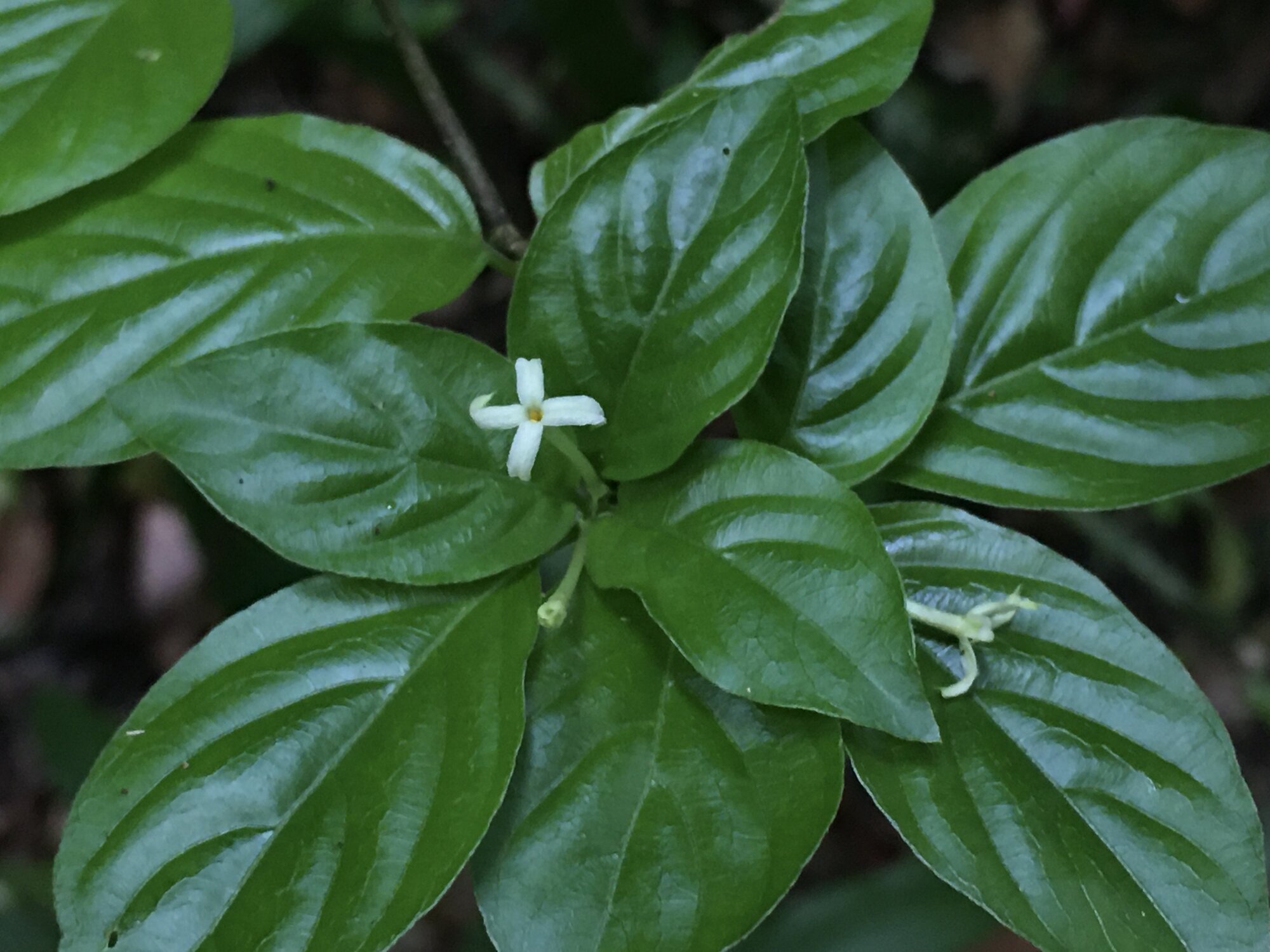
The flowers are the most distinctive feature of this species. They are sessile or short-pedicelled (with pedicels up to 12 mm in some populations), with white or cream-colored corollas. The corolla is hypocrateriform (salverform), meaning it has a long, narrow tube that opens abruptly into spreading lobes. The tube reaches 20-25 mm long. There are 4 lobes that are narrowly lanceolate, 8-10 mm long, and acute to acuminate at the apex. The flowers are 4-merous with an inferior ovary.
The species name "tenuiflora" directly refers to these slender flowers: from Latin tenuis (thin, slender) and flos/floris (flower). This narrow corolla tube suggests pollination by long-tongued moths, though formal pollination studies have not been conducted.
Fruits
The fruits are small drupes, 8-10 mm long and 4-5 mm wide, oblong and slightly laterally flattened. The surface is strigulose (finely hairy). Each fruit contains a solitary smooth pyrene that is 2-locular. Notably, fruits have not been collected from Mesoamerican populations; all fruit descriptions are based on South American specimens. The fleshy fruits suggest bird dispersal, consistent with other members of tribe Guettardeae.
Distribution
Chomelia tenuiflora has one of the broadest distributions in the genus, ranging from Costa Rica through Panama, Colombia, Ecuador, Peru, and Bolivia in the Andes, and across to Brazil, French Guiana, Guyana, and Suriname in the Guiana Shield and Atlantic Forest. GBIF records show 935 total occurrences globally, with the highest concentrations in Colombia (53 records), Brazil (33), Costa Rica (31), Peru (29), and Ecuador (26).
In Costa Rica, the species occurs in very humid and pluvial (rainforest) zones at elevations from sea level to approximately 1,300 m. It is found primarily on the Caribbean slope and near the Continental Divide in the Cordilleras de Guanacaste, Tilarán, and Talamanca, as well as on the Pacific slope in the southern zone. Within the Brunca region, there are 35 documented occurrences, including records from Parque Nacional Corcovado (Estación Sirena, Sendero Ollas), Parque Nacional Piedras Blancas (La Gamba), Refugio Nacional de Vida Silvestre Golfito, and the Fila Costeña.
Ecology
Chomelia tenuiflora inhabits the understory of very humid and pluvial tropical forests. The species requires the shaded, humid conditions found in mature and secondary forest, and has been collected from both primary forest and regenerating areas. Its elevational range from sea level to 1,300 m encompasses a variety of forest types, from lowland wet forest to premontane rain forest.
The white, tubular flowers with their remarkably narrow corollas strongly suggest pollination by long-tongued moths, possibly sphingid moths (hawk moths), which are common pollinators of white, tubular, night-blooming flowers in tropical forests. However, no formal pollination studies have been conducted on this species. The fleshy drupes are adapted for bird dispersal, consistent with the general pattern in tribe Guettardeae where fleshy fruits evolved during the Eocene-Oligocene radiation of modern bird dispersers.
Taxonomic History
Chomelia tenuiflora was first described by British botanist George Bentham in 1841 in the Journal of Botany (Hooker's Journal) 3:235, based on specimens collected by the German explorer Robert Schomburgk (collection number 314) in British Guiana (present-day Guyana). Type specimens are held at the Royal Botanic Gardens, Kew, and the Royal Botanic Garden Edinburgh.
The genus Chomelia was established by the Austrian botanist Nikolaus Joseph von Jacquin in 1760 to honor the French botanist and physician Pierre-Jean-Baptiste Chomel (1671-1740), author of "Abrégé de l'histoire des plantes usuelles" (1712), an important work on medicinal plants. Approximately 75 species are currently recognized in the genus, distributed from Mexico to Argentina.
The species has accumulated several synonyms over its taxonomic history: Anisomeris tenuiflora (Benth.) Pulle, Caruelina tenuiflora (Benth.) Kuntze, Chomelia atlantica Dwyer, and Chomelia barbellata Standl. These synonyms reflect the broad distribution and morphological variation within the species, which led different authors to describe populations as distinct species before modern taxonomic revisions consolidated them.
Conservation Outlook
Chomelia tenuiflora has not been formally assessed by the IUCN Red List. However, its broad distribution across multiple countries from Costa Rica to Brazil, combined with its occurrence in numerous protected areas, suggests it is not immediately threatened. In Costa Rica alone, the species has been documented in Parque Nacional Corcovado, Parque Nacional Piedras Blancas, Parque Nacional Volcán Tenorio, Refugio Nacional de Vida Silvestre Golfito, and the Área de Conservación Guanacaste.
The primary threats to this species are likely habitat loss through deforestation and forest degradation, particularly in lowland wet forests that continue to face pressure from agricultural expansion. The species' presence across a wide elevational range and its occurrence in both primary and secondary forest may provide some resilience to habitat change.
Key Sources & Resources
Species Information
Costa Rican botanical resource with distribution and habitat information.
Community-submitted observations with photographs and distribution maps.
Taxonomic information, synonyms, and global occurrence records.
Taxonomy & Nomenclature
Authoritative taxonomic information on the genus from the Royal Botanic Gardens, Kew.
Global flora database with nomenclatural information and type specimen data.
Related Reading
Taxonomic revision of Guettardeae including Chomelia species in Central and South America.