Belize Snowberry
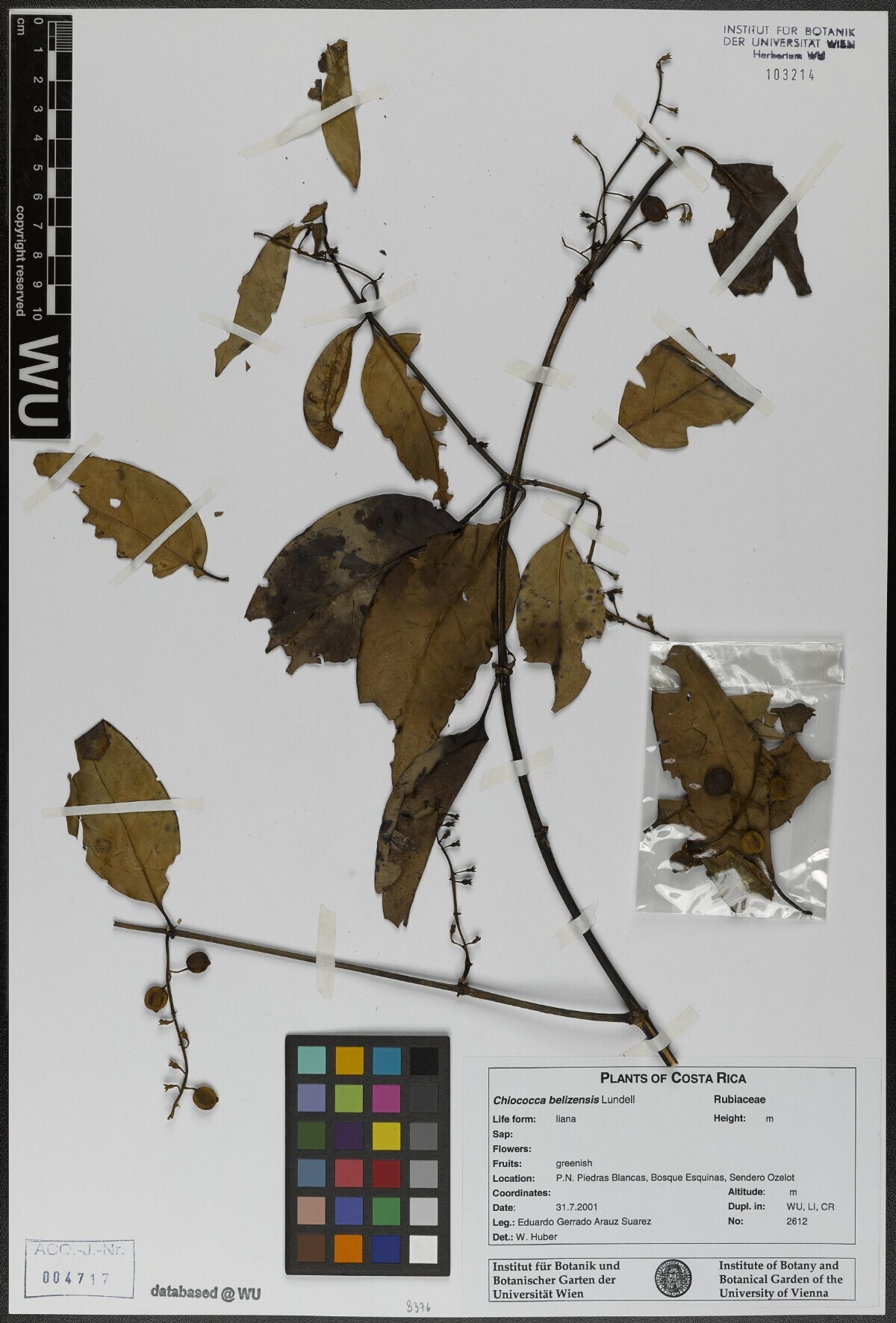
Chiococca belizensis is a scrambling shrub or vine of wet lowland forests from Mexico to Peru, named for Belize where botanist Percy Gentle collected the type specimen in 1942. Its snow-white drupes give the genus its name and attract birds throughout the Osa Peninsula's understory.
The genus Chiococca takes its name from Greek: chion (snow) and kokkos (berry), a reference to the distinctive white fruits, unusual among the fleshy-fruited Rubiaceae. With about 20 species distributed from Florida and Mexico to Argentina, Chiococca occupies a range of habitats from dry scrub to cloud forest, but C. belizensis favors very wet lowland forests such as those of the Osa Peninsula and Golfo Dulce, where annual rainfall can exceed 3,000 millimeters.
In Costa Rica, C. belizensis is one of the more commonly recorded species of the genus, ranking behind the widespread C. alba and C. pachyphylla. GBIF lists over 120 occurrences across the country, many of them in the Brunca region: Parque Nacional Corcovado, Piedras Blancas, and the Golfo Dulce Forest Reserve. The species ranges from near sea level to 2,400 meters, though most Osa records fall below 300 meters in wet evergreen forest.

Identification
Habit
Members of Chiococca show remarkable plasticity in growth form, ranging from erect shrubs to scrambling vines to small trees. C. belizensis grows as a scandent (climbing) shrub or woody vine, using surrounding vegetation for support as it reaches toward light gaps in the forest understory. The related C. alba can reach 5 to 6 meters or more when growing as a vine but remains shrubby in more exposed conditions.
Leaves
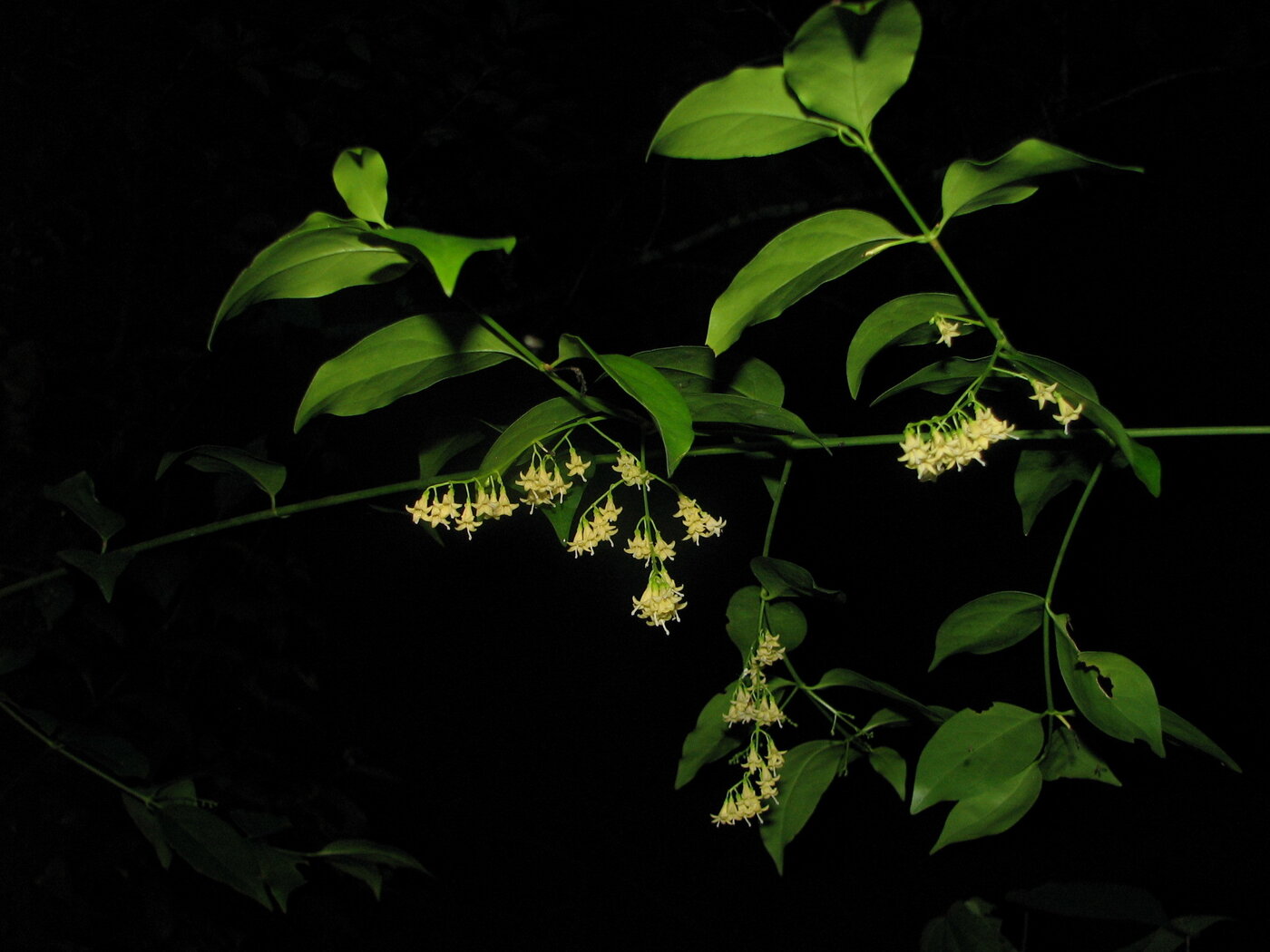
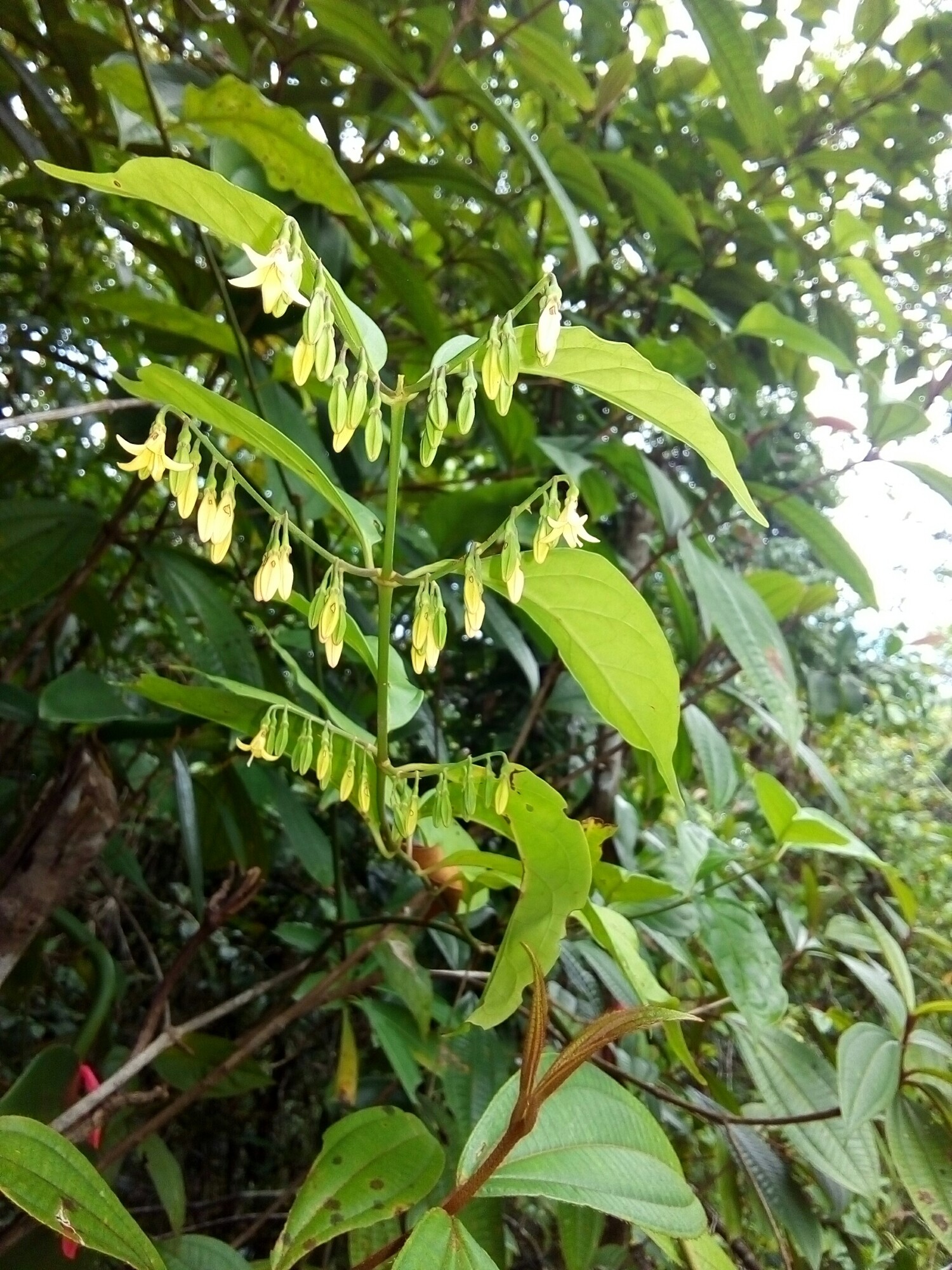
The leaves are opposite, a characteristic of the Rubiaceae, and typically elliptic to ovate with pointed tips. Leaf texture and size vary across the genus, and distinguishing C. belizensis from C. alba requires attention to subtle differences in leaf shape, venation, and pubescence that are best evaluated with flowering or fruiting material. The two species overlap in range and habitat throughout Costa Rica.
Flowers
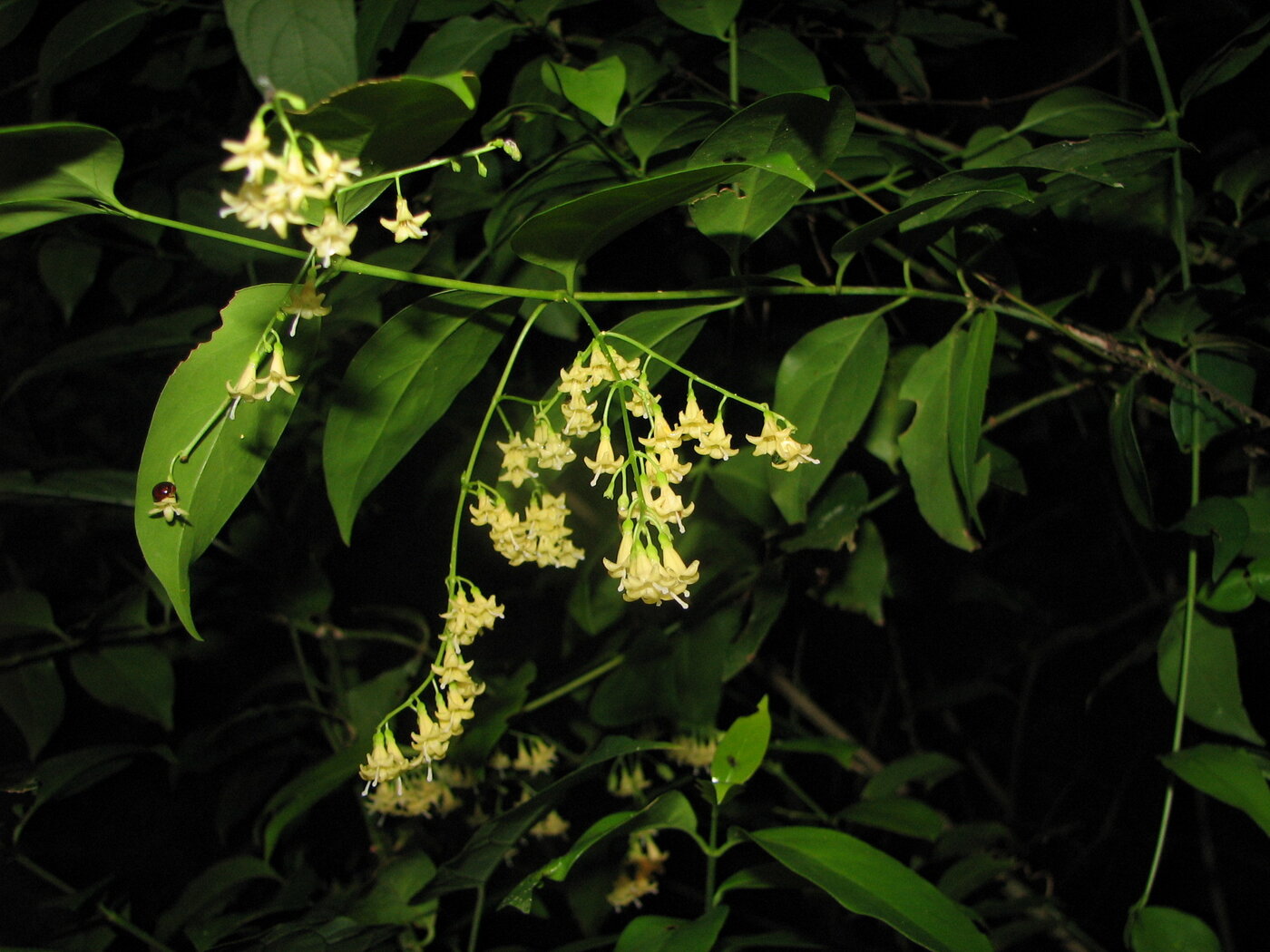
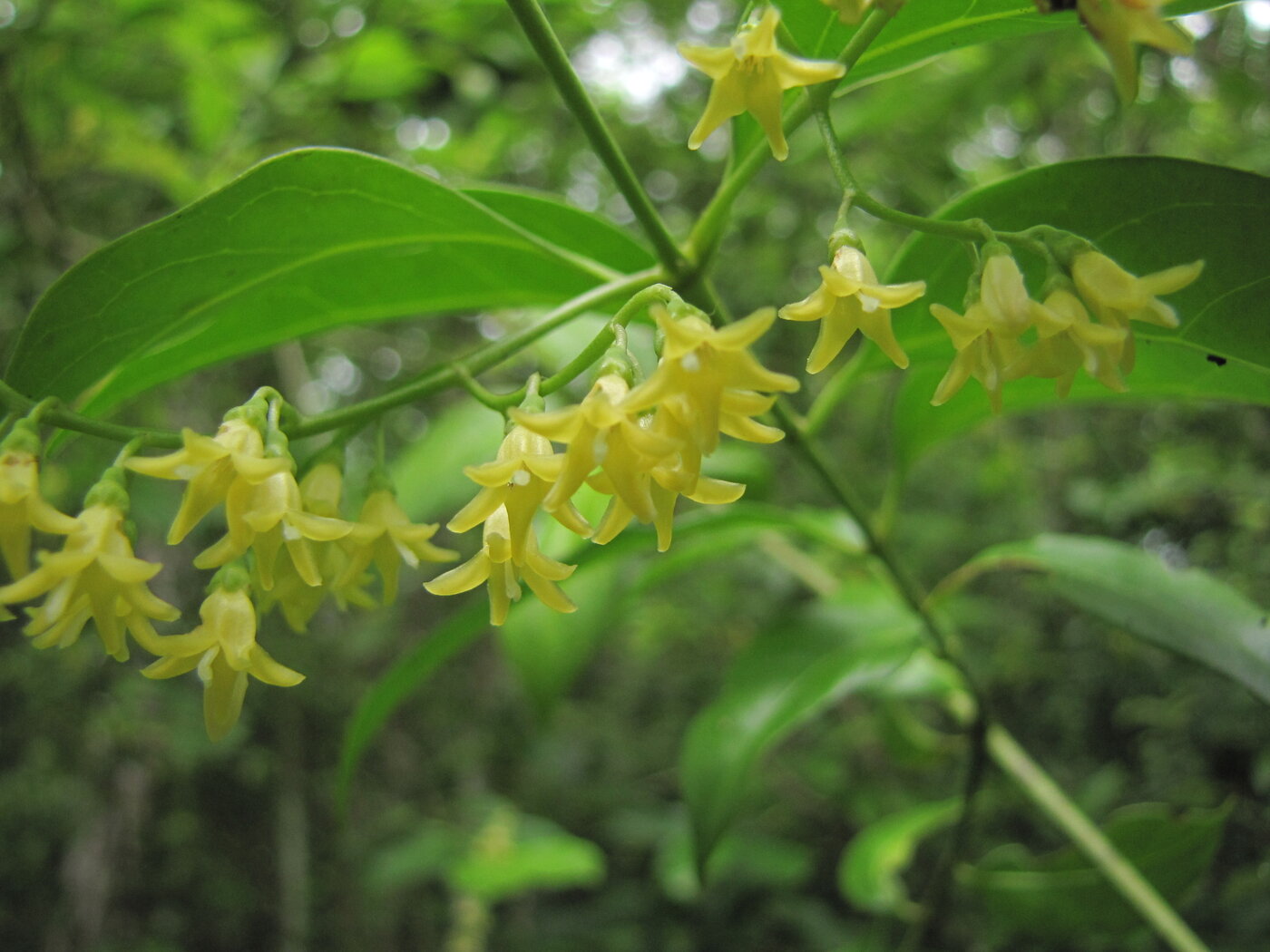
Chiococca flowers are small, funnel-shaped, and borne in racemes or panicles. The corolla is cream to pale yellow with five spreading lobes. Both flowering and fruiting material are often needed to confirm the species, which can complicate identification. Pollinators have not been specifically documented for C. belizensis, but the funnel-shaped corollas suggest bee or moth pollination.
Fruits
The fruits are small, fleshy drupes that ripen to brilliant white, the signature trait that gives the genus its "snowberry" common name. Each drupe contains two seeds and is consumed by birds, the likely primary seed dispersers. The white color is unusual among Rubiaceae and may represent a visual signal adapted to attract certain frugivores in the forest understory.
Distribution
Chiococca belizensis ranges from southern Mexico (Chiapas, Oaxaca, Veracruz) through Central America to Colombia, Ecuador, and Peru. Costa Rica holds more GBIF records than any other country, suggesting the species is common here or that Costa Rican forests have been more thoroughly sampled. The Brunca region is a stronghold for the species, with specimens from Corcovado, Piedras Blancas, the Golfo Dulce Forest Reserve, and localities along the Osa Peninsula including Rancho Quemado and Río Piro.
Beyond the Osa, Costa Rican records extend to Guanacaste (Estación Pitilla), the central highlands (Monteverde, San Marcos de Tarrazú), the northern lowlands (Boca Tapada), and the Caribbean slope (Reserva Biológica Hitoy Cerere). This broad distribution across life zones, from sea level to 2,400 meters, reflects the genus's ecological flexibility.
Ecology
Chiococca belizensis is an understudied species with no documented wildlife interactions specific to Costa Rica or Panama. However, ecological context from related species and the broader Rubiaceae family suggests likely patterns. The white drupes are presumably consumed by frugivorous birds, as documented for C. alba in the Bahamas (where Chiococca accounted for 16.9% of the identified fruits eaten by Kirtland's Warbler, Setophaga kirtlandii) and the Galápagos (where lava lizards, Microlophus spp., disperse seeds). Bird preferences among fruit colors are debated, and the ecological role of Chiococca's white fruit in Costa Rica remains little documented.
At La Selva Biological Station in Costa Rica, understory frugivores including thrushes concentrate in areas rich in Rubiaceae fruits, suggesting species such as Gray-cheeked Thrush (Catharus minimus) and possibly other Catharus species may consume Chiococca fruits where they co-occur. Sphingidae moths (hawkmoths) are documented specialists on Rubiaceae in Costa Rica's Area de Conservación Guanacaste, with 24 trophic interactions documented across 45 years of caterpillar rearing. Yet despite this extensive database of 431,212 caterpillar records, no externally-feeding caterpillar in the Guanacaste rearing dataset has been recorded on Chiococca, though leaf-mining moths such as Cameraria affinis and Phyllonorycter fragilella are documented on C. alba elsewhere.
Pollinator identity remains unknown for Chiococca species in Central America. A reproductive biology study of C. alba in Brazil found no measurable nectar despite nectary-like structures, raising questions about the pollination strategy. The flowers may be autogamous (self-pollinating), rely on pollen-collecting bees, or produce nectar at levels below detection thresholds of standard measurements.
Ethnobotany
The genus has a long history of traditional medicinal use. Chiococca alba roots were recorded in nineteenth-century materia medica and sold commercially in Europe as a diuretic, emetic, and treatment for snakebites. Whether C. belizensis shares these phytochemical properties is unknown, but the two species are closely related and may contain similar compounds.
Taxonomic History
Cyrus Longworth Lundell described Chiococca belizensis in 1943 in the American Midland Naturalist, based on a specimen collected by Percy H. Gentle in British Honduras (now Belize). The holotype is deposited at the University of Michigan Herbarium (MICH), with isotypes at Harvard, Field Museum, Missouri Botanical Garden, New York Botanical Garden, University of Texas, and the Smithsonian.
The Collectors
Percy H. Gentle (1890-1958) was the first major native Belizean botanical collector, amassing nearly 10,000 specimens over 26 years. He served as Lundell's field assistant on expeditions to the Petén and British Honduras in 1933 and 1936. The genus Gentlea and more than 40 named species with the epithet "gentlei" honor his contributions to Mesoamerican botany.
Lundell (1907-1994) was a Texas-born botanist who discovered over 2,000 plant species. Beyond his botanical work, he is remembered for discovering 16 Mayan cities, including Calakmul, during his expeditions through the Petén. He founded the Institute of Technology and Plant Industry at Southern Methodist University (later the Texas Research Foundation), collections that eventually fed into what is now the Botanical Research Institute of Texas.
Etymology
The specific epithet belizensis refers to Belize (formerly British Honduras), where the type specimen was collected. A later name, Chiococca durifolia Dwyer, described from Panama, is now treated as a synonym.
Conservation Outlook
Chiococca belizensis has been assessed by the IUCN Red List as Least Concern. Its wide distribution across ten countries and more than 440 GBIF occurrence records supports that assessment. In Costa Rica, populations within Corcovado National Park, Piedras Blancas National Park, and the Golfo Dulce Forest Reserve are protected from direct habitat loss.
The species' scrambling habit allows it to persist in forest edges and secondary growth, providing some resilience to disturbance. Its fruits are an important food source for birds, and maintaining populations of Chiococca contributes to the understory frugivore community of Brunca's wet forests.
Resources & Further Reading
Taxonomy & Nomenclature
Accepted nomenclature, synonymy, and distribution according to Kew's taxonomic backbone.
Type specimen citations and nomenclatural history from Missouri Botanical Garden.
Nomenclatural record confirming authorship, the 1943 protologue (Amer. Midl. Naturalist 29: 492), and Belize as the type distribution.
Data Portals
Occurrence records, herbarium specimen images, and the IUCN Red List category (Least Concern) from collections worldwide.
Citizen science observations from Central America.
The holotype specimen, Gentle 4115, collected in Toledo, Belize, on 2 September 1942.
Morphology & Ecology
Smithsonian genus treatment of Chiococca covering habit, corolla form, and the two-seeded white drupe.
Classic botanical narrative giving genus morphology and C. alba dimensions.
Source of the figure that Chiococca made up 16.9% of identified fruits eaten by the warbler.
Source for the 431,212 rearing records and the Sphingidae-Rubiaceae trophic links.
Documents Microlophus lava lizards dispersing Chiococca alba seeds.
Finds no measurable nectar despite a nectary-like structure at the corolla base.
Related Reading
Overview of the genus with range description and species list.
North Carolina Botanical Garden profile of the collector who gathered the type specimen.
Botanist biography covering his Maya discoveries, 2,000+ species, and institutional legacy.