Chancho Colorado
Vochysia ferruginea — A fast-growing pioneer whose rusty-haired twigs and violet-scented yellow flowers make it one of the most recognizable trees in Costa Rica's regenerating forests.
Walk through any secondary forest on Costa Rica's Caribbean slope and you will likely encounter Vochysia ferruginea. Its young branches, covered in distinctive rusty-brown hairs, catch the eye immediately. During the rainy season, clusters of bright yellow flowers perfume the humid air with a fragrance reminiscent of violets. This is the chancho colorado, or "red pig," named for the ferruginous pubescence that covers its growing tips like rust-colored fur.
Identification
Physical Characteristics
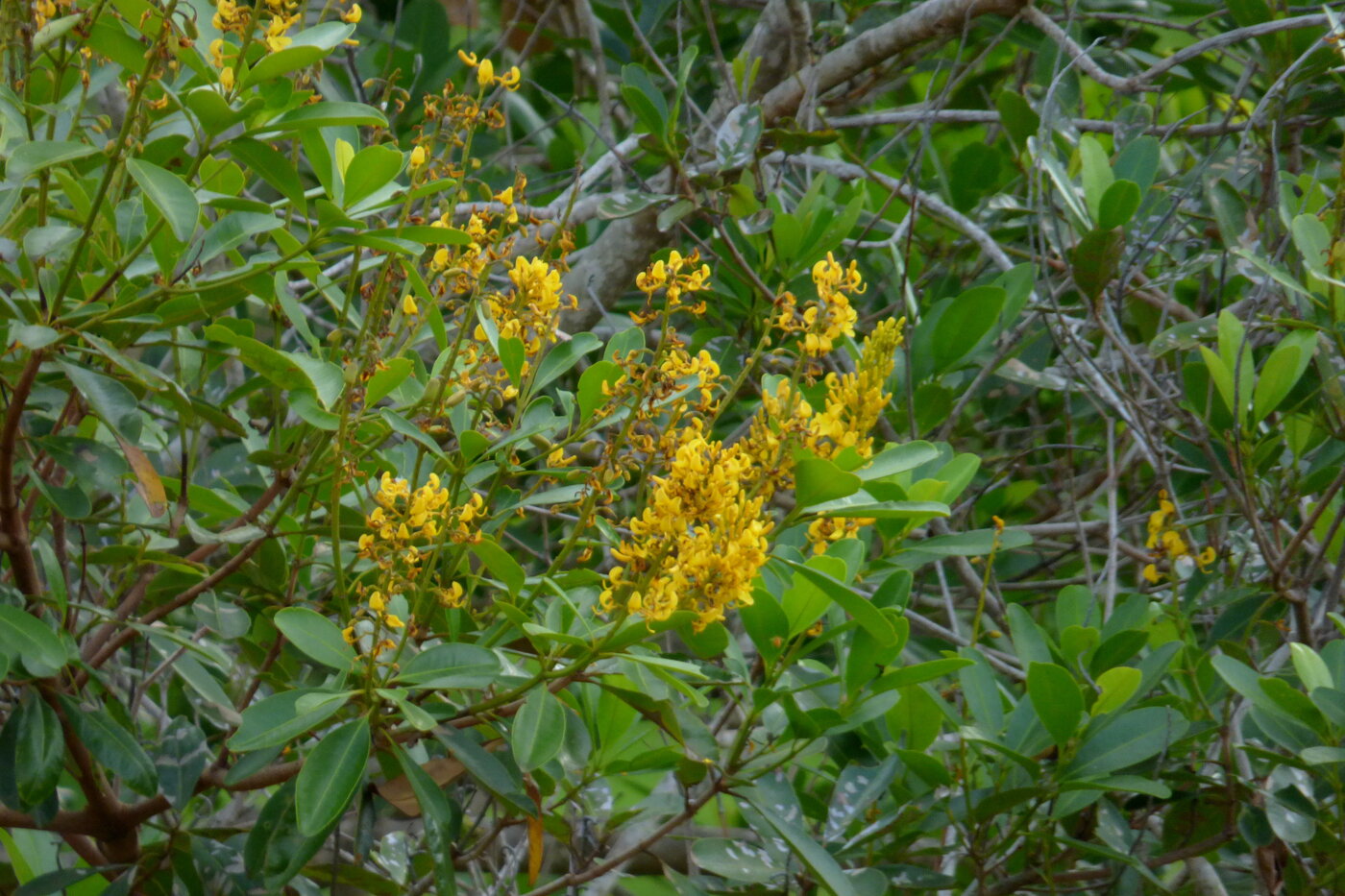
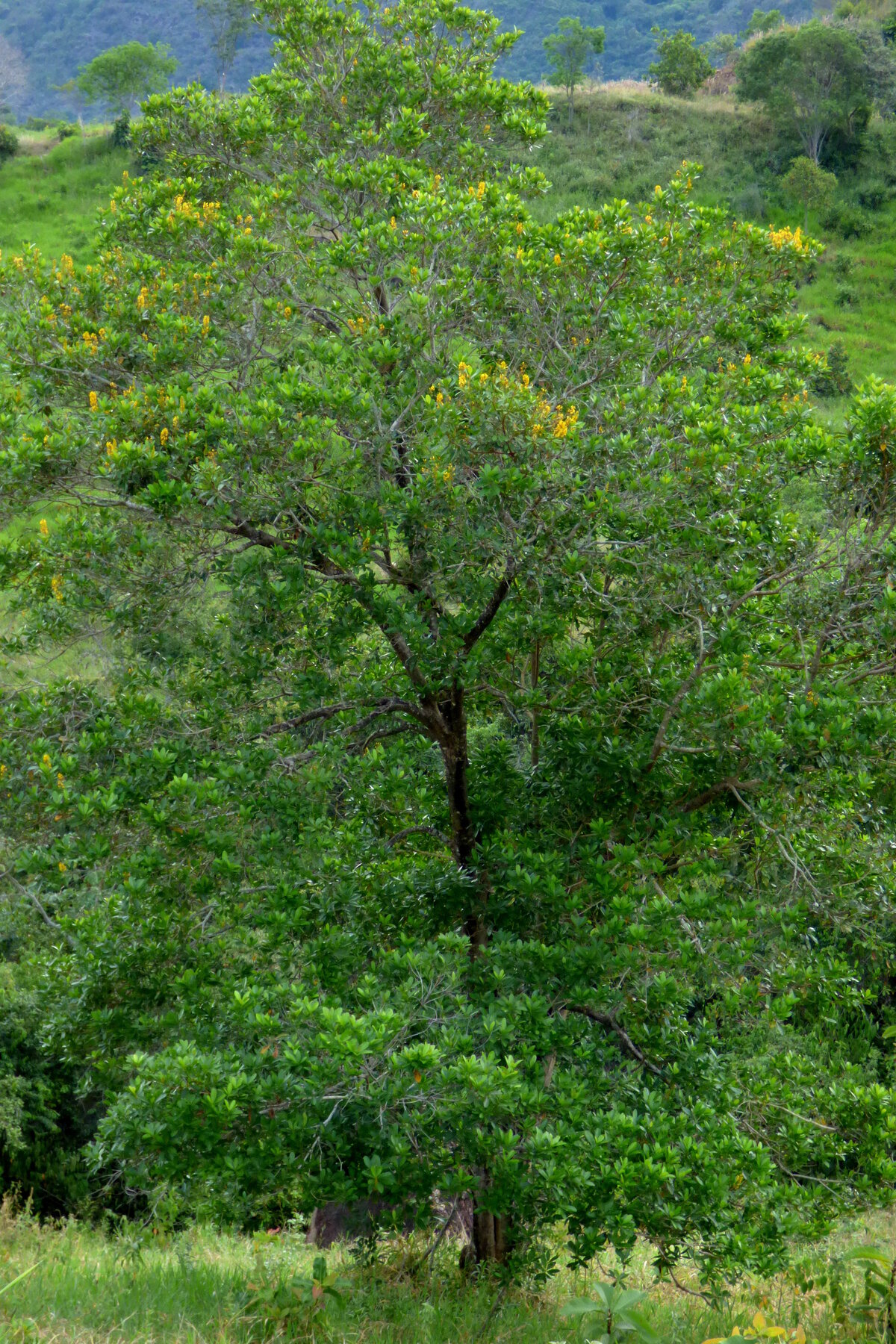
Crown & Trunk: Vochysia ferruginea typically grows 6 to 20 meters tall, though exceptional specimens can reach 35 meters. The crown is characteristically small and dense. The straight trunk remains unbranched for 7 to 15 meters and reaches 30 to 80 cm in diameter. The bark is grayish-brown and becomes fissured with age.
Leaves: The most distinctive feature of this species is the reddish-brown (ferruginous) pubescence covering young twigs and leaf undersides. This rusty indumentum gives the tree its species name (ferruginea = rusty) and its local name "chancho colorado" (red pig). Leaves are simple, opposite, with entire margins and prominent venation.
Flowers & Fruits: The showy yellow flowers are arranged in terminal panicles and emit a strong, pleasant fragrance reminiscent of violets. Like all members of the Vochysiaceae, the flowers display a distinctive architecture: strongly zygomorphic (bilaterally symmetrical) with a spurred calyx and, most unusually, a single fertile stamen. This reduction from the typical five stamens to just one is a hallmark of the family. The calyx spur contains nectar, making these flowers attractive to a variety of pollinators. Stands of V. ferruginea often flower synchronously during May and June, drawing primarily bees, with occasional visits from moths, butterflies, and hummingbirds. The fruits are three-valved capsules containing winged seeds dispersed by wind, though parrots and macaws also feed on them.
Ecology and Distribution
Vochysia ferruginea ranges from Honduras through Central America to Bolivia, Venezuela, Guyana, and Brazil. In Costa Rica, it is most abundant in the humid lowlands of the Caribbean slope, from sea level to about 1,000 meters, though it can reach 1,500 meters in some areas. It occurs on both the Atlantic and Pacific slopes, favoring areas with high rainfall and humidity.
This species shows a strong preference for well-drained but infertile soils, particularly those with high aluminum saturation. Research in Costa Rican secondary forests has shown that V. ferruginea tends to dominate on steeper slopes with soils of higher exchangeable acidity and lower manganese concentrations. Studies in Panama have documented significant associations between high soil aluminum concentrations and the distribution of Vochysiaceae trees, suggesting that aluminum tolerance provides a competitive advantage on these challenging substrates.
An Aluminum-Eating Tree
Perhaps the most remarkable adaptation of Vochysia ferruginea is its ability to hyperaccumulate aluminum, a metal that is toxic to nearly all other plants. While most trees actively exclude aluminum from their tissues, members of the Vochysiaceae do the opposite: they absorb it and concentrate it in their leaves. Research on Vochysiaceae species has documented aluminum concentrations ranging from 4 to 20 grams per kilogram of dry leaf tissue, far exceeding the threshold (1 g/kg) that defines an aluminum hyperaccumulator. This concentration is so high that it would poison almost any other tree species.
Studies on related Vochysiaceae species have revealed an unusual storage mechanism: unlike most aluminum-accumulating plants, which sequester the metal in cell walls, Vochysiaceae species appear to store aluminum primarily in their chloroplasts, the very organelles responsible for photosynthesis. How they accomplish this without disrupting photosynthesis remains an active area of research. This extraordinary tolerance allows V. ferruginea to thrive on highly acidic, aluminum-rich soils where few competitors can survive, helping explain its dominance in the secondary forests of Costa Rica's Caribbean lowlands.
An Ancient Lineage
The Vochysiaceae family has deep roots in Earth's history. Molecular studies indicate that the family originated approximately 100 million years ago, during the Late Cretaceous when dinosaurs still roamed the planet. At that time, South America and Africa were still connected as part of the supercontinent Gondwana. Around 50 million years ago, the family split into Neotropical and African lineages, a divergence that may reflect the final separation of these continents across the widening Atlantic Ocean.
Today, the family comprises about 245 species in eight genera, with six genera found in South America and two in equatorial West Africa (Erismadelphus and Korupodendron). Research suggests the family's ancestral home was the Brazilian Cerrado, with subsequent colonization events spreading species to the Amazon, Central America, and the Atlantic Forest. Intriguingly, this dispersal moved from open savanna habitats into closed forest, the opposite of the pattern seen in many other plant families, making Vochysiaceae an unusual case study in Neotropical plant evolution.
A Pioneer's Role
Vochysia ferruginea is classified as a long-lived pioneer, a category of trees that colonize disturbed areas but can persist and grow large enough to become canopy dominants. Unlike short-lived pioneers that are quickly shaded out, long-lived pioneers like the chancho colorado maintain rapid growth rates throughout their lives, eventually reaching the forest canopy where they can reproduce for decades.
Studies in Costa Rica's Caribbean lowlands have identified V. ferruginea as one of the dominant tree species in secondary rain forests. In a 28-year-old secondary forest near Florencia, San Carlos, the species was both the most abundant and the most commercially valuable canopy tree. Research on native tree plantations has confirmed that V. ferruginea is among the fastest-growing species for timber production, comparable to Vochysia guatemalensis, Hieronyma alchorneoides, and Terminalia amazonia.
Uses and Timber
The wood of Vochysia ferruginea is pinkish-brown, neither particularly hard nor heavy, but compact. It is easy to work with both hand and power tools, though it can produce somewhat woolly surfaces when planed. The timber is used for general construction, boxes, crates, carpentry, inexpensive furniture, interior trim, and plywood.
The species has moderate durability and is susceptible to fungal decay and dry-wood termites, limiting its use in applications requiring long-term outdoor exposure. However, the wood is amenable to preservative treatment, extending its utility. Its fast growth rate and ability to thrive on degraded soils make it an attractive option for reforestation and timber plantation projects in the humid tropics.
Genetic Resilience
Research in Costa Rica's San Juan-La Selva Biological Corridor has revealed a surprising aspect of V. ferruginea biology: despite the fragmentation of its forest habitat, the species maintains remarkably high genetic diversity. Scientists studying populations in old-growth forest, secondary forest, and even isolated trees in pastures found that progeny from all contexts were predominantly outcrossed, with nearly 100% of seeds resulting from cross-pollination rather than self-fertilization.
Long-distance pollen flow appears to maintain genetic connectivity between forest fragments. The species is self-compatible but prefers outcrossing, and its pollinators, primarily bees, can apparently transport pollen across considerable distances in agricultural landscapes. This genetic resilience has important conservation implications: even isolated remnant trees can contribute to the gene pool of regenerating forests, and secondary forests quickly develop genetic diversity comparable to old-growth stands. However, researchers caution that conserving primary forest remains essential for maintaining the full genetic legacy of the species.
Conservation
Vochysia ferruginea is listed as Least Concern by the IUCN and is not protected under CITES. Its wide distribution across Central and South America, combined with its ability to colonize disturbed habitats, means the species is not currently threatened. In fact, it is likely increasing in abundance across its range as forests regenerate on abandoned agricultural land.
The species plays an important role in forest succession, helping to rebuild canopy cover and soil fertility after disturbance. Its fruits provide food for parrots and macaws, while its flowers attract pollinators during the rainy season. As secondary forests mature, V. ferruginea gradually gives way to shade-tolerant species, completing its role as a forest healer.
Resources & Further Reading
Species Information
Spanish Wikipedia article with distribution and basic characteristics.
Authoritative taxonomic information and global distribution data.
Costa Rica-specific information including phenology and conservation status.
Detailed information on uses, wood properties, and cultivation.
Observations and photographs from across the species range.
Ecology & Forestry
Research on secondary forest dynamics and the role of V. ferruginea as a dominant species.
Overview of growth rates and reforestation potential of native Central American tree species.
Research comparing growth rates of native species including V. ferruginea in timber plantations.
Genetics & Evolution
Study of genetic diversity and mating patterns in Costa Rican populations across different forest contexts.
Analysis of genetic diversity partitioning across Costa Rican populations using AFLP and chloroplast markers.
Molecular dating and ancestral range estimation showing the family originated ~100 million years ago in the Brazilian Cerrado.
Aluminum Hyperaccumulation
Comprehensive review of aluminum accumulation mechanisms in tropical trees including Vochysiaceae.
Research revealing the unusual chloroplast-based aluminum storage mechanism in Vochysiaceae.
Early documentation of aluminum concentrations in Vochysiaceae leaves, including V. ferruginea data.