Ceiba
Ceiba pentandra — The sacred World Tree of Maya civilization, the ceiba towers above the rainforest canopy as one of the largest trees in the Americas. Its massive buttress roots, thorny trunk, and bat-pollinated flowers make it a keystone species across the Neotropics.
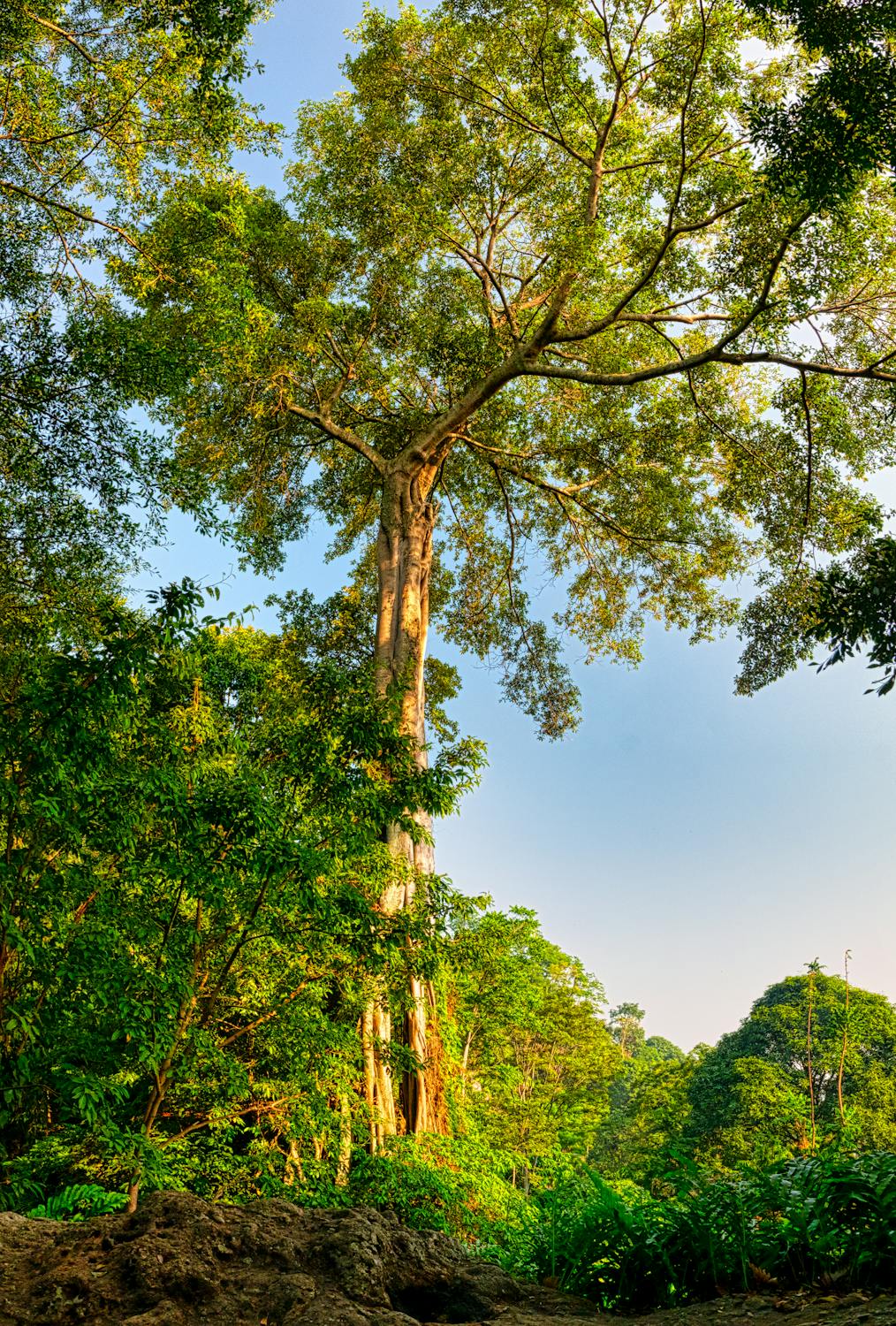
Rising 50 to 70 meters above the forest floor, the ceiba dominates the tropical landscape like no other tree. Its umbrella-shaped crown spreads wide above the canopy, visible from kilometers away. Massive buttress roots radiate from the base like the fins of a cathedral, anchoring the giant in the shallow soils of the rainforest. In Costa Rica, ceibas grow throughout the lowlands, from the Caribbean slopes to the Pacific coast, wherever rainfall is sufficient and temperatures never freeze.
The Maya called it Yaxche, the "first tree" or "green tree," and placed it at the center of their cosmos. They believed its roots reached into Xibalba, the underworld of the dead, while its branches held up the thirteen levels of heaven. The trunk connected these realms to the middle world of humans. This cosmological role made the ceiba sacred and inviolable. Villages planted ceibas in central plazas where communities gathered for decisions. Cutting one was unthinkable.
Identification
The ceiba belongs to the Malvaceae family under modern classification, though older references place it in the Bombacaceae (kapok family). Its closest relatives include the pochote (Bombacopsis quinata) and the balsa (Ochroma pyramidale), both notable trees of Neotropical forests.
Physical Characteristics
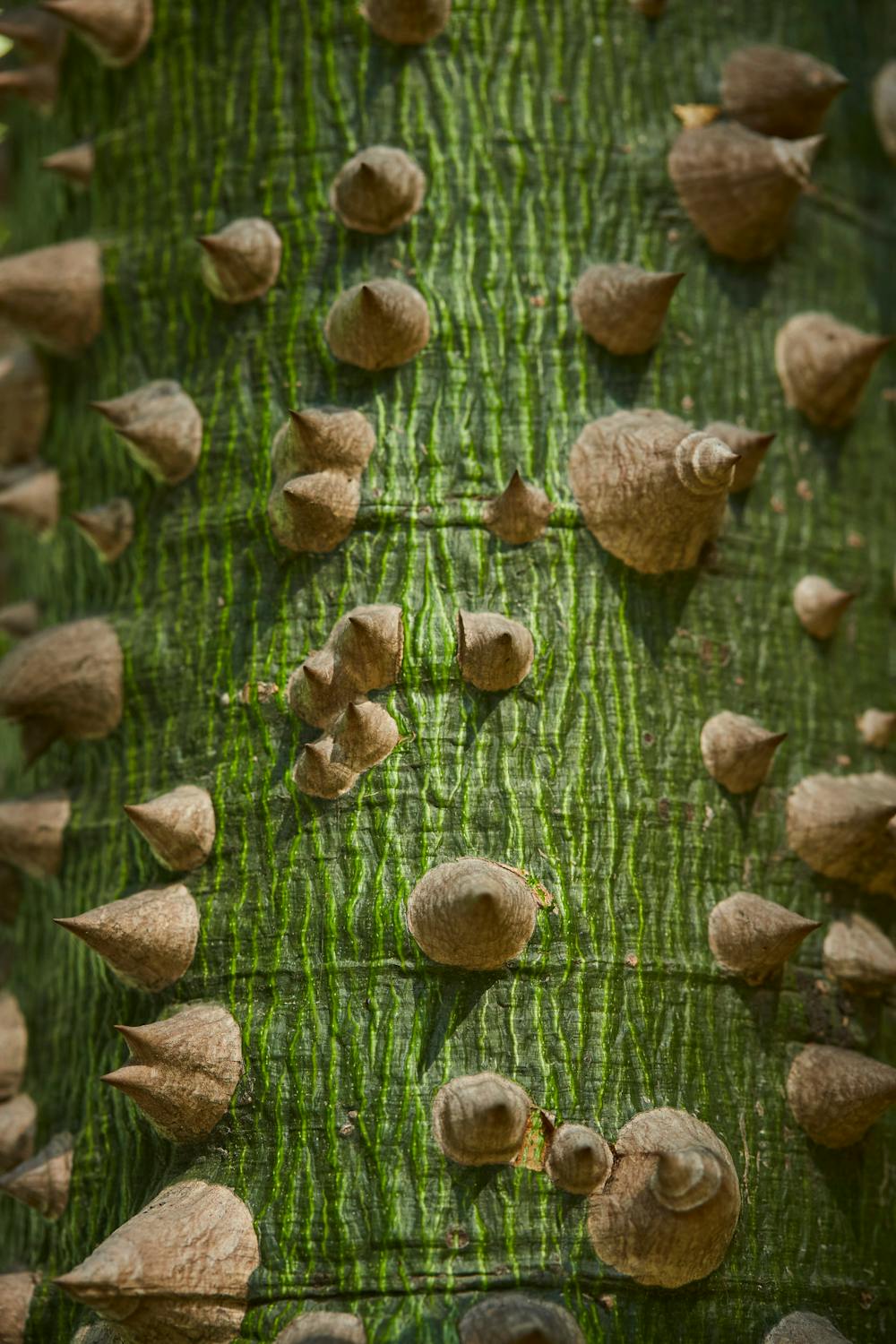
Trunk: Cylindrical and straight, rising 30 meters or more without branching before spreading into the canopy. Young trees bear large conical thorns on the bark that protect against climbing animals. These thorns diminish with age, and mature trees develop smooth, gray bark. The trunk can reach 3 meters in diameter above the buttress roots.
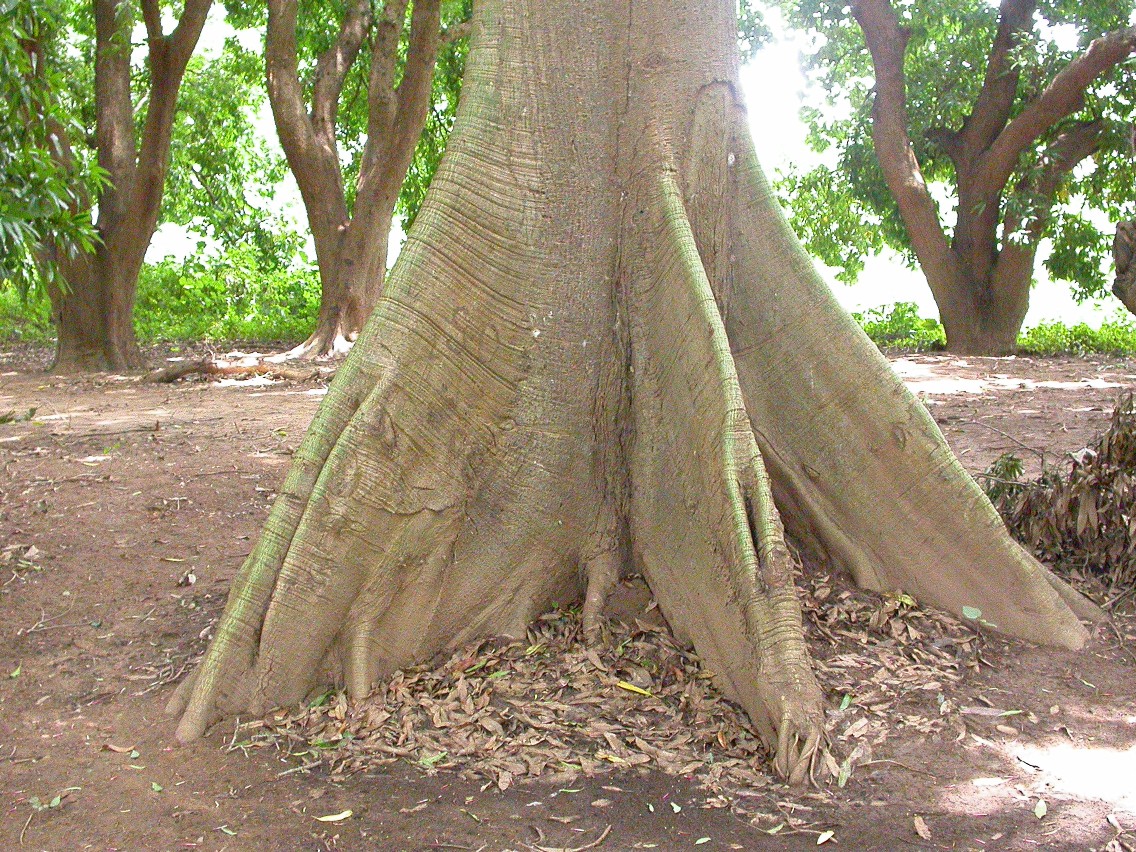
Buttress roots: The ceiba's most distinctive feature. These plank-like extensions spread outward from the trunk base in fin-like formations, sometimes extending 5 meters or more from the tree. They stabilize the massive trunk in shallow tropical soils and spread the tree's weight over a larger area. In large specimens, a person can walk between the buttresses as if through a narrow corridor.
Leaves: Palmately compound with 5-9 leaflets (typically 7), each leaflet 7-20 cm long. The leaves are arranged in a distinctive pattern at branch tips. The tree is deciduous, dropping its leaves during the dry season before flowering.
Flowers: Pink to white, with 5 cup-shaped petals about 3 cm across. They emerge in clusters when the tree is leafless, typically in January and February in Costa Rica. The flowers open at dusk and close after dawn. They produce copious nectar and emit a strong odor that attracts bats and other nocturnal pollinators. A single tree can produce up to 20 liters of nectar per day during peak flowering.
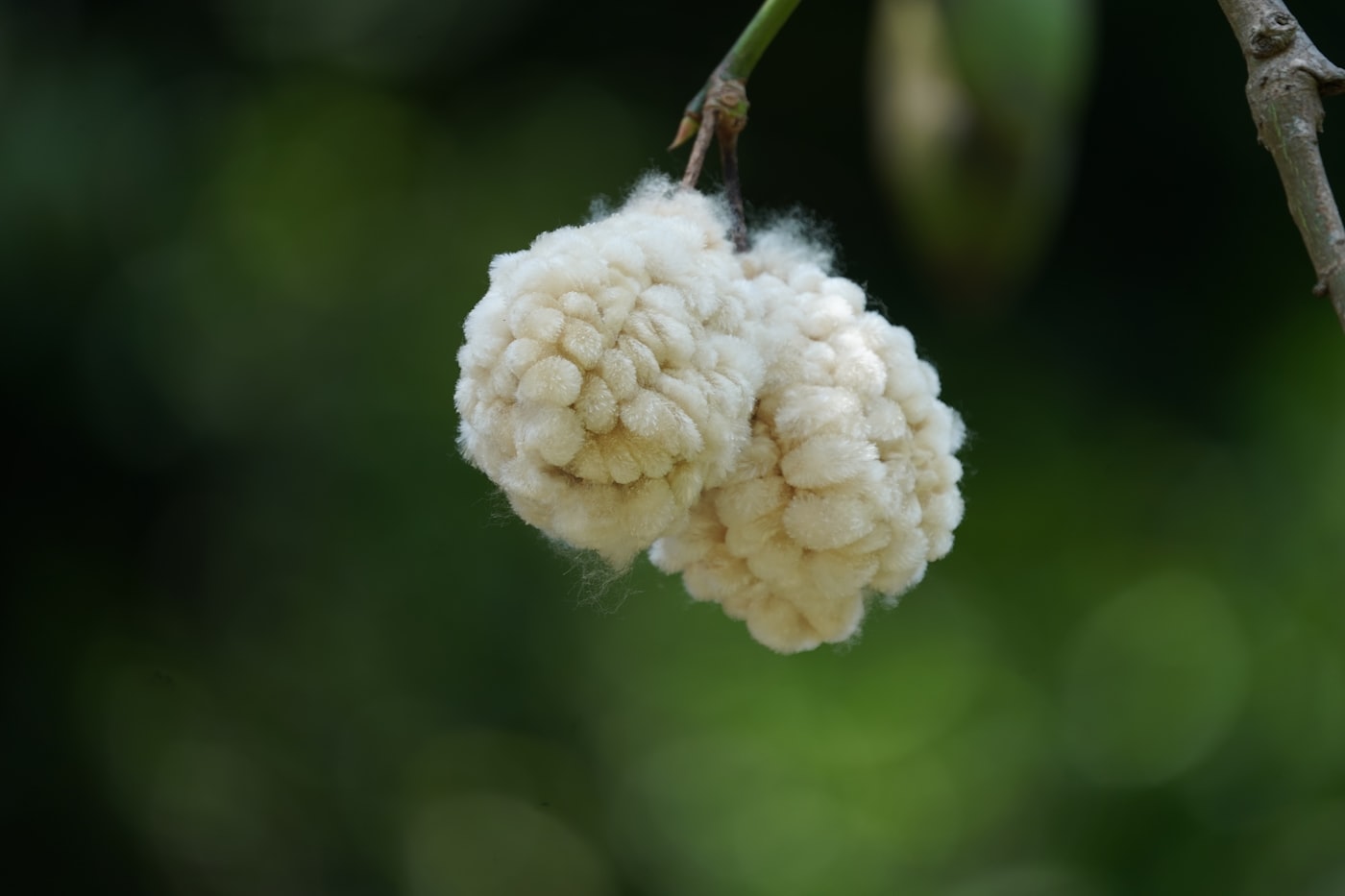
Fruit: Large elliptical pods, 10-15 cm long, containing seeds surrounded by fluffy, cotton-like fibers called kapok. A mature tree can produce 500 to 4,000 pods in a single season, with each pod containing about 200 seeds. This means one tree can produce up to 800,000 seeds annually. The pods mature in March and April, splitting open to release the kapok-wrapped seeds to the wind.
Habitat & Distribution
The ceiba is native to Central America, the Caribbean, and northern South America from Mexico to Bolivia and Brazil. It also occurs naturally in West Africa, possibly having arrived via seeds floating across the Atlantic. The water-repellent kapok fibers allow the fruit pods to float indefinitely, enabling oceanic dispersal. Today the ceiba is pantropical, cultivated and naturalized throughout the world's tropical regions.
Costa Rica distribution: Found throughout the country except in the driest and highest regions. Common in lowland areas on both the Caribbean and Pacific slopes. Notable specimens occur near Bijagua (close to Rio Celeste), in Volcan Tenorio National Park, and near Piedras Blancas National Park on the Osa Peninsula. One of the largest and oldest in Costa Rica, estimated at 500 years old and nearly 60 meters tall, stands near the Blue River Waterfall and was named Tree of the Year in 2006.
Ecosystem: Thrives in both wet evergreen rainforest and seasonally dry deciduous forest. Acts as a pioneer species, quickly colonizing forest gaps and clearings. The wind-dispersed seeds allow ceibas to establish in open areas, where they grow rapidly, sometimes adding 4 meters of height per year in ideal conditions.
Elevation: Sea level to approximately 1,000 meters. Most common in lowland rainforests and coastal areas. Cannot tolerate freezing temperatures.
Ecological Importance
The ceiba functions as a keystone species in tropical ecosystems. Its massive size and long lifespan make it a living scaffold for forest communities. A single mature ceiba can support dozens of other plant species and provide food and shelter for hundreds of animal species across its centuries of life.
Bat Pollination
The ceiba's flowers are primarily pollinated by bats. The blooms open at dusk, emit a strong musky odor, and produce abundant nectar throughout the night. In Costa Rica and Panama, several species of phyllostomid bats visit ceiba flowers, with Phyllostomus hastatus (the greater spear-nosed bat) and Phyllostomus discolor (the pale spear-nosed bat) being the most effective pollinators. As bats feed on nectar, pollen clings to their fur and is transported to flowers on other trees.
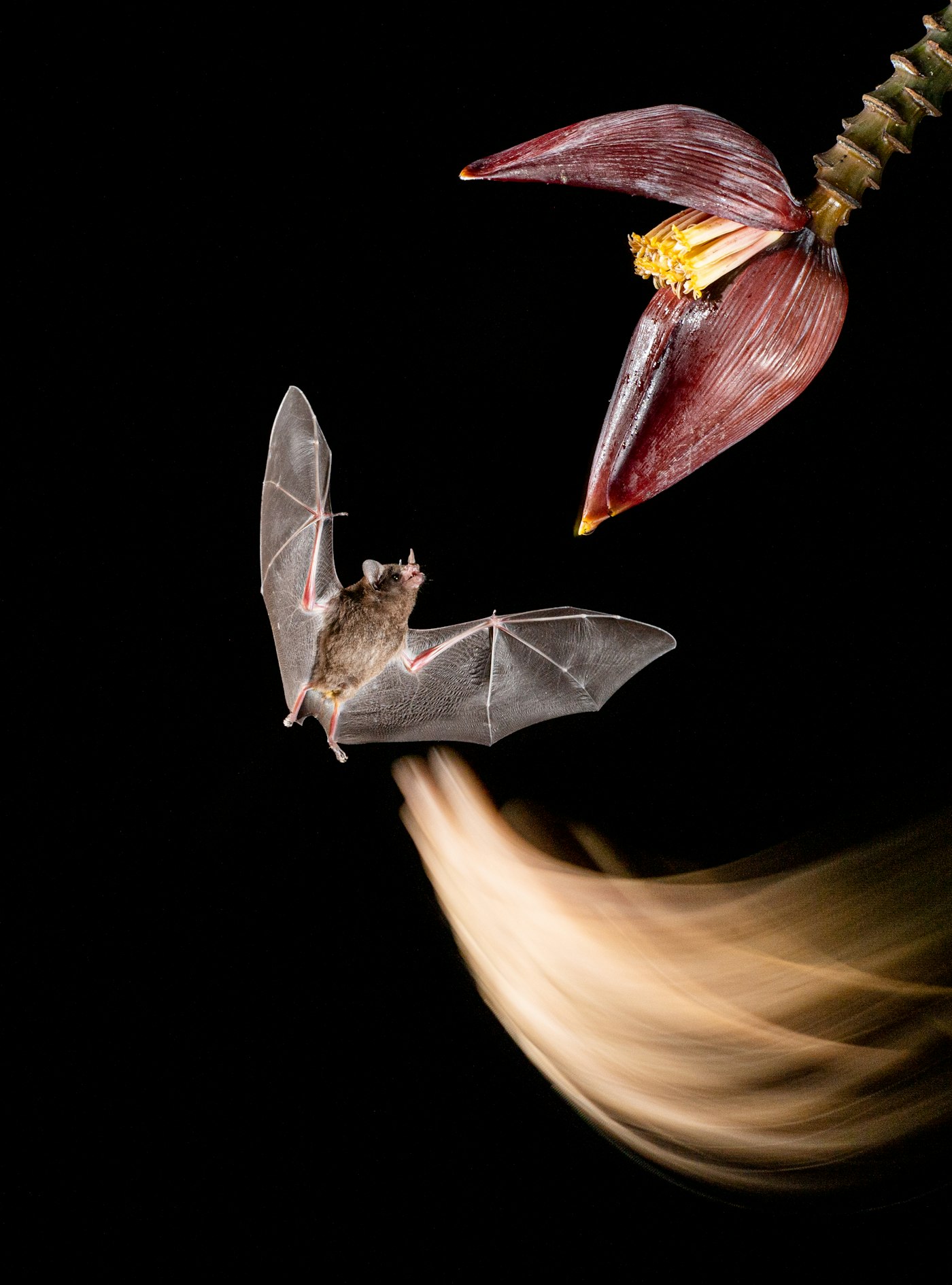
Research in Central Amazonia documented that bats can transport ceiba pollen up to 18 kilometers between trees. This long-distance pollen movement maintains genetic diversity across fragmented forest landscapes. Other nocturnal visitors include hawk moths, night monkeys, and marsupials, though bats perform most of the cross-pollination.
Canopy Ecosystem
The ceiba's massive crown and spreading branches create an aerial ecosystem. Epiphytes such as orchids, bromeliads, ferns, and mosses colonize the bark and branch crotches. These aerial plants collect water and organic debris, creating microhabitats more than 30 meters above the forest floor. Bromeliads trap rainwater in their leaf bases, forming miniature ponds where frogs raise their tadpoles.
Birds nest in the high branches, including toucans, aracaris, flycatchers, and trogons. Arboreal mammals such as white-faced capuchins, spider monkeys, and kinkajous use the massive limbs as aerial highways. Snakes hunt among the epiphytes. Insects reach extraordinary diversity in the canopy environment. The complex web of interactions that develops around a single ceiba over centuries makes it irreplaceable in forest ecology.
Seed Dispersal
The ceiba's primary dispersal mechanism is wind. The silky kapok fibers surrounding each seed allow them to float on air currents, sometimes traveling kilometers from the parent tree. This strategy explains why ceibas are among the first trees to colonize forest clearings and open areas. Water dispersal also occurs. The unopened pods float indefinitely due to the buoyant, water-repellent kapok, potentially traveling between islands or even across oceans.
Cultural Significance
No tree in the Americas carries greater spiritual weight than the ceiba. For the ancient Maya, it was the axis mundi, the cosmic pillar connecting the three realms of existence. They called it Yaxche and believed five great ceibas held up the world. Four stood at the cardinal directions, each associated with a color and specific deities. The fifth rose from the center, its roots reaching into Xibalba (the underworld), its trunk spanning the earthly realm, and its branches supporting the thirteen heavens.
Maya kings embodied the World Tree as living axes of the cosmos. Royal iconography frequently depicted rulers emerging from or supporting the ceiba, symbolizing their role in maintaining cosmic order. Caves at the base of ceibas were considered portals to Xibalba, places where priests performed rituals, left offerings, and communicated with gods and ancestors.
This reverence ensured that ceibas were protected. Even today, when forests are cleared, ceibas are often left standing as monuments to the great forests that once surrounded them. They stand solitary in pastures, their crowns rising above the landscape like memories of the vanished wilderness.
National Symbolism
The ceiba is the national tree of Guatemala, where the most revered specimen, La Ceiba de Palín Escuintla, has stood for over 400 years. It is also the national tree of Puerto Rico, where the Taíno people made their great dugout canoes from its wood, and of Equatorial Guinea, where a ceiba appears on the national coat of arms and flag. In Sierra Leone, the historic Cotton Tree in Freetown became a symbol of freedom for liberated slaves who gathered beneath it upon arrival.
Traditional Uses
Indigenous peoples throughout the ceiba's range developed practical uses for every part of the tree. The most historically significant was the construction of dugout canoes. Christopher Columbus in 1492, and the chronicler Gonzalo Fernández de Oviedo in 1526, recorded their amazement at the size of indigenous canoes carved from single ceiba trunks. Some measured 2 to 3 meters wide and could carry over 100 people. The Warao of Venezuela built canoes holding 80 passengers. The Taíno word for ceiba, seiba, may be the origin of the tree's name, and it meant "boat."
Kapok Fiber
The silky kapok fiber surrounding ceiba seeds is remarkably light, with a density of only 0.35 g/cm³, containing about 80% trapped air. The fibers are naturally water-repellent and provide excellent thermal insulation. These properties made kapok indispensable before synthetic materials.
During both World Wars, kapok filled military life jackets. Its buoyancy remains excellent even after prolonged immersion, losing only slight lifting capacity. The fiber stuffed mattresses, pillows, and upholstery. Hospitals favored kapok mattresses because the fibers could withstand dry sterilization without degrading. Today, kapok is experiencing a revival as a sustainable, biodegradable alternative to synthetic fills in bedding and outdoor gear.
Medicinal and Other Uses
Indigenous healers used various parts of the ceiba medicinally. Fresh compressed leaves treated vertigo. Root decoctions addressed edema. Leaf infusions soothed coughs and throat problems. The seed oil was applied to skin irritations and wounds. Flowers, bark, and resin had their own applications in traditional pharmacopeias across the tree's range.
The seeds yield an edible oil used for cooking, soap making, and as lamp fuel. The lightweight wood, though not durable enough for construction, was carved into containers, kitchen implements, and ceremonial objects.
Conservation Status
The IUCN lists Ceiba pentandra as Least Concern due to its wide distribution across the tropics and its presence in many protected areas. The tree's cultural significance has historically protected it from logging; even in deforested landscapes, ceibas are often spared.
The main threat to ceiba populations is increasing timber harvest pressure. The lightweight wood, though not highly durable, is used for plywood, crates, and paper pulp. No significant population declines have been documented, but monitoring is needed to ensure sustainable harvesting of wild populations.
The ceiba's persistence across fragmented landscapes demonstrates the power of cultural reverence to protect species. Where legal protections often fail, the simple refusal to cut a sacred tree has preserved ceibas through centuries of forest conversion. These scattered giants now serve as seed sources for forest regeneration and as refuges for wildlife in agricultural landscapes.
Key Sources & Resources
Species Information
Detailed species account including phenology, distribution, and ecology in Costa Rica.
Information on the ceiba's habitat and uses in the Osa Peninsula region of Costa Rica.
Overview of the kapok tree's ecology, cultural significance, and conservation.
Ecological and cultural information from the organization named after this iconic tree.
General overview of the species including taxonomy, distribution, ecology, and uses.
Maya Cosmology & Cultural Significance
Exploration of the ceiba's role as the World Tree in Maya cosmology and mythology.
Overview of the axis mundi concept in Mesoamerican cultures and the ceiba's central role.
The connection between the ceiba and the Maya underworld Xibalba.
Scientific Literature
Research documenting bat pollination and pollen movement up to 18 km between trees.
Recent research on ceiba pollination systems and the role of different bat species.
Comprehensive review of Ceiba biology and the potential for sustainable kapok fiber production.
Research on the ceiba as both an ecological and spiritual keystone species.
Traditional Uses
History of kapok fiber use from indigenous origins through industrial applications to modern sustainable revival.
Archaeological and ethnographic information on indigenous uses of the ceiba, including canoe construction.
Notable Trees in Costa Rica
Information about visiting the 500-year-old ceiba near Bijagua and Rio Celeste.
Documentation of a large ceiba near Piedras Blancas National Park, Osa region.