Trumpet Tree
Cecropia peltata — The hollow-stemmed pioneer that gave indigenous peoples their trumpets, drums, and blowguns. More drought-tolerant than its rainforest cousin, it dominates Costa Rica's Pacific lowlands.
The name tells you everything. In the Caribbean and across tropical America, people call this tree the trumpet tree, not for any botanical reason but because you can cut a length of its hollow stem and blow through it like a horn. The Uaupe Indians of the Amazon went further: they carved the stems into drums called amboobas, burning out the internal partitions with fire to create resonant chambers up to 1.2 meters long. Other groups fashioned blowguns from the straight, hollow branches. When Europeans arrived and needed a name, they reached for the obvious: trumpet tree, snakewood, pop-a-gun.
But Cecropia peltata is more than a musical curiosity. It is one of the most successful pioneer trees in the Neotropics, colonizing disturbed land from southern Mexico to Brazil. In Costa Rica, both this species and its close relative the Guarumo (C. obtusifolia) are called "guarumo," but they claim different territory. The Guarumo hugs the wet forests and cloud forest margins; the trumpet tree claims the drier Pacific lowlands, thriving in seasonal forests where the annual drought would stress its moisture-loving relative.
Identification
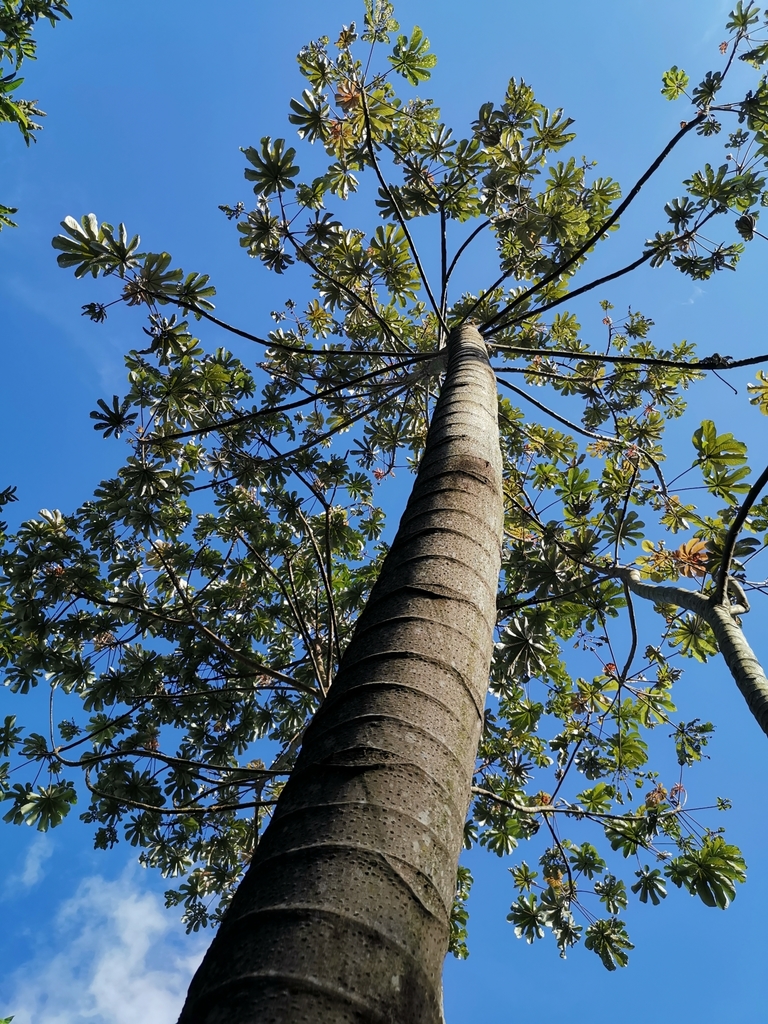
Distinguishing the trumpet tree from the Guarumo requires attention to detail. Both have the umbrella crown, the ringed trunk, the silvery-backed palmate leaves. But look closer. In the trumpet tree, the leaf lobes extend only about halfway to the center, giving the leaf a more rounded, shield-like appearance. In the Guarumo, the lobes are divided almost to the base, creating a more deeply incised, star-like outline. The leaf surface tells a story too: the trumpet tree's upper leaf surface feels rough and scabrous to the touch, while the Guarumo's is smooth. Count the secondary veins along the longest lobe: the trumpet tree has 14-20 pairs; the Guarumo has about 30, packed more densely. And notice the petioles: in the trumpet tree, they often show a distinctive reddish color; in the Guarumo, they tend to be green.
Physical Characteristics
Trunk: Slender and straight, with prominent horizontal rings marking former leaf attachments. The bark is smooth and pale gray. Like all Cecropia, the trunk is hollow, divided into chambers by thin internal walls at each node. Stilt roots or prop roots often develop at the base, sometimes reaching up to a meter tall, providing stability on steep slopes and in soft soils.
The hollow chambers were not lost on indigenous peoples. A trunk section 10-12 cm in diameter, cut to 1.2 meters and cleaned of its internal partitions by fire, becomes a resonant drum. The straight branches become blowguns. The petioles become simple trumpets. Few trees have offered such ready-made instruments to human hands.
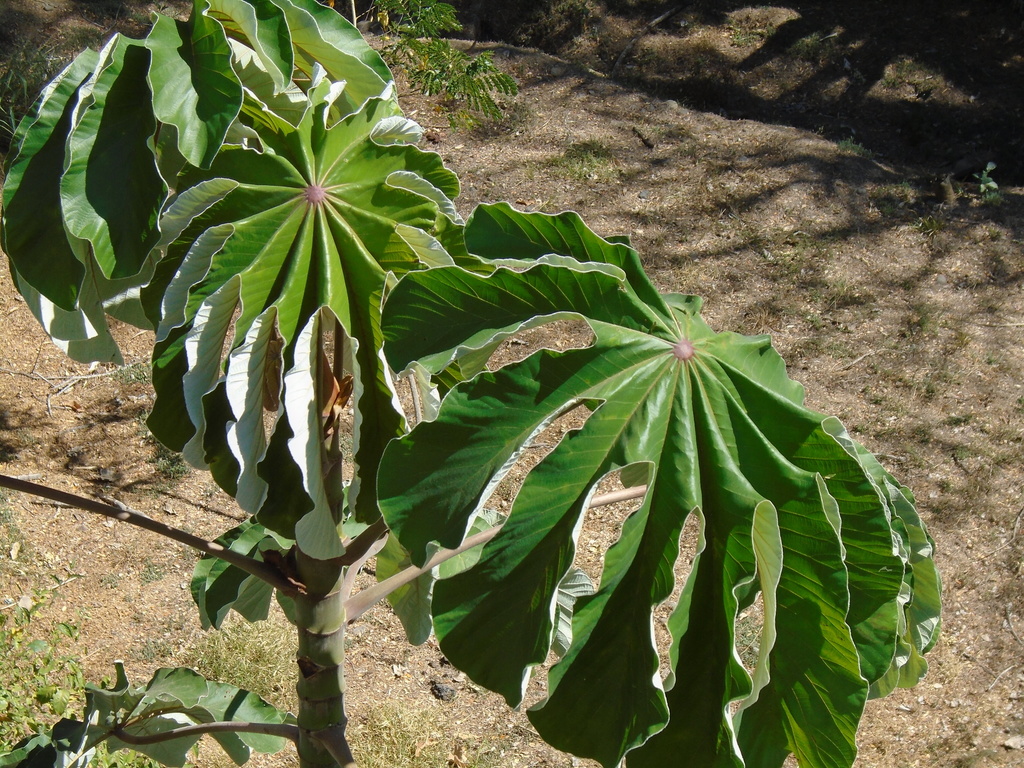
Leaves: Palmate and peltate (the petiole attaches to the center of the blade rather than the edge), measuring 20-40 cm across with 9-11 lobes. The lobes extend roughly halfway to the center, not nearly to the base as in C. obtusifolia. The upper surface is rough to the touch; the underside is silvery-white, covered with fine hairs. A distinctive red sheath covers the leaf bud before it unfurls. The rough texture made these leaves useful as natural sandpaper for smoothing gourds and polishing wood.
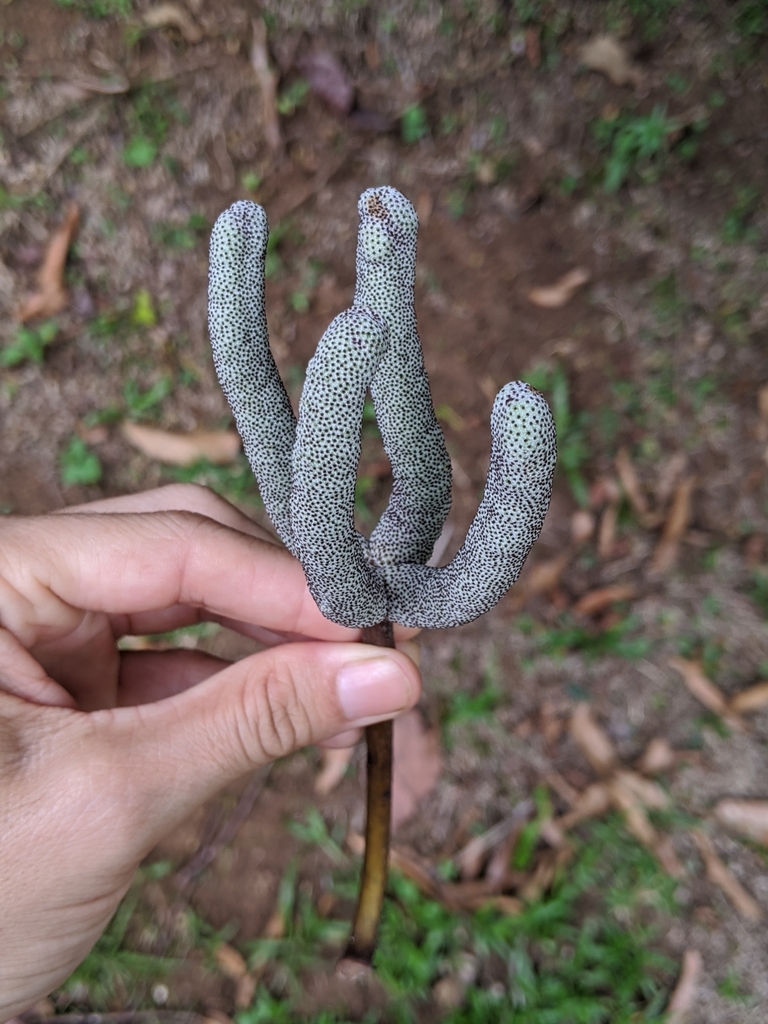
Flowers and fruits: Dioecious, with male and female flowers on separate trees. The flower spikes are thick and finger-like, 2-4 mm diameter for males and 5-10 mm for females. When fertilized, female spikes develop into elongated fruiting clusters 10-12 cm long, covered with tiny embedded fruits. The Guarumo's fruiting spikes are much longer and more slender, hanging like limp fingers; the trumpet tree's are shorter and thicker. The fruits are consumed by bats and birds, which disperse the seeds across the landscape.
The Dry-Forest Cecropia
In Costa Rica, C. peltata is the Cecropia of the Pacific lowlands. Drive the Pan American Highway in either direction from San José and you will see it lining the roadsides: north toward Guanacaste or south through the Brunca Region toward Golfito. It thrives in the seasonal climate where dry months would challenge C. obtusifolia. The species drops out around 1,000 meters elevation, where the forest transitions from deciduous to evergreen and C. obtusifolia takes over.
This drought tolerance has made C. peltata one of the most widespread Cecropia species. Its range extends from Mexico through Central America to Venezuela, Colombia, and Brazil, plus the Caribbean islands. In some regions outside its native range, including parts of Africa and Southeast Asia, it has become invasive, colonizing disturbed habitats with the same aggressive success it shows at home.
The Caribbean Puzzle
On the Central American mainland, C. peltata hosts the same mutualistic Azteca ants that colonize other Cecropia species. The hollow stems provide housing; the tree provides glycogen-rich food bodies at the leaf bases; the ants provide aggressive defense against herbivores. But in Puerto Rico and other Caribbean islands, something is different: the ants are absent, and so are the specialized structures that would attract them.
Caribbean C. peltata trees lack the prostomata (weak entry points in the stem wall) and produce fewer or no Müllerian bodies. Without the chemical signal and the easy entry, Azteca queens never colonize. The trees survive anyway, growing fast enough to outpace herbivores through sheer speed rather than defensive partnership. This geographic variation suggests that the ant mutualism, while ancient, is not essential for Cecropia survival. It is an enhancement, not a requirement.
Growth and Reproduction
Even among fast-growing pioneers, C. peltata is exceptional. Documented growth rates include reaching 22 cm in diameter and 13 meters in height in less than 3.5 years from germination. Seedlings can grow 10-15 cm in their first ten weeks, then over two meters in their first year. This explosive growth requires full sunlight; germination rates reach 80-90% in open conditions but drop to near zero in shade.
A mature female tree may produce six to seven million seeds over a 30-year lifespan. At least 15 species of birds and bats have been recorded feeding on the fruits and dispersing the seeds. The seeds remain viable in the soil for years, waiting for the light trigger that signals a forest gap. When that light arrives, the buried seed bank explodes into a cohort of competing seedlings, racing upward to claim the opening before it closes.
This strategy makes C. peltata essential for forest recovery. When land is abandoned after agriculture, it is often among the first trees to appear. Within a few years, the guarumo canopy creates shade that allows slower-growing species to establish beneath. In 20-30 years, as the guarumos senesce and die, they leave behind a young forest ready to mature.
Traditional and Modern Uses
Beyond the trumpets and drums, C. peltata has served human needs in countless ways. The rough leaves work as natural sandpaper. The inner bark yields tough fiber for ropes and cordage. The trunk latex produces a crude rubber. In Puerto Rico, the light, fine-grained root wood is prized for making the bodies of cuatros, a local guitar-like instrument, because it resists splitting and takes a smooth finish.
Traditional medicine uses the leaves for respiratory ailments, diabetes, and high blood pressure. Modern research has confirmed that leaf extracts contain compounds with hypoglycemic, anti-inflammatory, and diuretic properties. In Trinidad and Tobago, leaf infusions are still commonly used for cough relief. The sap is applied to fresh cuts, and dried leaves are sometimes smoked for asthma.
Distinguishing from Other Cecropia
In the Brunca Region, you will encounter two Cecropia species: the trumpet tree in drier areas and the Guarumo in wetter forests. Here is how to tell them apart:
| Feature | C. peltata (Trumpet tree) | C. obtusifolia (Guarumo) |
|---|---|---|
| Habitat | Pacific lowlands, seasonal dry forest | Wet forest, cloud forest margins |
| Elevation | Sea level to 1,000 m | Sea level to 1,500 m |
| Leaf lobes | 9-11, extend halfway to center | 7-11, extend nearly to base |
| Leaf surface | Upper surface rough, scabrous | Upper surface smooth |
| Secondary veins | 14-20 pairs | ~30 pairs |
| Petioles | Often reddish | Usually green |
| Max height | 20 m | 25 m |
Conservation
The trumpet tree faces no conservation threat. Its ability to colonize disturbed habitats, its prolific seed production, and its dispersal by common birds and bats ensure that it thrives wherever humans have altered the landscape. Like the Guarumo, it is a pioneer that benefits from disturbance rather than suffering from it.
For forest restoration in Costa Rica's drier Pacific lowlands, C. peltata is a natural ally. Its rapid growth quickly establishes canopy cover, its fruits feed dispersers that bring in seeds of other species, and its short lifespan ensures it will step aside as the forest matures. The trumpet tree, which gave indigenous peoples their instruments, now plays a different role: the opening act in the symphony of forest succession.
Key Sources & Resources
Species Information
General overview including distribution, morphology, and uses.
Comprehensive database entry with ethnobotanical uses, cultivation, and traditional medicine.
Detailed silvics including growth rates, reproduction, and habitat requirements.
Identification & Distribution
Technical key to Costa Rican Cecropia species with distinguishing characteristics.
Information on the species' invasive potential outside its native range.
Ethnobotany & Traditional Uses
Database of uses including musical instruments, fiber, and traditional medicine.