Guarumo (Cecropia)
Cecropia obtusifolia — The hollow-stemmed pioneer tree that feeds sloths and houses armies of Azteca ants in one of nature's oldest partnerships, stretching back eight million years.
Walk through any disturbed forest in Costa Rica's lowlands and you will encounter the guarumo. You may hear it called simply "Cecropia," though that refers to the genus; guarumo is the local name for this particular species. Its silvery-white leaves flash in the sunlight, their deeply lobed undersides catching the wind like open hands waving against the green canopy. The tree rises on a slender, ringed trunk that looks almost industrial, like a concrete column sectioned with joints. But what appears to be an exposed scaffold is actually a fortress, its hollow chambers patrolled by one of the most aggressive ant species in the Neotropics.
The guarumo is a master of colonization. When a tree falls in the forest and opens a gap to the sky, or when a farmer abandons a pasture and walks away, Cecropia seeds waiting in the soil spring to life. They grow faster than almost any other tropical tree, racing upward to claim the light before competitors can shade them out. In a few years, what was bare ground becomes a grove of guarumo, their umbrella canopies creating the shade that slower-growing species need to establish beneath them.
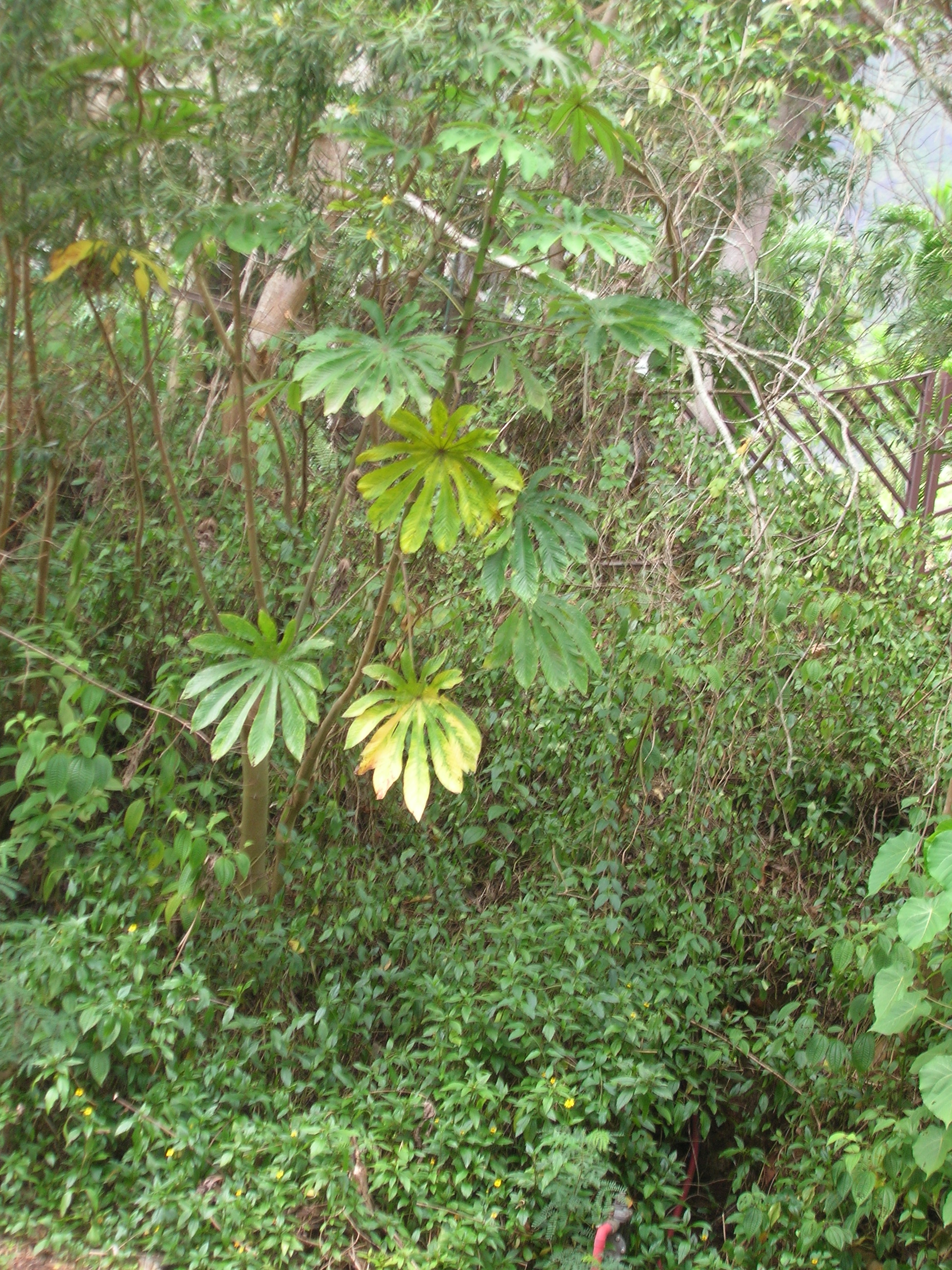
Identification
The genus Cecropia contains about 60 species distributed throughout tropical America. In Costa Rica, C. obtusifolia is the most widespread lowland species, though you may also encounter C. peltata and C. insignis in the Osa Peninsula and surrounding wet forests. All share the distinctive palmate leaves and hollow stems, but C. obtusifolia can be recognized by its leaves with 7-11 rounded lobes and the dense brownish hairs on the leaf undersides.
Physical Characteristics
Trunk: Slender and straight, with prominent horizontal rings marking where leaves once attached. The bark is smooth and pale gray to greenish. What makes this trunk remarkable is what lies inside: hollow chambers divided by thin internal walls called septa at each node. The pith splits and retracts during development, leaving a spacious, temperature-controlled cavity along the length of the stem. Ants enter through specialized weak points called prostomata, visible as slight depressions just above each leaf scar. Once inside, they chew through the septa to create continuous passages linking chambers throughout the tree.
The wood itself is among the lightest in the commercial world, with a specific gravity of just 0.29-0.33. This ultra-low density reflects the tree's investment strategy: grow fast, die young, and let density be someone else's problem. The soft wood also makes guarumo attractive to woodpeckers, which excavate nesting cavities in dead or dying portions of the trunk where ant colonies have failed or abandoned their chambers.
Crown: Open and umbrella-shaped, with branches radiating outward from the main stem in rhythmic whorls. Young trees have a distinctive candlestick form with a single unbranched trunk and a crown of leaves at the top. Botanists classify Cecropia's growth pattern as Rauh's architectural model: a monopodial trunk that branches sympodially, producing the characteristic tiered canopy.
The tree grows in distinct cycles of 25-35 nodes per year, creating a predictable rhythm of leaf production, branching, and flowering. Each ring visible on the trunk marks a former leaf attachment point, and by counting these scars, researchers can estimate a tree's age with reasonable accuracy. But the crown structure is surprisingly temporary: even the branches that appear in adolescent individuals die and rot away as the tree grows taller. This constant self-pruning channels the tree's energy into height rather than lateral growth, allowing it to outrace competitors in the race for canopy light.
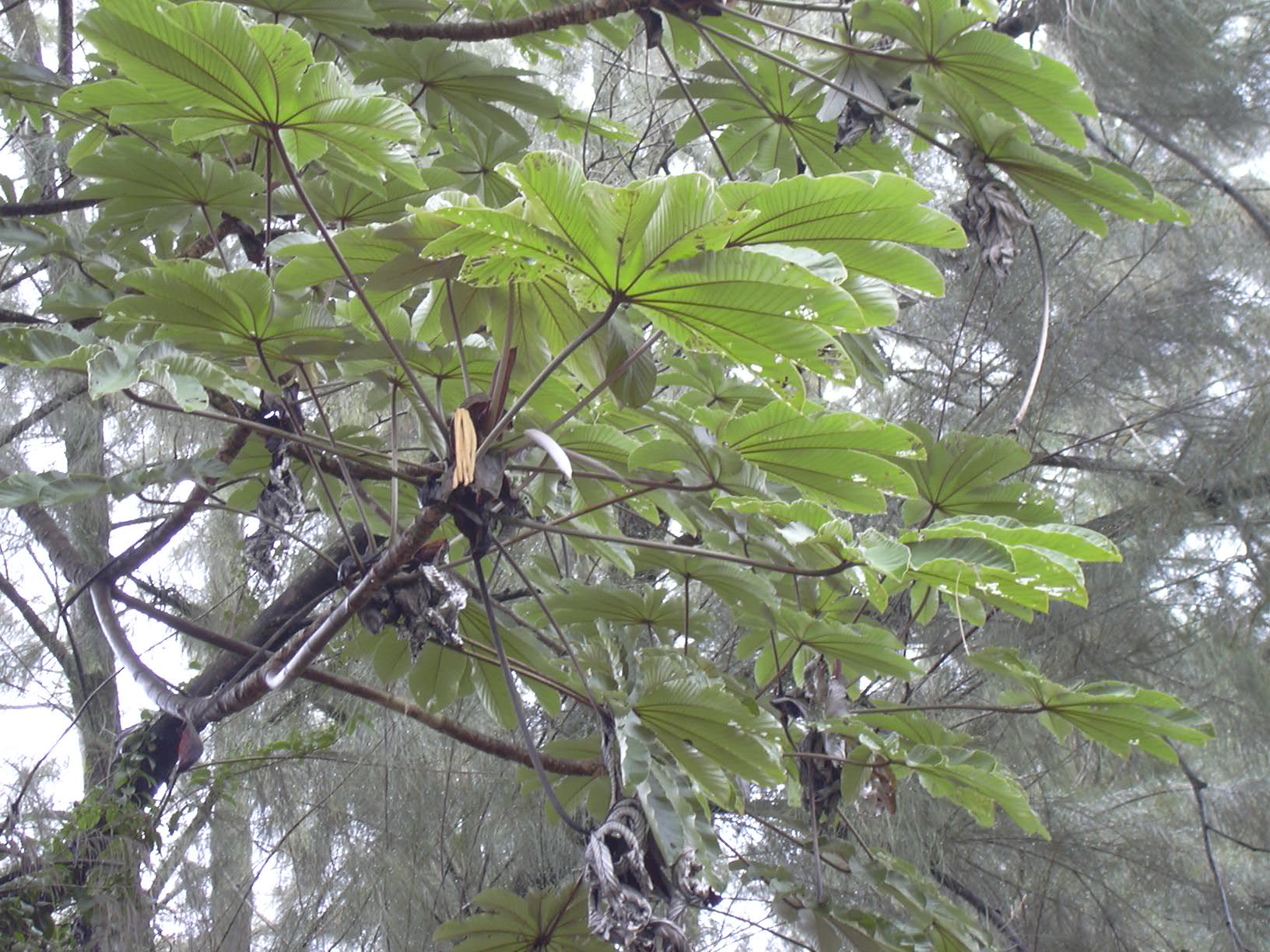
Leaves: Among the most distinctive of any tropical tree. Each leaf is palmately lobed like an open hand, measuring 30-60 cm across, with 7-11 deep lobes radiating from a central point. The upper surface is dark green and slightly rough; the underside is silvery-white to grayish, covered with fine hairs. Long petioles (leaf stalks) up to 60 cm connect the blade to the branch. When the wind blows, the leaves flip to reveal their pale undersides, making guarumo groves flash silver against the forest.
Flowers and fruits: The guarumo is dioecious, meaning male and female flowers occur on separate trees. The flower clusters are distinctive: slender, finger-like spikes (catkins) that hang in groups from the branch tips. Male catkins are whitish and produce copious pollen; female catkins are greenish and, when fertilized, develop into fleshy, segmented fruits resembling small fingers. These fruits ripen year-round and are consumed by dozens of bird and mammal species.
Eight Million Years of Partnership
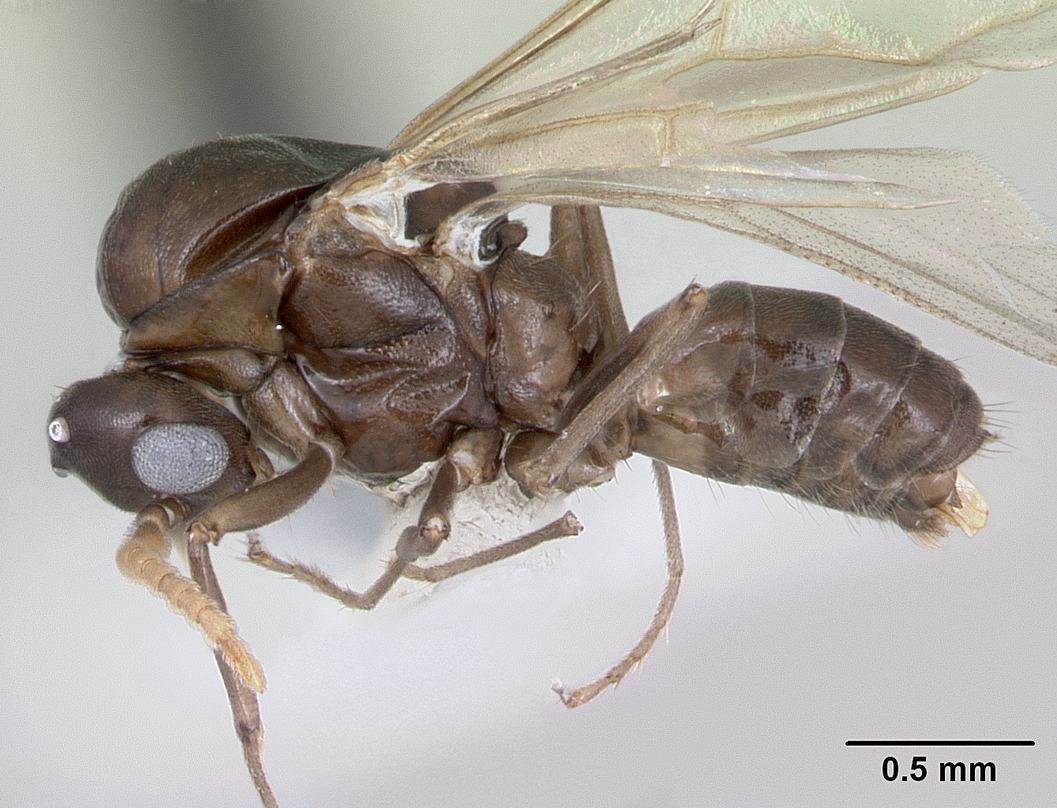
The relationship between Cecropia trees and Azteca ants is one of the most studied mutualisms in tropical ecology. Genetic evidence suggests this partnership began approximately eight million years ago, making it older than the earliest human ancestors. The arrangement is elegant: the tree provides housing and food; the ants provide defense.
The hollow internodes of the guarumo's stem create a series of interconnected chambers. A mated queen ant chews through the thin wall at a designated entry point, usually marked by a slight depression, and establishes her colony inside. As the colony grows, workers expand through additional chambers. A single large tree may house tens of thousands of ants.
But housing alone is not enough. The tree also provides food in the form of glycogen-rich bodies called Müllerian bodies, produced at the base of each leaf stalk. These small, pearl-like structures are the primary food source for the colony. What makes them biochemically remarkable is that they contain not starch but glycogen, the same energy storage molecule found in animal muscle and liver. This is extremely rare in plants. Analysis reveals that Müllerian bodies are 25-33% glycogen by dry weight, and their glycogen differs biochemically from the starch found in the tree's leaves. The tree appears to have evolved a specialized pathway to manufacture animal-style energy packets for its ant partners.
The exchange is not one-directional. Isotope studies have revealed that the ants return a crucial favor: nitrogen. Ant colonies accumulate debris in their chambers: dead workers, prey remains, fecal material. This nitrogen-rich waste decomposes within the hollow stems, and the tree absorbs it through the chamber walls. In well-established colonies, 93% of the nitrogen in the tree's tissues can be traced back to ant-derived sources. The relationship thus involves a true nutrient exchange: the tree trades carbohydrates for nitrogen, the same fundamental currency that drives plant-microbe partnerships in root nodules and mycorrhizal networks.
In return, the ants are ferocious defenders. When an herbivore lands on a guarumo leaf, workers swarm from entrance holes and attack. They bite, spray formic acid, and mob the intruder until it retreats. The ants also prune competing vegetation: any vine or epiphyte that attempts to climb the tree is attacked and severed. Studies have shown that guarumo trees with Azteca colonies grow faster and suffer less herbivory than those without.
The Sloth's Pantry
Despite the ant army, some animals have evolved ways to exploit the guarumo. The most famous is the three-toed sloth (Bradypus variegatus). Though sloths are generalists that consume over 90 plant species, guarumo is among their most important food sources in Costa Rica's lowland forests. Sloths move so slowly that ants cannot mount an effective defense, and their thick fur provides protection against bites. Their placid browsing style, moving imperceptibly from branch to branch, allows them to exploit the tree without triggering the same alarm response that faster-moving herbivores provoke.
The popularity of guarumo as sloth food is not random. Though Cecropia leaves are high in fiber and contain defensive compounds, they are relatively rich in protein compared to many rainforest leaves. Sloths have evolved specialized multi-chambered stomachs and extraordinarily slow metabolisms that allow them to extract nutrients from this challenging food source. Their low-energy lifestyle, the hanging, the sleeping 15-20 hours a day, is an adaptation to a leaf-based diet that provides minimal calories per unit mass.
The fruits of guarumo are more nutritious than the leaves, and they attract a different crowd. Toucans, aracaris, parrots, and dozens of other bird species feed on the ripe catkins. Spider monkeys and howler monkeys consume both fruits and young leaves. Bats visit at night to feed on fallen fruits. In this way, the guarumo serves as a keystone food source, providing calories to the forest community throughout the year.
Habitat & Distribution
Cecropia obtusifolia ranges from southern Mexico through Central America to Panama. In Costa Rica, it is abundant on both Pacific and Caribbean slopes, from sea level to approximately 1,500 meters elevation. It is particularly common in the Osa Peninsula, the Central Valley, and the lowlands of Guanacaste and Limón.
Ecosystem: The guarumo is the quintessential pioneer species. It thrives in disturbed habitats: roadsides, landslide scars, abandoned pastures, forest gaps created by fallen trees. It requires full sunlight and cannot regenerate under a closed canopy. In primary forest, guarumo appears only where disturbance has created an opening.
Climate requirements: Warm, humid conditions with annual rainfall exceeding 1,500 mm. The species tolerates a dry season of several months if soils remain moist. It is frost-intolerant and restricted to tropical and subtropical climates.
Soil preferences: Remarkably adaptable, growing in poor, compacted, and eroded soils where most species fail. This tolerance for degraded conditions makes guarumo an early colonizer of human-altered landscapes.
The Pioneer's Strategy
Like the balsa, the guarumo lives fast and dies young. Growth rates can exceed two meters per year under favorable conditions. Trees begin producing flowers and fruits within 3-4 years. By age 20-30, most guarumos have reached the end of their lives, shaded out by the slower-growing species they helped establish.
Reproduction is prolific. Female trees produce thousands of small seeds embedded in the fleshy fruit catkins. Birds and bats consume the fruits and defecate the seeds across the landscape. The seeds can remain viable in the soil for years, waiting for a disturbance to provide the light trigger for germination. When that light arrives, the buried seed bank springs to life, and a new cohort of guarumos races skyward.
This strategy makes guarumo essential for forest recovery. When land is abandoned after agriculture or logging, guarumo is typically among the first trees to appear. Its rapid growth creates canopy cover within a few years, moderating temperatures and humidity beneath. This microclimate shift allows shade-tolerant forest species to germinate and establish. In 20-30 years, as the guarumos senesce and fall, they leave behind a young forest of diverse species.
Traditional and Modern Uses
Indigenous peoples across the Americas have used guarumo for centuries. The rough leaf surface served as sandpaper for polishing wood and smoothing gourds. The hollow stems were used as blowguns and musical instruments. In folk medicine, Cecropia leaves are widely used to treat diabetes, high blood pressure, and respiratory ailments. Modern research has confirmed that leaf extracts contain compounds with hypoglycemic and anti-inflammatory properties, though clinical applications remain experimental.
The wood is too soft and short-lived for construction, but its rapid growth makes guarumo valuable for agroforestry systems. Farmers plant it as a quick-establishing shade tree in coffee and cacao plantations. The fallen leaves decompose rapidly, returning nutrients to the soil. In restoration projects, guarumo is often among the first species planted to jump-start forest recovery on degraded lands.
Conservation
The guarumo faces no conservation threat. Its ability to colonize disturbed habitats, its prolific seed production, and its dispersal by common birds and bats ensure that it thrives wherever humans have altered the landscape. If anything, guarumo populations have increased with human activity, as deforestation and land abandonment create the open habitats it requires.
This abundance makes the guarumo a friend of conservation. When protected areas like Corcovado experience natural disturbances, guarumo helps heal the wounds. When degraded lands are set aside for restoration, guarumo is among the first trees to return, jump-starting the succession that will eventually produce mature forest. For visitors to Costa Rica's forests, the guarumo serves as a living lesson in ecological resilience: a tree that turns destruction into opportunity, and opportunity into recovery.
Key Sources & Resources
Species Information
General overview of the species including taxonomy, distribution, and ecology.
Detailed species account including phenology, identification features, and distribution in Costa Rica.
Comprehensive database entry with ethnobotanical uses and cultivation information.
Ant-Plant Mutualism
Quantitative study of colony sizes (1,880-13,534 workers) and their isometric scaling with tree height.
Detailed technical account of the Cecropia-Azteca association including hollow stem anatomy and prostomata.
Database of ant species including the Azteca ants that colonize Cecropia trees.
Overview of the Cecropia genus including the ant-tree mutualism and sloth feeding relationships.
Biochemistry & Nutrient Exchange
Discovery that Müllerian bodies contain 25-33% glycogen, not starch, representing a rare plant glycogen pathway.
Isotope studies showing that 93% of nitrogen in ant-occupied Cecropia derives from ant debris.
Medicinal Research
Review of the medicinal compounds and therapeutic potential of Cecropia species.