Panama Rubber Tree
Castilla elastica Sessé ex Cerv. is a fast-growing deciduous tree of lowland wet forests from Mexico to Ecuador. For over 3,000 years, this was the source of rubber for Mesoamerican civilizations. The Olmecs derived their name from the Nahuatl word for rubber, ulli, made from this tree's latex. A fundamental anatomical difference from Amazonian rubber trees led to its commercial extinction in the 19th century.
At the El Manati archaeological site in Veracruz, Mexico, archaeologists discovered rubber balls dating to 1600-1700 BCE. These artifacts represent the world's oldest evidence of rubber technology, predating any other rubber use globally by more than a millennium. The balls were made from latex of Castilla elastica, processed by an indigenous technique that would not be understood by Western science until the late 20th century. Mesoamerican peoples mixed the tree's milky latex with juice from Ipomoea alba (moonflower vine), creating a chemical reaction that vulcanized the rubber, making it elastic and durable. Charles Goodyear would not "discover" vulcanization using sulfur until 1839, some 3,400 years later.
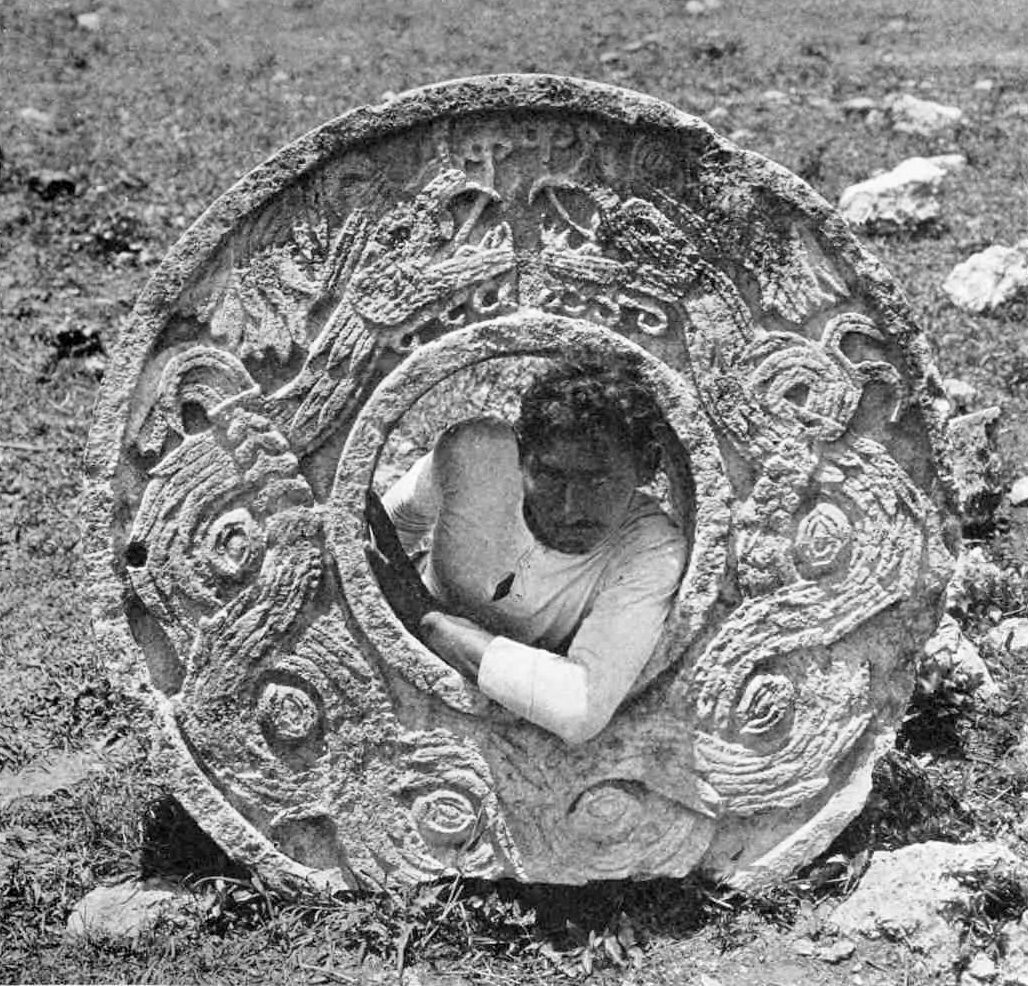
The Olmec, Maya, and Aztec civilizations all depended on this tree. The Nahuatl word for rubber, ulli (or olli), gave the Olmecs their name: "rubber people." They used the processed latex to make balls for the ceremonial Mesoamerican ballgame, waterproof sandals, ritual figurines, and adhesives. When Christopher Columbus observed indigenous peoples playing with bouncing balls during his 1493 voyage, it marked Europeans' first encounter with rubber. The material's remarkable properties astonished observers: it bounced, stretched, and repelled water unlike anything known in the Old World.
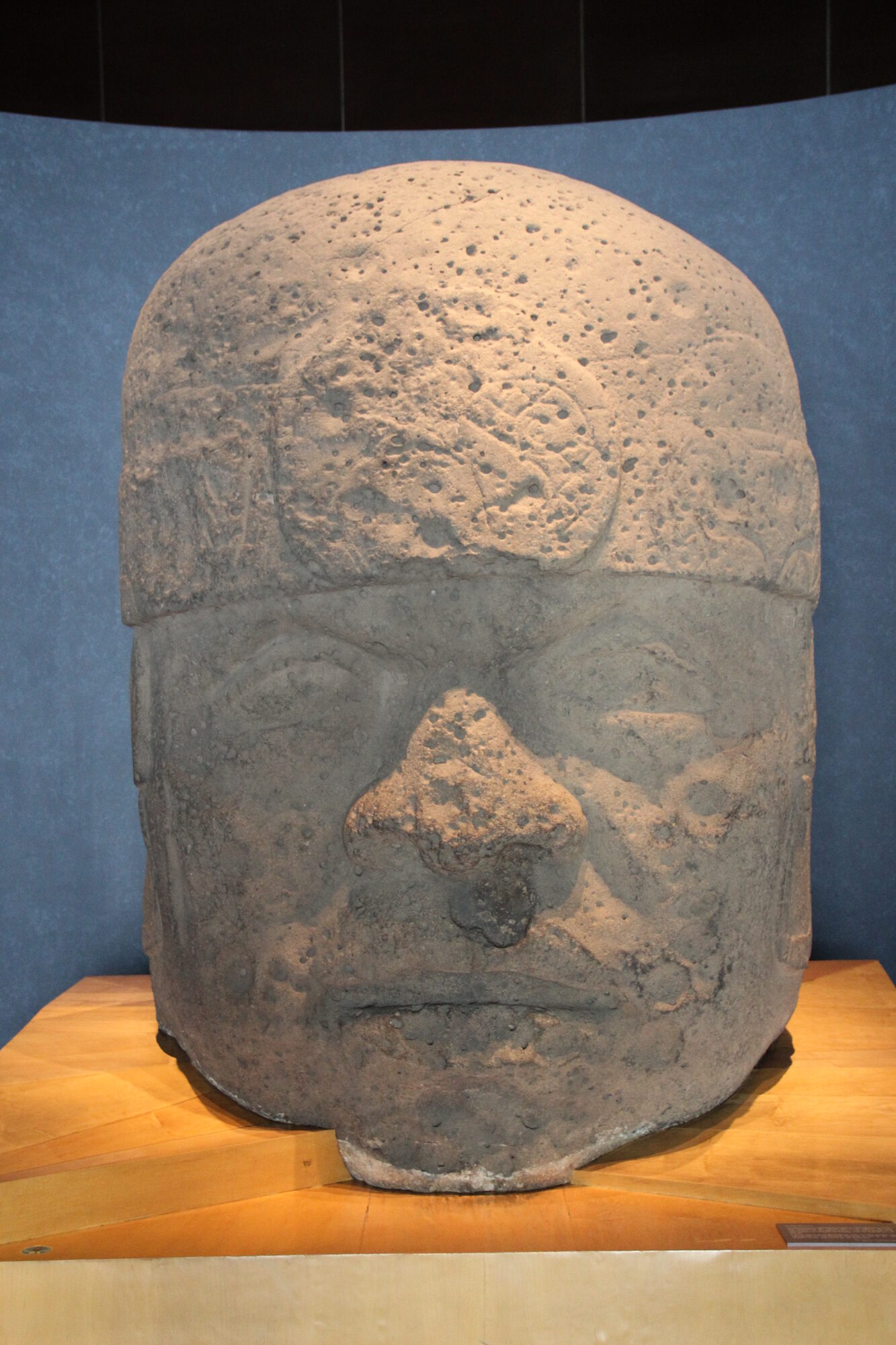
The 19th-century rubber boom would bring commercial exploitation and ultimately destruction to Castilla elastica populations across Central America. The species suffered from a fatal anatomical flaw: unlike Hevea brasiliensis (Para rubber) from the Amazon, which has connected latex tubes allowing sustainable tapping, Castilla lacks this network. Latex could not be extracted through cuts in the bark. Instead, trees were stripped of bark or felled entirely, yielding latex in a single destructive harvest. When Henry Wickham smuggled 70,000 Hevea seeds from Brazil to Kew Gardens in London in 1876, from which seedlings were sent to British colonies in Southeast Asia, the commercial fate of Castilla elastica was sealed. By the early 20th century, Malaysian and Indonesian plantations of the superior Hevea came to dominate global rubber production, and Castilla plantations in Mexico, Central America, and Java were abandoned.
Identification
Habit
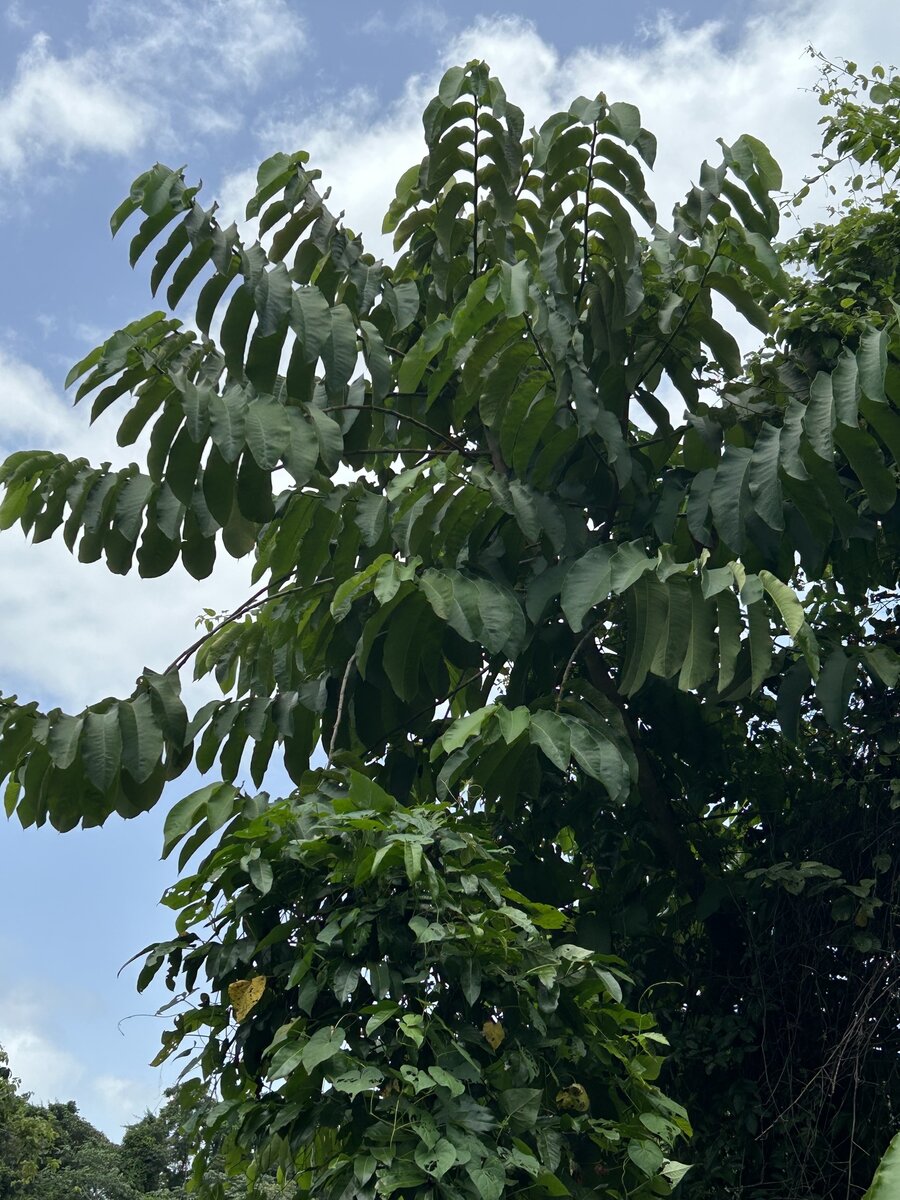
Castilla elastica is a deciduous to evergreen tree with a large, spreading or drooping crown. It typically grows 10-30 meters tall, occasionally reaching 60 meters. The trunk measures 30-90 centimeters in diameter, with buttresses forming at the base of large trees. As a pioneer species, it grows at a fast rate and can exceed 10 meters in height within four years under favorable conditions. The root system consists of a rather short taproot and several lateral roots spreading horizontally near the soil surface, often traceable for 20-30 meters. This shallow root architecture makes it difficult to cultivate other crops beneath the tree.
Bark & Latex
The bark is pale grey and fibrous, stripping easily from the trunk. When cut, it exudes copious white, milky latex. If left to dry naturally, the latex turns brown and brittle. The traditional Mesoamerican processing method mixed fresh latex with juice from Ipomoea alba (moonflower vine), causing the latex to coagulate rapidly within minutes and become highly elastic. The fibrous bark itself has traditional uses: after latex extraction, strips are beaten to manufacture mats, blankets, clothing, and cord.
Leaves & Stipules
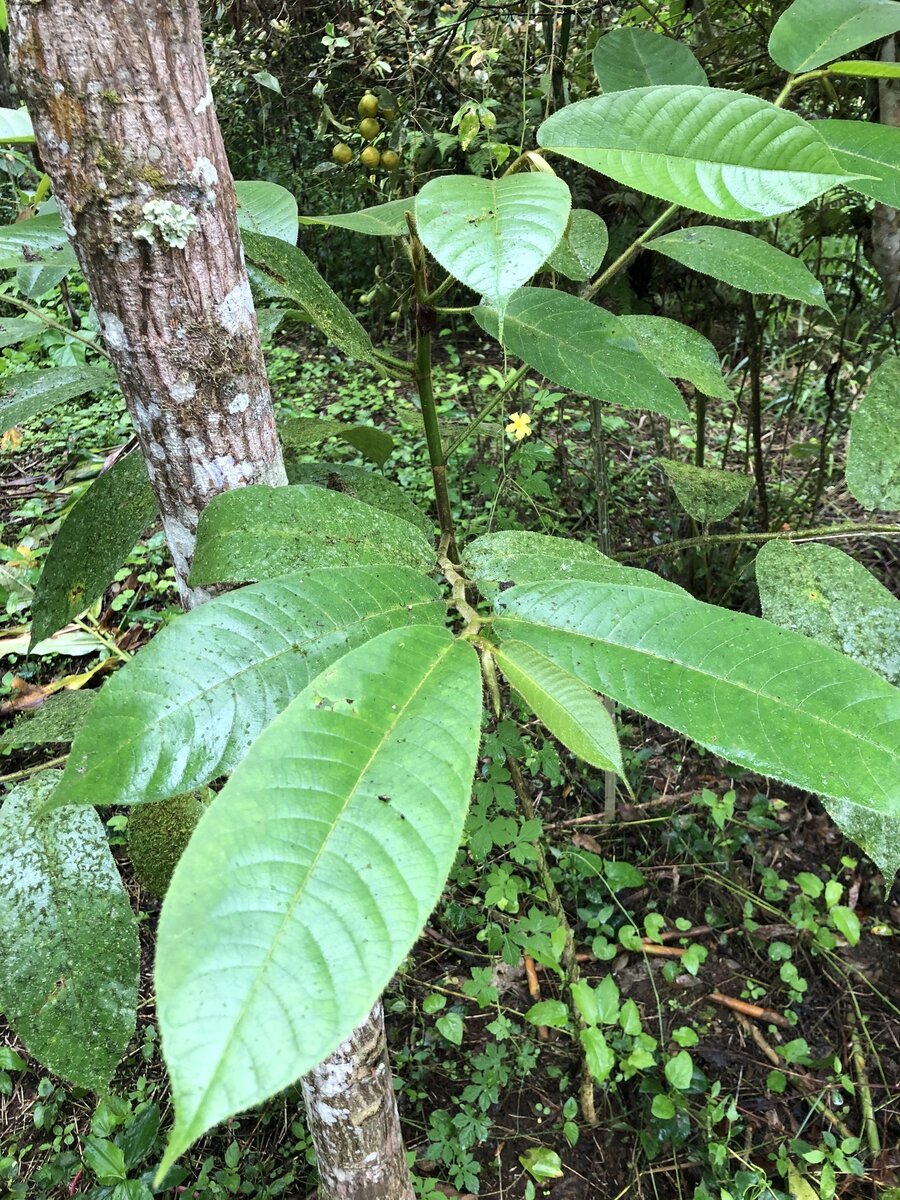
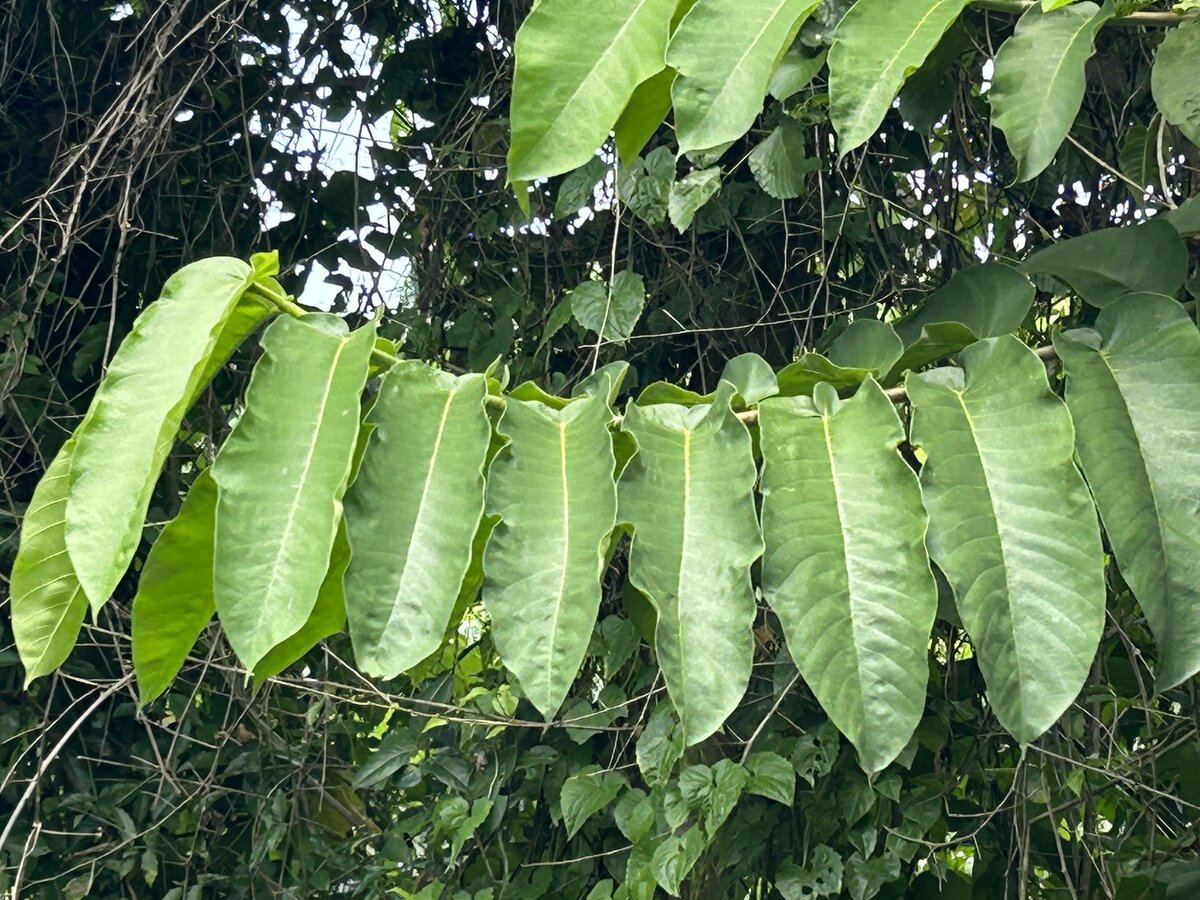
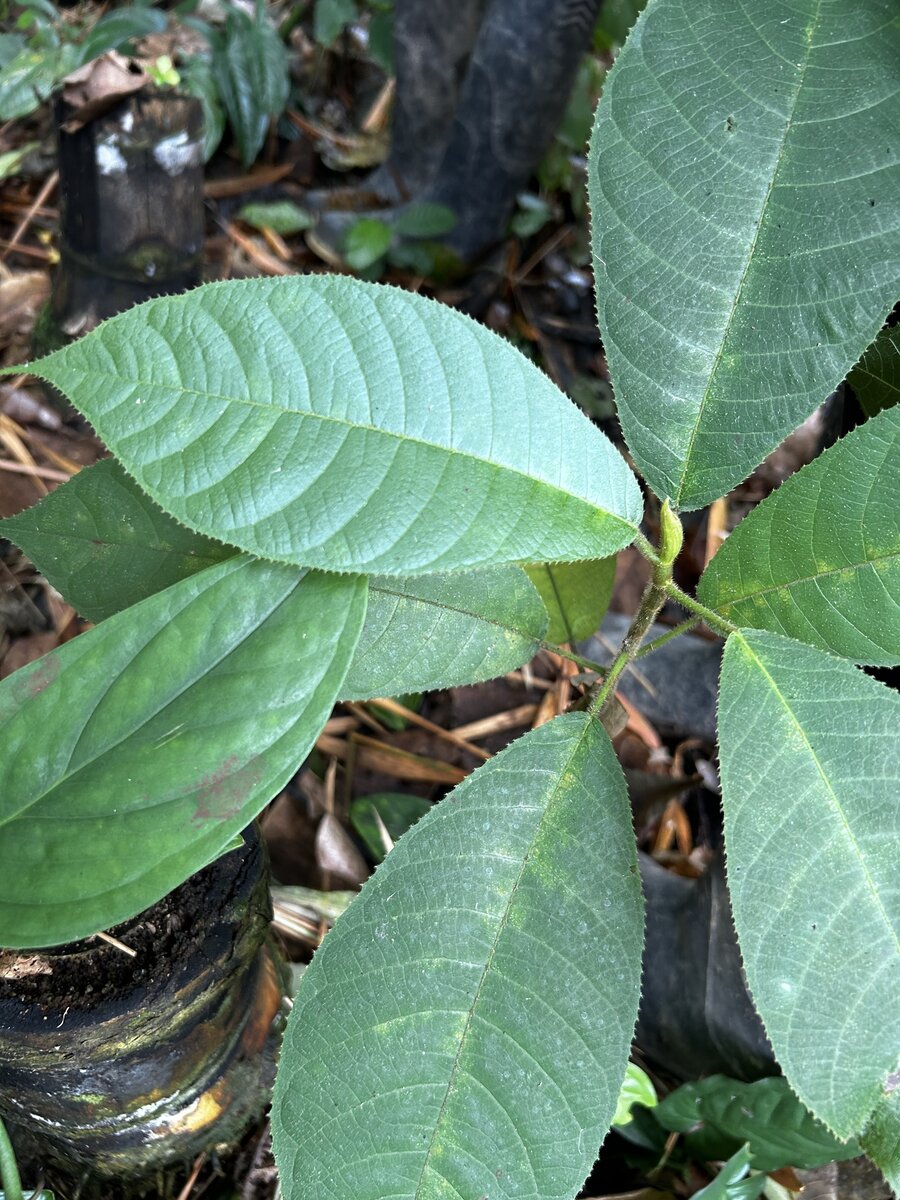
Leaves are distichous (arranged in two opposite rows), large, and short-petiolate. The laminae measure 18-38 centimeters long (occasionally to 55 cm) by 7-18 centimeters broad (occasionally to 25 cm), oblong to obovate-oblong or slightly pandurate (fiddle-shaped). The base is usually truncate to cordulate and subequal; the apex is caudate to abruptly short-acuminate with a slender tip about 1 centimeter long. Margins are obscurely to minutely denticulate with 5-12 teeth per centimeter. There are 14-22 pairs of major secondary veins. The texture ranges from chartaceous (papery) to subcoriaceous (somewhat leathery). The upper surface is scabrous with scattered stiff hairs. Petioles measure 5-20 millimeters long.
The stipules are completely united and fully encircle the stem (amplexicaul), appearing solitary at each node and enclosing the shoot apex in early stages. They measure 2-11 centimeters long, are large and caducous (falling off early), with distinct parallel venation and white tomentellous hairs along the edges. This amplexicaul stipule arrangement is a key diagnostic feature distinguishing Castilla from related genera like Poulsenia, which has free, laterally attached stipules.
Flowers
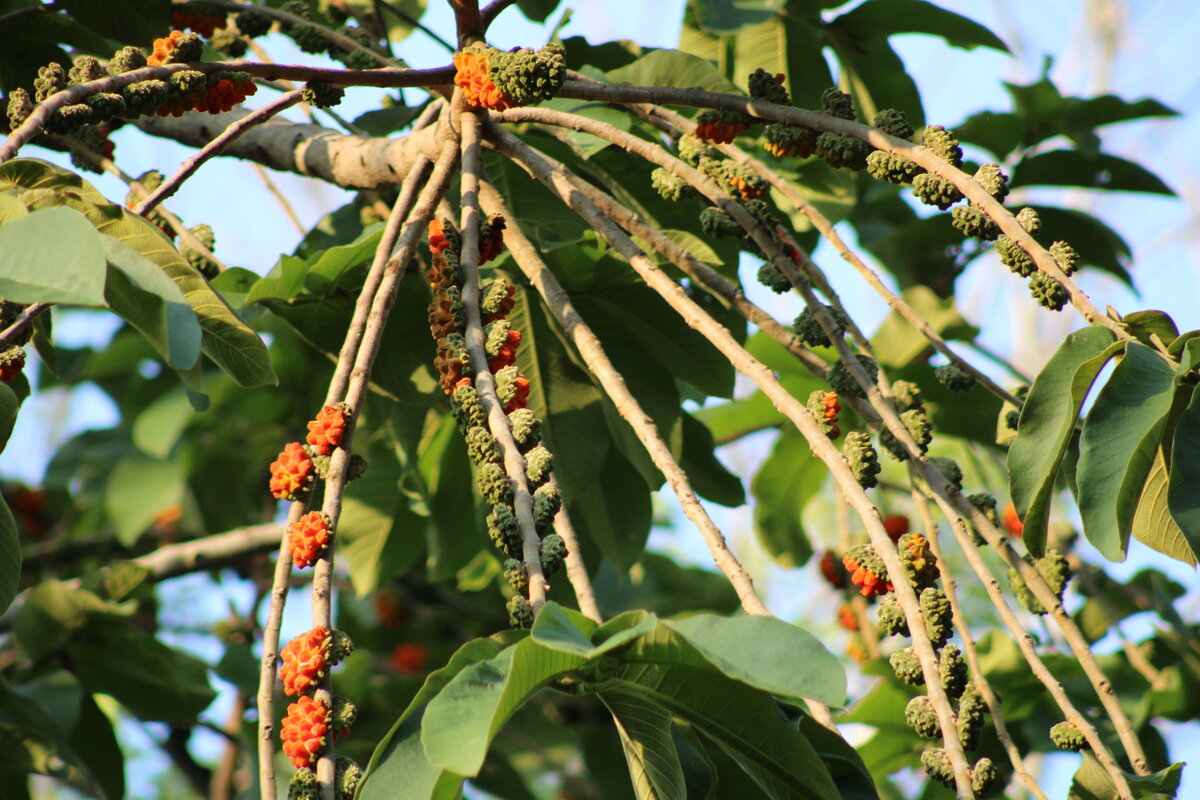
Castilla elastica exhibits an extremely rare reproductive system called androdioecy, with populations containing male and hermaphrodite individuals (true females are absent). Uniquely, even on hermaphrodite trees, male and female flowers occur on separate inflorescences. Male inflorescences come in two forms: (1) primary inflorescences are pedunculate, widening to a flabellate (fan-shaped) bivalvate disc 10-25 millimeters broad and 7-25 millimeters high, covered with large imbricate bracts and borne on peduncles 3-15 millimeters long; (2) secondary male inflorescences associated with female flowers are much smaller, infundibuliform (funnel-shaped) to cyathiform (cup-shaped). Stamens are numerous with filaments 0.5-3.5 millimeters long. Female inflorescences are usually solitary, sessile or subsessile, discoid to cupuliform, 1-2 centimeters in diameter, with 15-30 basally connate flowers. Flowering occurs year-round with peaks in February-March. The flowers are pollinated by thrips in what appears to be a mutualistic relationship evolved from plant-herbivore interactions.
Fruits
Fruits are ellipsoid, 8-10 millimeters long, borne within the velutinous (velvety) accrescent perianth. The infructescence is discoid, 2.5-4.5 centimeters in diameter. Mature fruits are reddish. Seeds measure about 8-10 × 6-8 millimeters with thick equal cotyledons. The succulent fruits have a mild sweetish flavor and are consumed by howler monkeys, which serve as the primary seed dispersers. Agoutis, pacas, peccaries, and coatimundis act as secondary dispersers after fruits fall to the forest floor. Fruiting occurs year-round.
Distribution
Castilla elastica ranges from southern Mexico through Central America to Colombia and northern Ecuador. It occurs in Guatemala, El Salvador, Nicaragua, Costa Rica, and Panama. The species is most common in lowland wet forests of the Atlantic slope but also inhabits deciduous forests on the Pacific side, particularly on the Nicoya Peninsula. In Costa Rica, herbarium collections document 168 records from 84 distinct localities spanning elevations from 5 to 1,148 meters. The species shows a pronounced distribution pattern: Caribbean lowland forests harbor subspecies costaricana, while the Nicoya Peninsula hosts subspecies elastica.
In the Brunca region, C. elastica has been documented from two localities: the Reserva Forestal Golfo Dulce at Cerro de Oro and the Cantón de Osa on the Osa Peninsula. Both collections date from 1995. The species inhabits lowland and premontane wet forests, deciduous and evergreen formations, and occasionally colonizes roadsides and disturbed areas. As a fast-growing pioneer species, it demands high light availability and readily establishes in forest gaps and secondary growth. Trees thrive in areas receiving full sunlight, though young individuals can tolerate partial shade. The species shows no particular preference for ridges or valleys but requires well-drained soils.
Ecology
Castilla elastica exhibits an androdioecious reproductive system, meaning populations contain both male trees and hermaphrodite (functionally female) trees. This arrangement is extremely rare in angiosperms. Even on hermaphrodite trees, male and female flowers develop on separate inflorescences rather than being mixed together. Thrips serve as the primary pollinators, visiting the small greenish flowers for pollen and nectar. This thrips-pollination system may represent an evolutionary precursor to the highly specialized fig-fig wasp mutualisms found elsewhere in Moraceae. Flowering occurs year-round with peaks in February and March.
Howler monkeys serve as the primary seed dispersers, consuming the mildly sweet fruits and defecating viable seeds away from parent trees. After fruits fall to the forest floor, agoutis, pacas, peccaries, and coatimundis act as secondary dispersers. The species develops a shallow root system with a short taproot and lateral roots spreading 20-30 meters horizontally near the soil surface. This architecture makes large trees vulnerable to windthrow during storms. As a fast-growing pioneer, individuals can exceed 10 meters in height within four years under favorable conditions. The species tolerates wind and storm disturbance well, rapidly colonizing gaps and edges. Leaf-cutter ants in the genera Atta and Acromyrmex harvest foliage, though they do not appear to significantly reduce tree vigor. Roots form associations with arbuscular mycorrhizal fungi that likely enhance nutrient uptake in the nutrient-poor soils where the species often establishes.
Taxonomic History
Martín de Sessé y Lacasta collected the type specimen during the Royal Botanical Expedition to New Spain (1787-1803), and Vicente Cervantes formally published the species in 1794 in the Gazeta de literatura de México. The lectotype, Sessé 4633, resides at the Real Jardín Botánico in Madrid. The genus Castilla honors Juan Diego del Castillo, a pharmacist who served on the expedition and died of scurvy in 1793, just one year before this species was described. The Royal Botanical Expedition, led by Sessé and including Cervantes as Professor of Botany, documented approximately 3,500 plant species across New Spain over sixteen years. Cervantes went on to found Mexico City's first botanical garden in 1788, the first European-style botanical institution in New Spain, and held the position of first Professor of Botany in New Spain.
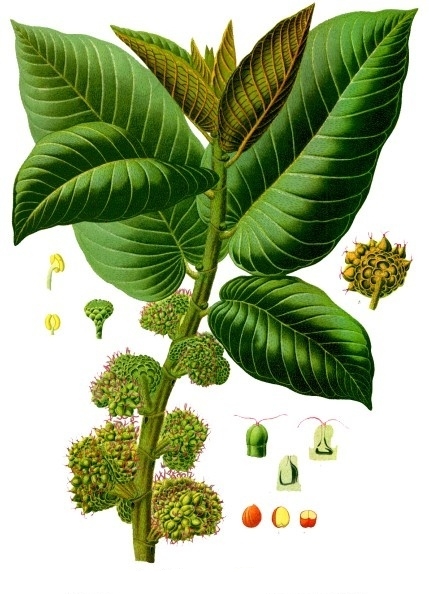
The specific epithet elastica refers to the tree's elastic rubber latex. The connection between this tree and Mesoamerican cultures runs deep: the Nahuatl word ulli (or olli), meaning rubber, gave the Olmec civilization its name. "Olmec" translates literally as "rubber people," reflecting the central role this tree's latex played in their culture from at least 1600 BCE. C.C. Berg's 1972 revision in Flora Neotropica Monograph 7 provided the definitive taxonomic treatment, recognizing two subspecies: subspecies elastica occurs on Costa Rica's Nicoya Peninsula and into Nicaragua, while subspecies costaricana inhabits Caribbean lowlands. Numerous synonyms reflect the species' wide range and variable morphology: Castilla costaricana Liebm., C. guatemalensis Pittier, C. gummifera (Bertol.) Pittier ex Standl., C. lactiflua O.F. Cook, C. nicoyensis O.F. Cook, C. panamensis O.F. Cook, and Ficus gummifera Bertol.
Similar Species
Castilla elastica can be confused with Poulsenia armata, another Moraceae tree that also produces milky latex and has large leaves. The amplexicaul stipules (completely united and encircling the stem) of C. elastica distinguish it immediately from P. armata, which has free, non-encircling stipules. Castilla leaves are generally larger (18-38 cm vs. 12-25 cm in Poulsenia) and produce more abundant latex when cut. The rusty-brown stellate pubescence on young branches of Castilla is also diagnostic. When flowers are absent and stipules have fallen, the larger leaf size and more copious latex provide reliable field characters.
Uses and the Rubber Industry
For over three millennia, Mesoamerican peoples extracted latex from Castilla elastica and processed it into elastic rubber by mixing it with juice from morning glory vines (Ipomoea alba). Without this botanical innovation, the latex remains sticky and brittle. Archaeological evidence from the El Manatí site in Veracruz, Mexico, dated to 1600-1700 BCE, includes rubber balls made from Castilla latex, representing the world's oldest known rubber artifacts. The Olmec, Maya, and Aztec civilizations used these rubber balls in ceremonial ball games from approximately 1200 BCE through 1500 CE. Indigenous peoples also fashioned the processed latex into waterproof sandals, ritual figurines, hafting adhesive for attaching stone tools to wooden handles, and botanical glue for various applications. After extracting latex, people beat the fibrous inner bark to produce mats, blankets, clothing, and cordage.
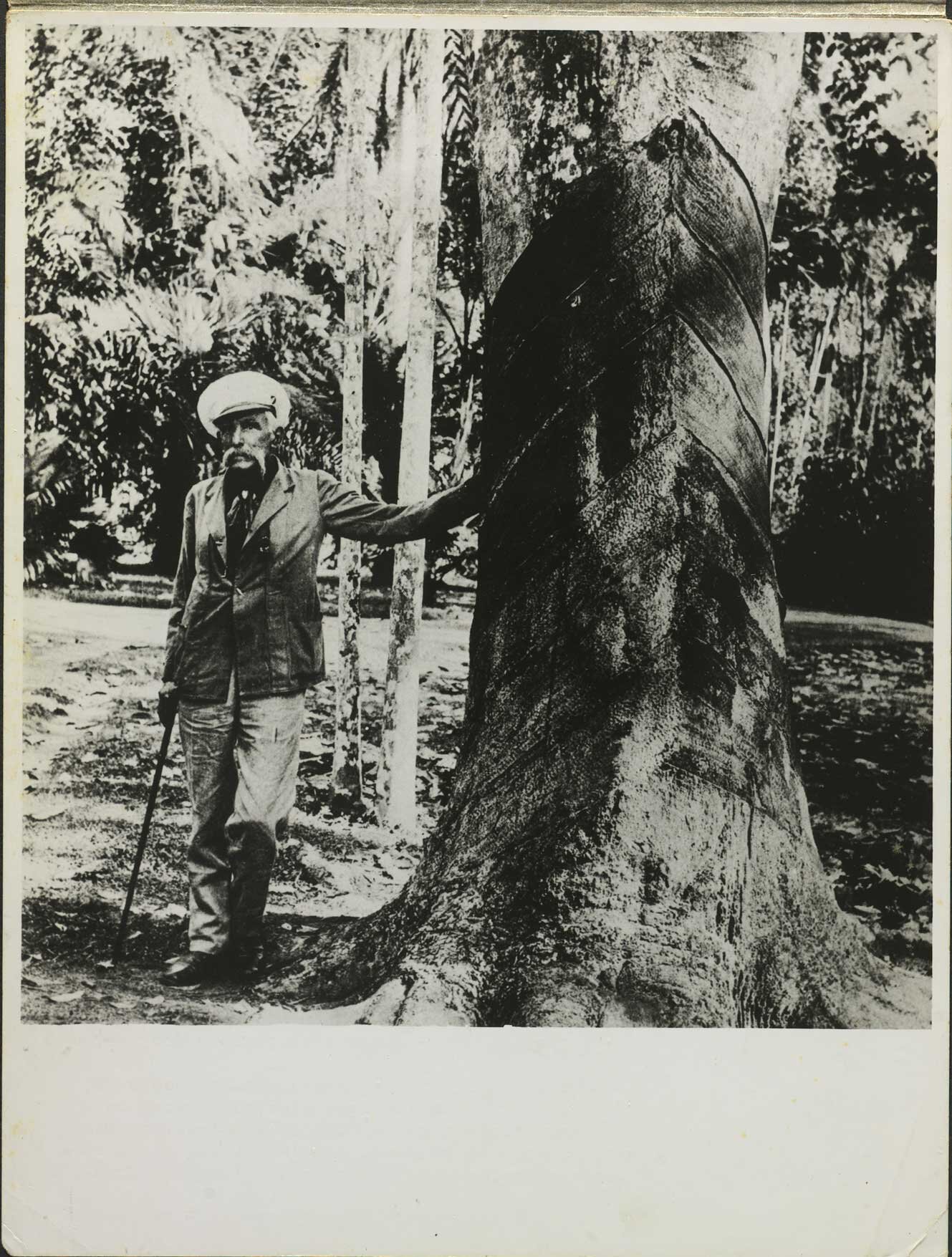
The anatomical structure of Castilla determined its commercial fate. Unlike Hevea brasiliensis (the Brazilian rubber tree), which possesses interconnected latex tubes that can be tapped repeatedly without killing the tree, Castilla elastica lacks such connected vessels. Harvesting latex from Castilla required destructive methods: workers stripped entire trees of bark or felled them completely to extract all available latex at once. This itinerant exploitation moved through forests, leaving destruction behind. When sustainable tapping was practiced using the half-spiral groove method on trees 8-10 years old, yields reached up to 25 kilograms of latex per year. However, the economic pressure of the rubber boom made such restraint rare.
The Amazon rubber boom (1860-1910) initially relied heavily on Castilla, with the region supplying 60% of global rubber during the peak years. The extraction system that developed, particularly for Castilla (called "caucho"), created one of history's most brutal labor regimes, essentially enslaving indigenous peoples in Peru, Colombia, and Brazil. In 1876, Henry Wickham smuggled 70,000 Hevea brasiliensis seeds from Brazil to Kew Gardens in London, breaking Brazil's rubber monopoly. This act of biopiracy proved devastating for Castilla. Attempts to establish Castilla plantations in Malaysia and Java after 1876 failed due to fungal diseases, pest infestations, and lower yields compared to Hevea. By the early 20th century, Southeast Asian Hevea plantations had entirely replaced Castilla in commercial rubber production. Global rubber consumption had exploded from 38 tons in 1825 to 8,000 tons in 1870, driven by demand for bicycle and automobile tires. Castilla elastica, unable to meet this demand sustainably, disappeared from commercial cultivation, its populations decimated by decades of destructive harvest.
Conservation Outlook
Castilla elastica has not been evaluated by the IUCN for conservation status. The species benefits from a relatively wide distribution across Central America and northern South America, and the collapse of commercial rubber extraction in the early 20th century removed the primary historical threat. Current threats center on habitat conversion for agriculture, cattle ranching, and logging for fuelwood. As a pioneer species adapted to disturbance, C. elastica tolerates moderate habitat fragmentation better than many forest specialists. However, the species requires forest habitat for regeneration and cannot persist in heavily cleared landscapes. In Costa Rica, populations occur in multiple protected areas including La Selva Biological Station, Parque Nacional Santa Rosa, and protected forests of the Osa Peninsula.
The historical legacy of rubber exploitation serves as a reminder that even widely distributed species can face rapid population collapse under intense economic pressure. While no conservation action appears urgently needed at present, maintaining forest connectivity across the species' range will ensure that populations can regenerate naturally. The species' value lies primarily in its ecological role as a fast-growing pioneer that provides food for howler monkeys and other frugivores, contributing to forest succession dynamics. All attempts to reestablish commercial cultivation have failed, with Mexican and Central American plantations abandoned due to fungal diseases, pest susceptibility, and processing challenges that made Castilla latex inferior to Hevea rubber.
Resources & Further Reading
Species Information
Plants of the World Online entry with distribution and synonymy.
Global occurrence records and specimen data.
Taxonomy & Nomenclature
Nomenclatural data and specimen records from Missouri Botanical Garden.
Definitive taxonomic revision recognizing subspecies and providing detailed morphological descriptions.
Costa Rican treatment with keys, descriptions, and distribution for Castilla elastica (pages 118-123).
Historical & Cultural Context
Discovery of ancient vulcanization process using Ipomoea alba juice mixed with Castilla latex, 3000+ years before Goodyear.
Archaeology of Mesoamerican rubber balls from 1600-1700 BCE found at El Manatí site in Veracruz.
Historical overview of rubber exploitation including the particularly brutal caucho (Castilla) extraction system.
Story of the 1876 Hevea seed smuggling that broke Brazil's rubber monopoly and doomed Castilla elastica commercially.
Cultivation & Economic Botany
Technical datasheet covering failed Asian plantation attempts, diseases, and cultivation challenges.
Explanation of why Castilla failed commercially: lack of connected latex vessels requiring destructive harvest.
Historical overview of rubber industry development, Amazon boom, and transition to Hevea plantations.
Database entry covering traditional uses, cultivation, and edibility of bark fibers and fruits.