Cannonball Tree
Couroupita guianensis — A tree that flowers on its trunk, deceives its pollinators with fake pollen, and drops fruits heavy enough to kill. The cannonball tree is one of the most unusual members of the Brazil nut family.
The flowers of the cannonball tree offer bees a choice: large, yellow, easy-to-collect pollen from the showy hood structure, or smaller, white, harder-to-reach pollen from a ring around the flower's center. Bees reliably choose the large yellow grains. They are making a mistake. The hood pollen is sterile. It cannot germinate, cannot produce offspring, cannot do anything except feed the bee. The ring pollen, meanwhile, is fertile, and as the bee reaches for the decoy, its back brushes against the real thing. The cannonball tree gets pollinated. The bee gets cheated.
This deception is just one of several peculiarities that make Couroupita guianensis one of the most unusual trees in the Neotropics. It flowers directly from its trunk. Its fruits can weigh up to 6 kilograms and fall without warning. And it belongs to the same family as the Brazil nut, the Lecythidaceae, a group known for elaborate flower structures and complex pollinator relationships.
Identification
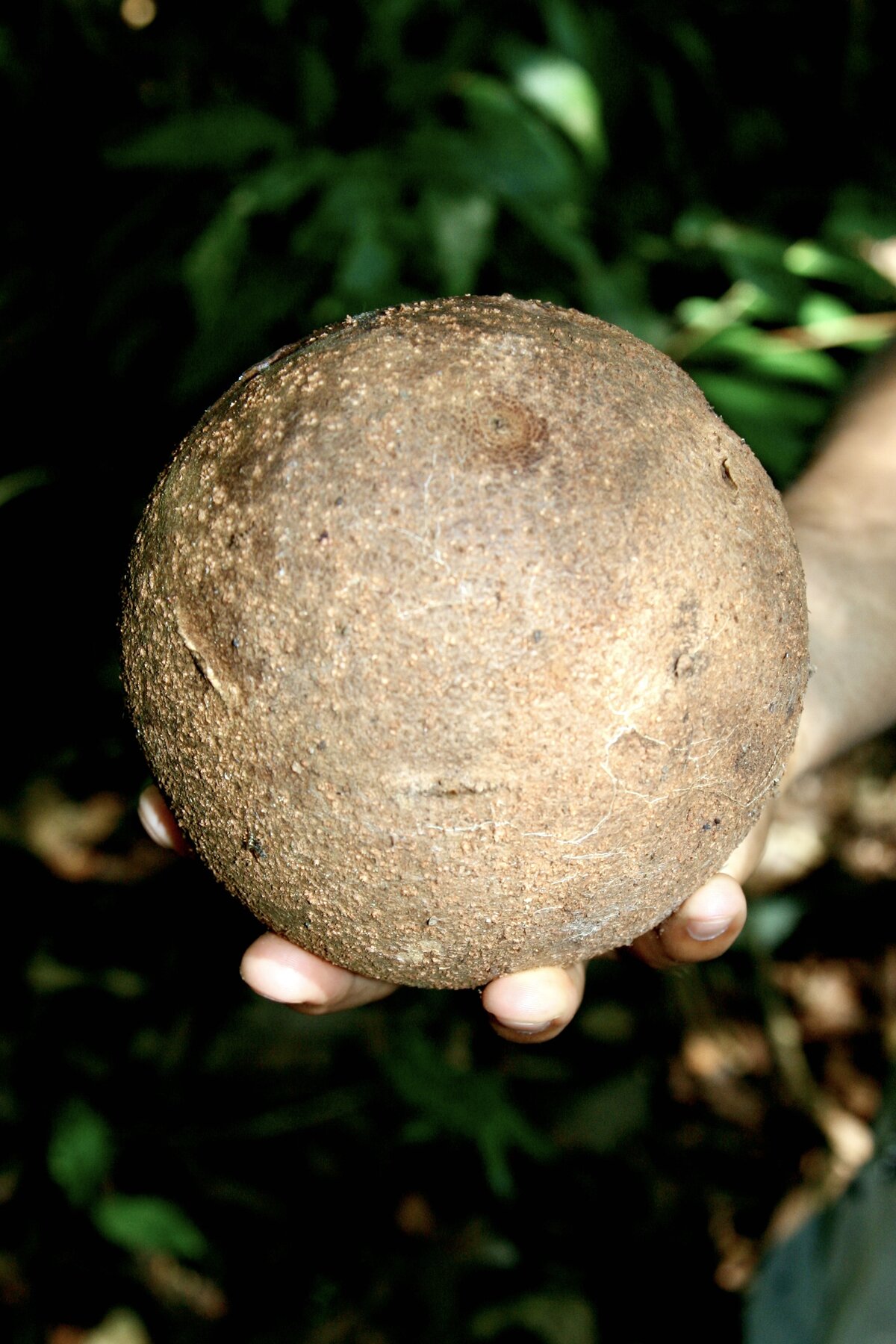
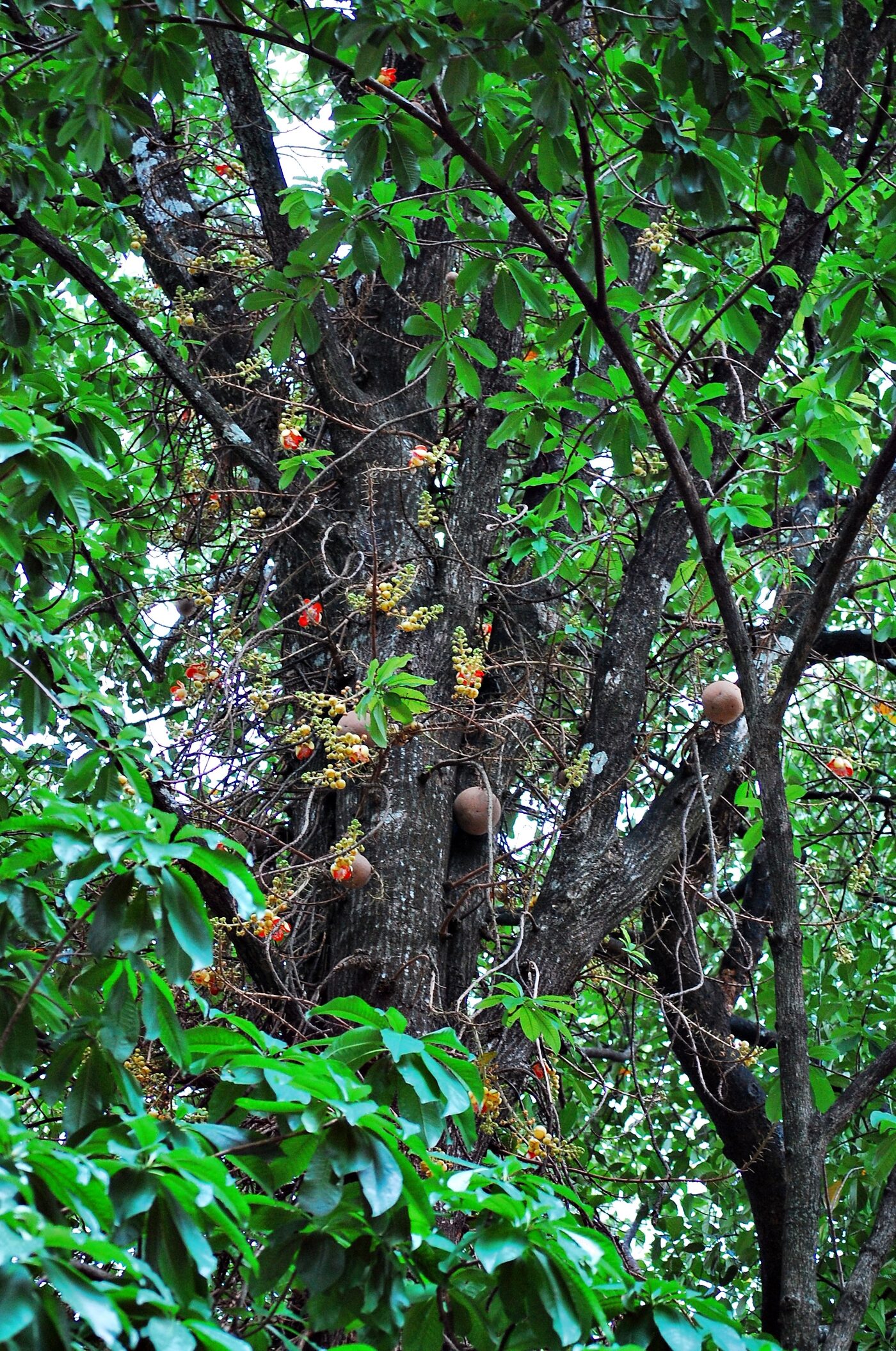
Cannonball trees are instantly recognizable when in fruit. Large, spherical, woody fruits cluster directly on the trunk and major branches, hanging on rope-like stalks that can persist for years. The fruits take 18-24 months to mature and may hang on the tree for two years before falling. They resemble rusty cannonballs, brown and rough-textured, typically 15-25 cm in diameter.
Cauliflory: Flowering on the Trunk
The cannonball tree exhibits cauliflory, a phenomenon where flowers and fruits emerge directly from the trunk and main branches rather than from branch tips. This is an adaptation to pollination by large-bodied animals. In the dense understory of tropical forests, flowers at branch tips may be inaccessible to heavy pollinators. Flowers on the trunk, by contrast, provide stable landing platforms.
The flowers themselves are spectacular: 8-12 cm across, with six waxy petals ranging from pink to orange-red, and a complex central structure of stamens. They are powerfully fragrant, especially at night, suggesting they evolved to attract both day-active bees and nocturnal visitors. Each flower lasts only a single day.
The Two-Pollen Deception
The flower's structure is a masterpiece of deception. Each flower has two distinct sets of stamens arranged in different positions:
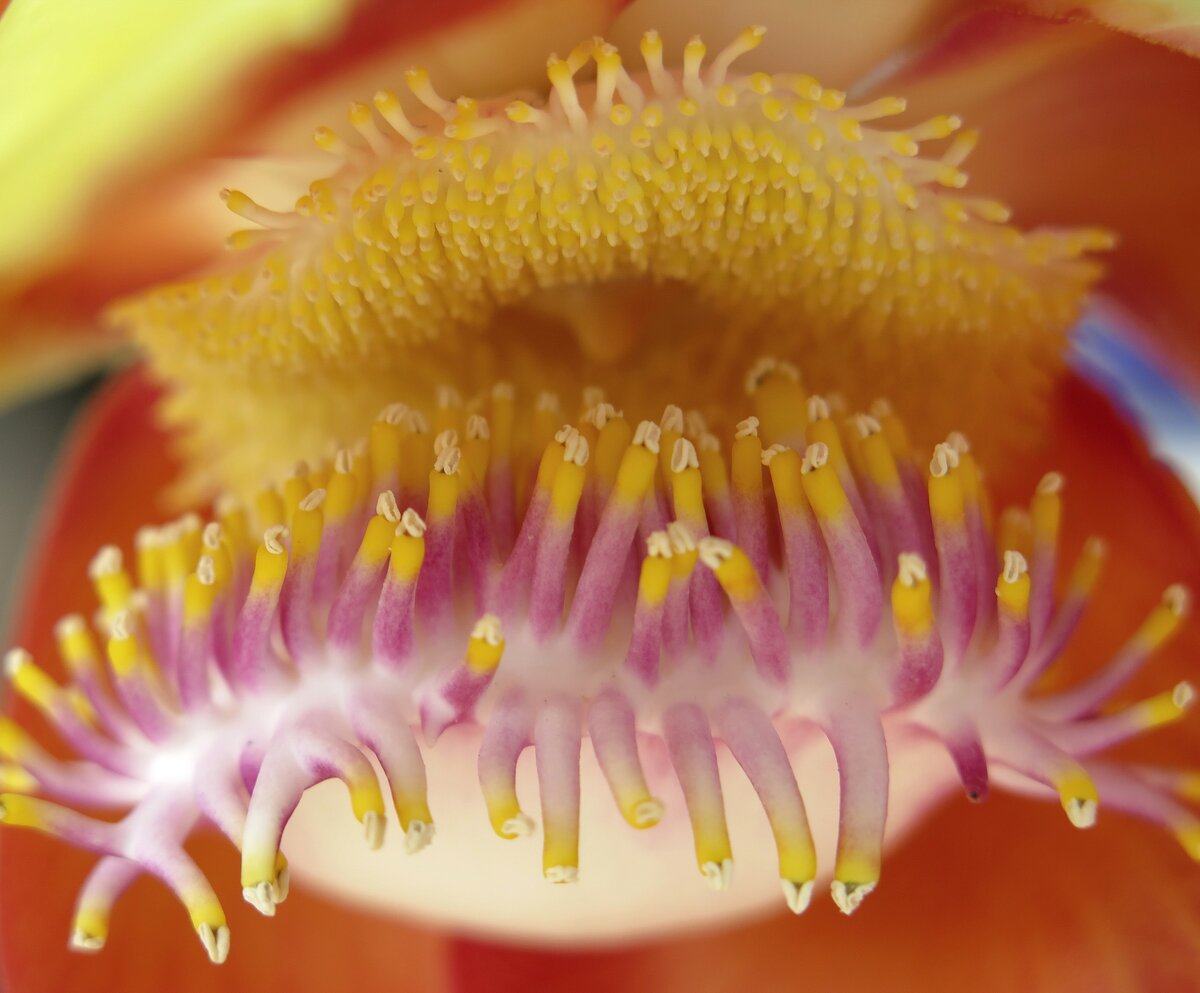
Studies have confirmed that nearly 100% of hood pollen is non-viable, while about 85% of ring pollen can germinate. The hood pollen is essentially fodder, a food reward that keeps pollinators coming back while contributing nothing to plant reproduction. The tree invests resources in producing pollen that will never fertilize anything, simply to attract bees.
Carpenter bees (Xylocopa species) are the primary pollinators. As a bee collects the attractive hood pollen, its back and head contact the ring stamens, picking up fertile pollen that will be deposited on the next flower visited. The tree also receives visits from bats, which may eat parts of the flower but also transfer pollen on their fur.
Dangerous Fruits
The cannonball fruits that give this tree its name are a genuine hazard. Weighing up to 6 kilograms and falling from heights of 20 meters or more, they can cause serious injury. The fruits hang on the tree for up to two years, then drop suddenly without warning. In areas where cannonball trees are planted as ornamentals, warning signs are sometimes posted beneath them.
When a fruit hits the ground, its woody shell typically cracks open, exposing the pulp and 200-300 seeds inside. The pulp has a distinctive and unpleasant odor that attracts seed dispersers. White-lipped peccaries and collared peccaries crack open intact fruits and consume the pulp and seeds. Pacas and agoutis also feed on fallen fruits. The seeds are covered in protective hairs that help them survive passage through animal digestive systems.
Habitat & Distribution
Couroupita guianensis has a "peri-Amazonian" distribution, occurring primarily around the edges of the Amazon basin rather than in its center. Its range extends from northern Bolivia and Brazil through the Guianas, Venezuela, Colombia, and Central America as far north as Costa Rica and Panama. In Costa Rica, the species occurs in lowland wet forests, typically below 500 meters elevation and often near rivers or in seasonally flooded areas. Trees have been documented in the South Pacific zone, including at Palmar Sur near the pre-Columbian stone spheres. However, the species has been so widely cultivated as an ornamental that distinguishing wild from planted populations can be difficult.
The tree grows quickly in cultivation, reaching 2.5 meters within two years, and has been widely planted as an ornamental throughout the tropics. Its spectacular flowers and strange fruits make it a popular botanical garden specimen. However, the falling fruit hazard limits its use as a street tree.
Traditional Uses
Despite the unpleasant odor of the fruit pulp, it is edible and has been used as a refreshing drink in parts of South America. The hard woody shells serve as containers and bowls. The flowers are used to make perfumes, and various parts of the tree have medicinal applications in traditional medicine, including treatment of skin conditions and use as an antiseptic.
A Family of Elaborate Flowers
The cannonball tree belongs to the Lecythidaceae, the Brazil nut family, which is known for complex flower structures and specialized pollinator relationships. Other members in Costa Rica include Lecythis ampla (olla de mono), whose pot-shaped fruits trap the hands of greedy monkeys in folklore, and Gustavia species with similar cauliflorous flowering. The family's elaborate flowers, with their hoods, rings, and asymmetric structures, represent some of the most sophisticated pollination mechanisms in the plant kingdom.
Key Sources & Resources
Species Information
Overview of the species with information on distribution, pollination, and cultural significance.
Detailed information on uses, cultivation, and ecology.
Specialized information on the species from the New York Botanical Garden's Lecythidaceae project.
Pollination Biology
Accessible explanation of the two-pollen deception and pollination mechanism.
Scientific study comparing pollen viability between hood and ring structures.