Canelo
Mespilodaphne veraguensis — Often the only member of the avocado family found in Costa Rica’s driest forests, this cinnamon-scented understory tree produces olive-like fruits in bright pink cupules that attract toucans and other forest birds.
Scratch the bark of the canelo and you will understand its name. The scent is unmistakably cinnamon-like, a reminder that this tree belongs to the same family as true cinnamon (Cinnamomum verum). The canelo stands out among Costa Rican laurels: it is often the only member of the Lauraceae found in the country's driest forests, including the North Pacific lowlands, where scorching heat and months without rain define half the year.
The Laurel That Escaped
The Lauraceae are quintessentially trees of humid forests. The 2007 Manual de Plantas de Costa Rica lists 146 species of Lauraceae in the country, including Ocotea, Nectandra, Persea, and their relatives, which overwhelmingly inhabit wet lowland forests, cloud forests, and montane rainforests. The canelo broke this pattern. Somehow, this species found its way into the seasonally dry forests of the North Pacific lowlands, Guanacaste, where temperatures soar and rain disappears for nearly half the year.
The key to the canelo's survival in dry forests may be its association with watercourses. Even in the driest regions, it tends to grow along stream banks and rocky hillsides where groundwater remains accessible. In these microhabitats, it can persist through the harsh dry season that would kill most of its relatives. The species also occurs in the humid forests of the Pacific slope and the Central Valley, where it grows in both primary forest edges and dark interiors.
A Name from Panama
The species takes its scientific name from Veraguas Province in Panama, where the type specimen was collected. Veraguas is Panama's only province with coastlines on both the Pacific and Caribbean, a geographic quirk that mirrors the canelo's own versatility. The province was named for an indigenous word, possibly meaning "goddess" or "strong woman," and was among the first regions of the American mainland explored by Columbus on his fourth voyage.
Across its range from Mexico through Central America into northwestern South America, the canelo goes by many names. In Costa Rica it is known as Canelo, Sigua Canela, or Aguacatillo. Panamanians call it Sigua Canelo. In Guatemala it becomes Pimentón, in El Salvador Canelito, in Honduras Aguacatillo, in Nicaragua Palo Colorado, and in Colombia Laurel Amarillo. This abundance of common names reflects both its wide distribution and the attention that humans have paid to its aromatic bark.
Identification
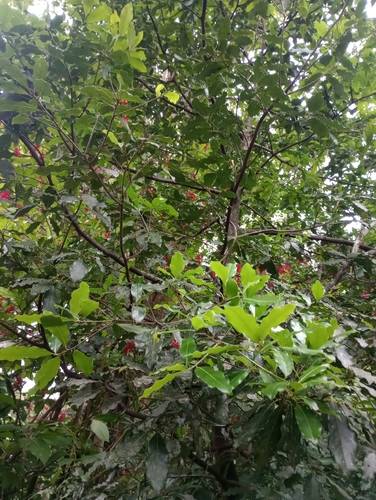
MundoForestal describes a mature canelo resembling an avocado tree, with a straight, cylindrical trunk, a round, dense crown, and bark that peels in large sheets. The Manuel Antonio account describes smooth gray bark and a narrow crown; the Guanacaste account describes rough, dark-brown bark. The Manuel Antonio account describes an understory tree 5–10 meters tall, while other Costa Rican records describe forest trees around 25 meters and occasionally up to 40 meters.
Physical Characteristics
Leaves: Simple, alternate, thick and leathery. The Manuel Antonio account describes elliptical leaves 10–17 cm long and 4–6 cm wide, with small drip tips around 1 cm and petioles around 0.5 cm; the national flora records broader variation and usually blunt or slightly pointed tips. In the Manuel Antonio account, new foliage appears sporadically throughout the year but peaks around January, just before flowering. As in many Lauraceae, the leaves are aromatic when crushed.
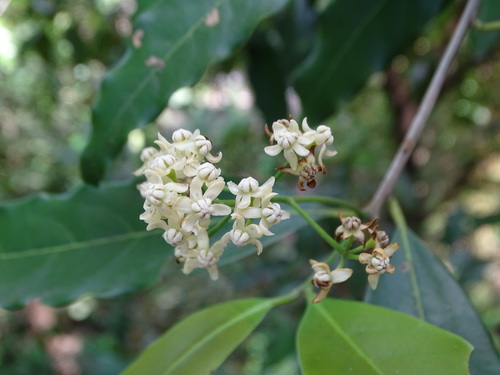
Flowers: Off-white, produced in terminal panicles of about 10 blossoms each. At Manuel Antonio, the flowers are described as about 1.5 cm across; the national flora gives their diameter as 5–10 mm. The flowers consist of six thick, pubescent tepals with six smaller petal-like appendages covering the center where stamens and pistil reside. In the Manuel Antonio account, flowering peaks from February through April, with sporadic blooms through September. Other Costa Rican records document flowering from January through May and July through December. When blossoms are abundant, they emit a strong, pungent odor that can be detected from some distance.
Fruits: The canelo's most distinctive feature is its fruit: an olive-shaped drupe about 3 cm long, initially green and maturing to black or dark blue. The drupe sits in a cup-shaped cupule approximately 2 cm in diameter, colored bright pink or red with an undulating rim. This colorful display attracts fruit-eating birds, including toucans. At Manuel Antonio, fruits ripen from July through early October; in Guanacaste, ripening begins in March or April and continues to June or July.
Ecology
The pungent flowers of the canelo attract insects for pollination, while its colorful fruits attract birds and mammals for seed dispersal. Toucans are particularly drawn to the bright pink cupules and dark fruits, swallowing the drupes whole and dispersing the seeds away from the parent tree. The combination of aromatic flowers and fleshy fruits makes the canelo valuable for wildlife, providing resources across multiple seasons.
The locally variable fruiting season, spanning July through early October in Manuel Antonio and March or April into June or July in Guanacaste, provides food during a critical time when many other species are not fruiting. In Manuel Antonio National Park, scattered canelo trees grow alongside major trails, in forest interiors, and by streams.
Chemistry and Research
The cinnamon-like aroma of the canelo's bark reflects its chemical kinship with true cinnamon. Scientific analysis of its leaf essential oils has revealed a complex mixture of compounds, dominated by oxygenated sesquiterpenes (58.8%) and non-oxygenated monoterpenes (27.5%). The most abundant compounds are bulnesol (29.5%) and p-cymene (19.8%). This chemical profile is distinctive; p-cymene is uncommon among related species, setting the canelo apart from its relatives in cluster analyses.
Research on the biological activities of Lauraceae essential oils has found that the canelo shows promising cytotoxic activity against certain cancer cell lines. In laboratory studies, the leaf essential oil was particularly effective against estrogen receptor-negative breast cancer cells (MDA-MB-231), achieving 93% cell death at a concentration of 100 μg/mL. It also showed activity against other mammary adenocarcinoma cells (MDA-MB-468) and melanoma cells. While these are preliminary laboratory findings, they highlight the potential pharmacological interest in this species.
A New Genus: How DNA Rewrote the Family Tree
For most of the 20th century, the canelo was known as Ocotea veraguensis. Ocotea is one of the largest genera in the Lauraceae, with some 400 species spread across the tropics. But taxonomists questioned which species belonged together under that name. Taxonomists had long suspected that Ocotea was what they call "paraphyletic," a polite way of saying it was a grab-bag of species that did not actually form a natural group. Some species placed in Ocotea were more closely related to species in other genera than they were to each other.
The problem was that early taxonomists had only physical features to work with: leaf shape, flower structure, fruit characteristics. These traits can be deceiving. Evolution sometimes produces similar features in unrelated lineages (convergent evolution), while closely related species can look surprisingly different. DNA sequencing gave taxonomists a powerful new way to test relationships inferred from physical features.
In 2019, Dimitrij Trofimov, Pedro L. R. de Moraes and Jens G. Rohwer published a molecular study that took a further step toward reorganizing Ocotea. By analyzing DNA sequences from over 120 species, they identified several groups that were genuinely monophyletic: each descended from a single common ancestor. One of these was the "Ocotea dendrodaphne group," a cluster for which the 2019 treatment recognized eight species with distinctive features: tongue-shaped, heavily papillose stamens, and fruits seated in double-rimmed cupules. The canelo was among them.
The researchers reinstated an old genus name, Mespilodaphne, which had been created by the German botanist Christian Gottfried Nees von Esenbeck in 1833 but later folded into Ocotea. The canelo thus became Mespilodaphne veraguensis. It now belongs to a smaller, more coherent genus of just nine species, all sharing the same evolutionary heritage and the same distinctive floral anatomy.
The name change places the canelo among its closest relatives. The nine Mespilodaphne species share an ancestor that the other 390-odd Ocotea species do not. They are a true lineage, not an artificial assemblage. The double-rimmed cupules that hold the canelo’s pink-capped fruits help identify the genus, alongside the distinctive stamens. How the double-rimmed cupules evolved remains uncertain.
Uses
The aromatic bark, reminiscent of cinnamon, gives the tree its common name. Whether the bark has historically been used as a cinnamon substitute is unclear, though the resemblance has certainly not escaped notice across its range. The wood is very dark brown, cross-grained and close-grained, hard, moderately heavy, strong, tough, and durable. It is reportedly easy to work and suitable for furniture and veneers, though the tree's typically small size and scattered distribution limit commercial timber applications.
Conservation
The canelo is not currently listed as threatened. The species ranges from Mexico into northwestern South America and occupies several forest types, but local populations can decline: a San Emilio census study reported a reduction in its abundance and biomass between 1976 and 1996. The species occurs in numerous protected areas across its range, including Manuel Antonio National Park and the Área de Conservación Guanacaste in Costa Rica. Its tolerance of disturbed habitats and forest edges may provide additional resilience in landscapes modified by human activity.
The species' occurrence as often the only Lauraceae in Costa Rica's driest areas makes it of particular ecological interest. As climate change shifts rainfall patterns across Central America, understanding how the canelo succeeded in colonizing dry habitats may offer insights into the adaptive potential of its family. Yet the San Emilio decline shows why a wide range and varied habitats cannot, by themselves, tell us how a population is faring within a particular forest.
Resources & Further Reading
Species Information
Detailed species account with identification features, phenology, and ecological notes.
Comprehensive information on habitat, uses, and wood properties.
Spanish-language account of the canelo's unique adaptation to dry forests.
Citizen science observations and photographs from across the species range.
Records from Panama, the type locality for this species.
The Lauraceae treatment documents the species' morphology, habitats, and elevation range; the link leads to the volume's publication notice.
Regional observations of deciduous habit, bark, flowering, and fruiting in Guanacaste.
Field guide with identification traits for Lauraceae, including variation in leaf scent.
Botanical descriptions from southern Costa Rica, including canelo's forest stature; linked bibliographic record.
San Emilio forest censuses document local changes in canelo abundance and biomass between 1976 and 1996.
Taxonomy
The molecular study by Trofimov, De Moraes & Rohwer that transferred the canelo from Ocotea to Mespilodaphne.
Current taxonomy and list of all nine Mespilodaphne species.
Explains how anatomical and molecular evidence help distinguish shared ancestry from convergence.
Chemistry and Research
Original laboratory study; Table 1 reports canelo leaf oil's effects on cultured cancer cells.
Chemical analysis including O. veraguensis, documenting its distinctive p-cymene content.
Review of Ocotea essential oil research including cytotoxic activity studies.