Cafetillo Bracteoso
Bertiera bracteosa is a shrub or small tree of wet lowland forests from Nicaragua to Ecuador. Distinguished by its connate stipules that form a distinctive sheath around the stem, this Rubiaceae species thrives in the understory of primary and secondary forests throughout Costa Rica's Pacific and Caribbean slopes.
Bertiera bracteosa belongs to a predominantly African genus that has only about five representatives in the Neotropics. The genus Bertiera contains roughly 55 species, most occurring in tropical Africa, Madagascar, and the Mascarene Islands, making this Central American species part of a small outlier population. The species has had a complex taxonomic journey, passing through four different genera since its original description in 1902: Gonzalea (Donnell Smith), Gonzalagunia (Robinson), Duggena (Standley), and finally Bertiera (Ståhl & Andersson) in 1999. This taxonomic instability reflects the challenges botanists faced in placing a Neotropical species within a predominantly Old World lineage.
Identification
Bertiera bracteosa grows as an understory shrub or small tree, typically reaching 1-4 meters in height. The plant is characterized by its hairy young stems and branches, which give it a somewhat soft, pubescent appearance when young. Unlike many larger Rubiaceae species that become canopy trees, this species remains in the shaded forest understory throughout its life.
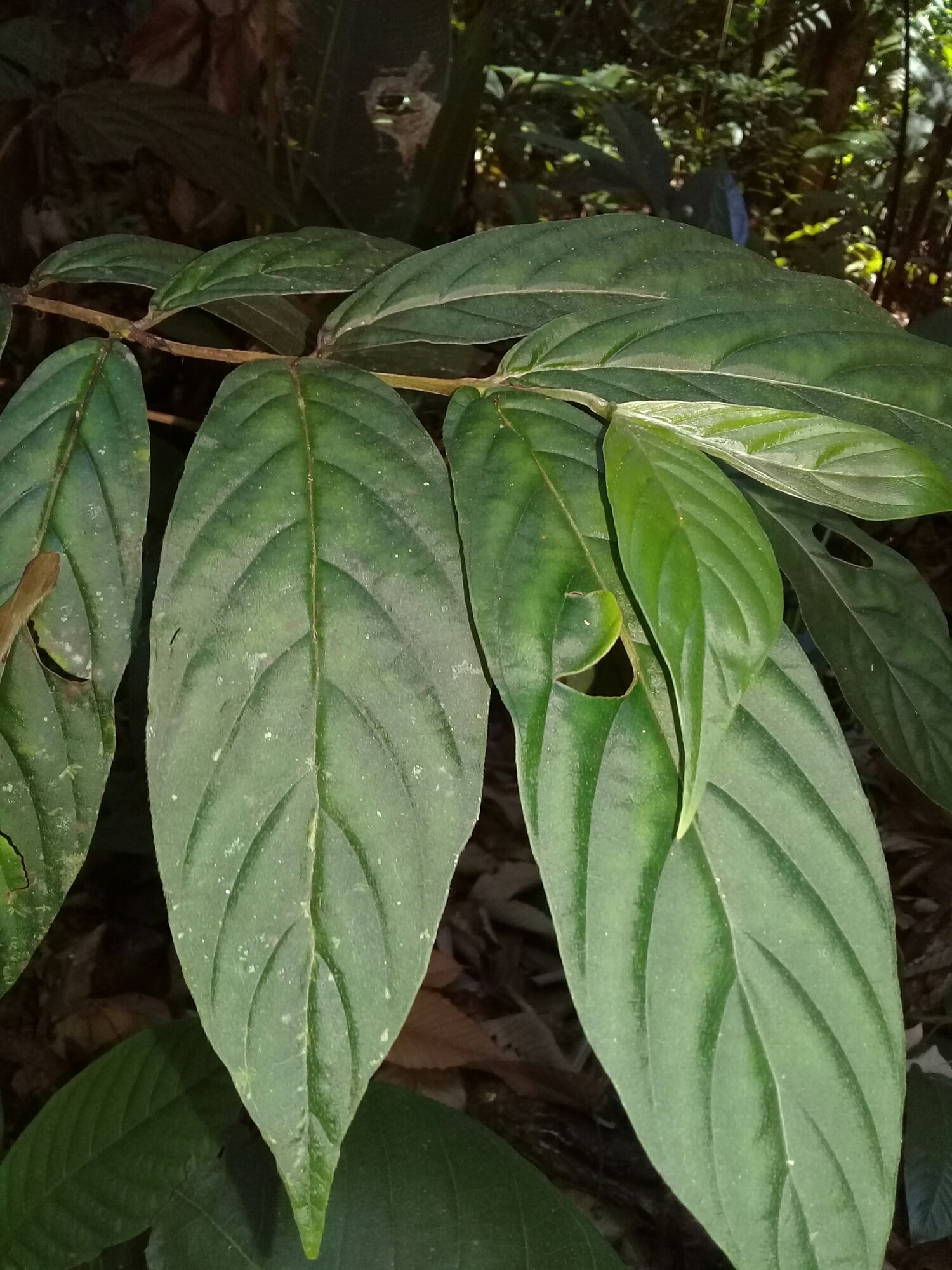
Twigs and Stipules
The most distinctive feature of Bertiera bracteosa is its stipules, small leaf-like appendages that occur in pairs at the base of each leaf where it meets the stem. In this species, the stipules are partially connate (fused together), forming a sheath that wraps around the stem at each node. This connate stipule structure is a key diagnostic character of the Rubiaceae family and helps distinguish B. bracteosa from other similar shrubs. The young stems are densely covered with fine hairs, giving them a soft, velvety texture.

Leaves
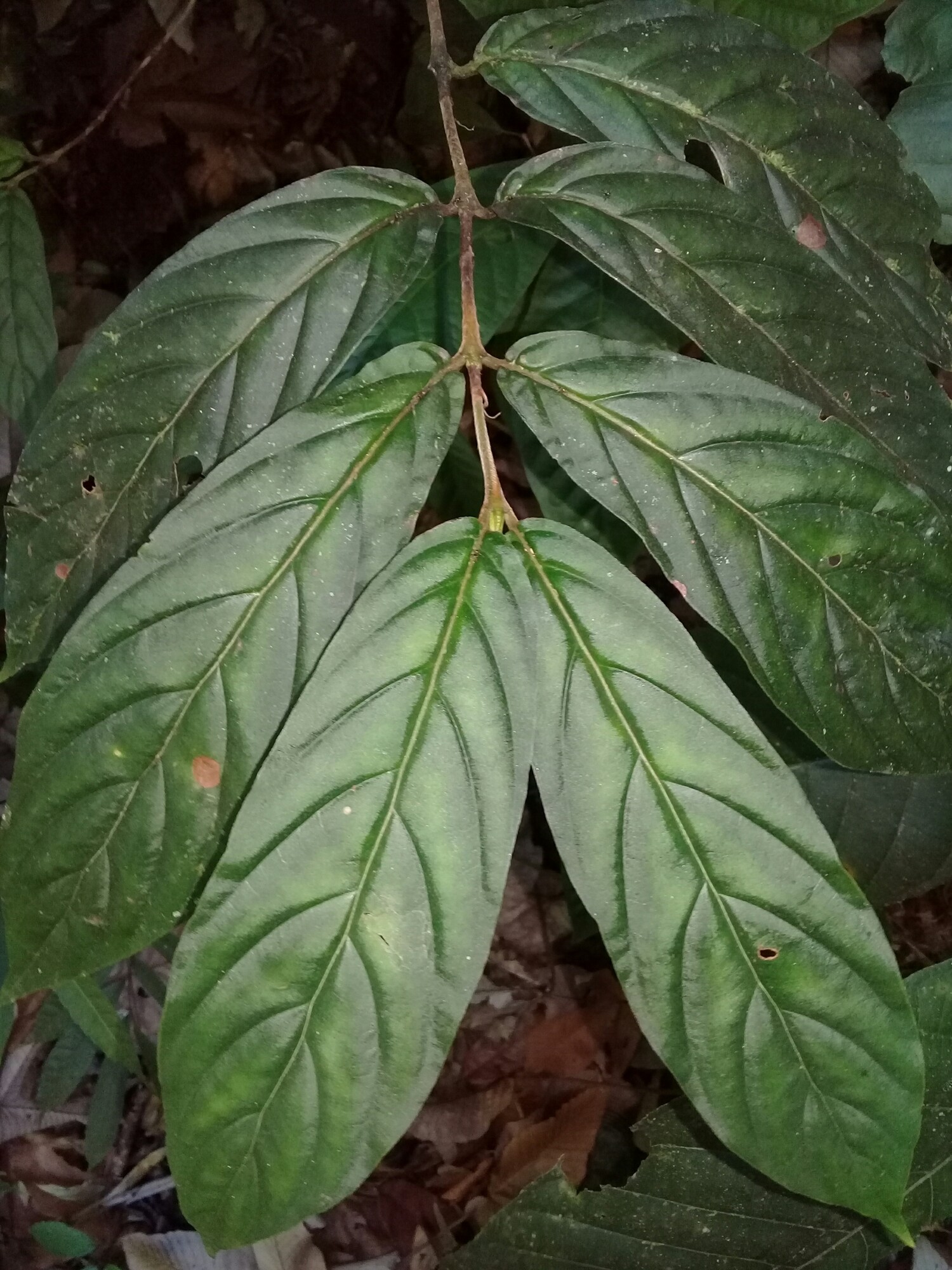
The leaves are opposite and simple, elliptic to oblong in shape, measuring 10-20 cm long and 4-8 cm wide. The upper surface is medium to dark green with prominent venation, while the underside is notably paler, sometimes appearing almost whitish. Both surfaces bear some pubescence, particularly along the veins. The leaf margins are entire, and the petioles are relatively short.

Flowers and Fruits
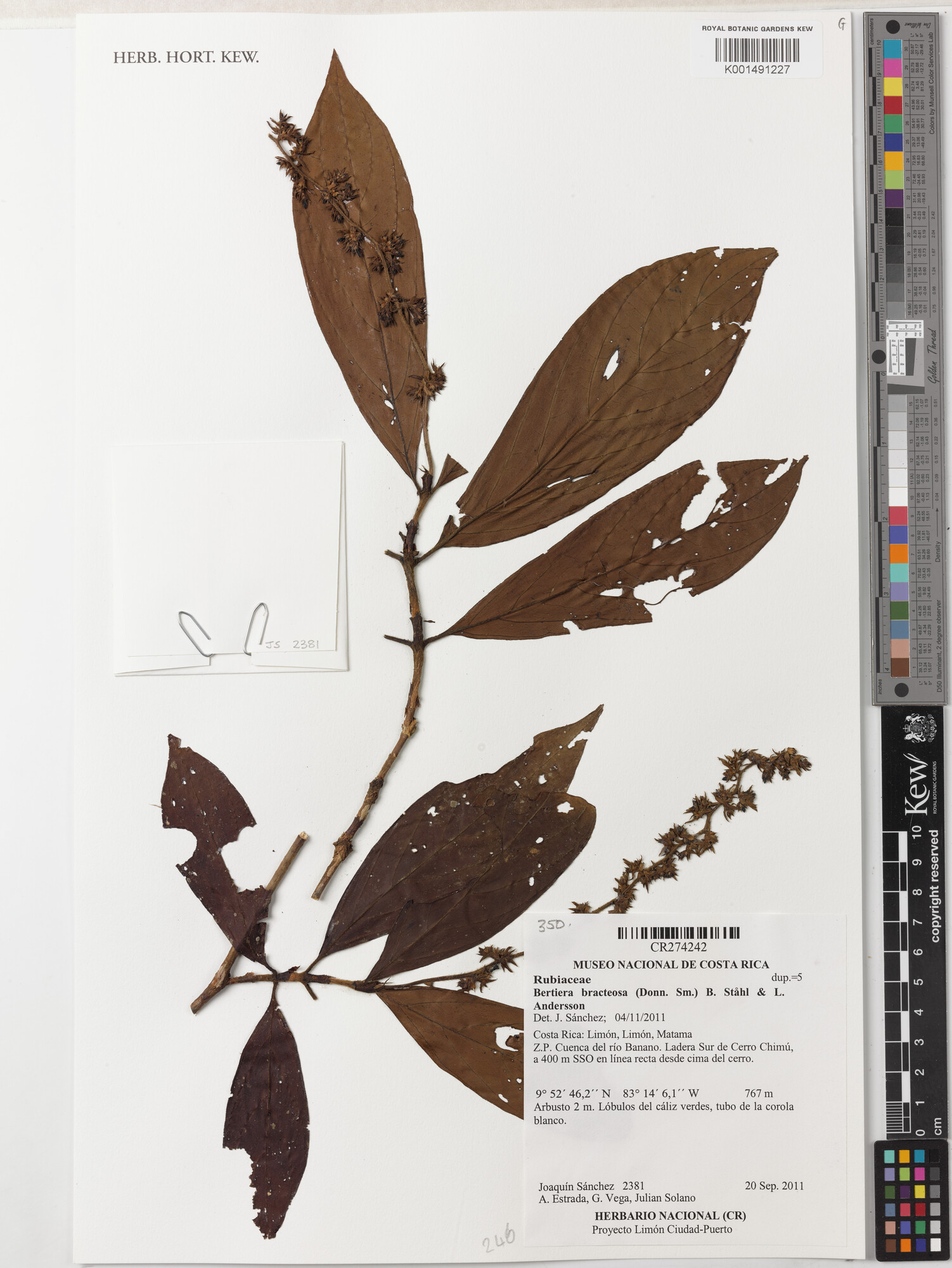
The flowers are small and white, borne in axillary cymes (branched clusters arising from the leaf axils). The corolla is tubular with spreading lobes, typical of the coffee family. The specific epithet "bracteosa" refers to the conspicuous bracts associated with the inflorescence. The fruits are small berries that turn dark when ripe, containing multiple seeds.
Distribution
Bertiera bracteosa ranges from Nicaragua through Costa Rica and Panama, continuing south through Colombia to northwestern Ecuador. A disjunct population also occurs in the Brazilian state of Roraima. The species occurs from sea level to 1,700 meters elevation across this range, though most records come from below 850 meters in very wet lowland forests.
In Costa Rica, the species is widely distributed across all provinces on both Caribbean and Pacific slopes. GBIF documents 497 records from Costa Rica (76.5% of the global total of 650 records) representing 151 unique localities, from La Selva Biological Station on the Caribbean slope to Guanacaste's conservation areas and the Osa Peninsula. This concentration of records in Costa Rica likely reflects both genuine abundance in the country's well-preserved wet forests and the exceptional botanical collecting infrastructure established through INBio and collaborations with international institutions, rather than indicating Costa Rica as the sole center of abundance for the species.
Ecology
Bertiera bracteosa is strictly an understory species, thriving in the deep shade of wet tropical forests. It is typically found in primary forest but also persists in mature secondary growth where canopy closure is sufficient to maintain shaded conditions. The species appears to require high humidity and consistent moisture, explaining its preference for very wet forest types.
The small berries are likely dispersed by birds and small mammals that forage in the forest understory. As with many understory Rubiaceae, the white tubular flowers suggest pollination by small insects, possibly including small bees and flies that operate in low-light conditions.
Taxonomic History
The species was originally described as Gonzalea bracteosa by John Donnell Smith in 1902, based on material from Costa Rica collected by A. Tonduz. The genus Gonzalea was later merged into Gonzalagunia, and the species appeared in literature as Gonzalagunia bracteosa for many years. Subsequently, it was transferred to Duggena as Duggena bracteosa.
The current placement in Bertiera follows the work of B. Ståhl and L. Andersson, who recognized that this species belongs to the primarily African and Malagasy genus Bertiera rather than to the exclusively neotropical Gonzalagunia or Duggena. This represents one of the relatively few Bertiera species native to the Americas. A synonym from Panama, Bertiera oligosperma, has also been placed in synonymy with this species.
Conservation Outlook
Bertiera bracteosa has not been formally assessed by the IUCN Red List. However, its relatively broad distribution from Nicaragua to Ecuador, combined with its presence in both primary and secondary forests, suggests the species is not immediately threatened. The strong representation in Costa Rica's protected areas, particularly Corcovado National Park and Piedras Blancas National Park, provides important habitat security.
As an understory specialist requiring wet forest conditions, the species is vulnerable to deforestation and forest degradation that opens the canopy. Climate change scenarios projecting reduced rainfall in some Central American regions could also affect suitable habitat in the future. Maintaining intact wet forest corridors in the Brunca region remains important for the long-term persistence of this and other understory specialists.
Resources & Further Reading
Species Information
Kew's authoritative database with accepted name, synonymy, and global distribution.
Occurrence records and specimen data from herbaria worldwide.
Costa Rican species account with local distribution data.
Regional Resources
Field documentation from 1998 with photos and description of bark, flowers, and fruits. Listed under the synonym Gonzalagunia bracteosa.
Taxonomy & Nomenclature
Missouri Botanical Garden's nomenclatural database with complete synonymy and publication details.
Official nomenclatural record with full publication details and synonymy.
Research & Publications
Academic article discussing genus phylogeny and recent taxonomic revisions of Bertiera.
Ramirez-Barahona (2023) on botanical sampling bias in Central America, explaining Costa Rica's exceptionally high representation in occurrence databases.
Comprehensive 2014 treatment of Costa Rica's Rubiaceae (458 species, 89 genera).
Historical Context
Biography of the botanist who originally described this species in 1902. Confederate artillery captain wounded at Gettysburg who later devoted himself to Central American botany.
The original publication by John Donnell Smith describing Gonzalea bracteosa.