Balsa
Ochroma pyramidale — The world's lightest commercial wood comes from a tree that grows faster than almost any other, lives fast, and dies young. From Thor Heyerdahl's Kon-Tiki raft to modern wind turbine blades, balsa has shaped human history while kinkajous feast on its nectar-filled flowers.
In April 1947, a balsa raft named Kon-Tiki slipped into the Pacific Ocean from the coast of Peru. Norwegian explorer Thor Heyerdahl and five companions were attempting to prove that ancient South Americans could have colonized Polynesia. For 101 days they drifted across 6,900 kilometers of open ocean, finally crashing onto a reef in the Tuamotu Islands. The raft held together. The nine balsa logs that formed its hull, lashed with hemp ropes in the traditional style, had carried them safely across the largest ocean on Earth.
Heyerdahl chose balsa for good reason. The wood is so light it floats even when waterlogged. Density ranges from 40 to 160 kg/m³, making it the lightest commercial hardwood in the world. Yet despite this featherweight quality, balsa possesses remarkable strength for its weight, a property that would make it essential for aircraft construction during World War II and, decades later, for the blades of wind turbines.
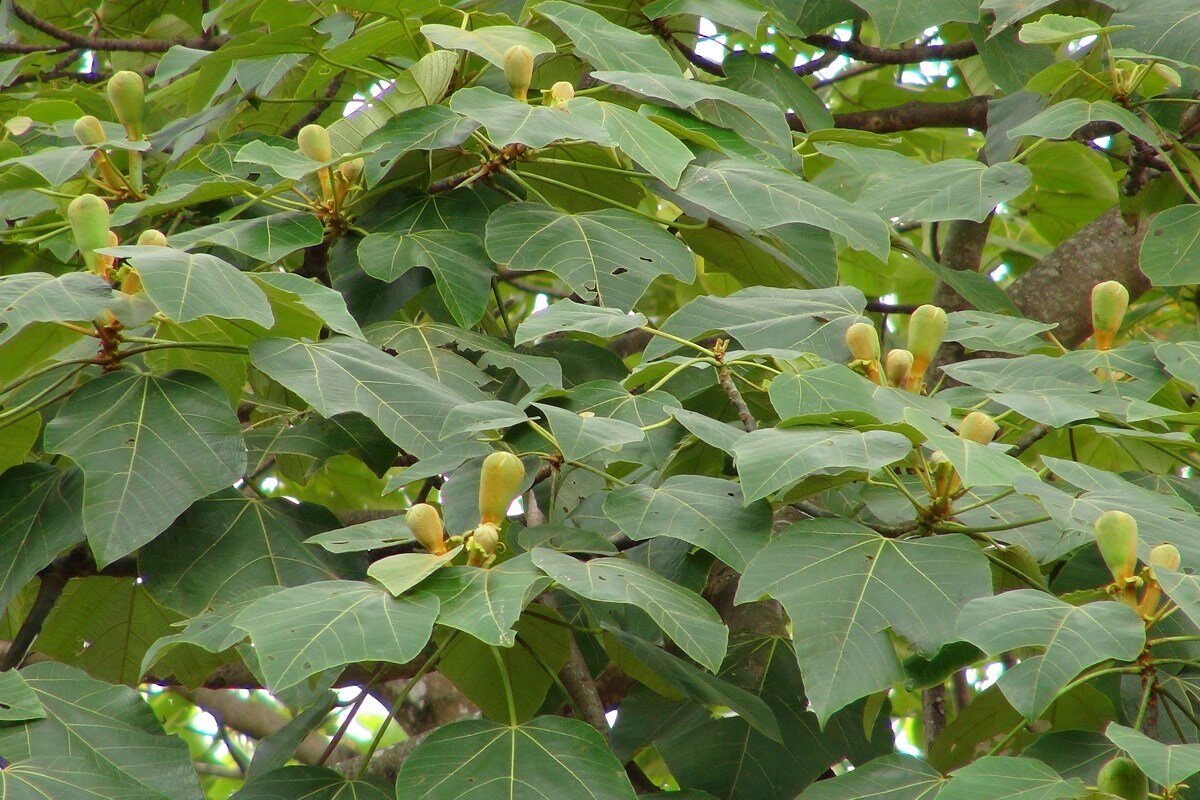
Identification
The name "balsa" comes from the Spanish word for "raft," reflecting the tree's ancient connection to watercraft. It is the sole species in the genus Ochroma, classified in the family Malvaceae alongside cotton, cacao, and the ceiba. In Costa Rica, local names include "enea" and "pung."
Physical Characteristics
Trunk: Cylindrical and remarkably straight, reaching up to one meter in diameter. The bark is smooth and light gray to whitish. Unlike many tropical giants, balsa trees lack buttress roots entirely. The trunk's interior contains soft, lightweight wood with a distinctive cellular structure that makes it both buoyant and strong relative to its weight.
Crown: Narrow and thin compared to the tree's height, with relatively few thick branches. This sparse architecture allows light to penetrate, consistent with balsa's role as a pioneer species that colonizes open areas rather than competing in closed-canopy forest.
Leaves: Large, simple, and alternately arranged, measuring approximately 30 cm across with long petioles (leaf stalks) of similar length. The blades are shallowly lobed and have a distinctive rough, sandpapery texture due to tiny reddish hairs on the surface. Growth continues nearly year-round, slowing only during the dry season.
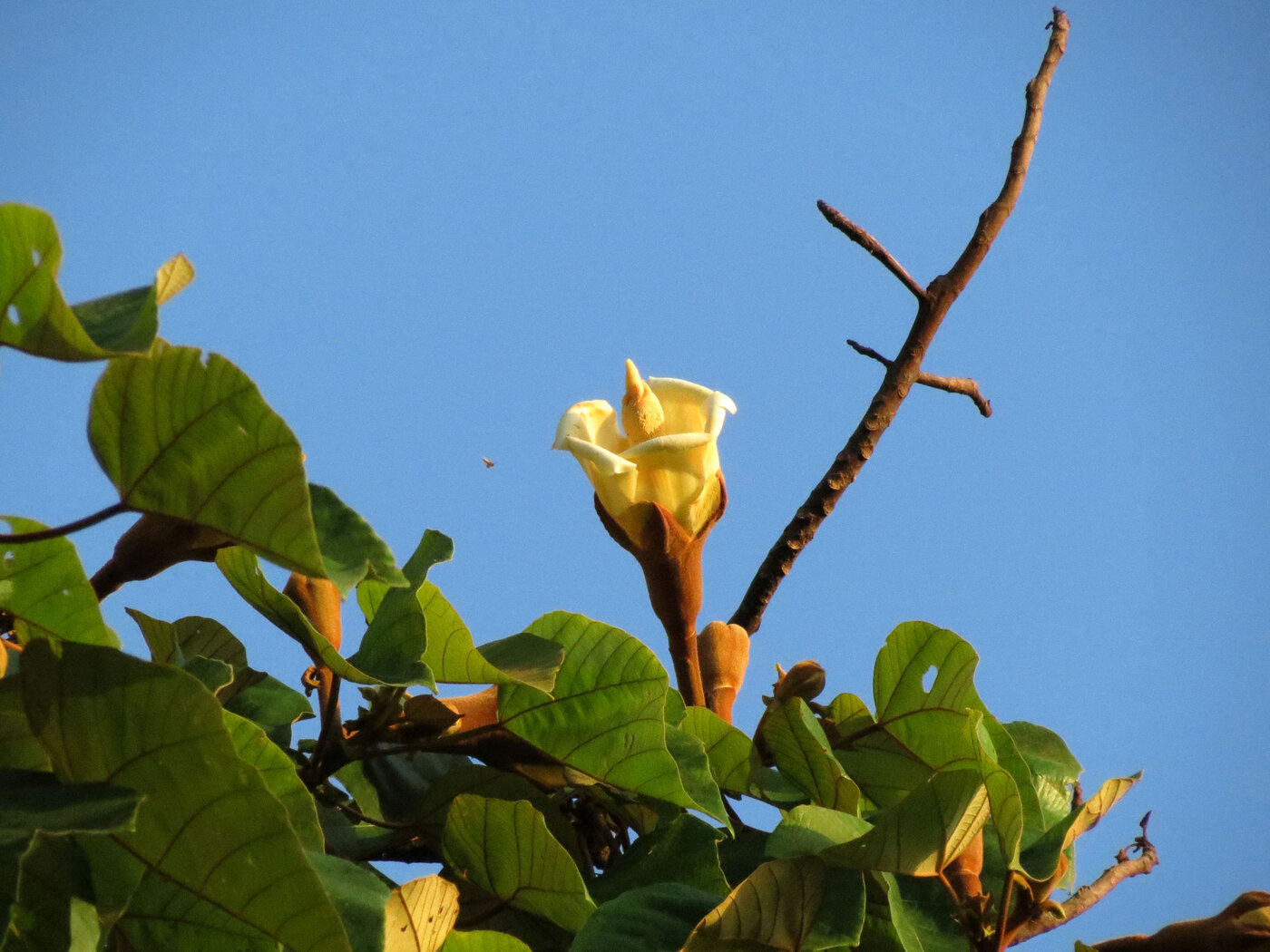
Flowers: Among the most spectacular of any tropical tree. Unopened flower buds resemble velvety ice-cream cones, measuring up to 12 cm long. When they open in late afternoon, five large, thick petals bend backward to reveal a fleshy center packed with hundreds of short stamens. The petals start creamy white, then transition through yellow to burgundy over several days. Each flower produces copious nectar, with pools up to 2.5 cm deep forming inside.
Fruits: Develop from the thick flower calyx as long, ridged green pods measuring about 20 cm long and 3 cm wide. At maturity, the pods split lengthwise to release tan-colored kapok-like fluff containing small seeds just 3-4 mm across. The opened fruit resembles a large rabbit's foot. The cotton has been traditionally used as stuffing material for pillows and insulation.
Kinkajous, Olingos, and the Night Shift
For decades, textbooks stated that bats pollinate balsa flowers. The flowers open at dusk, produce massive quantities of nectar, and remain open through the night. The large, sturdy structure seems designed for bat visitors. But recent research in Panama has upended this assumption.
Scientists recorded 22 vertebrate species visiting balsa flowers, including 13 diurnal birds, two diurnal mammals, five nocturnal non-flying mammals, and at least two bat species. The most frequent visitors were not bats but kinkajous (Potos flavus), the golden-furred procyonids related to raccoons. These arboreal mammals climbed through the branches night after night, plunging their long tongues into the nectar pools and emerging with pollen-dusted faces.
The research revealed that nocturnal mammals, not bats, may be the primary pollinators. Kinkajous and olingos carried heavy pollen loads on their fur, while bats carried relatively little. The scientists proposed that balsa benefits from attracting both groups: bats carry small pollen loads over large distances, while the climbing mammals deposit large pollen loads on nearby trees. During the day, capuchin monkeys also visit the flowers.
Live Fast, Die Young
The balsa is nature's sprinter among trees. A seedling that germinates in a forest gap can reach 7 meters tall with a trunk 15 cm in diameter within just three years. Under ideal conditions, trees grow to 27 meters in 10 to 15 years. Some individuals begin flowering in their second year. This breakneck pace comes at a cost: balsa trees rarely live beyond 30 to 40 years, an eyeblink compared to the centuries-long lifespans of climax forest species.
This strategy suits a pioneer species perfectly. When a tree falls in the forest, creating a gap in the canopy, balsa seeds waiting in the soil spring to life. They need high soil temperatures and direct sunlight to germinate. Once started, their rapid growth allows them to claim the gap before slower-growing species can compete. Eventually, shade-tolerant trees overtop the balsa, which cannot reproduce in the shade it helped create. The balsa dies, its mission complete, having converted bare ground to forest in a single human generation.
Habitat & Distribution
The balsa ranges from southern Mexico through Central America to Bolivia, and throughout the West Indies. In Costa Rica, it is one of the most common trees in lowland disturbed habitats on both the Pacific and Caribbean coasts. You will find it along roadsides, in secondary forests, on the flanks of steep cliffs where landslides clear vegetation, and in abandoned agricultural fields.
Ecosystem: Secondary forest, forest gaps, roadsides, landslide scars, and abandoned fields. Balsa thrives in disturbed sites with full sunlight and tolerates shallow, droughty, and infertile soils where most primary forest species cannot survive.
Elevation: Sea level to approximately 1,000 meters. Most abundant in lowland humid tropics.
Climate requirements: Best growth occurs with annual rainfall of 2,500-3,000 mm, though the tree tolerates 1,500-4,000 mm. It can withstand a dry season of up to four months if humidity remains above 75%. Optimal temperatures range from 18-35°C.
Seeds on the Wind
Balsa flowering occurs from December through February, during the dry season when few other trees bloom. Fruits mature from mid-January through early April. When the long pods split open, they release clouds of kapok-like cotton bearing tiny seeds. The wind carries these seeds across cleared areas and forest gaps, depositing them exactly where the sun-loving balsa needs them to be.
The seeds can also travel by water, their buoyant fibers keeping them afloat. This allows balsa to colonize riverbanks and floodplains. Once deposited, seeds require specific conditions to germinate: high soil temperature and direct sunlight. They can remain dormant in forest soil for years, waiting for a treefall gap or human disturbance to provide the light they need.
From Rafts to Wind Turbines
The properties that make balsa wood remarkable, its combination of extreme lightness and high strength-to-weight ratio, have made it valuable to humans for centuries. Indigenous peoples of South America built rafts from balsa logs long before European contact. The Spanish conquistadors recorded these vessels, some large enough to carry significant cargo along the Pacific coast.
During World War II, balsa became strategically important. The British de Havilland Mosquito, one of the fastest aircraft of the war, used balsa in its construction. The lightweight wood allowed designers to create a fast, maneuverable plane from materials that did not compete with aluminum needed for other aircraft. Model aircraft enthusiasts have used balsa for decades, and it remains the material of choice for radio-controlled planes.
Today, the largest consumer of balsa wood is the wind energy industry. The cores of wind turbine blades require a material that is both lightweight and structurally sound. Modern blades can reach 100 meters in length, and each may contain 150 cubic meters of balsa wood. Ecuador supplies more than 90% of the world's commercial balsa, and demand has surged with the growth of wind power. This has raised concerns about sustainable harvesting and the pressure on natural populations.
Conservation and Restoration
The balsa faces no conservation threat. Its ability to colonize disturbed habitats, its rapid growth, and its prolific seed production ensure that it thrives wherever humans have altered the landscape. In fact, balsa populations have likely increased since European colonization, as forest clearing created the open, sunny habitats it prefers.
This makes balsa valuable for ecological restoration. When degraded lands need to be converted back to forest, balsa is among the first species to establish. Its rapid growth provides quick canopy cover, moderating temperatures and creating conditions for slower-growing forest species to establish beneath. Within a few decades, the balsa will be overtopped and will die, but by then it will have served as the nursery for a new forest.
In the Osa Peninsula and surrounding regions of Costa Rica's southern Pacific slope, balsa appears wherever forest has been disturbed. It lines roadsides, fills gaps left by fallen trees, and colonizes abandoned pastures. For visitors, it is one of the most common large trees encountered outside primary forest, its distinctive pale trunk and large leaves visible from a distance.
Key Sources & Resources
Species Information
Detailed species account including phenology, identification features, and distribution in Costa Rica.
Species profile from the Osa Peninsula region with ecological and restoration information.
General overview of the genus including taxonomy, distribution, and uses.
Information on balsa wood properties, commercial production, and applications.
Pollination Research
Research documenting 22 vertebrate species visiting balsa flowers, including the surprising role of kinkajous as primary pollinators.
Wood Properties & Uses
Overview of balsa wood properties and commercial applications.
Technical specifications for balsa wood including mechanical properties and processing characteristics.
Wind Energy & Sustainability
Analysis of balsa demand from the wind energy industry and sustainability concerns.