Wine Palm
A towering palm with vertical "rooster-tail" fronds that hosts the primary vector of Chagas disease in the Orinoco region. Indigenous peoples extract wine from its sap and use its parts in 36 documented ways.
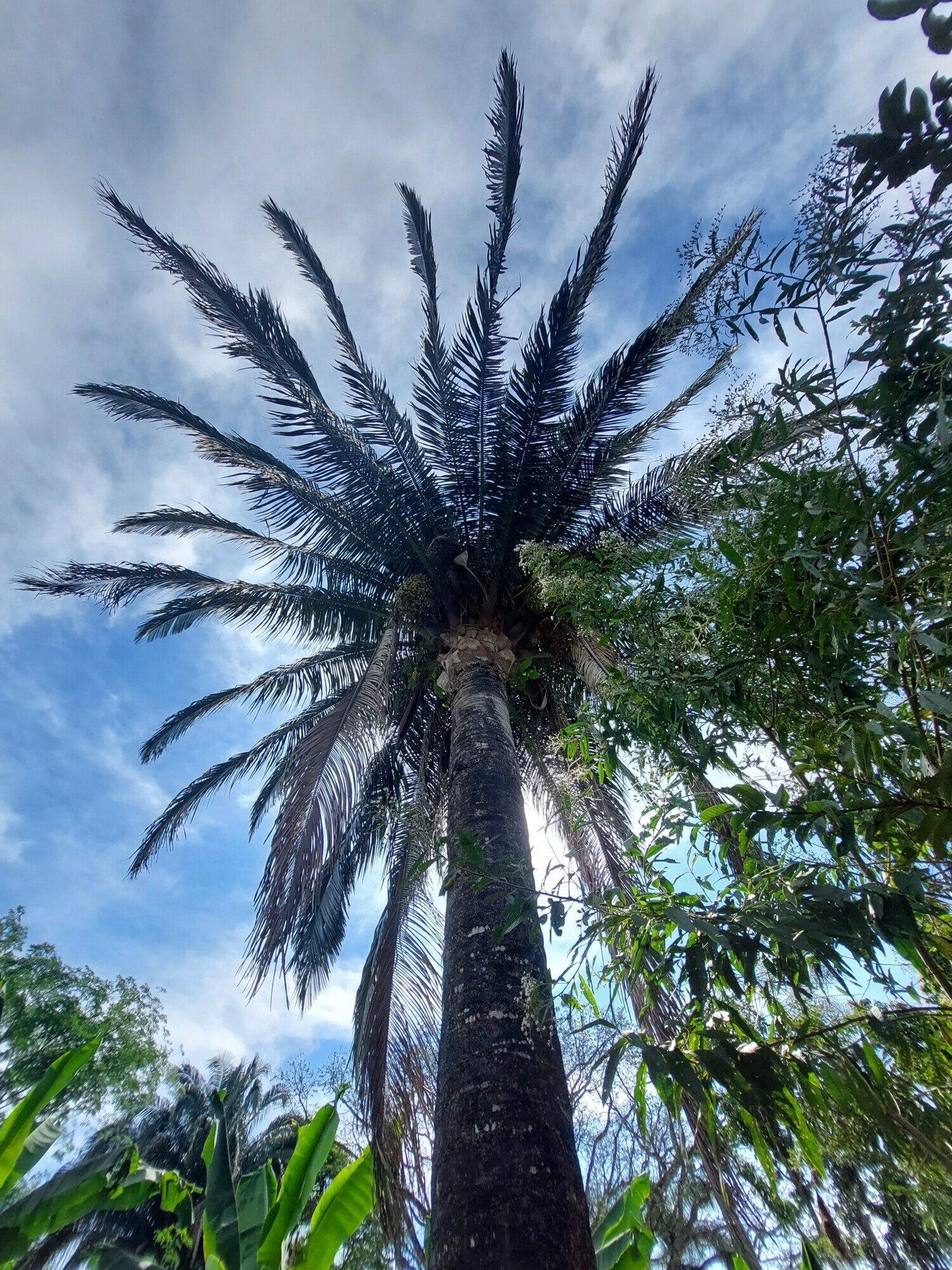
In the Orinoco Llanos of Colombia and Venezuela, Attalea butyracea palms stand as silent hosts to one of tropical medicine's most concerning disease vectors. In a 2015 study across the Colombian llanos, researchers inspected 172 wine palms and found that 64.5% were infested with Rhodnius prolixus, the kissing bug that transmits Trypanosoma cruzi, the parasite responsible for Chagas disease. The palms provide ideal habitat: decomposing leaf bases create crevices where the insects hide during the day, emerging at night to feed on mammals including humans who sleep beneath or near the trees. Palm physiognomy matters: taller trees with more leaves and larger crowns harbor denser populations of the vectors, making the largest, most productive palms also the most epidemiologically significant.
Attalea butyracea, commonly known as the wine palm or palma de vino, is a large solitary palm of the family Arecaceae that ranges from southern Mexico through Central America to Bolivia and Brazil, occurring primarily below 425 meters elevation in lowland tropical forests. The species reaches 20 to 25 meters in height with a distinctive crown architecture: the massive pinnate leaves, up to 12 meters long, arrange themselves in a vertical plane that gives the palm its "rooster-tail" appearance. This architectural feature, combined with its oil-rich seeds containing 50 to 60 percent oil and the traditional practice of tapping its trunk for fermentable sap, has made it one of the most economically important palms in its range. In Costa Rica, the species occurs on the Pacific slope with documented populations at Manuel Antonio and historically throughout the lowlands, though it appears to be less common than in its Amazonian and Colombian strongholds.
Identification
Habit and Crown Architecture


Attalea butyracea is a large, solitary, evergreen palm typically reaching 10 to 20 meters in height, occasionally up to 25 meters in optimal conditions. The trunk is unbranched, cylindrical, and 20 to 55 centimeters in diameter, with a smooth, spineless surface marked by conspicuous horizontal leaf scars in a gray-brown color. The base of the trunk flares slightly to accommodate the fibrous root system. The crown bears 15 to 40 pinnate leaves, each measuring 3 to 12 meters long in mature individuals. The defining characteristic of this species is the distinctive vertical orientation of its fronds. About two-thirds along the petiole (leaf stalk), the rachis (central leaf axis) weakens and bends, causing the distal (outer) portion to droop downward while the leaflet plane (the flat orientation of the individual leaf segments) remains vertical, creating the appearance of a rooster's tail. This vertical leaf arrangement distinguishes A. butyracea from most other large palms and makes it easily recognizable even at a distance.
Trunk and Bark

The trunk surface is smooth and spineless, ranging from gray to gray-brown in color. Horizontal leaf scars encircle the trunk at regular intervals, creating a distinctive ringed pattern. These scars mark where old leaf bases have abscised, and they are typically round to elongate in shape. The outer bark is relatively thin, while the wood beneath is fibrous and moderately hard. At the leaf bases, robust stiff marginal fibers persist, creating crevices and spaces that serve as refugia for insects, epiphytes, and in some regions, disease-vector triatomine bugs. The trunk does not produce aerial roots or spines, maintaining its smooth cylindrical form from base to crown.
Leaves

The leaves are pinnately compound, measuring 3 to 12 meters long, with 180 to 240 pairs of leaflets (pinnae). Individual leaflets reach up to 1 to 1.5 meters long in the central portion of the leaf and approximately 6 centimeters wide. The leaflets are bright green on the upper surface and pale green below, distributed regularly along the rachis in a single plane rather than radiating in multiple directions. The petiole is very short or nearly absent in typical A. butyracea, though some populations (historically called A. rostrata) possess a distinct petiole. The leaf base is characterized by robust, stiff marginal fibers that persist after the leaf blade deteriorates, creating a fibrous mass around the trunk apex. These fibers have been harvested traditionally for cordage and other fiber products. The leaf arrangement in a vertical plane, combined with the downward-arching rachis, creates the diagnostic rooster-tail crown silhouette.
Flowers
The palm is monoecious, bearing both male and female flowers on the same individual. Inflorescences emerge among the leaves, enclosed initially in a persistent woody spathe up to 2 meters long. The inflorescence itself is erect, approximately 1 meter long, with 100 to 300 branches measuring up to 30 centimeters long. Male flowers are cream-colored, small at approximately 1.5 centimeters long, with three sepals, three petals, and six stamens. Female flowers are darker cream, slightly larger at approximately 2 centimeters long, and positioned toward the base of the inflorescence branches. The flowering pattern typically produces two to four all-male inflorescences followed by one female or mixed inflorescence, then repeats this cycle. The flowers emit a strong musky fragrance that attracts various insect visitors including nitidulid beetles, weevils, stingless bees, wasps, and flies. In Costa Rica, stingless bees called "cuchuco" (Trigona species) are common flower visitors.
Fruits and Seeds
The fruits are ovoid to ellipsoid drupes measuring 5 to 12 centimeters long and 3 to 8 centimeters wide. The exocarp is fibrous, green when immature, turning yellow-brown to burnt-orange or wine-red when ripe. The mesocarp is fleshy, orange in color, and edible with a sweet oily taste. Beneath the mesocarp lies an extremely hard, woody endocarp that protects one to three seeds. The multiple seeds per fruit represent a bet-hedging evolutionary strategy: even if bruchid beetles destroy one seed, others may survive and germinate. The seeds themselves contain 50 to 60 percent oil by weight. The seed oil composition varies between the mesocarp and endosperm: mesocarp oil contains 64 percent oleic acid, while endosperm oil is rich in lauric acid at 42.9 percent. Fruits mature over an extended period, with fruiting typically occurring from May to August though the nearly 12-month fruit development cycle means fruiting trees can be found year-round in some populations.

Distribution
Attalea butyracea ranges from southern Mexico (Chiapas, Veracruz) through Guatemala, Honduras, Costa Rica, and Panama, extending into South America through Colombia, Venezuela, Ecuador, Peru, Bolivia, and Brazil. The species occurs primarily in lowland regions below 425 meters elevation, with most populations concentrated below 300 meters. In Costa Rica, the species is documented from the Pacific slope with historical collections by Anders Sandoe Oersted from 1846 to 1848 and modern records from Manuel Antonio National Park and other lowland sites. The palm thrives in disturbed habitats including secondary forests, pastures, and forest edges, exhibiting pioneer species characteristics that allow it to colonize cleared areas. In Panama, a detailed study identified over 50,000 individual palms within a 300 square kilometer study area, demonstrating that in optimal habitat the species can achieve high population densities. The species appears to avoid montane zones and true primary rainforest understory, preferring open or semi-open conditions with direct sunlight.
Ecology
Attalea butyracea exhibits pioneer species ecology, colonizing disturbed sites and secondary forests where it receives adequate sunlight. Seedlings are shade tolerant and can persist in forest understory for extended periods, waiting for canopy gaps. However, mature palms require high light levels for flowering and fruiting. The species flowers from July to November depending on location, with peak flowering typically in the rainy season. Fruit maturation takes nearly 12 months, with most fruits ripening from May to August. The palm is pollinated primarily by small beetles of the genus Mystrops (Nitidulidae) and curculionid weevils including Celetes and Phyllotrox. In Costa Rica, stingless bees (Trigona species) are abundant flower visitors. The flowers exhibit morphological characteristics associated with beetle pollination including strong odor, stigmatic secretions, heat production, and sticky pollen.
Seed dispersal involves a complex interaction between vertebrate dispersers and seed predators. The primary dispersers are agoutis (Dasyprocta species) which scatter-hoard the large seeds, burying them in caches throughout the forest. Spiny rats (Proechimys semispinosus) also remove and cache seeds. Large mammals including tapirs, peccaries, and cattle consume the fleshy mesocarp and inadvertently disperse seeds in their feces, though peccaries often destroy seeds by crushing them. Arboreal mammals including white-faced capuchin monkeys and coatis harvest fruits directly from palm crowns. On Barro Colorado Island in Panama, northern tamanduas have been observed consuming palm fruits, possibly to access insects living inside. Bruchid beetles, probably Speciomerus giganteus, are major seed predators. These beetles lay eggs on endocarps only after vertebrates have removed the husk and pulp. A key study by Wright and Duber documented that bruchid predation ranged from zero to 10 percent in sites with intact agouti populations to 30 to 50 percent in sites where agoutis had been poached, demonstrating the critical mutualistic role of these rodents in palm regeneration.
The palm's most significant ecological relationship from a human health perspective is its role as primary habitat for Rhodnius prolixus, one of the principal vectors of Chagas disease in Colombia and Venezuela. Over 140 triatomine species can transmit Chagas, but only a handful are epidemiologically important, and R. prolixus is specifically the palm-associated vector. While Triatoma infestans dominates domestic transmission in southern South America by colonizing house walls and roofs, and Triatoma dimidiata serves as the main vector in Central America and Ecuador, Rhodnius species maintain sylvatic cycles in palm crowns across northern South America. In the Orinoco Llanos, 64.5 percent of inspected wine palms were infested with R. prolixus. The insects colonize decomposing leaf bases and fibrous materials in the palm crown, hiding in crevices during the day and emerging at night to feed on blood from mammals. Palm architecture influences vector population density: taller palms with more leaves and larger crowns harbor significantly more bugs. This creates a public health paradox where the largest, most productive palms that provide the greatest economic value through fruit, fiber, and sap production are also the most dangerous from a disease transmission standpoint. Research has shown that palm density and proximity to human dwellings are critical risk factors for Chagas disease transmission in palm-dominated landscapes.


Taxonomic History


The species was first described as Cocos butyracea by Jose Celestino Mutis with formal publication by Carl Linnaeus the Younger (Linnaeus filius) in Supplementum Plantarum, page 454, in 1782. The "Mutis ex L.f." citation indicates that Mutis provided the description and material from his collections in Colombia, while Linnaeus the Younger handled the formal publication. Jose Celestino Mutis was a Spanish botanist and physician who directed the Royal Botanical Expedition of Nueva Granada (modern Colombia) from 1783 until his death in 1808. Linnaeus called him "Phytigorum Americanorum Princeps" (Prince of American Botanists). Mutis arrived in Colombia in 1760 carrying a volume of Linnaeus's Species Plantarum, and his expedition ultimately produced drawings of 2,696 Colombian plants.
The genus name Attalea was coined by Carl Sigismund Kunth in 1816 to honor King Attalus III Philometor of Pergamon (circa 170 to 133 BC), the last Attalid king, who was renowned for his interest in medicine, botany, and gardening. Attalus III devoted most of his time to botanical pursuits rather than ruling, and upon his death without heirs, he famously left his kingdom to the Roman Republic. The species epithet "butyracea" derives from the Latin "butyraceous," meaning buttery or oily, from "butyrum" (butter), referring to the oil-rich seeds which historically provided extracted oil for cooking and illumination.
The current accepted name Attalea butyracea (Mutis ex L.f.) Wess.Boer was published in Pittieria volume 17, page 292, in 1988 by Johannes Gerardus Wessels Boer, who transferred multiple species from Scheelea and other genera to Attalea. The species has 52 synonyms, reflecting a complex taxonomic history. Key synonyms include Scheelea butyracea (Mutis ex L.f.) H.Karst. ex H.Wendl. (1878) and Attalea rostrata Oerst. (1859), the latter described by Anders Sandoe Oersted from his Costa Rican collections made between 1846 and 1848. For many years, Costa Rican palms were known as A. rostrata, though current taxonomy treats this as a synonym. Some sources note that A. rostrata differs in possessing a distinct leaf stalk or petiole whereas A. butyracea sensu stricto has a very short or absent petiole, suggesting this may represent infraspecific variation rather than distinct species.
The excessive synonymy resulted from the palm's wide geographic range leading to multiple independent descriptions, historical splitting of Attalea into separate genera including Scheelea, Orbignya, and Maximiliana, and morphological variability across populations. In 1999, Sidney Glassman divided the subtribe Attaleinae into five genera based on male flower structure. However, Henderson and colleagues in 1996, Govaerts and Dransfield in 2005, and molecular phylogenetic work by Meerow and colleagues in 2009 supported treating all as a single genus Attalea, since the multi-genus approach did not produce monophyletic groups. Henderson's 2020 revision in Phytotaxa represents the most recent comprehensive treatment, maintaining the broad genus concept that includes approximately 67 species ranging from Mexico to Argentina.
Ethnobotany and Uses
Attalea butyracea ranks among the most economically important palms in tropical America, with 36 documented uses in Colombia alone. The common name "wine palm" or "palma de vino" references the traditional practice of extracting fermentable sap from the trunk. To produce palm wine, harvesters cut down the palm and remove the crown, then hollow out the trunk apex to create a basin where sap accumulates. The sap ferments naturally within hours, producing a mildly alcoholic beverage consumed fresh. A mature palm approximately 8 meters tall can yield about 1 liter of sap per day for 20 to 30 days after felling. The wine has cultural significance in rural communities and is sold in local markets. However, this use is destructive as it requires killing the palm, and concerns exist about overharvesting in some regions.
The seed oil has been extracted traditionally for cooking and illumination. The oil composition makes it suitable for multiple applications: mesocarp oil with 64 percent oleic acid is appropriate for cooking, while endosperm oil rich in lauric acid (42.9 percent) resembles coconut oil in properties and can be used in soap making and cosmetics. Recent research has identified novel bioactive compounds in the seed oil with antiparasitic activity against Giardia duodenalis, suggesting pharmaceutical potential. The fleshy mesocarp is consumed fresh or cooked, particularly by children, and the edible palm heart can be extracted though this requires sacrificing the palm. The woody endocarp is extremely hard and durable, used for making small containers, buttons, and crafts.
The leaves serve multiple purposes. Young unopened leaves provide thatch for roofing that can last four years or more with proper maintenance. The leaflets are woven into mats, baskets, hats, and brooms. The stiff midribs of leaflets are fashioned into arrows, fishing implements, and small tools. The fibrous leaf bases yield strong cordage used for rope, hammocks, bags, and general binding. In some regions, the fiber is processed more extensively to produce textiles. The trunk wood, while not commercially valuable, is used locally for construction of temporary structures, fencing, and water troughs. The palm's tolerance of disturbed habitats and ability to grow in degraded soils has led to interest in its potential for reforestation projects and agroforestry systems, particularly in combination with cacao or cattle pasture.
Conservation
Attalea butyracea is assessed as Least Concern on the IUCN Red List. The species is abundant throughout much of its range, with population studies in Panama documenting over 50,000 individuals in a 300 square kilometer area. The palm's pioneer ecology and tolerance of disturbed habitats allow it to persist and even thrive in human-modified landscapes including pastures, secondary forests, and agricultural areas. In some regions, it is actively managed or semi-cultivated for its various products. However, localized threats exist. Overharvesting for palm wine production, which requires killing the tree, has reduced populations in some Colombian and Venezuelan localities. Conversion of forest to intensive agriculture eliminates habitat, and in some areas the palm is removed from pastures due to concerns about Chagas disease transmission or because it is perceived as competing with grass for cattle. The species is not listed under CITES and faces no major rangewide conservation concerns at present, though monitoring of populations subject to intensive wine extraction would be prudent.
Resources
Taxonomy & Nomenclature
Accepted name, synonymy, and distribution
Nomenclatural database with type specimens and literature
Occurrence data and distribution maps
Species Information
Comprehensive species account with morphology and uses
Detailed palm cultivation and identification guide
Horticultural information and morphological details
Costa Rica regional information and identification
Scientific Literature
Rhodnius prolixus infestation of palms in Colombian llanos
Agouti dispersal and bruchid beetle predation on Barro Colorado Island
Beetle pollination in Attalea genus
Seed predation and rodent foraging behavior
Remote identification of over 50,000 palms in Panama study area
Fruit characteristics and oil composition analysis
Ethnobotany & Uses
Documentation of 36 uses in Colombia across eight categories
Comprehensive ethnobotanical and cultivation information
Regional species information and traditional uses
Historical Sources
Biography of the describing botanist
Taxonomic history and genus circumscription
Chagas Disease & Public Health
Foundational study on prevalence, vector infection rates, and seroprevalence in endemic areas
Identification of peridomestic risk factors: dirt floors, tile roofs, poor sanitation
Pilot project on ecological control methods for peridomestic colonies
Comprehensive clinical review of cardiac manifestations, diagnosis, and management
Regional epidemiology, control initiatives, and Central American transmission interruption
Patient-oriented overview of symptoms, phases, and treatment options
Conservation & Distribution
Conservation status: Least Concern (LC)