Arrayán
Gaultheria erecta — A cloud forest shrub with edible berries that forms the understory of Costa Rica's highest mountains, from Chirripó to the Talamanca highlands.
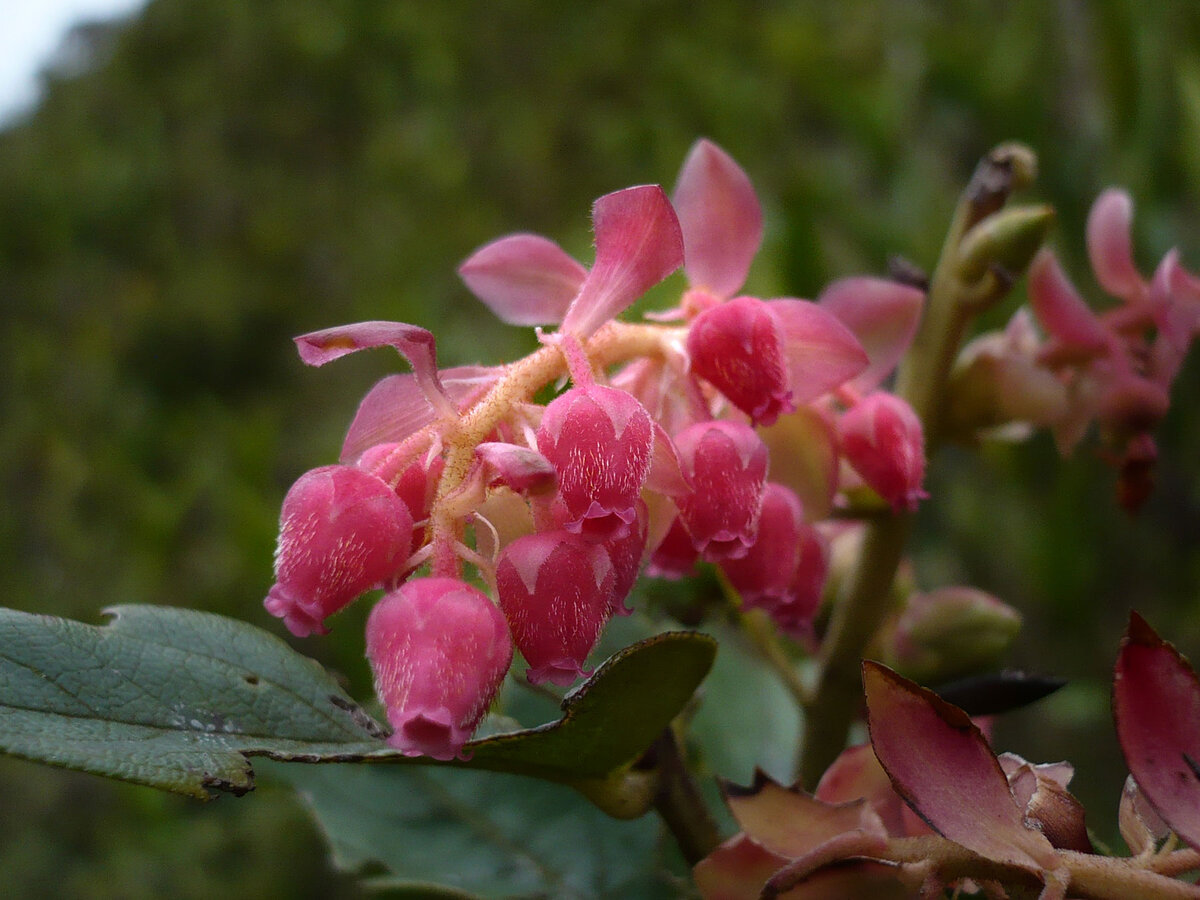
High on the flanks of Cerro Chirripó, where the cloud forest gives way to open páramo and the wind carries the chill of 3,000 meters, a low shrub with glossy leaves catches the eye. Clusters of pink, urn-shaped flowers hang like tiny bells from its branches, and later in the season, dark berries attract birds and hikers alike. This is the arrayán, known locally as borrachera, a plant that has made the harsh conditions of Costa Rica's highest peaks its home.
The arrayán belongs to the Ericaceae, the heath family, which includes blueberries, cranberries, and rhododendrons. This family has evolved remarkable adaptations for nutrient-poor, acidic soils, and the arrayán is no exception. Through a specialized root symbiosis with fungi, it thrives in conditions where most plants would struggle to survive.
Identification
Gaultheria erecta is one of approximately 280-290 species in the genus Gaultheria, distributed primarily in the Americas and Asia. This count increased substantially when the former genus Pernettya was merged into Gaultheria based on molecular evidence. In Costa Rica, the species was historically described as several distinct taxa based on specimens from different volcanoes, including G. costaricensis, G. poasana, and G. donnellii, before modern taxonomy recognized them as variations within a single widespread species.
Physical Characteristics
Form: An erect to spreading shrub, sometimes with a rhizomatous habit, meaning it can spread by underground stems. In favorable conditions it may reach small tree stature, up to 7.5 meters, though most individuals in Costa Rica's páramo are 0.5 to 3 meters tall. The growth habit varies from upright to arching, and the plant occasionally grows as an epiphyte on larger trees.
Leaves: Coriaceous (leathery) and glossy on the upper surface, with deeply impressed veins that create a quilted appearance. The leaves are elliptical to ovate, 5-11 cm long and 2.5-6.5 cm wide, with a cordate (heart-shaped) or subcordate base. The margins are finely toothed. Young stems and the undersides of leaves bear rust-colored (ferruginous) hairs, giving new growth a distinctive woolly texture.
Flowers: The flowers are the plant's most distinctive feature, displaying the classic Ericaceae urn shape (urceolate to cylindrical). They measure 6-7 mm long and occur in axillary or terminal racemes 3-6 cm long. Flower color varies from intense red to white, cream, or pink. The hairy, glandular flower stalks and the imbricate (overlapping) bracts at the base of the inflorescence are useful identification features.
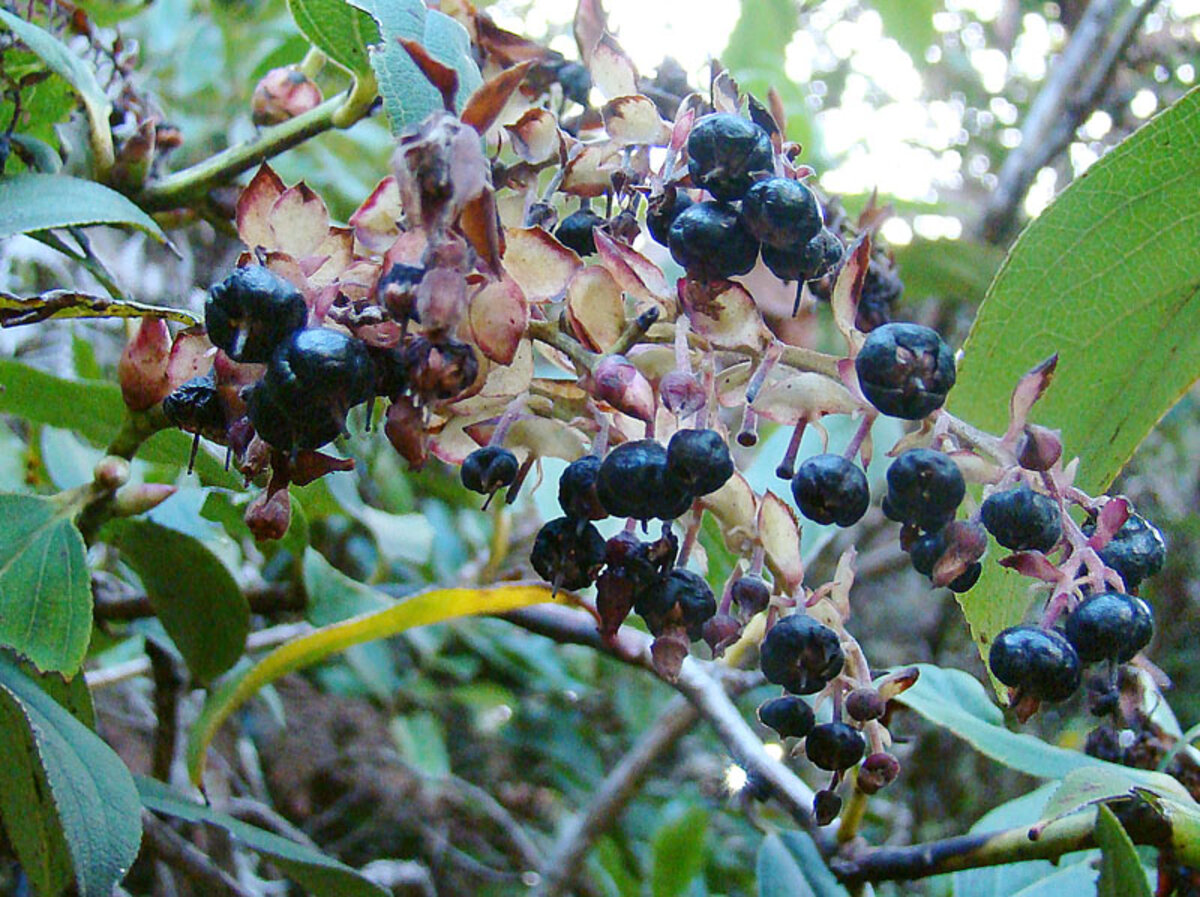
Fruits: What appears to be a dark blue or red berry is actually a botanical deception. The true fruit is a small, dry capsule, but it becomes surrounded by the accrescent (enlarging) calyx, which turns fleshy and colorful, mimicking a berry. This structure, technically called a pseudoberry, attracts birds and mammals that disperse the seeds contained within. The fruits are edible and have a pleasant, slightly sweet flavor.
Ecology and Habitat
The arrayán is a specialist of high-elevation habitats, found between 1,300 and 3,500 meters elevation throughout its range. In Costa Rica, it occurs in cloud forests, in the transition zone between cloud forest and páramo, and in the open shrubby vegetation of the páramo itself. It also colonizes forest edges, roadbanks, landslides, and rocky outcrops, demonstrating a preference for open or disturbed sites with good light availability.
The Mycorrhizal Connection
The Ericaceae family has evolved a unique relationship with soil fungi that allows its members to thrive in harsh, nutrient-poor environments. This symbiosis, called ericoid mycorrhiza, involves fungi that colonize the fine roots of the plant, forming dense coils within root cells. In return for carbohydrates from the plant, these fungi break down organic matter in the soil and deliver nitrogen and phosphorus directly to their host.
Research in Costa Rican cloud forests has documented ericoid mycorrhizal colonization in Gaultheria erecta roots. The fungi, primarily belonging to the order Helotiales, form abundant hyphal mantles around terrestrial roots, though colonization is less dense on epiphytic roots. This partnership explains how the arrayán can thrive in the acidic, nutrient-poor soils typical of páramo and cloud forest environments, where organic matter accumulates but decomposes slowly due to cold temperatures.
Wildlife Interactions
The arrayán's urn-shaped flowers are adapted for pollination by insects, particularly bees. The flower structure, with its narrow opening and pendant orientation, requires visitors to push into the corolla to access nectar, ensuring contact with the reproductive parts. In Costa Rica's highlands, bumblebees (Bombus species) are likely among the primary pollinators, as they are one of the few bee groups active at high elevations.
The colorful, fleshy pseudoberries attract a variety of fruit-eating birds and small mammals. The fruits persist on the plant well into the dry season, providing an important food resource when other sources may be scarce. Small rodents, including mice, also consume the fruits and may contribute to seed dispersal, though birds are likely the primary dispersers over longer distances.
Co-occurring Species
In the cloud forests and páramo of Costa Rica's highlands, the arrayán grows alongside a distinctive community of plants adapted to cool, wet, and often exposed conditions. The Talamanca highlands and Chirripó region, where this species is most common, host a flora with strong connections to both North and South American mountain ecosystems.
Names and Etymology
The genus Gaultheria honors Jean-François Gaultier (1708-1756), a French-Canadian physician and naturalist who studied the flora of Quebec. The species epithet erecta comes from Latin, meaning "upright," referring to the plant's erect growth habit. The plant was first described in 1800-1803 by French botanist Étienne Pierre Ventenat based on cultivated specimens originating from Peru.
The common name "arrayán" is used throughout Latin America for various aromatic shrubs, typically in the Myrtaceae (myrtle family), but in Costa Rica's highlands it refers specifically to Gaultheria erecta. The more evocative local name "borrachera," meaning "intoxication" or "drunkenness," likely references either the mildly intoxicating effects attributed to consuming large quantities of the berries or the plant's traditional use in folk medicine. Other regional names include "mortiño" (also used for related Ericaceae in the Andes) and "uvilla" (little grape).
Traditional Uses
The edible berries of the arrayán have been consumed by indigenous peoples and rural communities throughout the plant's range. The fruits can be eaten fresh, with a pleasant, slightly sweet flavor, or processed into jams, jellies, and beverages. In some regions, the berries are fermented to produce a mildly alcoholic drink, which may contribute to the "borrachera" name.
Like many Ericaceae, Gaultheria erecta contains methyl salicylate derivatives, the same compounds that give wintergreen its characteristic flavor and medicinal properties. Traditional medicine has employed various parts of the plant for their anti-inflammatory and analgesic effects. The leaves and fruits contain terpenoids, phenolic compounds, and flavonoids with documented antioxidant and antibacterial activities, lending scientific support to some traditional uses.
Conservation
The IUCN Red List assesses Gaultheria erecta as Least Concern, reflecting its extremely wide distribution from Mexico to Argentina. The species occurs across multiple countries and numerous protected areas, and its populations appear stable throughout most of its range. It is neither endemic nor particularly threatened in any region.
However, as a high-elevation specialist, the arrayán faces potential long-term vulnerability from climate change. As temperatures warm, suitable habitat is expected to shift upslope. Species like the arrayán may eventually face habitat compression, as they are pushed toward mountaintops with diminishing area. In Costa Rica, the high-elevation habitats where this species occurs are protected within Chirripó National Park and La Amistad International Park, providing some buffer against direct human impacts.
Where to See
The arrayán can be observed along the trails of Costa Rica's highest mountains, particularly in the following areas:
The best time to observe the arrayán in flower is during the wet season, when the pink, urn-shaped blooms are most abundant. The fruits develop later in the season and persist into the dry months, providing a different but equally interesting aspect of the plant's biology to observe.
Resources & Further Reading
Species Information
Authoritative taxonomic information, synonyms, and distribution data.
Citizen science observations and photographs from Costa Rica.
Conservation status assessment and population information.
Global taxonomic database with nomenclatural information.
Protected Areas
Information about the UNESCO World Heritage Site where this species occurs.
Official information about Chirripó National Park, home to Costa Rica's highest páramo ecosystems.