Amarillón
Terminalia amazonia — A large native tree with excellent plantation growth in southern Costa Rica, amarillón is valued for its yellowish timber and buttressed trunk.
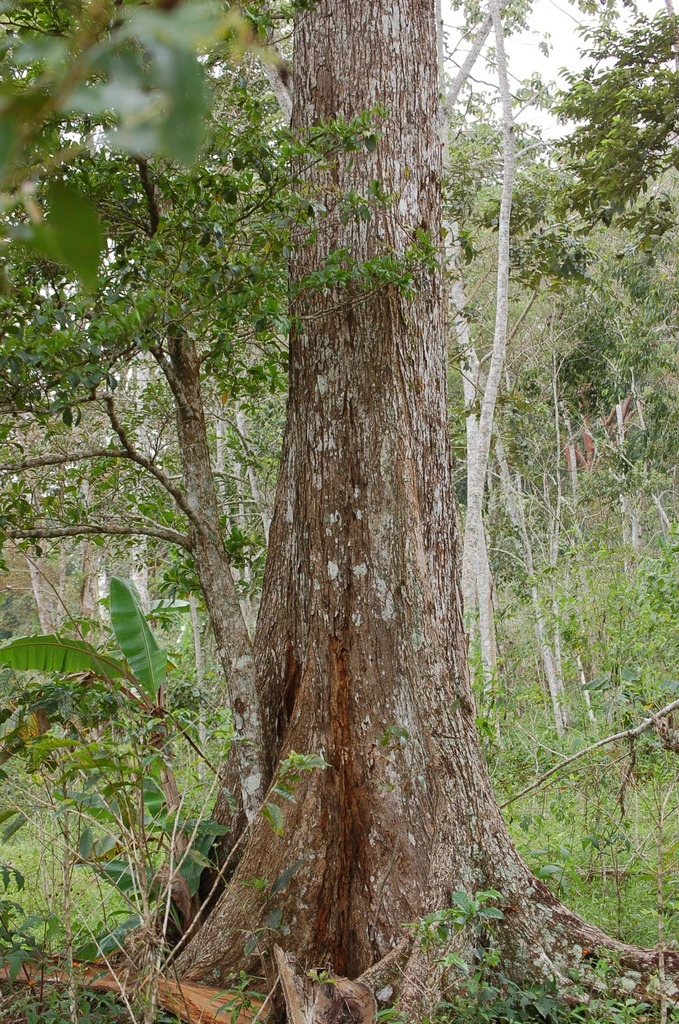
In the humid forests of southern Costa Rica, certain trees rise above all others. The amarillón is one of these large forest trees. Its straight trunk may remain unbranched for 15–18 meters, and its wood is characteristically pale yellow to yellowish-brown.
Unlike many tropical hardwoods that have been overexploited to scarcity, the amarillón has become a promising reforestation species. Costa Rican plantation research documents strong growth by amarillón, including trials on former degraded pasture.
Identification
Growth form: The amarillón has a straight, cylindrical trunk, with a clear bole reported at 15–18 meters and substantial plank buttresses.
Bark: The bark is thin, grayish-brown to yellowish, with a characteristic tendency to curl up in thin sheets that can be easily peeled off. This shedding bark is one of the tree's distinguishing features.
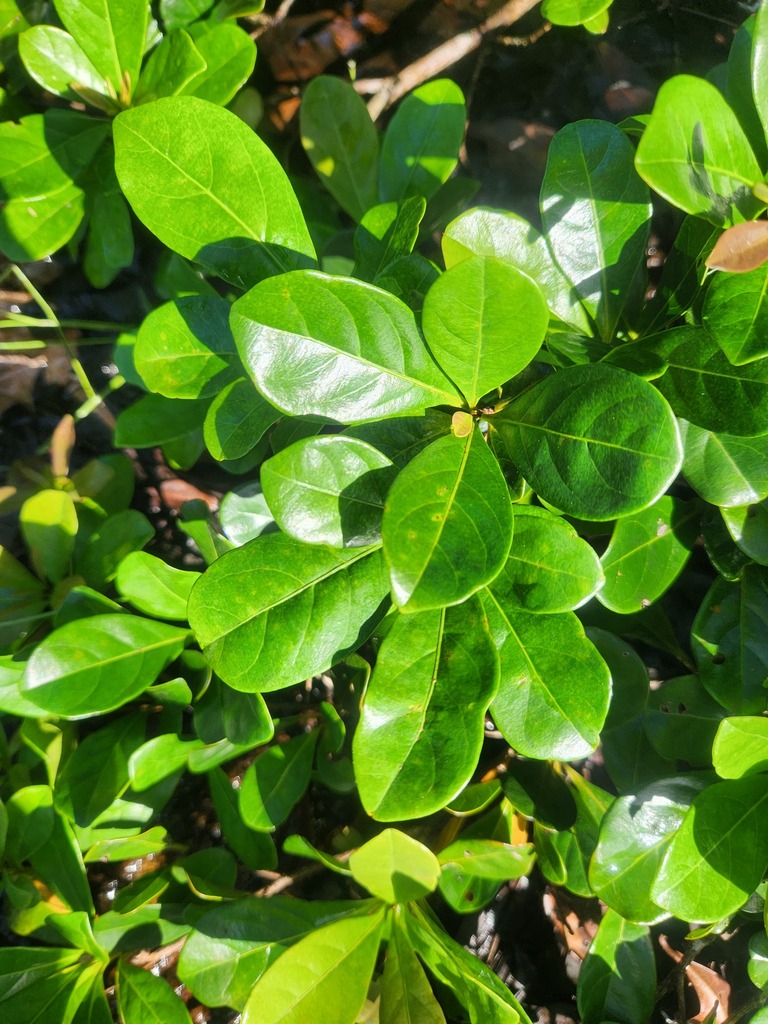
Leaves: The leaves are simple, obovate to oblong-elliptic, measuring 4-15 cm long and 2-6.5 cm wide. They cluster at branch tips in a characteristic arrangement. The upper surface is dark green and glossy, while the underside is paler. Leaves may drop during dry periods, making the tree semi-deciduous in seasonal climates.
Flowers: Small, bisexual, pale flowers appear in axillary spikes. Reports of their scent vary from fragrant to not fragrant; pollination is mainly by medium-sized bees, with possible partial wind pollination. Flowering typically occurs from February to April, before or during early leaf renewal.
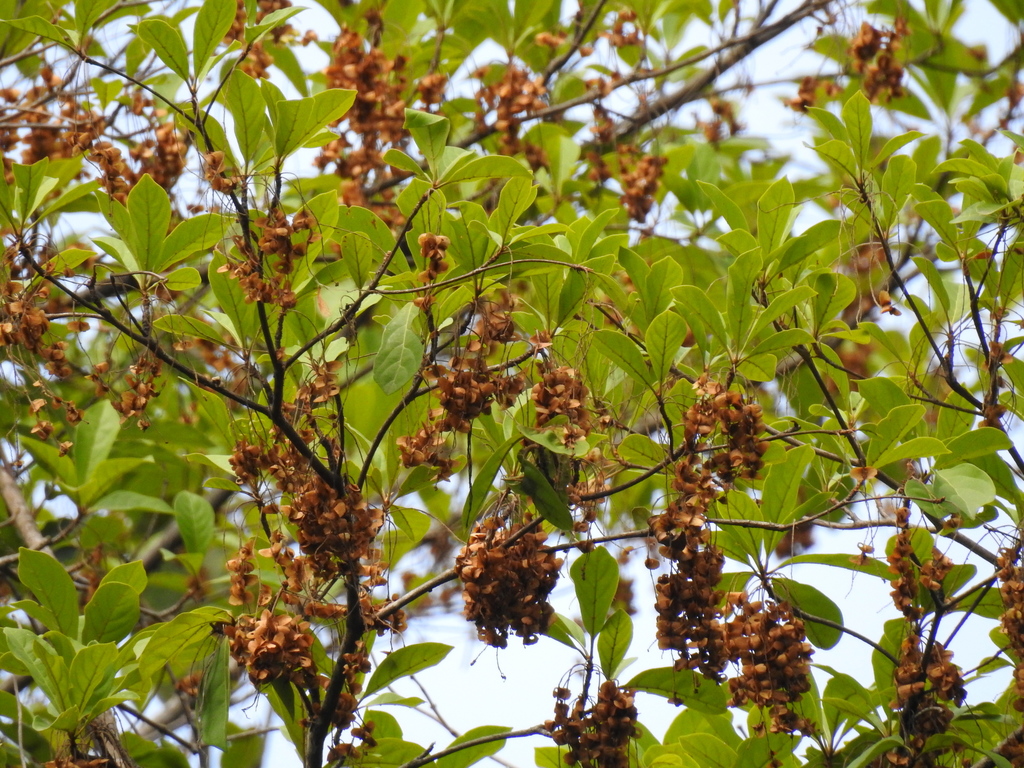
Fruit: The fruits are small samaras, 0.5-2 cm including wings, with two elongated wings and three short or vestigial wings that allow wind dispersal. This adaptation is unusual among large tropical trees, most of which rely on animals for seed dispersal. Fruits ripen from February through May, with regional variation, and the winged seeds can travel considerable distances on the wind.
Habitat & Distribution
The amarillón ranges from southern Mexico through Central America to the Amazon basin in Brazil. It is one of the most widely distributed large timber trees in the Neotropics, occurring in wet and moist tropical forests at elevations from sea level to about 1,200 meters, though most abundant below 900 meters.
In Costa Rica, the species occurs on both Caribbean and Pacific slopes, particularly in the southern Pacific region including the Osa Peninsula, Coto Brus, and the Golfo Dulce lowlands. It thrives in primary rainforest as well as secondary growth, often appearing as an emergent above the main canopy on slopes and flat lowlands.
Soil preferences: The amarillón demonstrates remarkable adaptability to different soil conditions. While it grows best on well-drained, fertile soils, it tolerates poor sands, clays, and even degraded pastureland, making it valuable for reforestation. It also tolerates seasonal flooding and occurs in swampy areas, where buttresses tend to develop larger.
Ecological Role
As an emergent species, the amarillón plays a structural role in tropical forests. Its crown rises above the main canopy, capturing direct sunlight and creating variation in the forest profile. The massive buttresses at its base create microhabitats for seedlings, ferns, and small animals. When old trees fall, they open large gaps that drive forest regeneration.
Its fruits carry that influence beyond the tree itself. Amarillón uses a wind-dispersal strategy well suited to an emergent tree exposed to strong winds above the canopy. Its five-winged samaras spiral down from the canopy and can travel hundreds of meters on strong winds, and the tree is abundant in secondary forest in parts of its range.
That same combination of stature and growth has drawn attention from restoration researchers. Costa Rican amarillón plantations can store substantial carbon. In a ten-year trial at Mogos on the Osa Peninsula, a spacing of 2.5 by 2.5 meters—1,600 trees per hectare—produced the most dry biomass and stored carbon at about 4.9 metric tonnes per hectare per year. Mixtures do not automatically improve that performance: another study found no significant productivity difference between pure and mixed treatments for amarillón. The species' rapid growth rate and dense wood combine to make it one of the better carbon-storing native trees available for reforestation.
Timber & Human Uses
The heartwood that gives amarillón its name is yellowish to brownish-olive with distinctive red-brown streaks. It has a medium texture, generally straight grain, and high natural luster. The wood is hard, heavy, strong, and elastic, with moderate durability, resistance to dry-wood borers, and moderate resistance to fungi (though susceptible to marine borers). These qualities have made it one of Central America's most valued native timbers.
The wood can plane well under suitable machining conditions and takes a good polish, although working properties are rated medium, radial finishing can be difficult, and its blunting effect calls for durable cutting tools. It is used for furniture, cabinetry, industrial flooring, veneer, shipbuilding, joinery, tool handles, molding, and general woodwork. The bark contains tannins historically used for leather tanning.
Those timber qualities are only part of the tree's appeal. The amarillón has proven to be one of Costa Rica's most successful native reforestation species. After Costa Rica introduced certificate-based reforestation incentives in 1986, followed by the Payment for Environmental Services program in 1996, amarillón has been planted extensively across the humid lowlands. Researchers studying multiple species found it among the top performers for height, diameter, and volume growth.
In some trials, mixed plantations performed as well as or better than pure stands. Amarillón grew faster beside the nitrogen-fixing Inga edulis (guaba), which improved its nitrogen nutrition on degraded pasture soil. Yet the amarillón's total timber volume in that experiment remained too low for forestry goals. The more promising result was ecological: in most cases the interplanting began to form a more complex secondary forest with value as wildlife habitat. Mixtures can therefore outperform monocultures in some combinations, but timber production and restoration value are not the same measure of success.
The benefits can continue beneath the planted canopy. Beyond timber production, amarillón plantations can support woody understory regeneration on degraded pastureland. Studies found that amarillón stands generate abundant understory regeneration, with thousands of woody understory plants recorded per hectare beneath planted trees at some study sites. Amarillón plantations can promote woody understory regeneration and local biodiversity recovery.
Key Sources & Resources
Species Information
General overview of the species including taxonomy, distribution, and uses.
Species page with observations, photographs, and distribution maps from citizen scientists.
Comprehensive botanical information including uses, wood properties, and cultivation requirements.
Silvicultural guide covering amarillón morphology, habitat, soils, and phenology.
Botanical description and distribution record, including leaf, flower, and fruit morphology.
Overview of emergent-layer conditions and the prevalence of wind-dispersed winged seeds among emergent trees.
Species monograph documenting amarillón fruiting phenology, pollination, bark, wood properties, and seed dispersal.
Belize study examining how long-term fragmentation and surrounding forest cover relate to genetic diversity.
Reforestation Research
Research comparing growth and economics of native species plantations including amarillón.
Study demonstrating improved amarillón growth when planted with nitrogen-fixing trees.
Research on how amarillón and other native plantations support understory regeneration.
Long-term study comparing carbon sequestration among native species including amarillón.
Costa Rican trial comparing amarillón productivity in pure and mixed plantation treatments.
Ten-year Osa Peninsula spacing trial measuring biomass, wood density, and carbon storage in amarillón plantations.
Official legal history distinguishing the first forestry incentives, the 1986 certificate programs, and the 1996 PES framework.
Research database with studies on the species' use in forest restoration.
Wood Properties
Technical research on wood quality from Costa Rican plantations.
Costa Rican machining study identifying conditions under which amarillón lumber planes well.