Pata de Yanqui
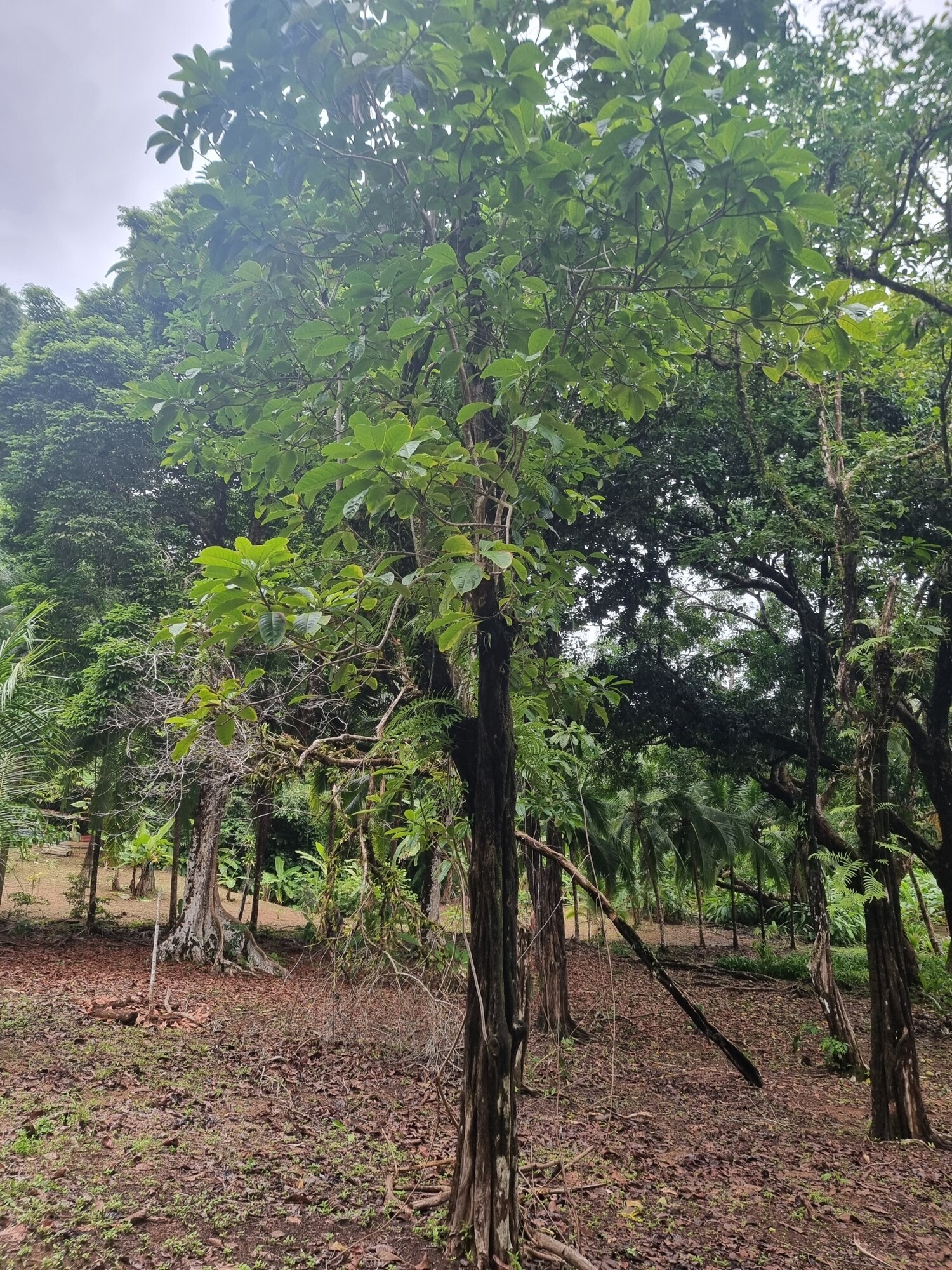
Alseis costaricensis is a Near Threatened canopy tree endemic to Nicaragua and Costa Rica: reaching 35 meters tall with spike-like inflorescences and wind-dispersed seeds, it haunts the lowland wet forests of the Osa Peninsula and Golfito where deforestation keeps tightening its already narrow range.
In the forests around Golfito and the Osa Peninsula, where so many Rubiaceae crowd the understory, Alseis costaricensis stands apart: it climbs into the canopy, reaching heights that dwarf its coffee-family cousins. The genus name honors the Alseids, the grove nymphs of Greek mythology who protected sacred woodlands. For this species, the name proves grimly fitting: it survives only in the shrinking groves of Central America's wettest lowlands.
Charlotte M. Taylor, the Rubiaceae specialist at the Missouri Botanical Garden who has described over 500 plant species, named A. costaricensis in 2002. The species epithet simply marks its Costa Rican home, though it also crosses into Nicaragua's Río San Juan basin. Among the 19 species of Alseis, this one occupies the smallest range.
Identification
Habit and Bark
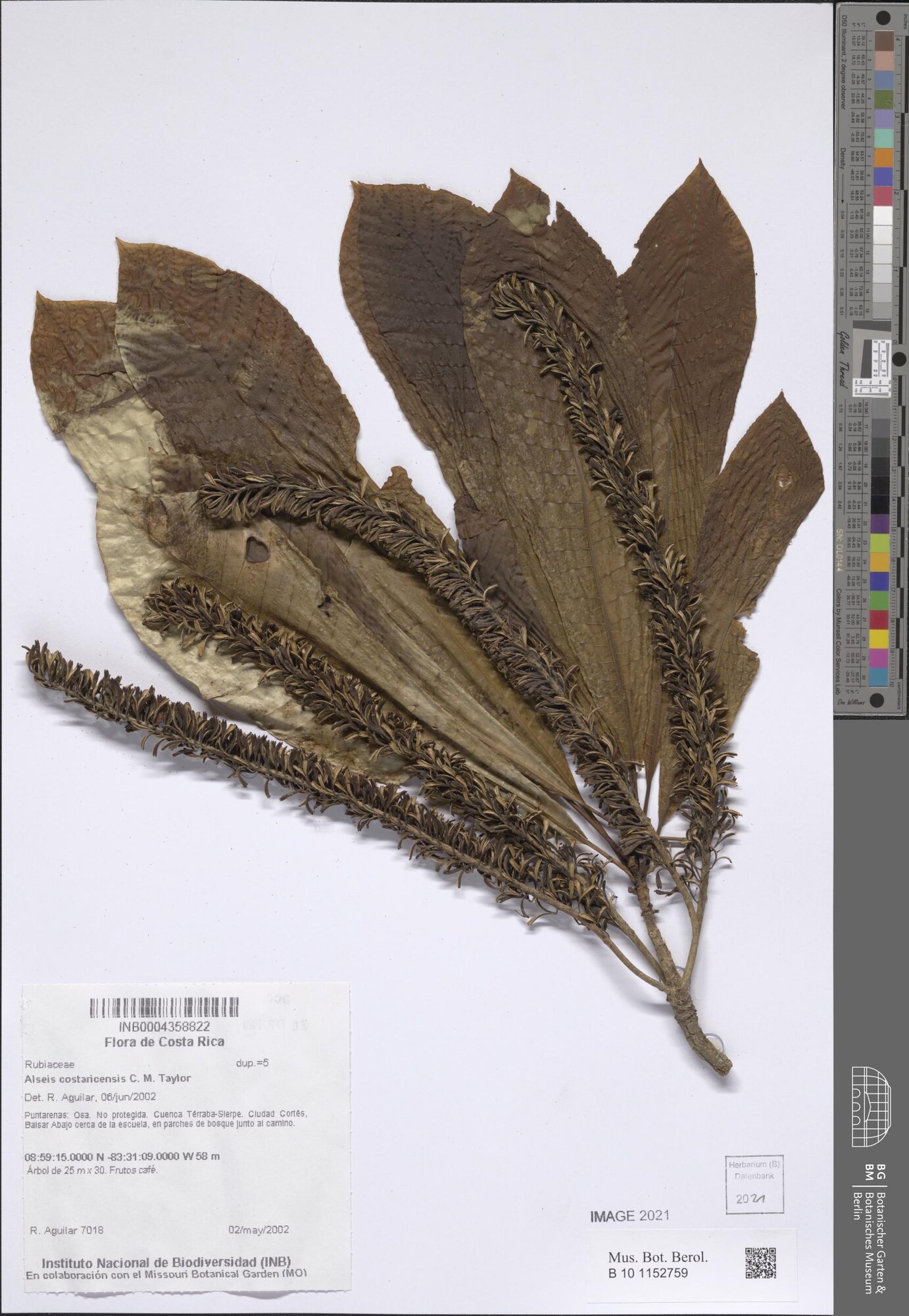
Alseis costaricensis grows as a canopy-emergent tree that reaches 35 meters tall, making it one of the larger members of the Rubiaceae in Costa Rica. The trunk is straight and cylindrical, with bark that becomes vertically fissured and somewhat shaggy with age, developing irregular furrows that expose the yellowish inner bark beneath a gray-brown surface.
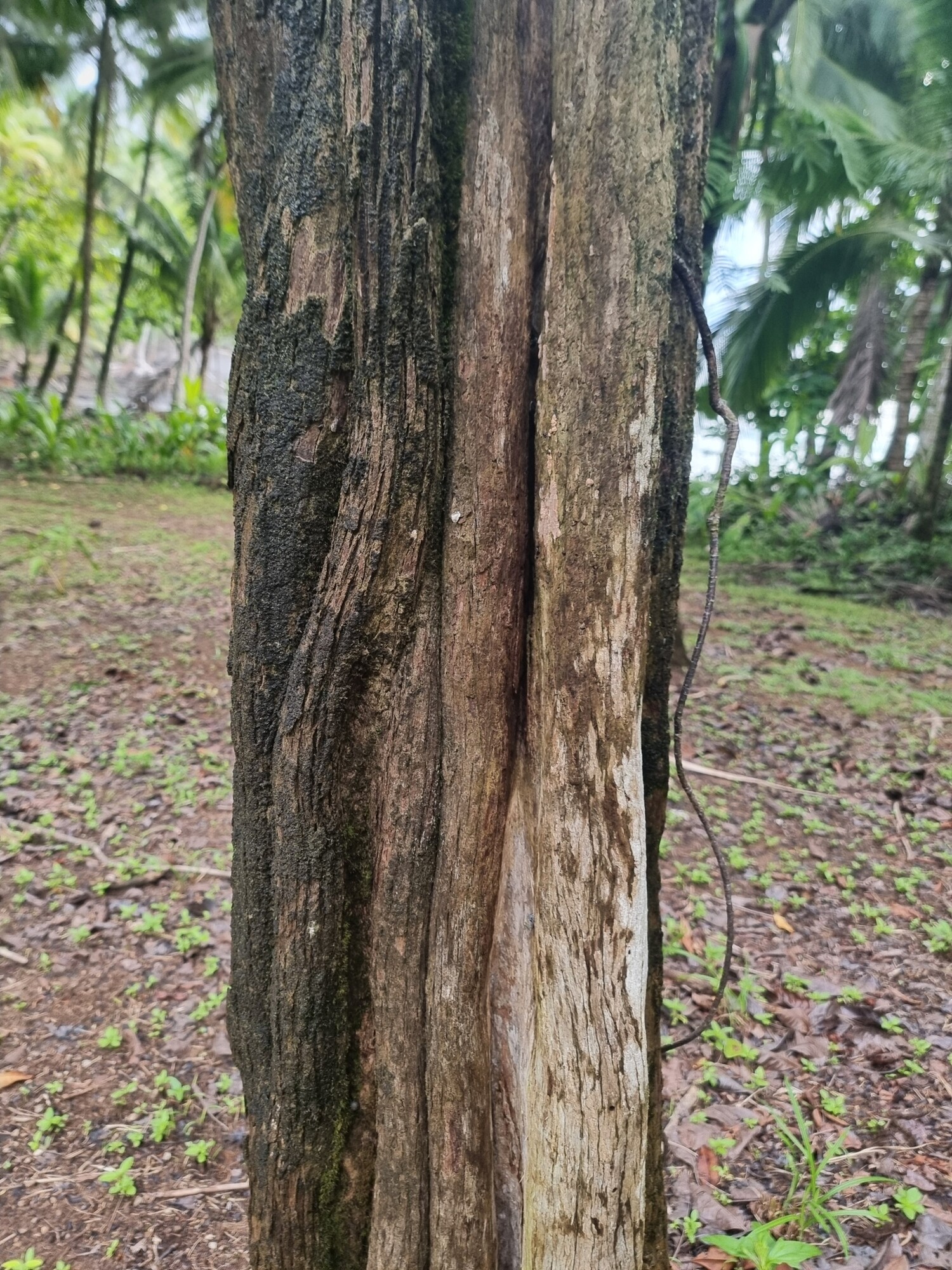
Studies of the related Alseis blackiana in Panama reveal that the wood is yellowish with nearly white sapwood, fine-grained, hard, heavy, and tough. It takes a good polish but is not considered high-quality timber and is seldom traded commercially. Whether A. costaricensis shares identical wood properties remains undocumented.
Leaves
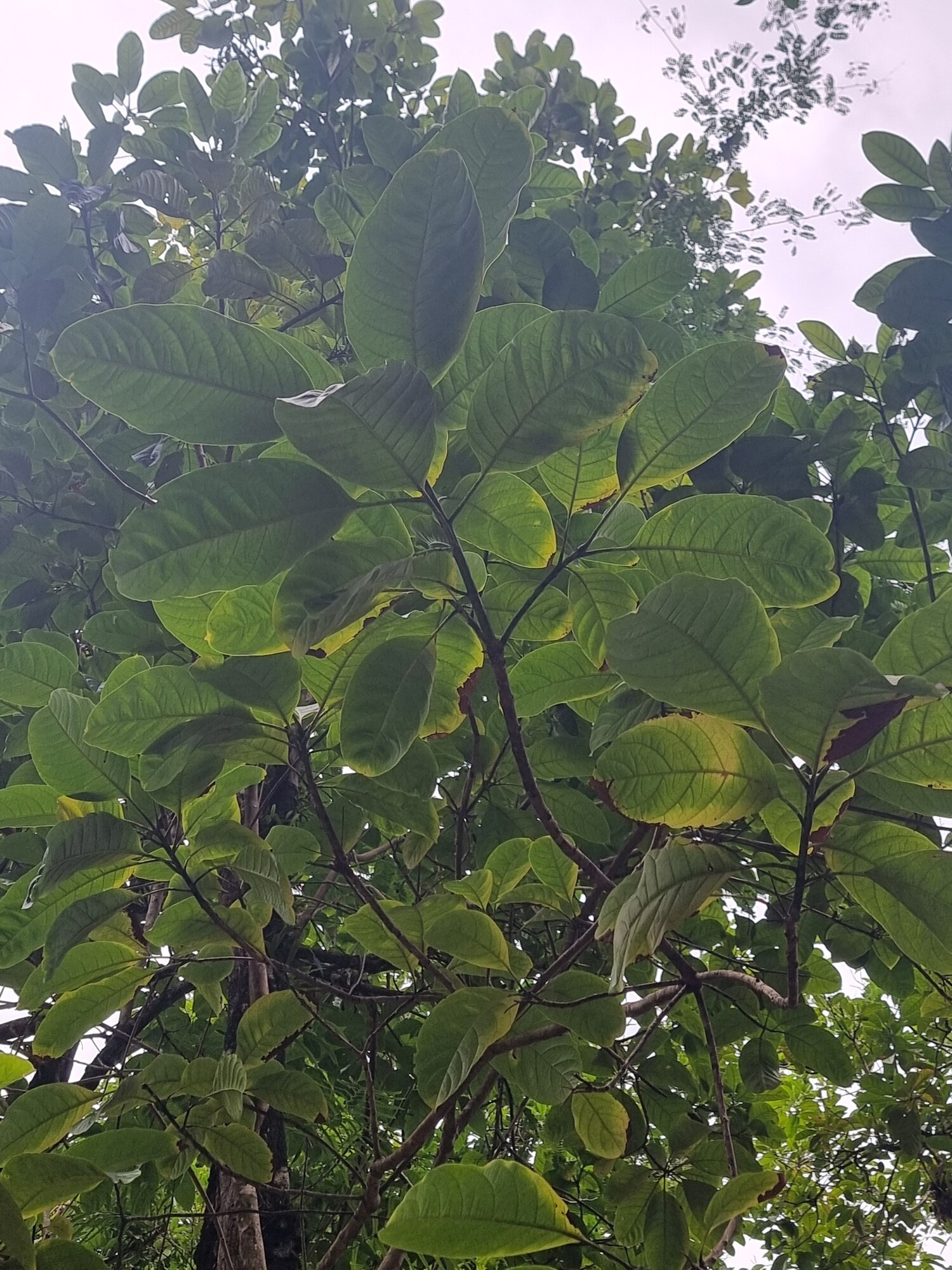
The leaves are opposite and simple, with an oblanceolate shape (widest beyond the middle) that is characteristic of the genus. Based on the related A. blackiana, leaves typically measure 6–20 centimeters long and 3–7 centimeters wide, with short petioles. The stipules are deciduous, leaving distinctive scars that ring the branches at each node.
Flowers
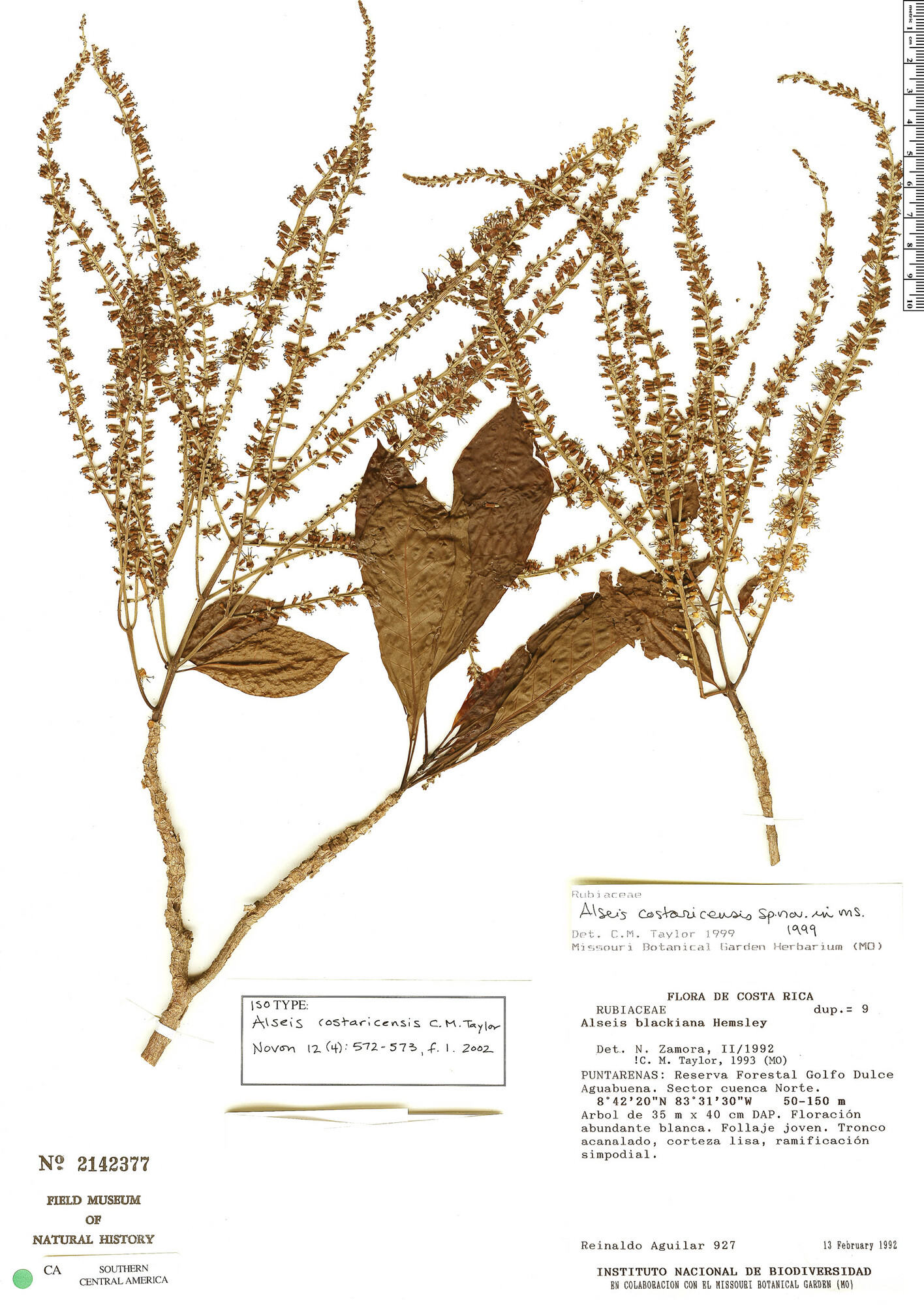
The flowers are small, white, and bell-shaped, clustered in terminal spike-like inflorescences that can reach 10–25 centimeters long. Each spike carries numerous small, aromatic flowers with tubular corollas 2–4 millimeters long. The Osa Arboretum records flowering in February, March, June, and November, suggesting multiple flowering peaks throughout the year, perhaps responding to rainfall patterns.
Fruits
The fruits are small capsules containing winged seeds adapted for wind dispersal (anemochory). When mature, the capsules cluster along the spike axis, turning from green to black and resembling dried spruce branchlets. This wind-dispersal strategy allows seeds to colonize light gaps in the forest, matching the species' ecological strategy as a "shade-persistent pioneer."
Distribution
Alseis costaricensis is endemic to Nicaragua and Costa Rica, making it one of the most geographically restricted species in its genus. GBIF records show 90 occurrences total, with 87 from Costa Rica and just 3 from Nicaragua's Río San Juan department (specifically Refugio Bartola in El Castillo municipality).
Within Costa Rica, the species concentrates in Puntarenas province (50 records), particularly in the Golfito and Osa Peninsula region. Additional records come from Alajuela (10), Limón (8), San José (6), and Guanacaste (4) provinces. In the Brunca region specifically, 36 occurrence records fall within the bounding coordinates, with localities including Río Nuevo, Ciudad Cortés, and the Golfito Peninsula.
Elevation records from georeferenced specimens range from 50 to 448 meters, with a mean of approximately 138 meters. This places A. costaricensis firmly in the lowland wet forest zone, unlike some congeners that reach higher elevations.
Ecology
Research on the closely related Alseis blackiana in Panama has revealed an unusual life history that likely applies to A. costaricensis as well. Scientists describe A. blackiana as a "shade-persistent pioneer": it germinates in high-light conditions like a typical pioneer species, but once established, achieves one of the lowest sapling mortality rates in the forest. This allows the species to accumulate high abundance over time despite its pioneer-like regeneration requirements.
Unlike typical shade-tolerant trees that produce thick, long-lived leaves to maximize carbon gain under low light, Alseis species produce thin, nitrogen-rich, short-lived leaves. This strategy may allow them to respond rapidly when light gaps open above them, quickly ramping up photosynthesis and growth.
The aromatic white flowers likely attract insect pollinators, though specific pollinator observations for A. costaricensis remain undocumented. The wind-dispersed seeds fit the species' role as a gap colonizer, capable of reaching newly opened forest clearings where germination conditions are favorable.
Taxonomic History
Heinrich Wilhelm Schott established the genus Alseis in 1827, naming it after the Alseids (Greek alsos, "grove"), the nymphs who protected groves and forests in Greek mythology. The genus now contains approximately 19 species distributed from Mexico through Central America to Brazil, with most diversity concentrated in South America.
Charlotte M. Taylor described Alseis costaricensis in 2002, publishing the species in Novon (volume 12, pages 572–575). Taylor, based at the Missouri Botanical Garden, has devoted her career to Rubiaceae taxonomy and is considered the most prolific female author of new plant species alive today, having described over 500 species. The type specimen was collected by Reinaldo Aguilar (number 927) in February 1992 from the Reserva Forestal Golfo Dulce in Puntarenas province, at 50–100 meters elevation.
Conservation Outlook
The IUCN lists Alseis costaricensis as Near Threatened (NT), reflecting concern over its restricted endemic range and dependence on lowland wet forests that face ongoing conversion to agriculture and pasture. The species' entire global distribution spans just two countries, with the overwhelming majority of records concentrated in Costa Rica's Puntarenas province.
The Osa Peninsula and Golfito region, where most populations occur, represent both hope and concern. These areas retain significant forest cover within protected areas like Corcovado National Park and the Golfo Dulce Forest Reserve. However, agricultural expansion, illegal logging, and gold mining continue to fragment the surrounding landscape, isolating populations and reducing genetic exchange.
The species' wind-dispersed seeds offer some capacity to colonize regenerating forest, but the shade-persistent pioneer strategy requires both gap creation for germination and long-term forest stability for sapling survival. Maintaining corridors between forest patches in the Brunca region and supporting community-based forest monitoring will be critical for this grove nymph's namesake to persist.
Resources & Further Reading
Species Information
Regional species account with phenology, habitat, and conservation status for the Osa Peninsula.
Smithsonian research on the "shade-persistent pioneer" ecology of a close relative, providing insights into A. costaricensis ecology.
Taxonomy & Nomenclature
Accepted nomenclature and native range from the Royal Botanic Gardens, Kew.
Missouri Botanical Garden nomenclatural database with publication details (Novon 12: 572–575, 2002).
Data Portals
Downloadable herbarium vouchers and occurrence records from Nicaragua and Costa Rica.
Citizen science observations with field photographs from the Osa Peninsula and Golfito.