Almendro
Dipteryx panamensis — A towering keystone species of Central American rainforests, the almendro provides critical nesting habitat for the Great Green Macaw. Now planted in the Brunca Region for habitat restoration.
Rising 40 to 50 meters above the forest floor, the almendro breaks through the canopy as one of the great emergent trees of Central American rainforests. Its crown spreads wide above the surrounding vegetation, visible from kilometers away. In Costa Rica, wild populations are documented on the Caribbean lowlands, from Tortuguero to the San Carlos plains. Reforestation programs are now planting almendro on the Pacific slope, where its value as a keystone species makes it a priority for habitat restoration.
The name "almendro" comes from the almond-like seeds hidden within its large woody pods. Indigenous peoples harvested these seeds for food and medicine long before European contact. Today, these same seeds sustain one of Central America's most endangered birds, binding the fate of two species across ecological time.
Identification
The almendro belongs to the Fabaceae, the legume family, placing it among relatives like Dalbergia (cocobolo), Andira, and other tropical hardwoods.
Physical Characteristics
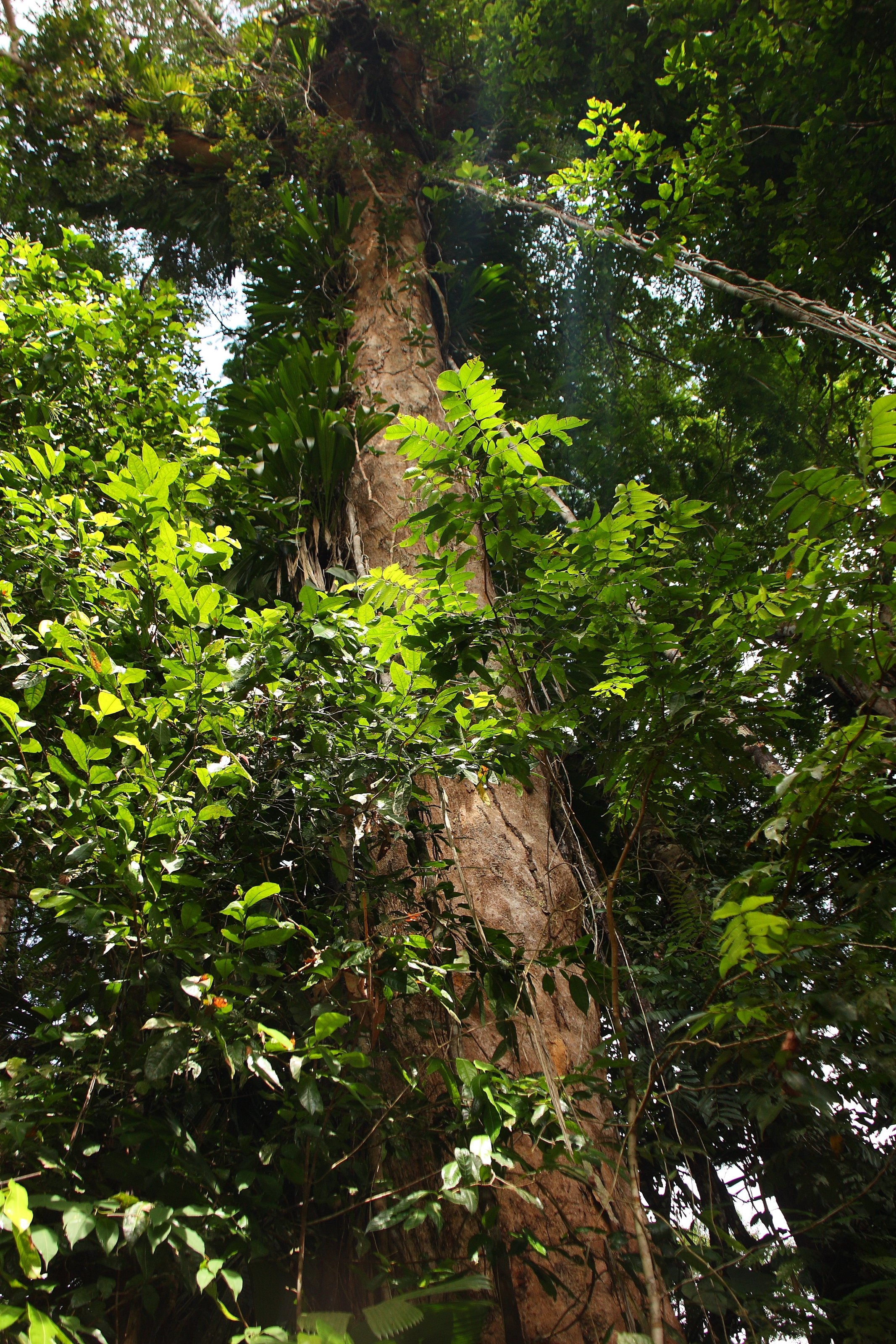
Trunk: Massive and columnar, reaching 1 to 1.6 meters in diameter. The base features ample spreading roots; some trees develop buttresses while others do not, varying by site conditions. Bark is gray-brown, becoming deeply fissured with age.
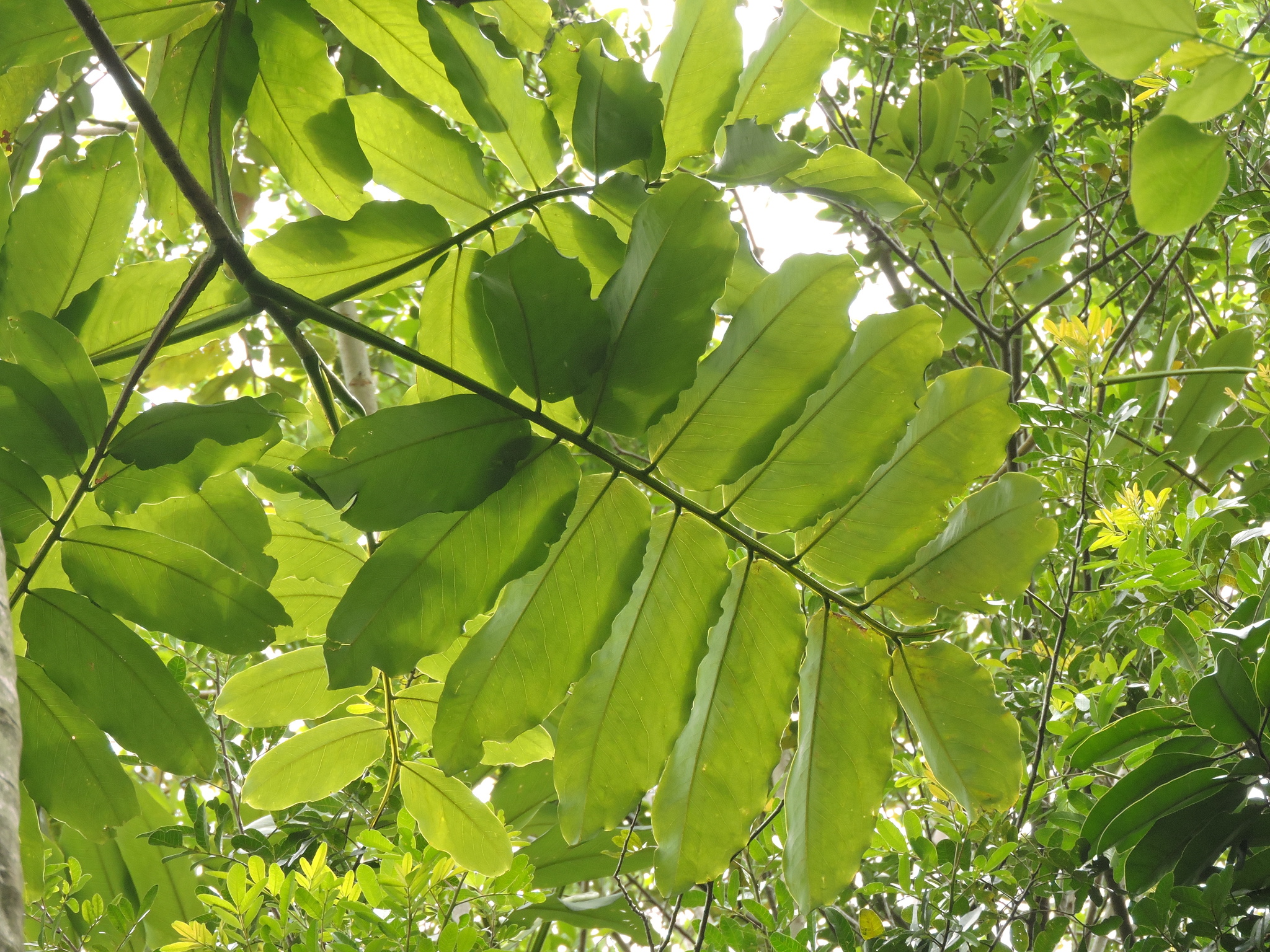
Leaves: Pinnately compound with 10-16 alternate or opposite leaflets, occasionally up to 20. Each leaflet is 7-22 cm long, glossy dark green above, and somewhat leathery in texture. The leaves cluster near branch tips in a pattern typical of the subfamily.
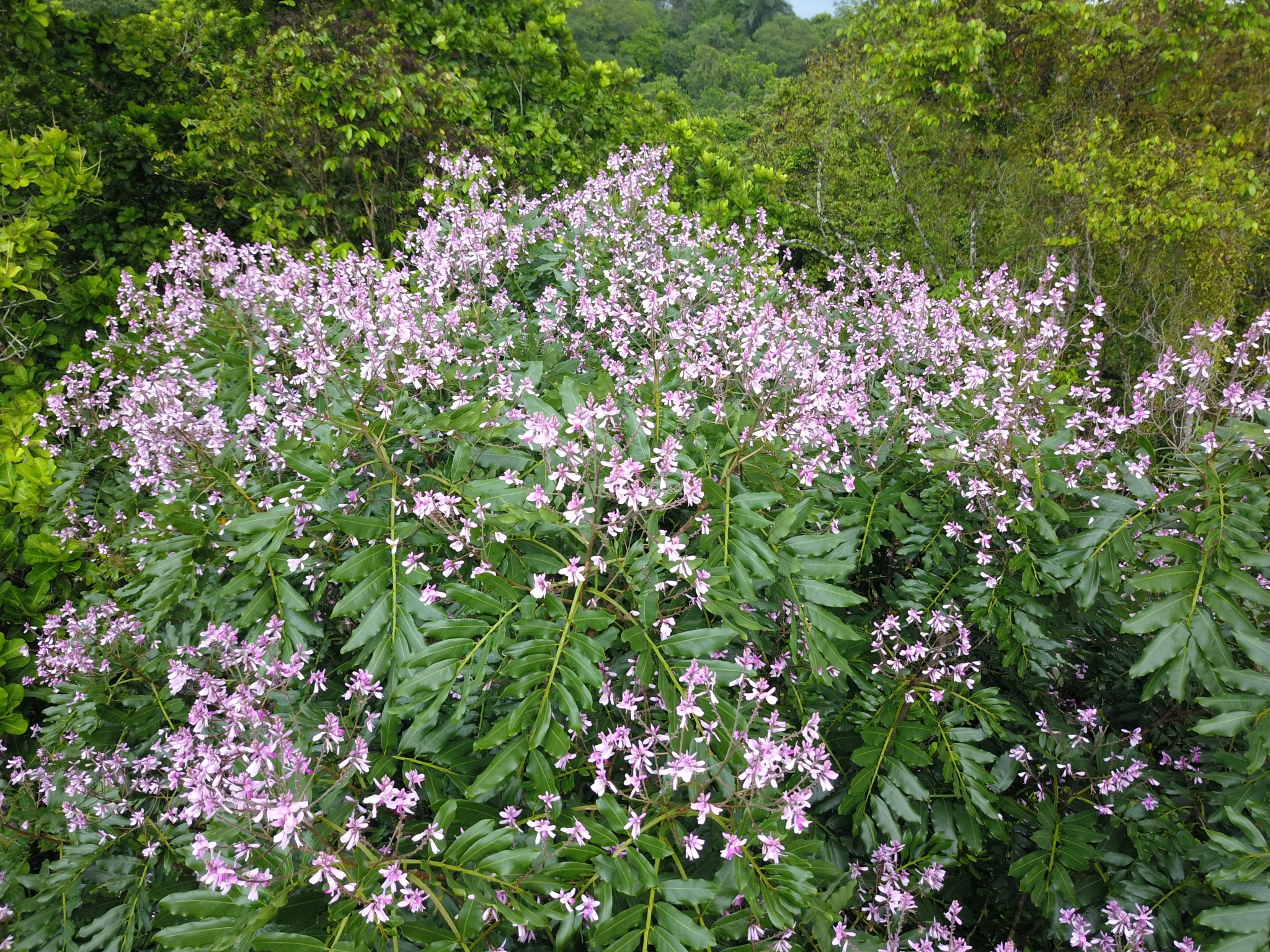
Flowers: Small, pink to purple, appearing in terminal panicles during the early wet season (May-August). The flowers attract bees and other pollinators to the canopy. A mature tree in full bloom is visible from the forest floor as a purple haze above the green canopy.
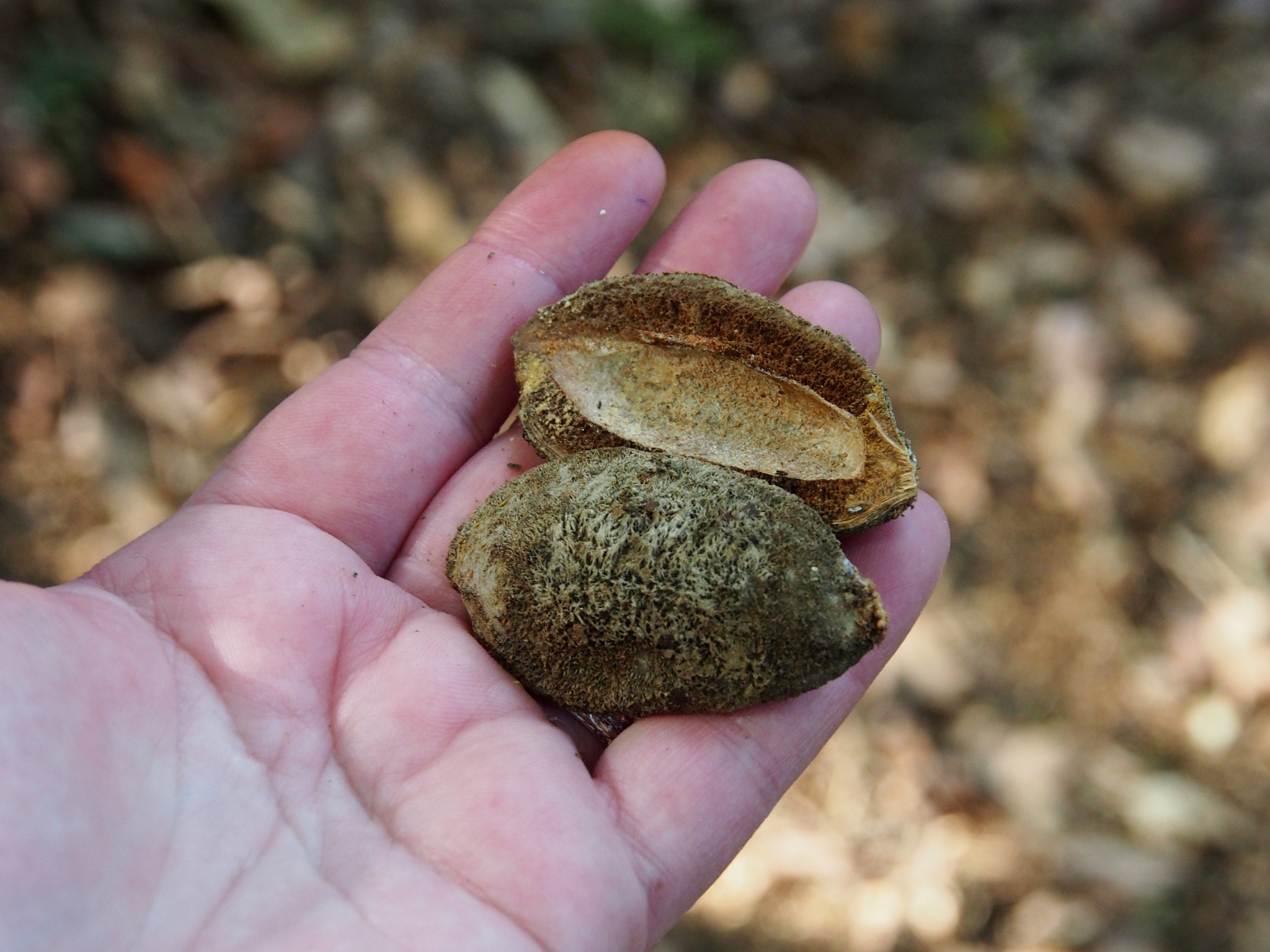
Fruit: Large woody pods, 5-7 cm long, containing a single seed. The pod has a thick, hard shell that protects the oily, almond-like seed within. Fruits mature during the wet season and fall to the forest floor where they are dispersed by mammals.
Habitat & Distribution
The almendro ranges from Nicaragua through Costa Rica and Panama into northwestern Colombia. In Costa Rica, documented populations occur on the Caribbean lowlands and northern lowlands, particularly the Northern Zone, Tortuguero region, Lower Talamanca, and the San Carlos plains. This distribution overlaps with the remaining range of the Great Green Macaw.
Pacific slope: No wild almendro populations have been documented in the Brunca Region or elsewhere on Costa Rica's Pacific slope in recent decades. Whether this reflects historical absence or early logging pressure is unknown. Conservation organizations have begun planting almendro in the region as part of reforestation programs, recognizing its value as a keystone species for wildlife corridors and habitat restoration.
Ecosystem: Tropical wet forest and lowland rainforest. The almendro thrives in areas receiving 3,000-5,000 mm of annual rainfall with no pronounced dry season or only a brief one.
Elevation: Sea level to 1,300 meters, though most common below 500 meters in lowland rainforests.
Succession stage: The almendro is a late-successional species and a primary forest indicator. It requires centuries to reach maturity and does not regenerate well in disturbed or fragmented forests. Its presence signals old-growth conditions and relatively intact forest ecosystems.
Abundance: Uncommon to rare. Historical logging decimated populations throughout its range. While protected in Costa Rica since 2008, recovery is slow due to the species' long life cycle and specific habitat requirements.
Ecological Importance
Biologists consider the almendro a keystone species. Its removal from an ecosystem triggers cascading effects that alter the entire community structure. More than 60 animal species depend on the almendro for food during the critical dry season when other resources are scarce.
Lightning Resistance
The almendro's towering height makes it a natural lightning rod. Research by forest ecologist Evan Gora and colleagues found that almendros are 68% more likely to be struck by lightning than other tall trees due to their height and wide crowns. A typical almendro is struck about five times during its lifespan.
Remarkably, almendros are practically unscathed when struck, losing only small patches of leaves. Other species of similar height lose 40% of their upper branches on average, and 64% die within two years. The almendro's wood is more electrically conductive than other species, allowing current to flow through without generating the heat that kills other trees.
Lightning strikes benefit almendros in two ways: they kill 78% of parasitic vines growing on the tree, and they kill nearby competing trees. Trees growing near an almendro are 48% more likely to die from lightning than those near other species. This competitive advantage may allow almendros to produce up to 14 times more seeds than they otherwise would.
The Great Green Macaw Connection
No relationship defines the almendro's ecological importance more than its bond with the Great Green Macaw (Ara ambiguus). This critically endangered parrot depends on the almendro in two fundamental ways: as a primary food source and as its exclusive nesting habitat.
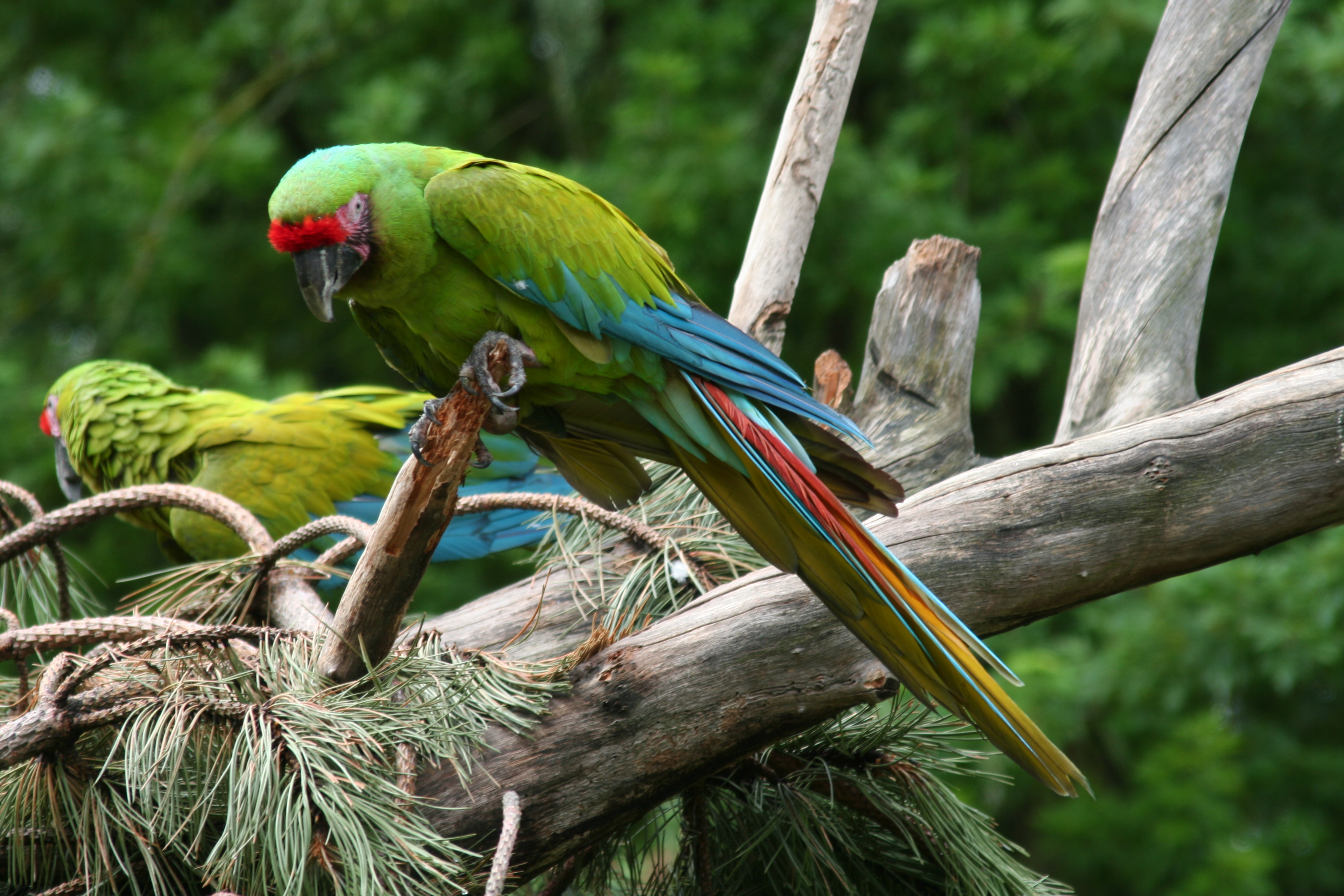
The macaws nest almost exclusively in natural cavities that form in old almendro trunks. These cavities take 80 to 100 years to develop, meaning only ancient trees can support breeding pairs. When an almendro falls or is cut, that nesting site is lost for a century. The almendro's oily, protein-rich seeds also comprise a major portion of the macaw's diet, particularly during the breeding season.
The correlation is direct: where almendros disappear, Great Green Macaws cannot breed. This has made the almendro a conservation priority. Protecting the tree means protecting the bird.
Other Wildlife Interactions
Beyond the macaw, the almendro supports a community of dependent species. Bats disperse seeds by carrying fallen fruits away from the parent tree. White-lipped peccaries and collared peccaries crack open the hard pods to consume the seeds. Agoutis cache seeds and forget them, enabling germination at new sites. Spider monkeys and capuchins feed on flowers and developing fruits high in the canopy.
The tree's massive crown and bark support epiphytic orchids, bromeliads, and ferns. Its buttressed roots create microhabitats for insects, amphibians, and small mammals. Dead almendros remain ecologically valuable, providing cavities for woodpeckers, owls, and arboreal mammals for decades after death.
Conservation Status
The almendro faced severe pressure throughout the 20th century. Its dense, durable wood resisted rot and insects, making it prized for construction, furniture, and railroad ties. Loggers targeted the largest, oldest trees, precisely the individuals most valuable for wildlife.
In 2008, Costa Rica banned commercial harvest of almendro through Executive Decree 35242-MINAET. The law prohibits cutting, transporting, or selling almendro wood without special permits, which are rarely granted. This protection came late. By 2008, populations had already crashed across much of the tree's former range.
Recovery requires patience measured in centuries. A reforestation program planting almendro seedlings today will not provide macaw nesting habitat until the 22nd century. This timeline makes protecting existing old-growth trees essential. Every mature almendro represents irreplaceable ecological infrastructure.
Conservation efforts now focus on protecting remaining populations within national parks and biological reserves, establishing forest corridors connecting fragmented populations, and working with private landowners to preserve almendros on their property. The fate of the almendro, the Great Green Macaw, and the integrity of Costa Rica's lowland rainforests remain intertwined.
Key Sources & Resources
Species Information
Authoritative taxonomic information from the Royal Botanic Gardens, Kew. Notes that D. oleifera is the accepted name, with D. panamensis as a widely-used synonym.
Overview of the almendro's ecology, noting that more than 100 species of animals depend on its fruits.
Species page with observations, photographs, and distribution maps for the almendro throughout its range.
Comprehensive botanical information including uses, cultivation requirements, and ecology.
Great Green Macaw Conservation
Conservation status, threats, and protection efforts for this critically endangered species.
Detailed species profile including diet, breeding ecology, and almendro dependency.
Current population data and census methodology for the Great Green Macaw in Costa Rica.
Scientific Literature
Scientific paper documenting the almendro's role as a keystone species in Panamanian forests.
Coverage of Evan Gora's research showing almendros are 68% more likely to be struck by lightning but suffer minimal damage, while killing parasitic vines and nearby competitors.
Research on habitat suitability assessing the relationship between almendro distribution and macaw reintroduction potential.
Documents the bi-national conservation experience between Costa Rica and Nicaragua, noting that 90% of the macaw's nesting range had been reduced by early 2000s.
Dissertation using aerial surveys to map almendro populations in Maquenque National Wildlife Refuge, the last breeding habitat for Great Green Macaws in Costa Rica.
Costa Rica Protection
Legal status overview including CITES Appendix III listing and Costa Rica's 2008 Constitutional Court decision prohibiting exploitation.
Costa Rica's conservation authority responsible for protecting almendro populations within national parks and biological reserves.
Information on timber characteristics and historical uses of almendro wood.
Documents reforestation efforts in the Brunca Region, including planting of almendro and other keystone species for wildlife corridor restoration.