Utley's Borojó
Alibertia utleyorum is an endemic Costa Rican tree classified as Vulnerable by the IUCN, found almost exclusively in the wet lowland forests of the Osa Peninsula. Named in honor of botanists John Utley and Kathleen Burt-Utley, it persists quietly in remnant forests where little is known of its ecology.
Of the roughly fifteen species in the genus Alibertia, most occupy the Amazon basin. A. utleyorum stands apart as a Central American outlier, endemic to Costa Rica's Pacific lowlands. GBIF records show 57 occurrences, with 43 concentrated in the Brunca region: the Osa Peninsula, Piedras Blancas National Park, and the Golfo Dulce Forest Reserve. The species grows in wet evergreen forest between 20 and 300 meters elevation, where annual rainfall exceeds 4,000 millimeters.
The species was originally described in 1993 as Duroia utleyorum by John Dwyer in Fieldiana Botany, based on specimens collected by Ronald Liesner in 1974 near the Rincón de Osa airstrip. Three years later, Charlotte Taylor transferred it to Alibertia in Novon (vol. 6, p. 298), recognizing morphological evidence that Duroia was nested within the broader Alibertia lineage. This placement was later confirmed by Claes Persson's molecular phylogenies in 2000, and formalized in Flora Neotropica Monograph 119 (2017). The genus Alibertia now encompasses former members of both Duroia and Borojoa, including the cultivated borojó (A. patinoi) of Colombia's Chocó region.
Identification
Habit
Like other members of the Alibertia lineage, A. utleyorum grows as a dioecious tree, meaning male and female flowers occur on separate individuals. The genus typically produces trees and shrubs reaching 5 to 15 meters in height with tiered, horizontal branching adapted to capture filtered light in the forest understory. Bark and trunk characteristics for this specific species have not been described in the literature.
Leaves
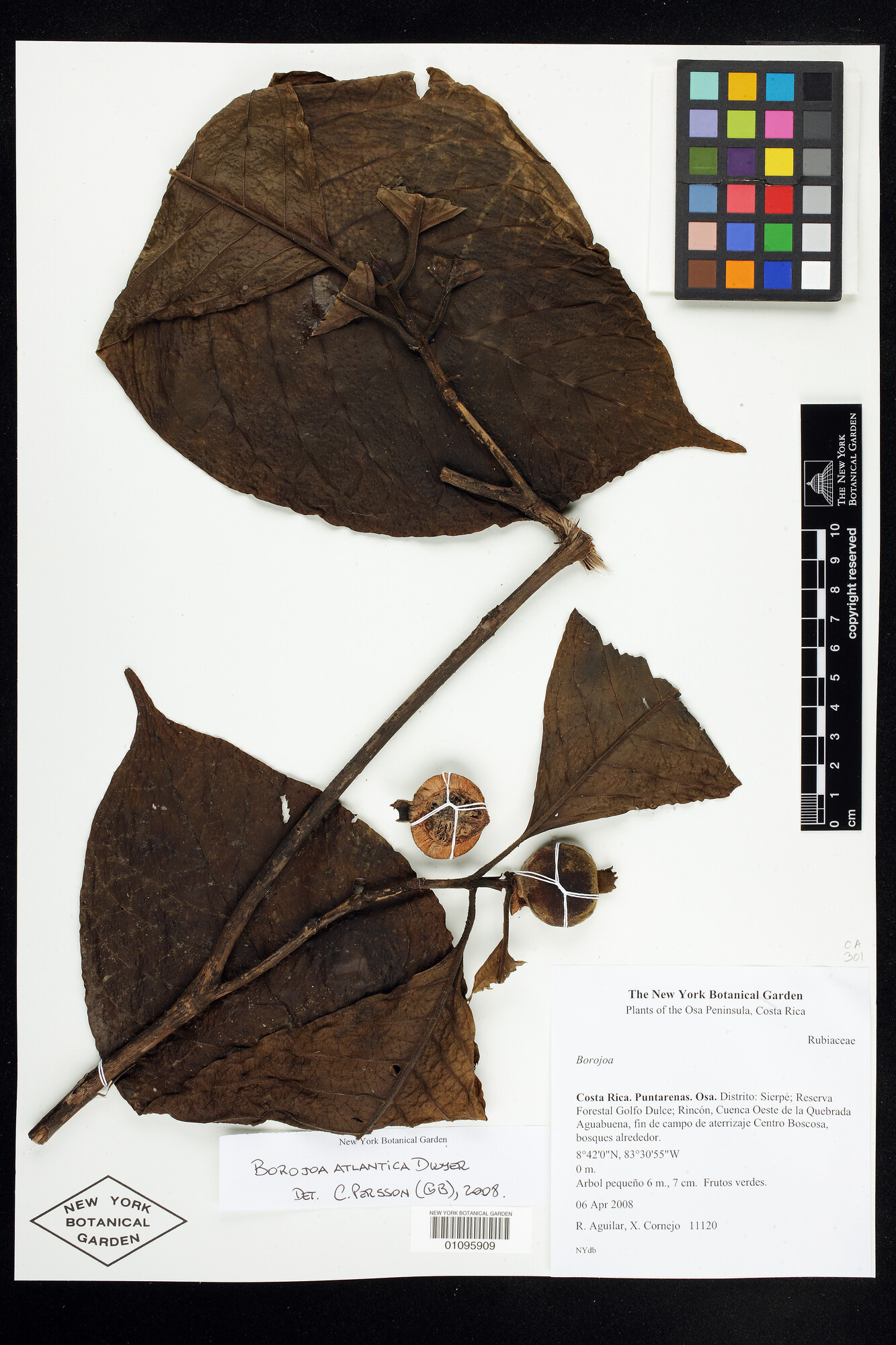
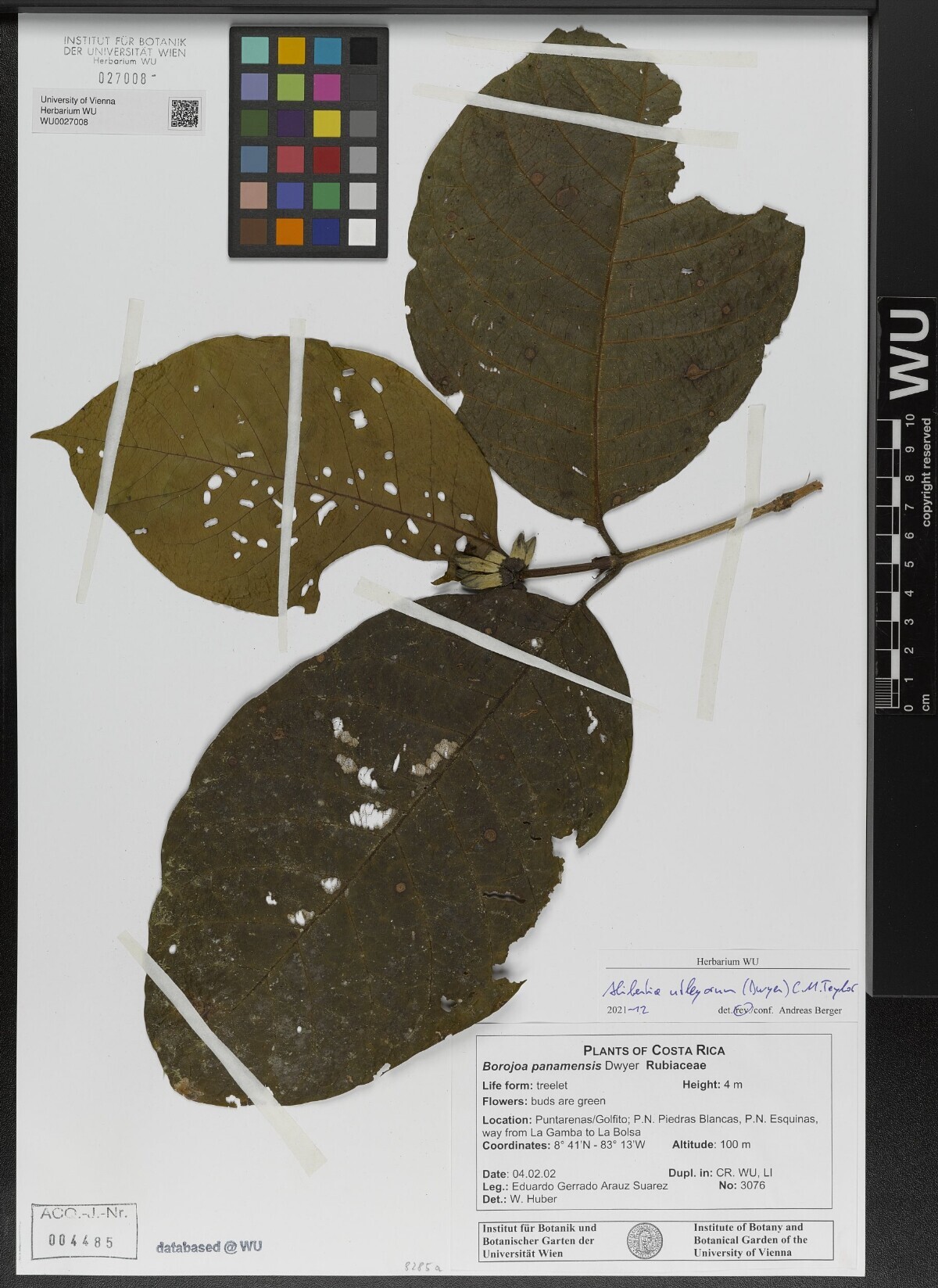
The leaves are large and elliptic, typical of the genus. Herbarium specimens show leaves with prominent curved lateral veins that arc toward the margin, a pattern shared with A. atlantica and other members of the borojó lineage. The triangular stipules (small appendages at the leaf base) that characterize Alibertia are visible on pressed specimens.
Flowers
Flowering material for A. utleyorum is scarce in herbaria. Based on genus-level morphology, male flowers likely occur in small cymes with white, fleshy corollas and 4-6 lobes, while female flowers bear sterile stamens and a functional pistil. No field photographs of flowers have been published.
Fruits
Alibertia species produce leathery or woody berries 5-15 centimeters in diameter with thick walls and numerous flattened seeds embedded in mucilaginous pulp. This architecture is shared with the cultivated borojó of Colombia, whose fruits are prized for their complex flavor. Whether A. utleyorum produces similarly palatable fruits remains unknown; its rarity and remote habitat mean no traditional use has been documented.
Distribution
Alibertia utleyorum is endemic to Costa Rica, with the vast majority of records concentrated in the Brunca region. GBIF data show 43 of 57 occurrences falling within the Osa Peninsula and surrounding areas: Reserva Forestal Golfo Dulce, Parque Nacional Piedras Blancas, Bahía Drake, and Rancho Quemado. Additional specimens have been collected from Limón Province on the Caribbean slope and from Heredia in the northern lowlands, suggesting the species may have a wider but sparse distribution in wet forests across the country.
The type locality is the airstrip at Rincón de Osa, where Ronald Liesner collected the holotype in 1974. This area remains a stronghold for the species, with multiple collections made in the adjacent Golfo Dulce Forest Reserve over subsequent decades. Costa Rican botanist Reinaldo Aguilar has been instrumental in documenting this species, contributing collections spanning 1992 to 2023, including the most recent specimen from Bahía Drake in November 2023.
Ecology & Phenology
Little is known about the ecology of A. utleyorum. The species occupies wet lowland forest between 20 and 300 meters elevation, in areas receiving over 4,000 mm of annual rainfall. Based on congeners, pollination is likely by insects, and the thick-walled fruits suggest dispersal by mammals that consume the pulp and pass the seeds. Studies of the cultivated borojó (A. patinoi) reveal that seeds in this genus are recalcitrant, with high moisture content (~44%) and rapid germination rates (96-99%) that cannot survive desiccation. If A. utleyorum shares this seed biology, it would be highly sensitive to forest fragmentation and canopy gaps that increase desiccation stress.
Phenological data are sparse. Flowering and fruiting periods have not been systematically documented, though herbarium specimens with reproductive material have been collected in February and April.
Taxonomic History
John Dwyer described this species in 1993 as Duroia utleyorum in his treatment of Costa Rican Rubiaceae for the Flora Costaricensis series (Fieldiana Botany, new series 33). He based the description on the holotype collected by Ronald Liesner at Rincón de Osa in 1974, deposited at the National Museum of Costa Rica (CR 1185021), with isotypes at Missouri Botanical Garden (MO) and the University of Texas (LL, TEX).
In 1996, Charlotte Taylor transferred the species to Alibertia when phylogenetic work by Claes Persson and others showed that Duroia was nested within Alibertia. This broader circumscription of Alibertia was formalized in Flora Neotropica Monograph 119 (2017), which treats the entire "Alibertia group" including former members of Borojoa and Duroia.
Etymology
The epithet utleyorum honors the American botanist couple John F. Utley (b. 1944) and Kathleen Burt-Utley (b. 1944), both Professor Emeriti at the University of New Orleans. John Utley, a Duke University graduate, authored the Bromeliaceae treatment for Flora Mesoamericana (1994) and published extensively on Central American epiphytes. Kathleen Burt-Utley specialized in Begoniaceae, describing numerous species from Costa Rica and Mexico. The genitive plural ending (-orum) indicates that both are honored. Their contributions to Central American botany were further recognized in 1977 when the monotypic genus Utleya (Ericaceae) was named for them, containing the Costa Rican endemic U. costaricensis. Other species bearing the epithet utleyorum include Disterigma utleyorum (Ericaceae) and Anthurium utleyorum (Araceae).
Conservation Outlook
The IUCN Red List classifies Alibertia utleyorum as Vulnerable (VU), reflecting its restricted range and dependence on intact wet forest. The species' stronghold on the Osa Peninsula benefits from protection within Corcovado National Park, Piedras Blancas National Park, and the Golfo Dulce Forest Reserve. These protected areas encompass much of the remaining wet lowland forest on Costa Rica's Pacific slope.
Threats include forest fragmentation outside protected areas, gold mining in buffer zones, illegal logging, and climate change impacts on lowland wet forest ecosystems. The species' dioecious reproduction means that both male and female trees must persist in proximity for successful seed set, making small isolated populations vulnerable to functional extinction even if individual trees survive. If the species shares the recalcitrant seed biology of its congeners, forest fragmentation poses an additional risk by creating desiccating conditions unsuitable for seed establishment. Organizations like Osa Conservation have trained 30 Rainforest Protectors who patrol nearly 70,000 kilometers annually to combat poaching and illegal resource extraction in the region.
Documentation of flowering phenology, pollinator identity, and seed dispersers would help guide conservation efforts. The single iNaturalist observation from Rancho Quemado (2025) suggests that citizen science may help fill knowledge gaps about this poorly known endemic.
Resources & Further Reading
Taxonomy & Nomenclature
Accepted nomenclature, synonymy, and distribution according to Kew's taxonomic backbone.
Type specimen citations and nomenclatural history from Missouri Botanical Garden.
Original description of Duroia utleyorum and key to Costa Rican Duroia species.
Publication transferring the species to Alibertia.
Comprehensive taxonomic treatment of the genus including molecular phylogeny.
Conservation
Conservation assessment classifying the species as Vulnerable (VU).
Ecology
Study of recalcitrant seed biology in a congener, with implications for A. utleyorum conservation.
Data Portals
Occurrence records and herbarium specimen images from collections worldwide.
Citizen science observations from Costa Rica's Pacific lowlands.