Mountain Borojó
Alibertia dwyeri is a dioecious understory tree of lowland wet forests from Nicaragua to Colombia, bearing large globular fruits with edible mucilaginous pulp that local communities blend into beverages. Its ridged stipules and leathery leaves distinguish it from the more famous borojó of the Chocó.
Deep in the wet forests of southern Costa Rica, where annual rainfall exceeds 4,000 mm and the canopy drips year-round, Alibertia dwyeri grows as an inconspicuous understory tree. Unlike its celebrated relative Alibertia patinoi, whose fruits have achieved commercial fame across Colombia and Ecuador, the mountain borojó remains largely unknown beyond the botanical community. The vernacular name "borojó de montaña," documented by the Smithsonian Tropical Research Institute in Panama, distinguishes this species from the commercial borojó despite both being lowland trees. For the rural communities of the Osa Peninsula and the Golfo Dulce lowlands, the tree offers the same gifts: large, sweet-sour fruits whose mucilaginous pulp can be blended into refreshing beverages.
The species ranges from southeastern Nicaragua through Costa Rica and Panama into Colombia's Pacific lowlands. In Costa Rica, GBIF records cluster in Parque Nacional Piedras Blancas and the surrounding Esquinas forest, with additional collections from La Selva Biological Station, the Talamanca highlands, and the Chirripó foothills. The tree favors primary and old secondary forest between sea level and about 800 meters elevation, typically growing in the shaded understory where humidity remains consistently high.
Identification
Leaves
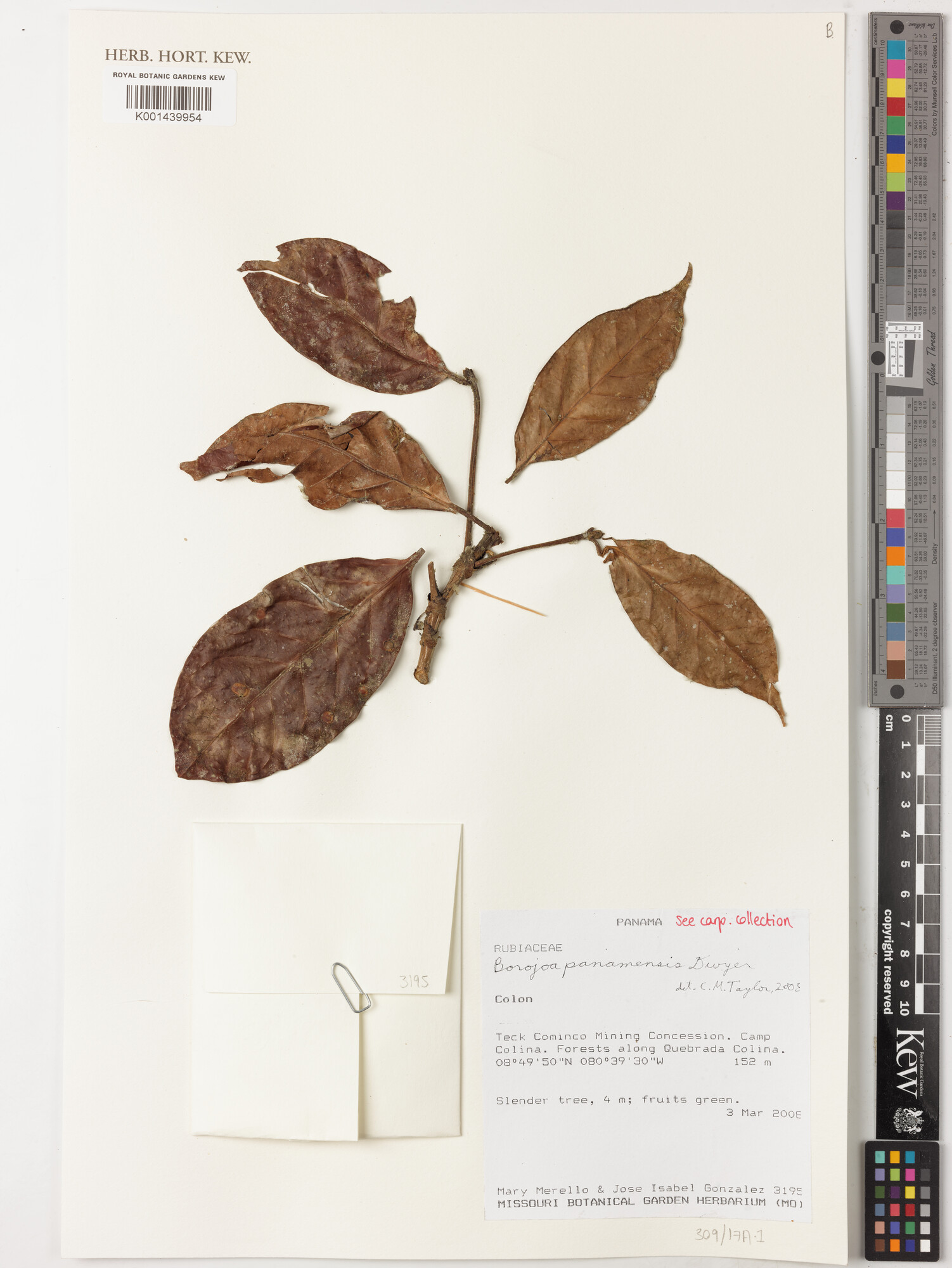
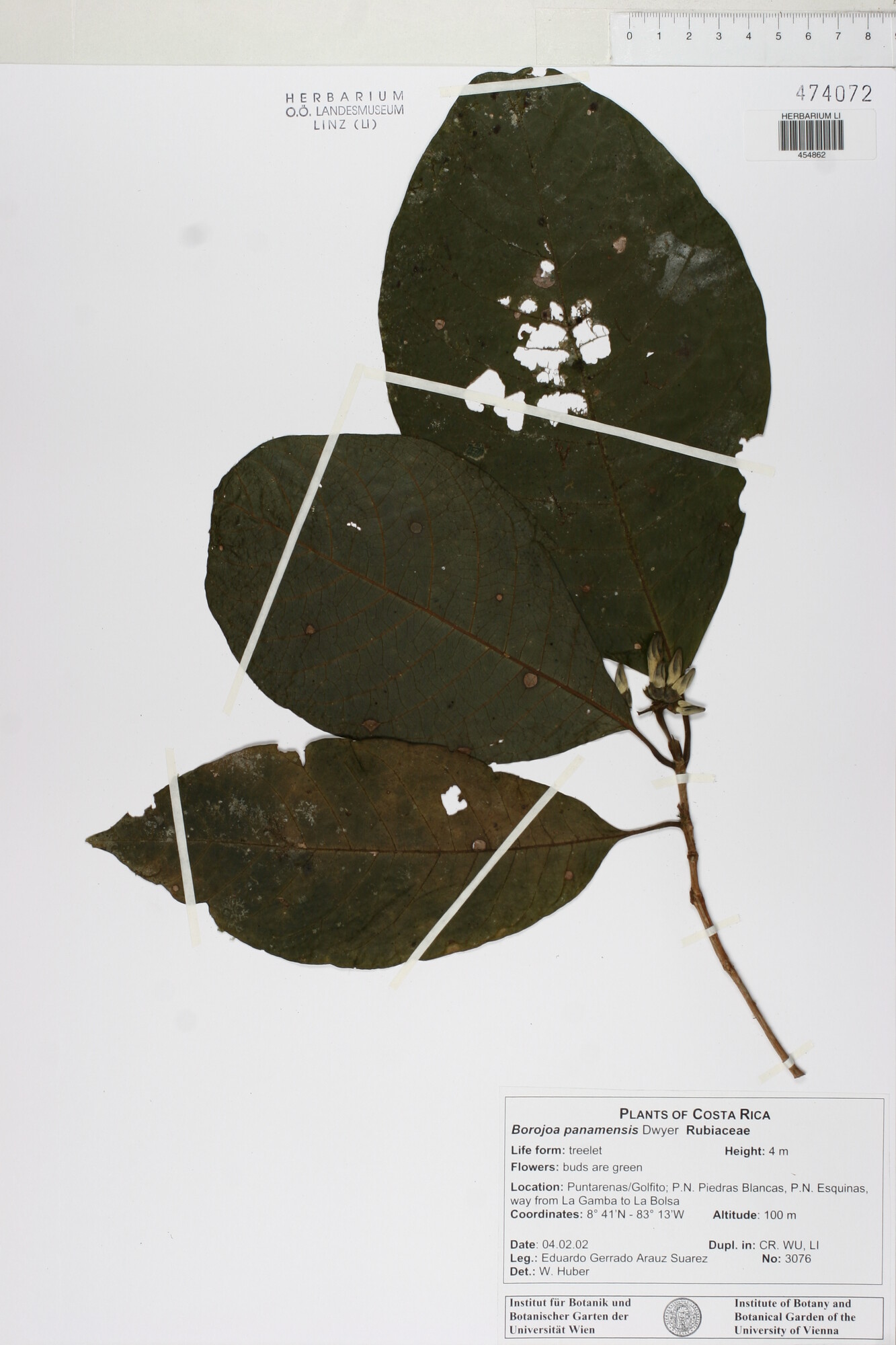
Leaves are simple, opposite, and measure 7-20 cm long by 5-14 cm wide. The blades are elliptical to ovate with entire margins and a leathery texture. Prominent lateral veins curve toward the apex, and the undersurface may show fine pubescence along the midrib. Small domatia (tiny pockets that house beneficial mites) occur as hair tufts in the axils of secondary veins. Stipules are distinctive: persistent, triangular, 2-3 cm long, and longitudinally ridged (costulate), a character that helps distinguish this species from similar Rubiaceae.
Flowers
The species is dioecious, with male and female flowers on separate trees. Male flowers are grouped in capitate (head-like) inflorescences, a characteristic of the genus Alibertia. Female flowers are solitary or few, producing the distinctive large fruits. Flowering occurs from April through September.
Fruits
Fruits are globose berries, 4-7 cm in diameter, with a leathery or somewhat woody outer layer. They ripen from green to yellow. Inside, numerous seeds are embedded in a mucilaginous pulp that is edible and mildly sweet-sour. Like other members of the Alibertia group, the fruits are adapted for mammal dispersal, their size and fleshy pulp attracting forest-floor frugivores.
Distribution
Alibertia dwyeri ranges from southeastern Nicaragua through Costa Rica and Panama to the Pacific lowlands of Colombia. It is a species of lowland wet forest, rarely found above 800 meters elevation. In Costa Rica, the majority of collections come from the Golfo Dulce region, particularly Parque Nacional Piedras Blancas and the adjacent Esquinas forest, with specific records from Rincón de Osa, Aguabuena, and Rancho Quemado. The species also occurs at La Selva Biological Station in the Atlantic lowlands, Tortuguero's Lomas de Sierpe, Barra del Colorado, and along the Los Patos trail in Parque Nacional Corcovado. Additional records exist from the Monteverde region and the Talamanca foothills.
A January 2026 query of GBIF returned 97 occurrence records for the species, with the largest cluster in Costa Rica (77 records), followed by Panama (12 records, particularly in Darién and Coclé provinces). The tree appears genuinely rare or overlooked, with most collections made by dedicated botanical surveys rather than casual observation.
Ecology
As a dioecious species, Alibertia dwyeri requires pollinators to transfer pollen between male and female trees. Little has been published on the specific pollinators of this species, but related Alibertia are visited by bees and other insects attracted to the fragrant flowers. The capitate male inflorescences produce abundant pollen, while female flowers offer nectar rewards.
The large fleshy fruits suggest mammalian dispersal. In the wet forests of southern Costa Rica, potential seed dispersers include agoutis (Dasyprocta punctata), pacas (Cuniculus paca), and various primates. The mucilaginous pulp likely passes through the gut intact, with seeds germinating in forest gaps where light penetrates the canopy.
Uses
The common name "borojó" derives from the Embera language of Colombia's Chocó region, where boro means "head" and jo or ne means "fruit," describing the large globular shape. Local communities in Panama and Costa Rica use the ripe fruits to prepare beverages. The pulp, described as having a pleasant sweet-sour flavor similar to other borojó species, is blended with water and sugar to make a refreshing drink.
Taxonomic History
John Duncan Dwyer first described this species as Borojoa panamensis in 1968, publishing it in Phytologia (volume 17, page 446). The genus Borojoa, established by José Cuatrecasas in 1949, was long treated as distinct from Alibertia. However, Charlotte Persson's molecular phylogenetic analysis of the Gardenieae tribe, published in the American Journal of Botany in 2000, demonstrated that Borojoa was nested within Alibertia, making the latter genus paraphyletic as traditionally circumscribed.
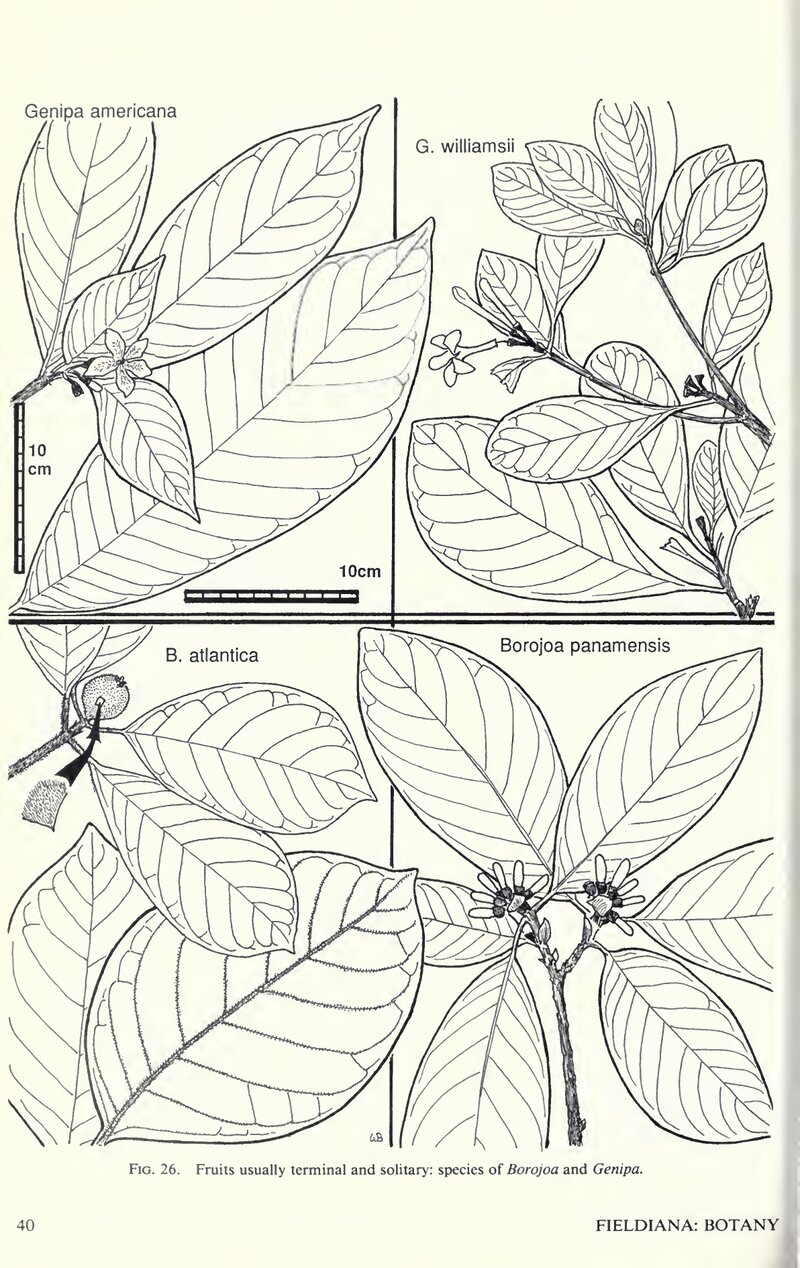
In 2011, Piero Delprete and Charlotte Taylor published a major revision of the Alibertia group in Novon, formally synonymizing Borojoa with Alibertia and transferring all species to the expanded genus. Because the name Alibertia panamensis was already occupied by a different species, they provided the replacement name Alibertia dwyeri, honoring the original author. The specific epithet commemorates John Duncan Dwyer (1915-2005), an American botanist who earned his PhD from Fordham University in 1941 and spent his career as a research associate at the Missouri Botanical Garden. Dwyer led more than twenty botanical expeditions to Panama, collecting some 6,000 specimens from difficult-to-reach areas, and was elected a Fellow of the Linnean Society in 1984.
Similar Species
Alibertia dwyeri can be confused with Alibertia edulis, a more widespread shrub to small tree with smaller fruits (2-4 cm diameter). A. edulis often grows in drier, more seasonal forests and reaches only about 6 meters in height, whereas A. dwyeri can reach 15 meters in optimal conditions. The ridged, persistent stipules of A. dwyeri are distinctive. Agouticarpa curviflora, another Rubiaceae of wet forests, has caducous (early-falling) stipules rather than persistent ones, and differently shaped flowers.
Conservation Outlook
Alibertia dwyeri has not been assessed by the IUCN. Its apparent rarity may reflect genuine scarcity or simply insufficient botanical survey effort in its preferred habitat of lowland wet forest. The species occurs within several protected areas, including Parque Nacional Piedras Blancas, La Selva Biological Station, and parts of the Talamanca highlands, which provides some de facto protection.
Deforestation in the Golfo Dulce lowlands and continued conversion of wet forest to agriculture or pasture represent the primary threats. As an understory species dependent on closed-canopy forest, A. dwyeri cannot persist in fragmented or degraded landscapes the way more disturbance-tolerant species can. Maintaining connectivity between forest patches in the Osa-Golfito corridor will be important for the species' long-term survival.
Resources & Further Reading
Species Information
Species account with morphological description, distribution, and similar species from the STRI portal.
Taxonomy & Nomenclature
Global occurrence records and distribution data.
The 2011 publication by Delprete & Taylor establishing the new name Alibertia dwyeri.
Molecular phylogenetic analysis demonstrating that Borojoa is nested within Alibertia.
Related Reading
Comprehensive monograph treating all genera of the Alibertia group (2017).