Atlantic Alibertia
Alibertia atlantica stitches the borojó lineage across Costa Rica’s Caribbean ridges: a dioecious shrub or tree, usually 3 to 12 meters tall and occasionally reaching 18 meters, whose leaves, flower clusters, and berries link Sarapiquí and Osa to southeastern Nicaragua and Panama.
Herbarium records and occurrence maps trace Alibertia atlantica around the humid Atlantic rim, from Nicaragua's Río San Juan basin through Sarapiquí, Boca Tapada, the Cabécar highlands, and Bahía Chal in Osa, then south to Panama's Colón ridges.
Up close it recalls its Colombian cousin, the cultivated borojó: leaves 12–32 centimeters long carry 6 to 14 secondary veins per side with pubescent domatia, while male shoots end in two-to-six-flowered cymes beneath persistent stipules.
The fruits are solitary, globose to slightly obovoid berries 3 to 6 centimeters across.
Identification
Habit and Bark
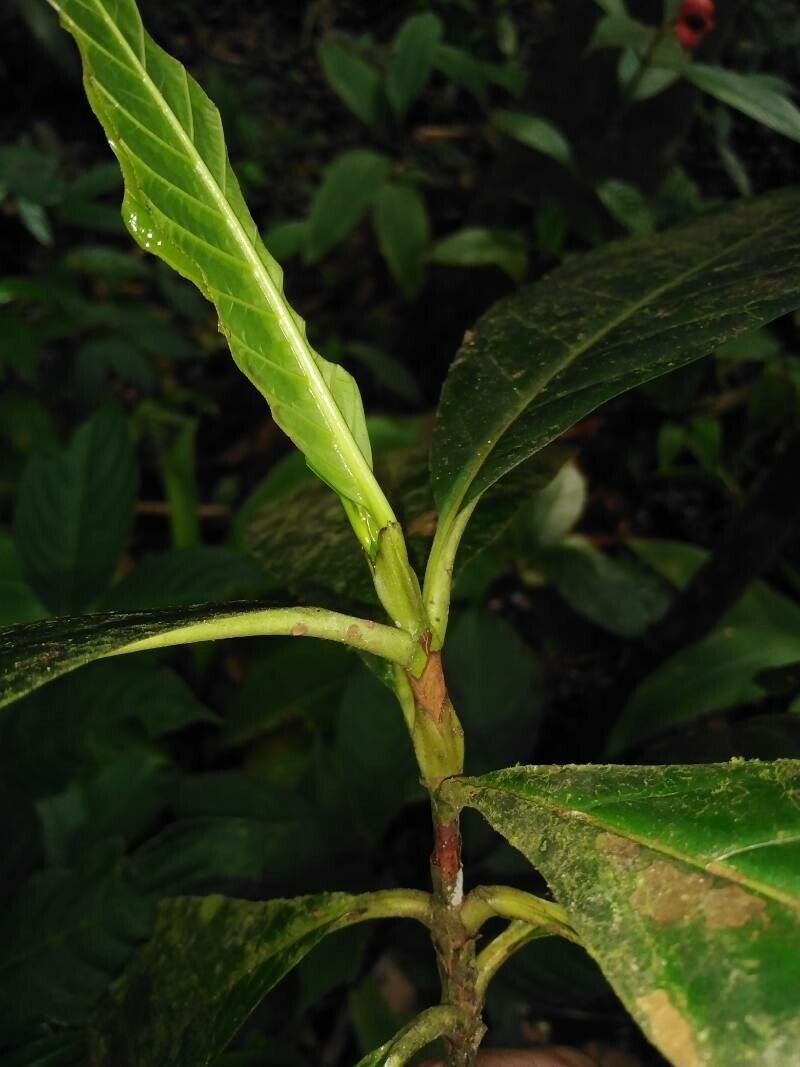
Alibertia atlantica grows as a shrub or tree reaching 3 to 12 meters tall, occasionally 18 meters. Its branchlets are hairless. Ovate stipules (small leafy appendages) 10 to 28 millimeters long have abruptly acute, or rarely acuminate, tips.
Leaves
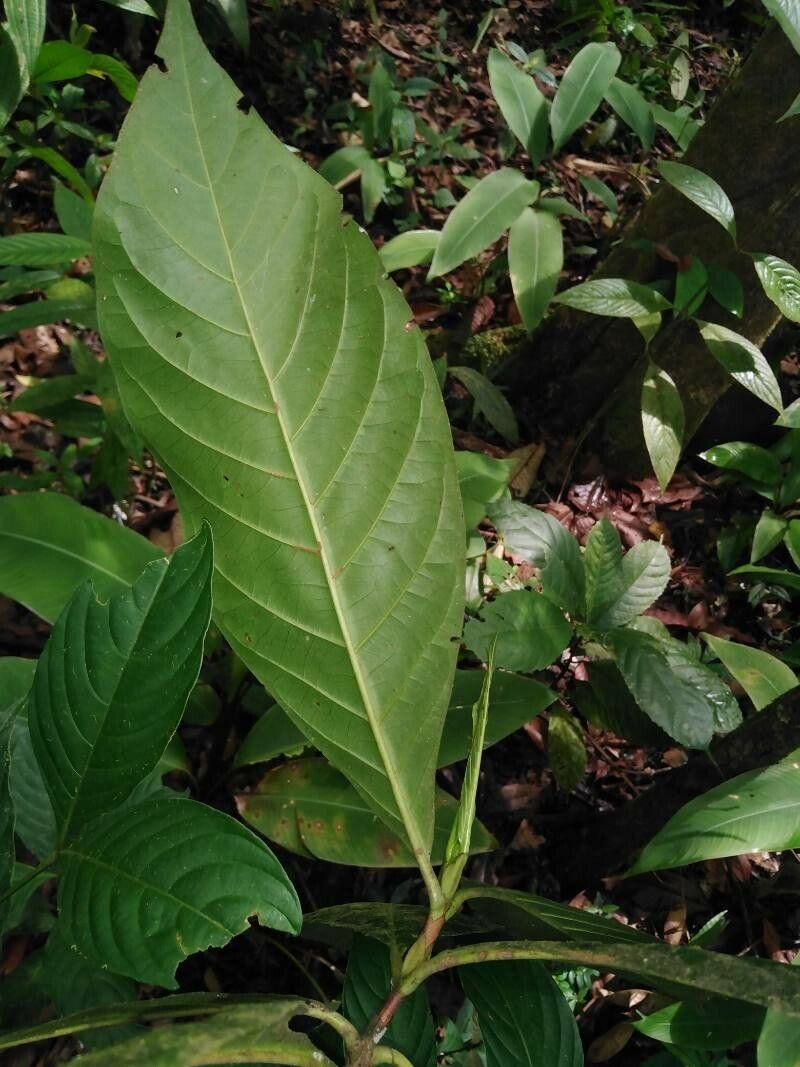
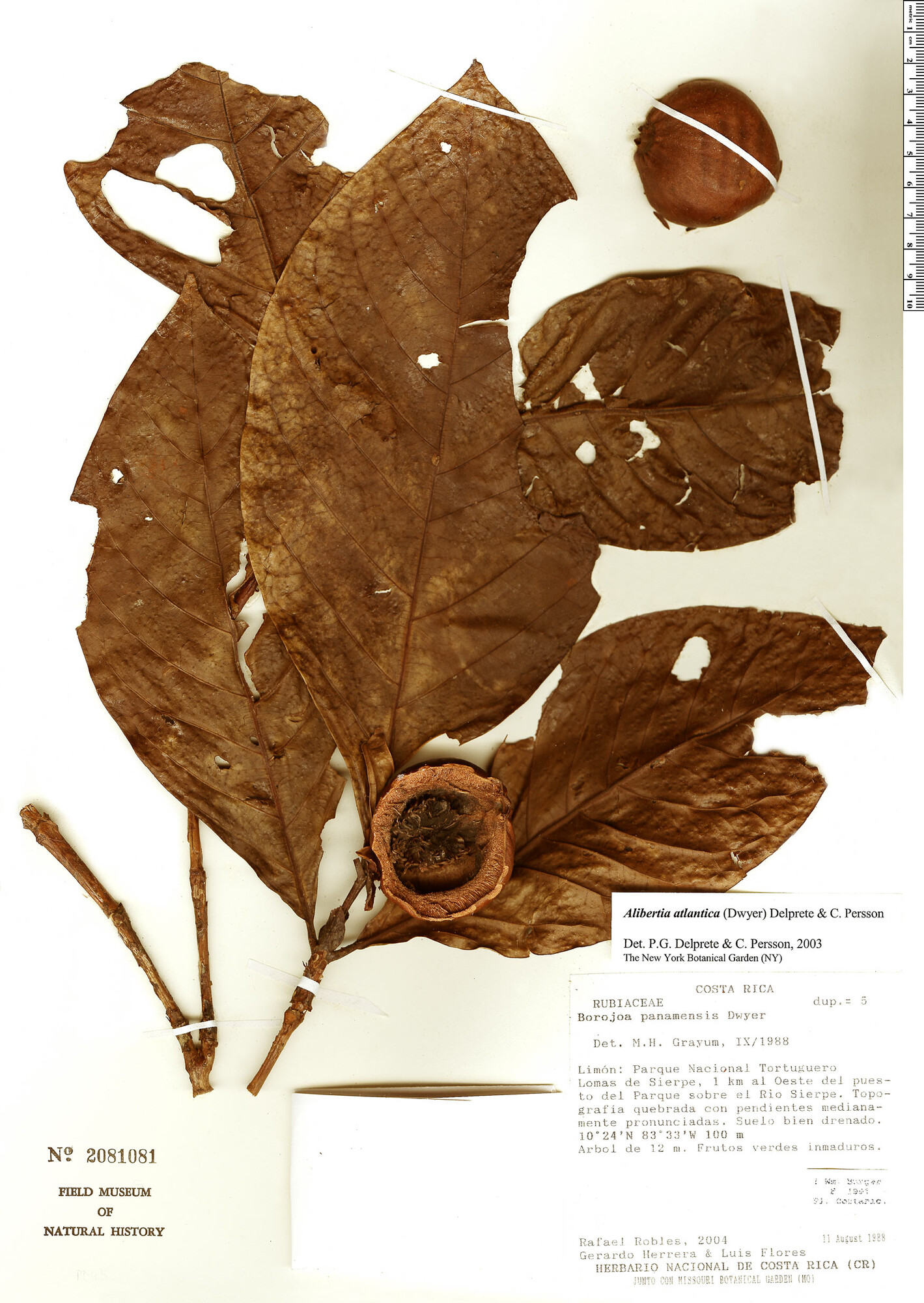
The leaves are large, 12 to 32 centimeters long and 6 to 17 centimeters wide, with an ovate to broadly elliptic outline. They are hairless except for pubescent domatia beneath and carry 6 to 14 secondary veins per side.
A key identification feature: each vein axil (where secondary veins meet the midrib) carries a small tufted pocket called a domatium. These tiny shelters house beneficial mites that help protect the leaf from herbivores. The tufted domatia separate A. atlantica from glossier species like Genipa that lack them.
Flowers
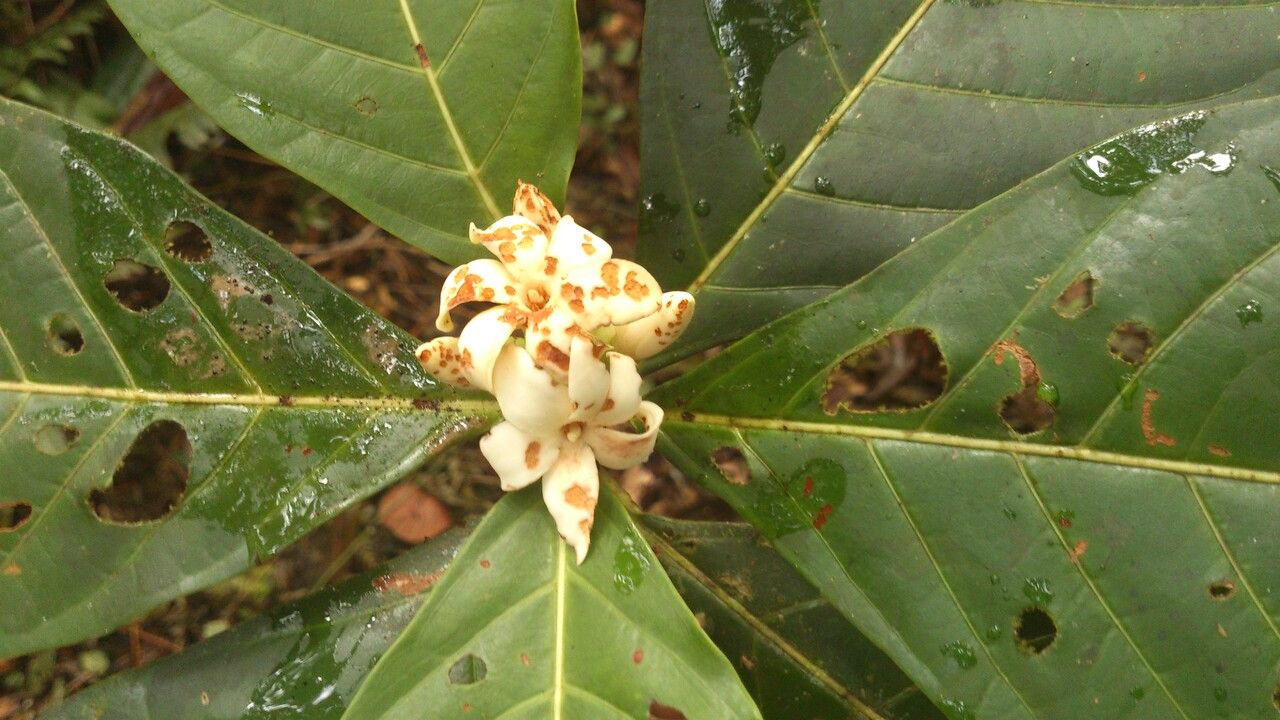
The species is dioecious, meaning male and female flowers grow on separate trees. Male flowers cluster in small cymes (branched flower clusters) of two to six blooms. Each staminate flower has a 2.5–10 millimeter calyx limb and a five-lobed corolla with a 12–20 millimeter tube and 10–20 millimeter lobes. Persistent stipules sit beneath the terminal flower clusters.
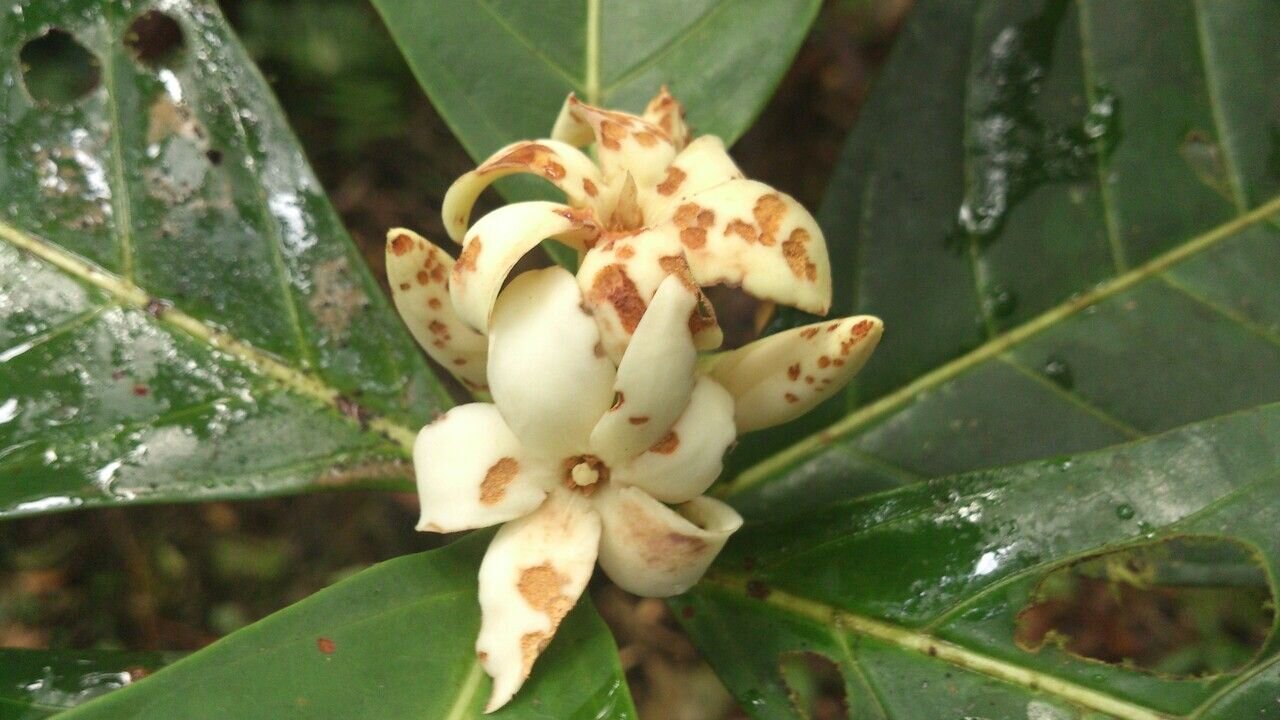
Female flowers remain poorly documented in Costa Rica. The current Costa Rican flora records flowering from May through September, while an older treatment reports Costa Rican fruiting material collected in June.
Fruits
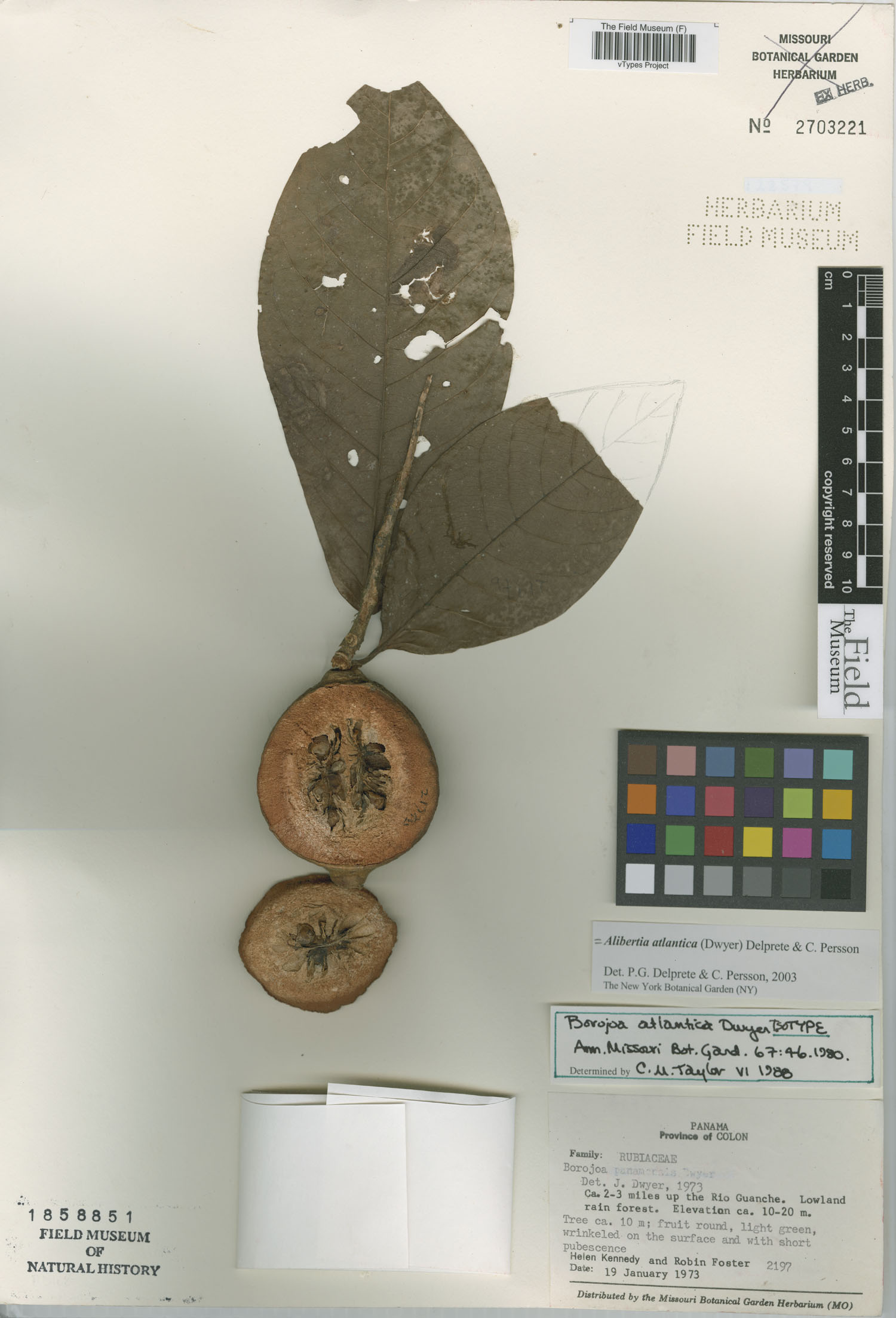
The fruits are solitary, globose to slightly obovoid berries 3 to 6 centimeters across. Their form resembles that of the cultivated borojó of Colombia's Chocó region, Alibertia patinoi. Borojó fruit is used in juices, marmalades, and the traditional "jugo de amor," but the botanical sources reviewed for this article do not document whether A. atlantica is palatable or used in cooking.
Distribution
Kew’s checklist and La Selva’s digital flora agree on a range from southeastern Nicaragua’s Río San Juan through Costa Rica to central Panama, with Costa Rican records spanning the Caribbean slope (La Selva station, Selva Verde, La Tirimbina, Cerro Negro) and southward to Bahía Chal on the Golfo Dulce coast.
GBIF adds dozens of herbarium and photo records. They include Boca Tapada and San Carlos, with plots inside the Crucitas mining concession; Sarapiquí; the trail between San Miguel Cabécar and Cerro Mirador; and Panama's Colón mining cordillera.
Ecology & Phenology
La Selva field crews consider the species “ocasional” and report that it has been collected more frequently on hills occupied by primary forest; GBIF includes at least one record from mixed primary and secondary forest.
Plants are dioecious. The current Costa Rican flora records flowers from May through September, while an older treatment reports Costa Rican fruiting material collected in June.
Pl@ntNet submissions show staminate flowers from Sarapiquí in 2013–2014 and vegetative shoots from Boca Tapada in 2023. However, the Costa Rican GBIF and Pl@ntNet records reviewed for this article did not include a receptive stigma or ripe fruit section, images that could help clarify pollination and dispersal.
Taxonomic History
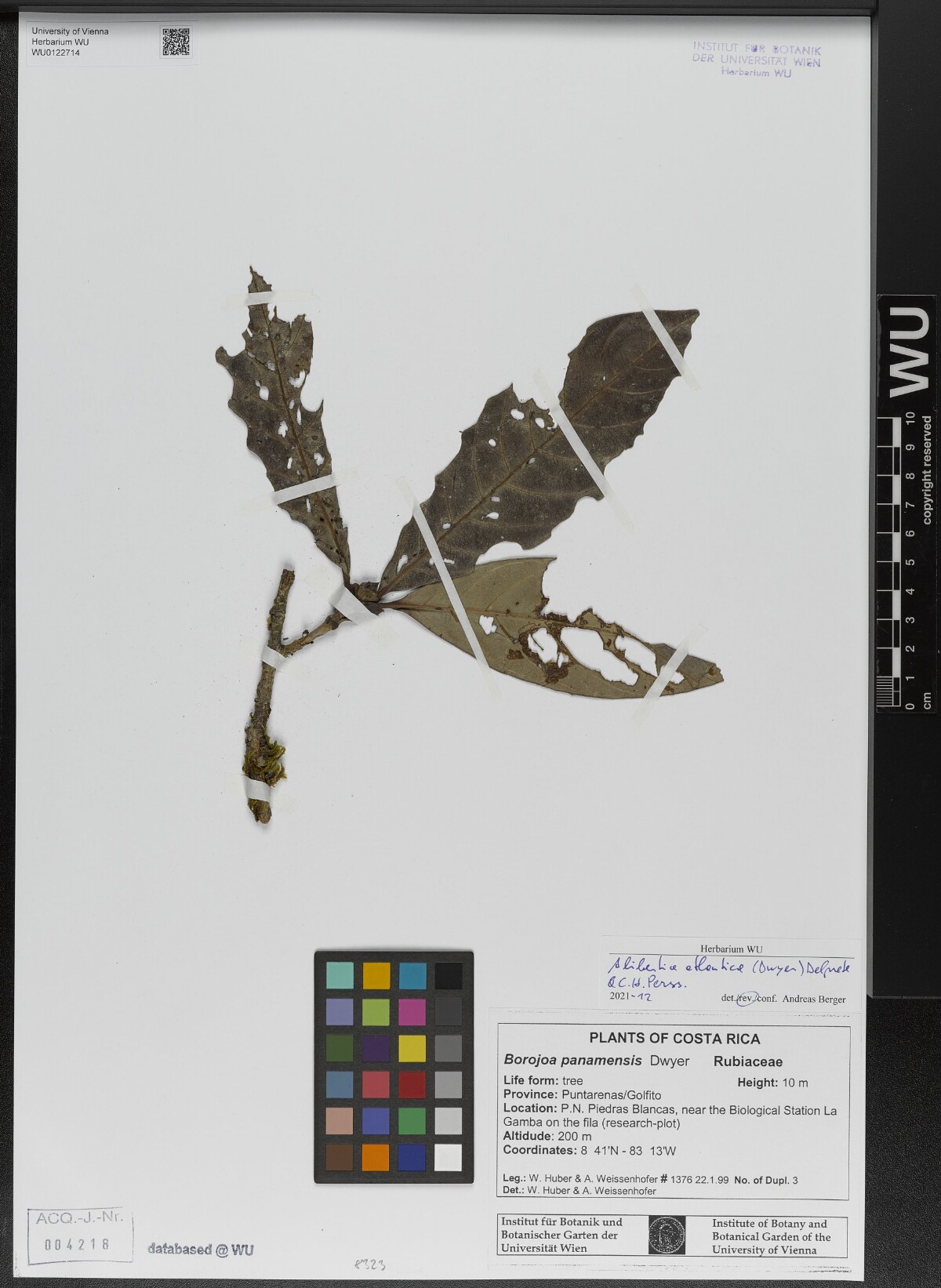
John Dwyer described the species in 1980 as Borojoa atlantica, distinguishing it from B. panamensis by its more numerous lateral veins and noting that its fruits resembled those of B. patinoi, the cultivated borojó of Colombia.
Thirty years later, Delprete and C.H. Persson transferred the Atlantic material into Alibertia after molecular and morphological evidence placed Borojoa within that broader genus. Kew's Plants of the World Online and regional floras later adopted the change.
Conservation Outlook
The IUCN Red List assesses the species as Least Concern. Older or less certain signals differ: it appeared in the World List of Threatened Trees in 1998, and the Angiosperm Extinction Risk Predictions model labels it “threatened” with low confidence.
GBIF occurrence metadata records multiple vouchers along the Placer-Dome/Crucitas mining roads, in Panama's Teck Cominco concession, and at Bahía Chal. It identifies collection sites but does not establish current forest loss.
Documenting female flowers, ripe fruit, pollination, dispersal, and the condition of known populations would address the species' most important scientific gaps.
Resources & Further Reading
Florulas & Revisions
Local descriptions, phenology, and linked La Selva collection records curated by the Organization for Tropical Studies.
Current Costa Rican Rubiaceae treatment clarifying the species’ morphology, habitat, phenology, and the reassignment of material previously identified as Borojoa atlantica.
Older Costa Rican treatment with measurements and habitat notes; the 2014 Manual de Plantas de Costa Rica reassigns at least part of its material to Alibertia utleyorum.
Original diagnosis and type citations for the species, including comparisons with B. panamensis and B. patinoi.
Taxonomy & Conservation
Accepted nomenclature, synonymy, and native range, plus links to the Angiosperm Extinction Risk Predictions dataset.
Formal global assessment classifying the species as Least Concern.
Global machine-learning assessment that flags A. atlantica as threatened (low-confidence prediction).
Experimental evidence that leaf domatia can shelter mites that reduce herbivore damage.
Historical reference that listed Borojoa atlantica under Rubiaceae in an appendix of trees previously categorized Endangered or Vulnerable but not evaluated for the 1998 publication.
Data Portals
Downloadable herbarium vouchers and Pl@ntNet photo records from Nicaragua, Costa Rica, and Panama.
Field imagery of male cymes produced by SINAC botanists, available under CC BY-SA and mirrored in GBIF media.