Ajo
Caryocar costaricense — Costa Rica's endemic garlic tree, named for the pungent scent of its yellow flowers that attract bat pollinators in the night.
Deep in the lowland rainforests of Costa Rica's southern Pacific coast, a giant emerges from the canopy. The ajo tree rises 50 meters above the forest floor, its massive trunk supported by buttresses that can reach a person's height. In January and February, yellow flowers explode across its crown, releasing the distinctive garlic scent that gives this tree its name. At night, nectar-feeding bats converge on these fragrant blooms, drawn from across the forest to pollinate one of Central America's rarest trees.
The ajo belongs to the Caryocaraceae, a small family of tropical trees found almost exclusively in South America. Caryocar costaricense is the only member of its family to range north of Colombia, making it a botanical outlier whose ancestors somehow crossed into Central America millions of years ago. Today, it survives in scattered populations from Costa Rica to Panama, with the Osa Peninsula holding its largest remaining stands.
Identification
The Caryocaraceae is one of the smaller plant families in the Neotropics, containing only about 25 species in two genera. Most are found in the Amazon basin and the Guianas, where they play prominent ecological roles. The family's scientific name derives from the Greek karyon (nut) and kara (head), describing the characteristic nut-like fruit with its hard, woody shell. The species epithet costaricense honors Costa Rica, where botanist John Donnell Smith first described the tree in 1913.
Physical Characteristics
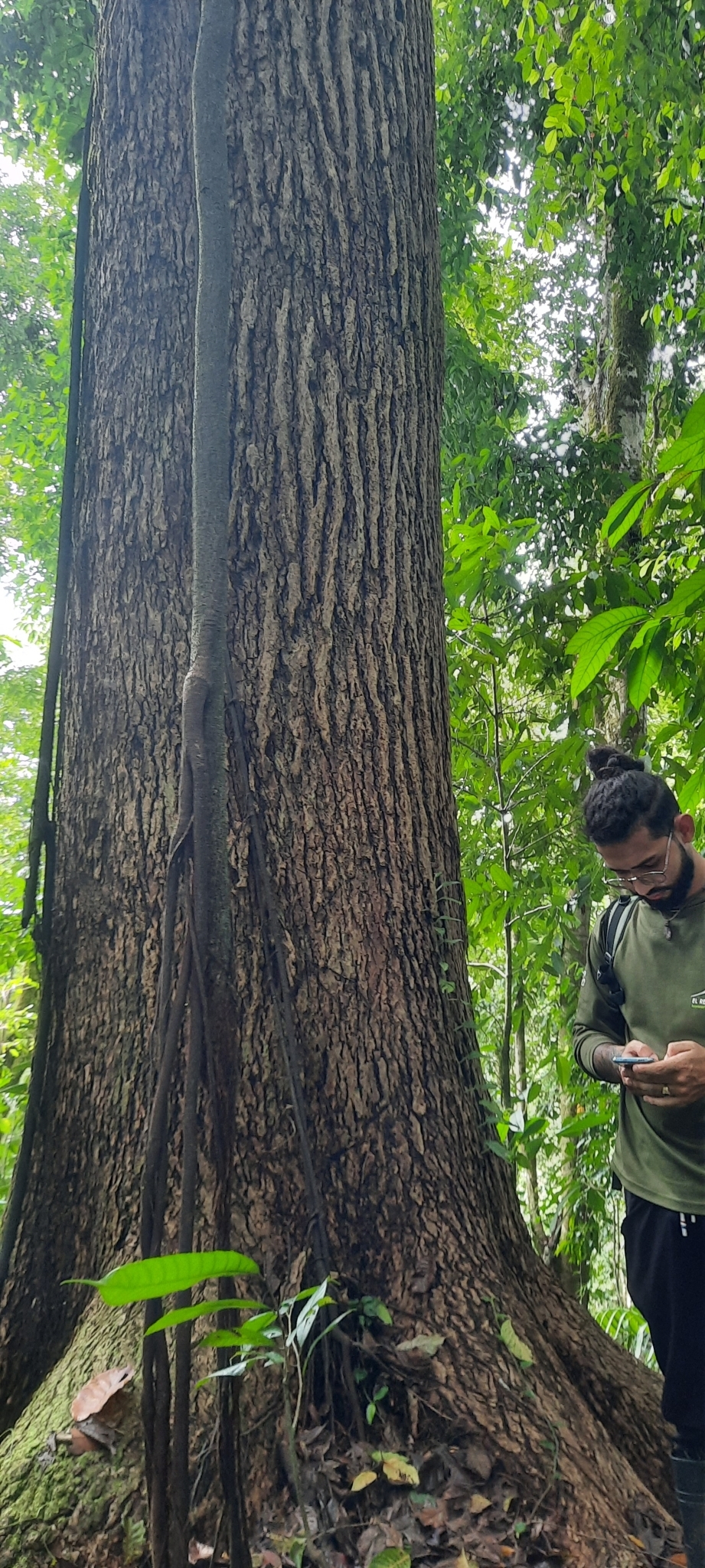
Trunk: Massive and columnar, reaching over 1 meter in diameter. The base features buttresses up to 1.5 meters tall that provide stability for the immense height. Unlike many smooth-barked tropical trees, the ajo develops deeply fissured, rough bark that resembles temperate oak more than a rainforest giant. As trees mature, cavities and crevices form in the trunk, creating habitat for bats.
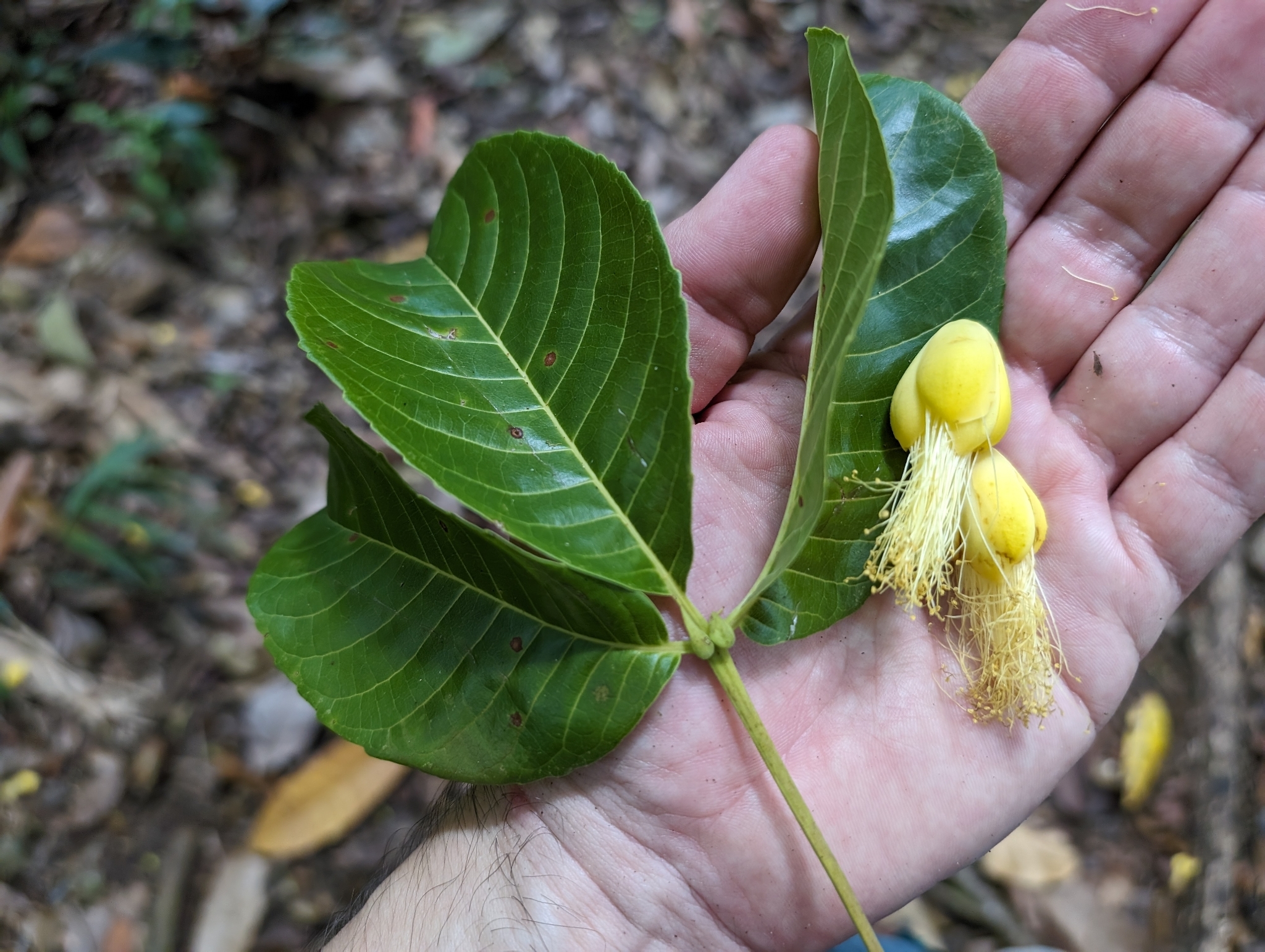
Leaves: Trifoliolate, meaning each leaf has three leaflets radiating from a central point. This distinguishes the ajo from most other large rainforest trees. The leaflets are large, leathery, and oval-shaped with serrated margins. Leaves are arranged oppositely on the branches and have small stipules at the base of the petiole.
Flowers: Large and showy, produced in clusters at branch tips during the dry season (January to March). Each flower has small, inconspicuous petals but hundreds of long, brush-like yellow stamens that spread outward, giving the blooms their distinctive appearance. The flowers emit a strong garlic-like odor, especially at night, attracting nectar-feeding bats that serve as the tree's primary pollinators.
Fruit: A large drupe measuring 5-8 cm, with a leathery outer skin, oily flesh, and a very hard, woody inner shell protecting the seed. The seeds are rich in oil and edible when cooked. Fruits mature from March to May, as the rainy season begins, and fall to the forest floor where they are consumed and dispersed by mammals.
Habitat & Distribution
The ajo is endemic to southern Central America, found primarily in Costa Rica and Panama. Some sources report populations extending into Colombia and Venezuela, though field surveys have not confirmed specimens in Colombian herbaria. In Costa Rica, it occurs along the central and southern Pacific slopes, with its stronghold in the Osa Peninsula. Corcovado National Park and the Golfo Dulce Forest Reserve contain the most significant remaining populations.
Ecosystem: Tropical wet forest and lowland evergreen rainforest. The ajo thrives in areas receiving 4,000-5,000 mm of annual rainfall with a brief dry season from January to March.
Elevation: Sea level to approximately 500 meters, typically below 200 meters in optimal habitat.
Succession stage: Late-successional species and primary forest indicator. The ajo requires decades to reach maturity and does not regenerate well in disturbed or fragmented forests. Its presence signals old-growth conditions.
Abundance: Rare. Research on the Osa Peninsula found maximum densities of only 4 trees per hectare for individuals greater than 50 cm diameter. Historical logging has removed the largest trees from most accessible areas.
Ecological Importance
The ajo plays a critical role in forest ecology despite its rarity. Its relationship with bats illustrates the complex interdependencies of tropical forests. The tree's trunk cavities provide roosting sites for bats, which in turn pollinate the garlic-scented flowers during their nocturnal forays. This mutualism has evolved over millions of years, binding the fates of tree and pollinator.
The Scarlet Macaw Connection
Research on the Osa Peninsula revealed a surprising finding: the ajo is one of the most important nesting trees for Scarlet Macaws (Ara macao). A 2006 study found that 24% of all macaw nests occurred in ajo trees, making it the most commonly used nesting species. One individual ajo tree contained four active nests. The tree's tendency to form large cavities as it ages creates ideal nesting habitat for these large parrots.
The ajo's nesting cavities form high in the trunk, averaging 24 meters above the ground. This height provides protection from ground predators and maintains the temperature stability that developing chicks require. When an ajo tree falls or is cut, multiple potential nesting sites disappear simultaneously.
Other Wildlife Interactions
Spider monkeys feed on the ajo's ripe fruits, consuming the oily flesh and inadvertently dispersing seeds. Scarlet Macaws eat the immature fruits directly from the tree. Agoutis and other ground-dwelling mammals consume fallen fruits, with some seeds escaping predation through burial and forgetting. Research suggests that many ungerminated seeds form a latent seed bank in the forest floor, protected by their woody endocarp until conditions favor germination.
Studies of ajo reproduction reveal extreme inequality among trees. In one research plot, just two trees contributed 72% of all fruits produced in a given year, while 30% of trees produced nothing. Only individuals larger than 30 cm diameter appear capable of reproduction, meaning decades must pass before a seedling can contribute to the next generation.
Conservation Status
The IUCN classifies Caryocar costaricense as Endangered, and the species is listed under CITES Appendix II, which regulates international trade. The primary threats are habitat loss through deforestation and selective logging for the tree's valuable timber. The wood is yellowish to light grayish-brown, extremely durable, and historically prized for heavy construction, bridges, railroad ties, and marine applications.
Research on the Osa Peninsula documented the effects of selective logging on ajo populations. Because loggers target the largest trees, extraction removes precisely the individuals most important for reproduction and wildlife habitat. Younger trees cannot compensate for the loss of these dominant reproducers. Recovery, if it occurs, will require generations.
The species now survives primarily in protected areas. Costa Rica's national park system and forest reserves provide refugia where remaining populations can persist, but even within reserves, past logging has left its mark. The ajo's future depends on strict protection of remaining old-growth forest and patience measured in centuries.
Key Sources & Resources
Species Information
-
Caryocar costaricense. iNaturalist.
Species page with observations, photographs, and distribution maps for the ajo tree.
-
Caryocar costaricense. Useful Tropical Plants Database.
Botanical information including uses, wood characteristics, and conservation status.
-
Caryocar costaricense. Osa Arboretum.
Local information from the Osa Peninsula including phenology and photographs.
Scientific Literature
-
Phenology and recruitment of Caryocar costaricense. Revista de Biología Tropical (2009).
Key research on reproduction, seed dispersal, and population dynamics in the Osa Peninsula.
-
Effects of selective logging on Caryocar costaricense. Forest Ecology and Management (2007).
Documents the impact of logging on population abundance and regeneration.
-
Scarlet Macaw Nest Characteristics in ACOSA. Revista de Biología Tropical (2009).
Research documenting the importance of ajo trees for Scarlet Macaw nesting on the Osa Peninsula.
Conservation & Legal Status
-
Aji (Caryocar costaricense). Forest Legality Initiative.
Legal status overview including CITES listing and national protections.
-
Ajo Tree Project. iNaturalist.
Community science project tracking ajo observations throughout its range.