The Dark Laurel
A rare tree known from only one specimen when first described, with fruits so striking they seem designed to catch the eye of hungry birds.
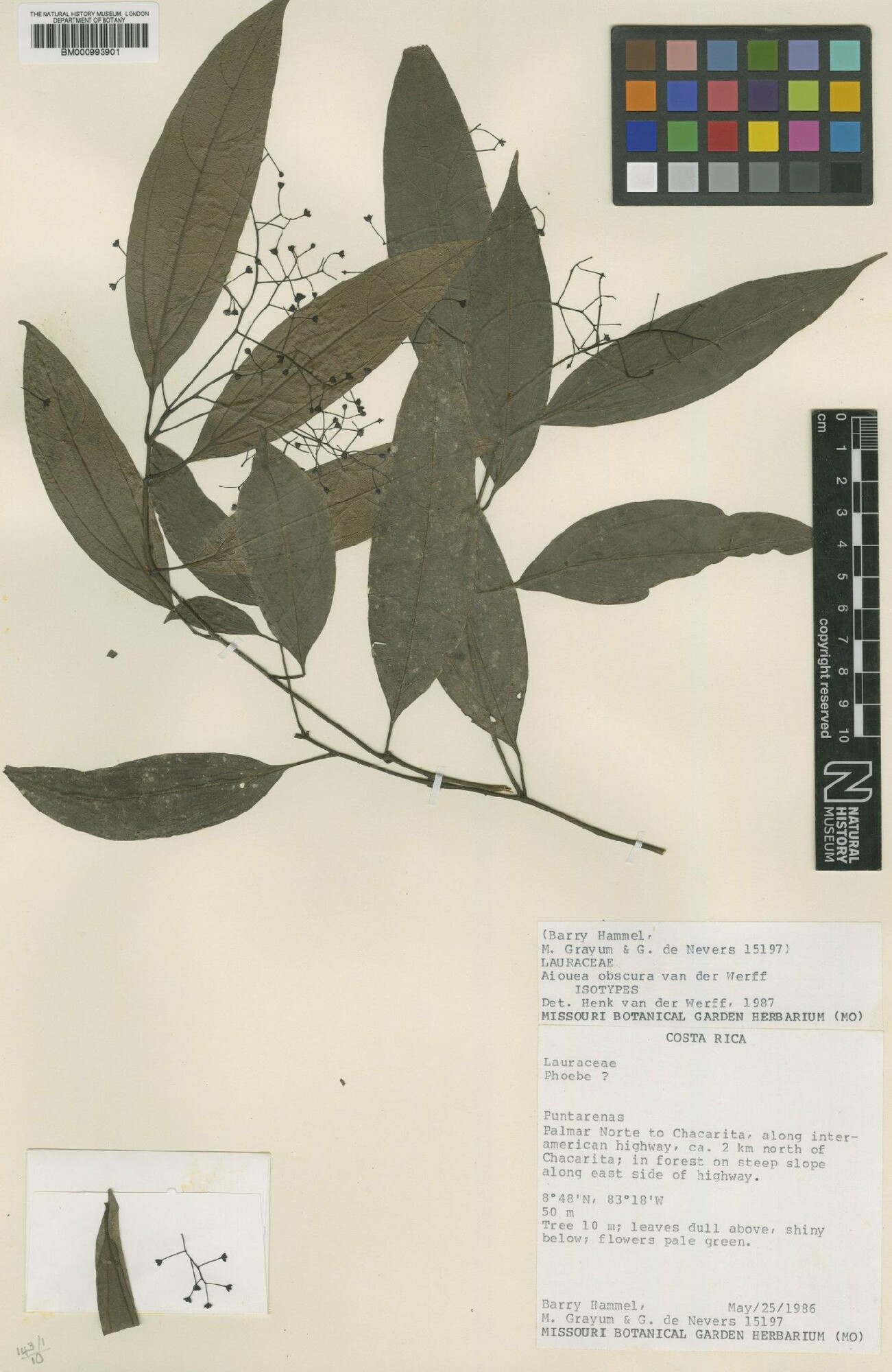
In May 1986, botanists Barry Hammel, Michael Grayum, and Greg de Nevers were exploring the steep, rain-soaked slopes southeast of Palmar Norte in Costa Rica's southern Pacific lowlands. On a forested hillside just 50 meters above sea level, they collected a flowering specimen of what they suspected was an undescribed laurel. Two years later, Henk van der Werff, one of the world's foremost authorities on the Lauraceae, confirmed their suspicion and named the tree Aiouea obscura, describing it from that single collection. The species epithet, from the Latin for "dark" or "shadowy," refers to the deep olive-green color the leaves take on when dried for herbarium preservation.
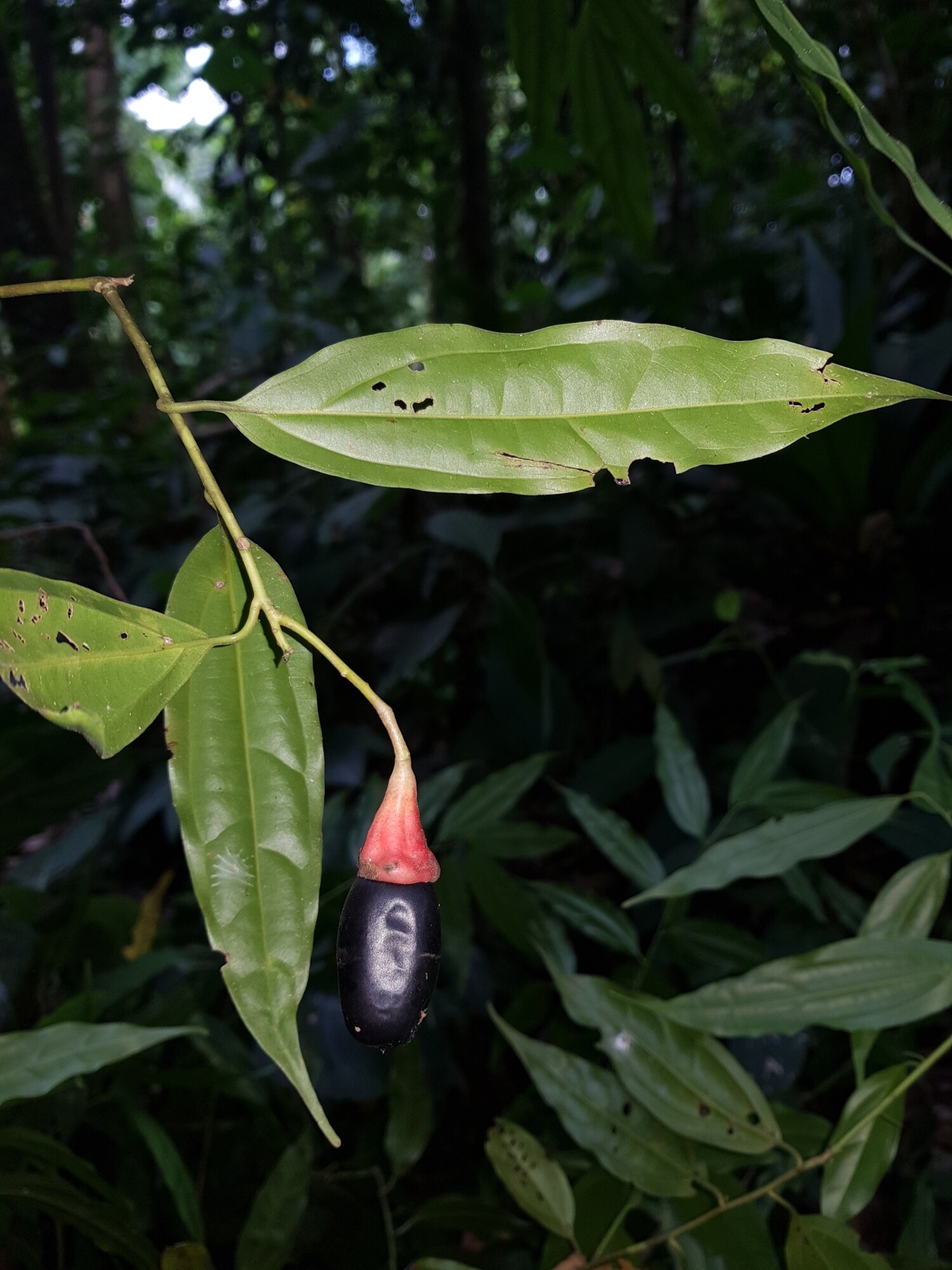
For years after its description, Aiouea obscura remained one of Costa Rica's most poorly documented trees. The original Flora Costaricensis treatment, published in 1990, noted that "fruits and fruiting cupules [are] unknown." Yet field photographs taken in recent decades have revealed what the herbarium specimens could not: when this tree fruits, it produces one of the most visually arresting displays in the Lauraceae. Each ripe drupe is a deep, glossy purple, cradled in a bright scarlet cupule that flares outward like a collar. The effect is unmistakable, a color combination that seems almost artificial in its intensity, yet perfectly evolved to attract the frugivorous birds that disperse its seeds through the lowland forests of the Osa Peninsula.
Identification
Habit
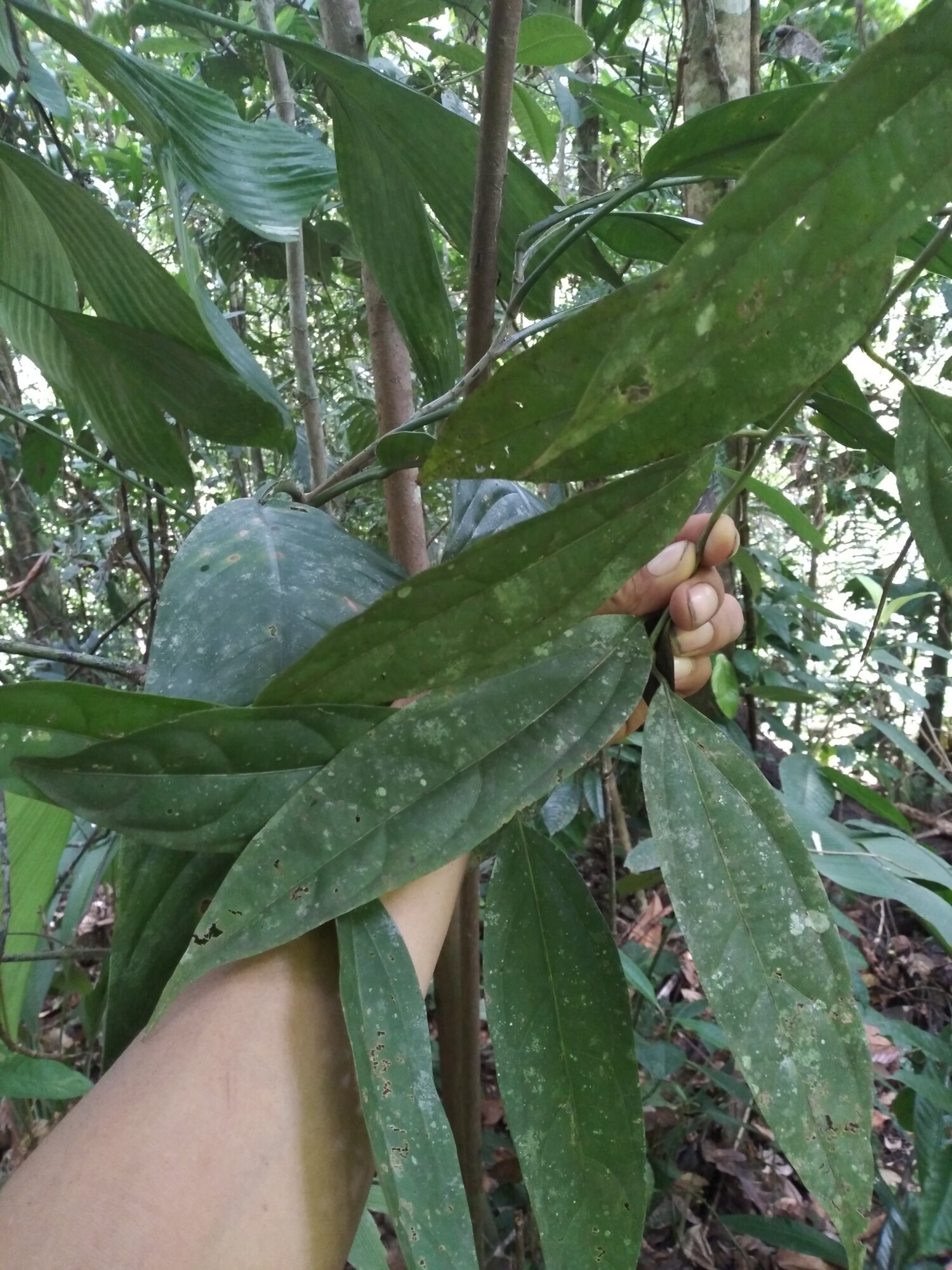
Aiouea obscura grows as a small tree reaching approximately 10 meters in height, typically found in the forest understory or lower midstory. The leafy branchlets are slender, measuring just 1-2 mm in diameter, glabrous (completely hairless), dark brown, and circular in cross-section. One of the most distinctive characteristics of this species is its unusual glabrous nature: the Flora Costaricensis treatment notes it is "an unusually glabrous species; the shoot apex is almost glabrous except for minutely ciliate margins of the young leaves." This smoothness extends throughout the plant, from the shoots to the leaves to the flower buds, setting it apart from many other Lauraceae that bear various types of pubescence.
Leaves
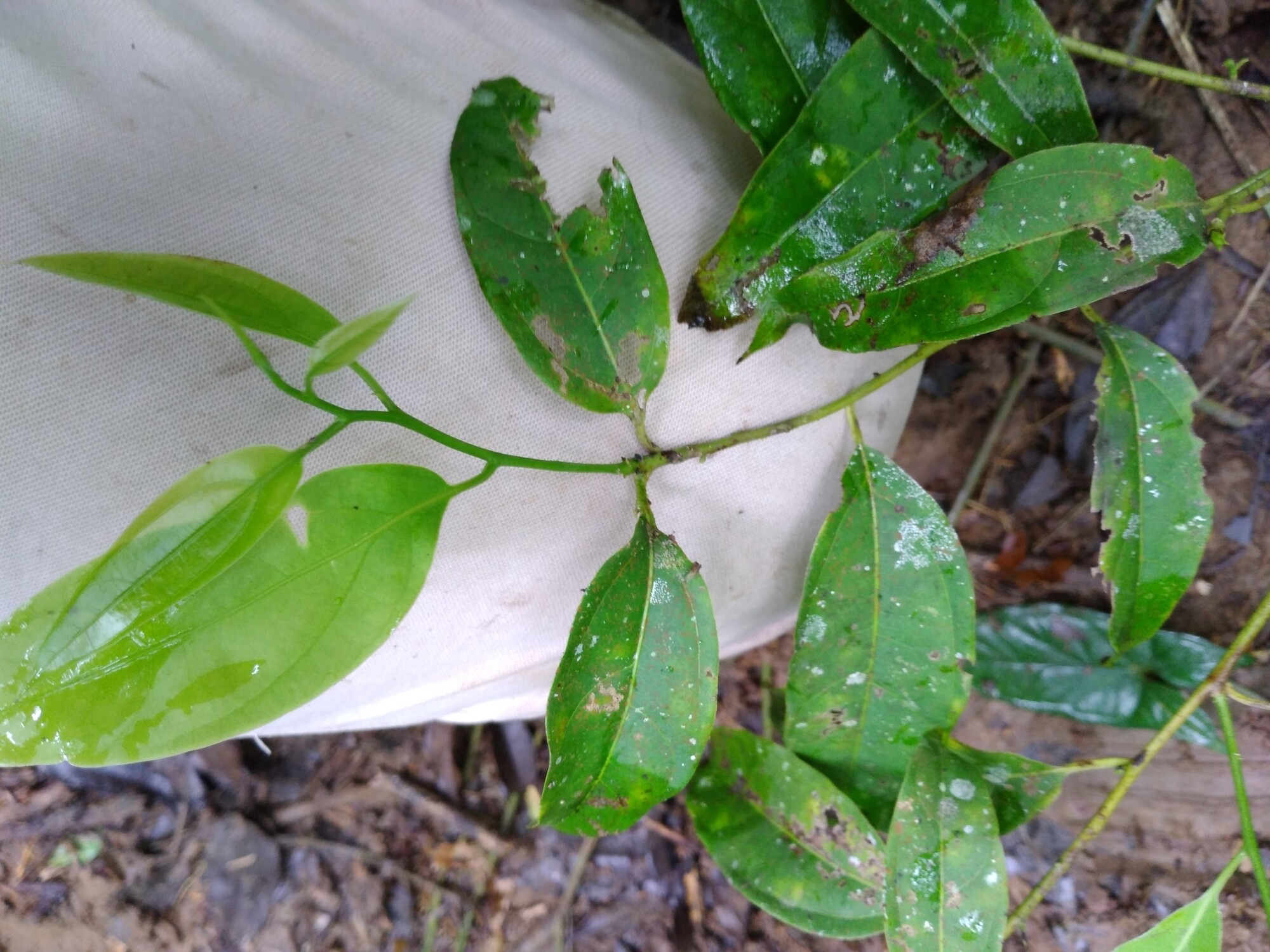
The leaves are arranged alternately along the stem, spaced relatively far apart, giving the branches an open appearance. Each leaf blade measures (8-)11-17 cm long and 2.5-5.3 cm broad, narrowly elliptic to narrowly elliptic-oblong in shape, tapering gradually to an acute or acuminate apex with a tip 5-10 mm long. The base is acute and slightly decurrent (running down) onto the petiole. The petioles themselves are 10-18 mm long and about 1 mm thick, terete (cylindrical) but flat or slightly grooved on the upper surface.
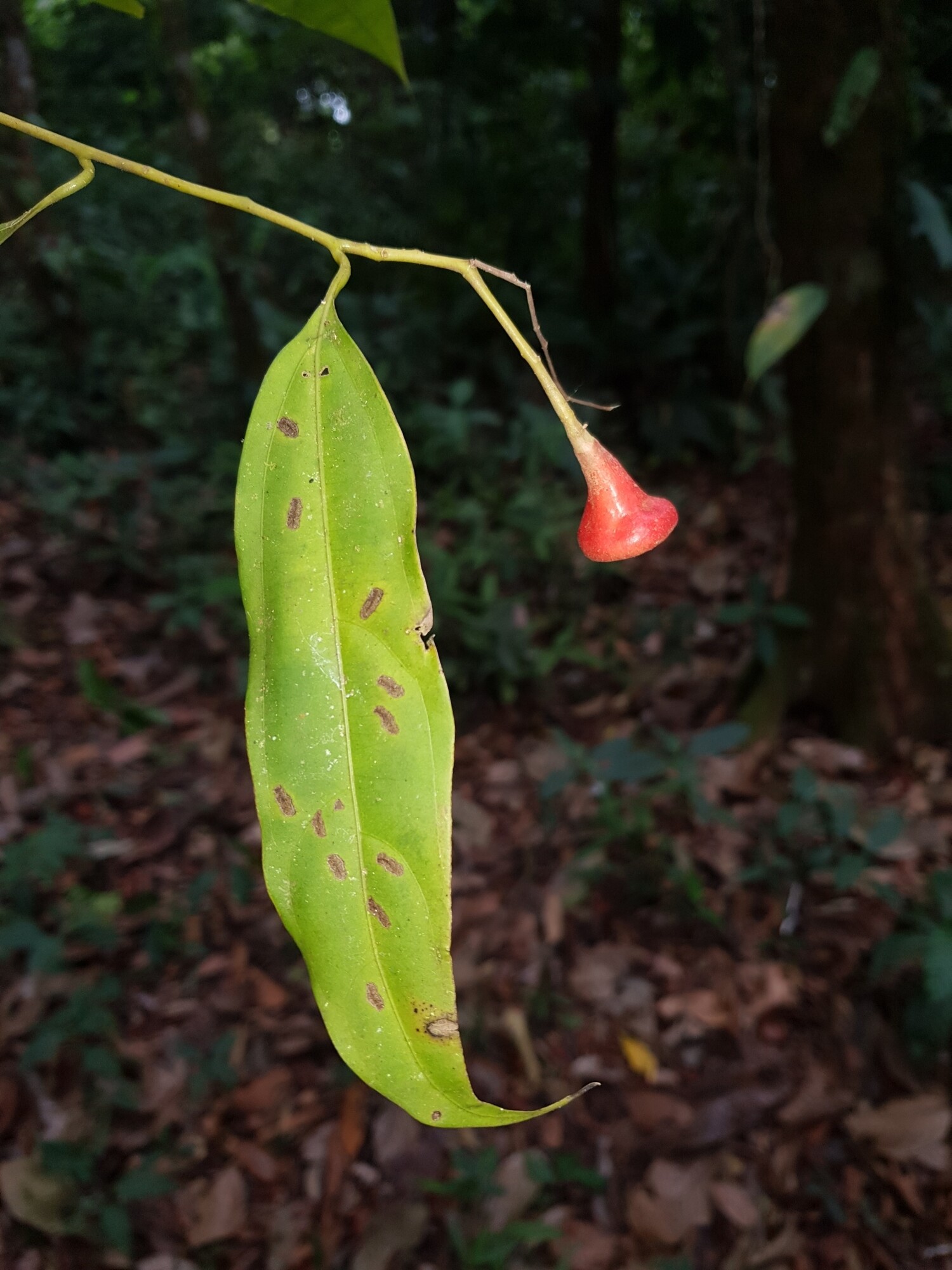
The venation pattern is one of the key diagnostic features. The leaves are tripliveined, meaning they have a prominent pair of basal secondary veins that arise 8-15 mm above the point where the petiole meets the blade and ascend beyond the middle of the leaf, with 2-3 additional secondary veins on each side arising in the upper half. These secondary veins connect near the margin to form a submarginal vein running 1.5-5 mm from the leaf edge. When dried, the leaves become thin-chartaceous (papery) or membranaceous, taking on the dark gray or olive-green color that inspired the species name. The upper surface is dull, while the lower surface is glabrous and slightly lustrous with the midvein prominent above. Small inflated domatia (tiny pocket-like structures) with minute pore-like openings sometimes occur in the axils of the major veins on the lower surface. These domatia are symbiotic structures that house predaceous or fungivorous mites, which protect the leaf from pathogenic fungi and herbivorous mites in exchange for shelter. The mite-domatia relationship in A. obscura has not been studied directly, but similar pit domatia are well documented in other Lauraceae, including Cinnamomum camphora.
Flowers
The flowers are bisexual and small, measuring just 2-2.5 mm long and about 3 mm broad, arranged in open-branched panicles that arise from the axils of deciduous bracts near the branch tips. Each inflorescence is 7-15 cm long, bearing relatively few flowers (approximately 50), with a peduncle 1-6 cm long. The pedicels supporting individual flowers are slender and elongated, 5-10 mm long. The tepals (petal-like structures) are equal in size, measuring 1-1.5 mm long and about 1.2 mm broad. The flowers are pale green and glabrous on the outside.
The staminal structure is key to placing this species in Aiouea rather than the closely related genus Ocotea. Aiouea obscura has nine fertile stamens, all with two-thecous anthers (anthers with two pollen sacs rather than four). The outer stamens measure 1.2-1.4 mm long with prominent, minutely puberulent filaments, and the outer anthers are about 0.7 mm long and 0.5 mm broad, with the connective tissue slightly prolonged beyond the pollen sacs. The glands associated with the inner stamens are approximately 0.4 mm in diameter, and staminodes (sterile stamens) are absent. The pistil is about 1.6 mm long with a 0.5 mm style and a simple stigma. Flowering has been recorded in May, June, August, and October.
Fruits
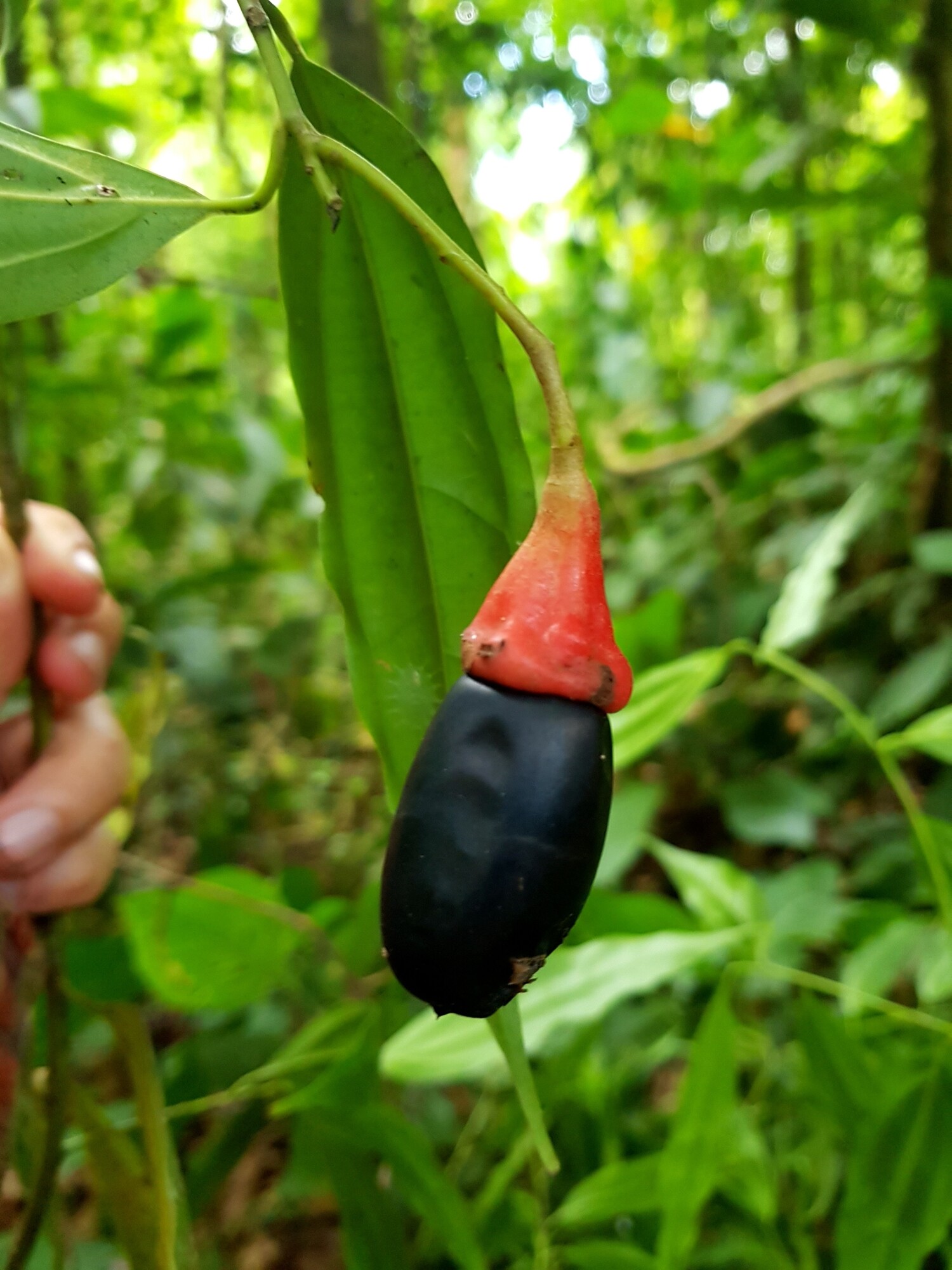
The fruit is a drupe, a fleshy fruit with a single seed enclosed in a hard stone. Each fruit sits in a cupule, a cup-shaped structure formed from the enlarged flower base that is characteristic of the Lauraceae. The cupule wraps around the lower half of the drupe and expands at maturity, forming a wide, shallow platform. In Aiouea obscura, the ripe cupule turns vivid red while the drupe darkens to near-black, producing a two-toned display visible even in the dim understory light. Fruits and fruiting cupules were entirely unknown at the time of the Flora Costaricensis treatment in 1990; their description comes from field photographs and more recent collections.
Distribution
Aiouea obscura is endemic to Costa Rica's southern Pacific lowlands. Plants of the World Online lists its native range as Costa Rica only, and all verified herbarium collections come from Puntarenas and San Jose provinces. GBIF contains one record each from Colombia and Mexico out of 71 total, but these are unverified and likely represent misidentifications. Within Costa Rica, the species is concentrated on the Osa Peninsula and the surrounding Golfo Dulce region. The tree has been collected from Rancho Quemado, Bahia Chal, Cerro Brujo in Corcovado National Park, the Reserva Forestal Golfo Dulce, Fila Ballena near Punta Uvita, and as far north as Tinamaste in San Jose Province.
The species grows in tropical lowland wet forest, typically on steep slopes with evergreen vegetation. Recorded elevations range from sea level (37 m) up to 1000 m at the upper limits of its range, though most collections come from below 500 m. The original type collection was made at approximately 50 m elevation on a steep, forested hillside along the Interamerican Highway about 2 km north of Chacarita. The tree appears to prefer primary forest conditions and has been noted growing in forest edges as well as the interior understory.
Ecology
The striking bicolored fruits of Aiouea obscura are almost certainly adapted for bird dispersal. Throughout the Neotropics, the Lauraceae family provides critical food resources for frugivorous birds, with lauraceous fruits making up more than half the diet of species such as the Resplendent Quetzal (Pharomachrus mocinno) and the Three-wattled Bellbird (Procnias tricarunculata). Wenny and Levey (1998) demonstrated directed seed dispersal of Ocotea endresiana (Lauraceae) by bellbirds in Monteverde, finding that bellbirds deposited 52% of seeds under habitual song perches in treefall gaps more than 25 meters from parent trees, creating recruitment advantages for the seedlings. Other known dispersers of Lauraceae fruits in Costa Rica include the Emerald Toucanet (Aulacorhynchus prasinus), Mountain Robin (Turdus plebejus), and Black Guan (Chamaepetes unicolor). In the lowland Pacific forests where A. obscura grows, Keel-billed Toucans (Ramphastos sulfuratus), Chestnut-mandibled Toucans (Ramphastos ambiguus), and various tanagers and manakins are also likely dispersers.
The red and purple color combination likely serves as an honest signal of fruit ripeness and nutritional quality. Red is highly visible against green foliage and contrasts with the unripe green fruits, while the dark purple of the ripe drupe indicates the presence of anthocyanin pigments often associated with antioxidant-rich flesh. The persistence of empty red cupules on the tree after dispersal may serve to continue attracting birds to branches where other fruits are still ripening. Hamilton et al. (2018) found that no single Lauraceae species produces a consistent food supply for bellbirds each year, meaning the birds' survival depends on multiple Lauraceae species fruiting at different times across the landscape. Trees like A. obscura are one link in a chain of laurel species that together sustain these frugivore populations.
Specific pollinator information for Aiouea obscura has not been documented. However, Lauraceae flowers are typically small and inconspicuous, often pollinated by small insects including flies and small bees. The pale green flowers and lack of obvious scent (at least as recorded from herbarium notes) suggest insect pollination rather than wind or vertebrate pollination.
Taxonomic History
Aiouea obscura was described by Henk van der Werff in 1988 in a paper titled "Eight New Species and One New Combination of Neotropical Lauraceae," published in the Annals of the Missouri Botanical Garden. Van der Werff (born 1946) is a Dutch-American botanist who has spent most of his career at the Missouri Botanical Garden in St. Louis, where he serves as Curator Emeritus for Lauraceae. He is considered one of the world's leading authorities on the family, with particular expertise in Neotropical species.
The type collection (Hammel, Grayum & de Nevers 15197) was made in May 1986 by Barry Hammel, Michael Grayum, and Greg de Nevers. Hammel (born 1946) is a U.S. botanist who has worked at the Missouri Botanical Garden since 1984 and at INBio (Costa Rica's National Biodiversity Institute) since 1989. He resides in Costa Rica and is one of the principal editors of the "Manual de las Plantas de Costa Rica" project. His PhD thesis at Duke University (1984) focused on the flora of La Selva Biological Station. Grayum has worked at the Missouri Botanical Garden since 1984, lived in Costa Rica from 1984 to 1990, and co-directs the Manual de Plantas de Costa Rica project with Hammel. The holotype is deposited at MO (Missouri Botanical Garden), with isotypes distributed across seven herbaria: CR (Museo Nacional de Costa Rica), F (Field Museum, Chicago), NY (New York Botanical Garden), HBG (Herbarium Hamburgense), IBUNAM (Instituto de Biologia, UNAM, Mexico), MeiseBG (Meise Botanic Garden, Belgium), and NHMUK (Natural History Museum, London).
After the original collectors, the botanist who has done the most to document A. obscura in the wild is Reinaldo Aguilar Fernandez, a field botanist based on the Osa Peninsula. Since 1991, Aguilar has collected over 7,000 specimens and archived roughly 270,000 photographs of the peninsula's flora, discovering and publishing 15 new plant species along the way. In 2017, Costa Rican President Luis Guillermo Solis honored him for his botanical inventory work. His specimen Aguilar 016017, collected in Puntarenas in 2017, was used in molecular phylogenetic studies of Lauraceae (GenBank accessions MK507230, MK507298), giving A. obscura its first DNA sequence data. The most recent collection of the species, made in 2024 near Tropenstation La Gamba (a University of Vienna research station on the edge of Piedras Blancas National Park), confirms that new localities are still being found nearly four decades after the original description.
The genus name Aiouea was coined by Jean Baptiste Christophore Fusee Aublet in 1775 in his "Histoire des Plantes de la Guiane Francoise." The name is notable for being composed entirely of vowels (A-I-O-U-E-A). Aublet used indigenous names from French Guiana for his botanical nomenclature, latinizing local terms for over 60 genera without further explanation; subsequent authors considered these names "barbaric" and often replaced them. The name Aiouea likely derives from an Amerindian term used in the region, though its specific meaning has not been documented.
The genus today contains approximately 80 accepted species distributed from Mexico through tropical South America, with the center of diversity in Brazil. It roughly doubled in size in 2017 when Rohde et al. demonstrated that the Neotropical species of Cinnamomum do not form a natural group with their Paleotropical counterparts. The molecular data required 42 new combinations transferring American Cinnamomum species into Aiouea, along with two new names and six newly validated species. The only morphological character that had separated the two genera, the number of pollen sacs per anther (two in Aiouea, four in Cinnamomum), turned out to be phylogenetically unreliable. A. obscura was already in Aiouea and was not directly affected by the transfer, but it now has far more congeners than it did when first described. Van der Werff himself, at 78, co-authored the description of five more new Aiouea species in 2024.
Similar Species
The Flora Costaricensis (1990) recognized three species of Aiouea in Costa Rica: A. obscura, A. costaricensis, and A. talamancensis. The genus has since grown following the 2017 transfers from Cinnamomum, but among the original three, A. costaricensis is the most likely to be confused with A. obscura, but it differs in several important ways: it grows at much higher elevations (1100-2500 m versus below 500 m for most A. obscura collections), occurs on the Caribbean side of the Cordillera Central and Cordillera de Talamanca rather than the Pacific lowlands, has obovate to spathulate leaves (broader toward the tip) rather than narrowly elliptic leaves, and its leaves dry subcoriaceous (somewhat leathery) and grayish or yellowish brown rather than chartaceous and dark olive green.
Aiouea obscura may also be confused with species of Phoebe, another Lauraceae genus with tripliveined leaves. The key differences are that A. obscura has leaves that dry chartaceous and usually dark olive green with secondary veins that are loop-connected near the margin, while Phoebe species usually have leaves that dry subcoriaceous and yellowish brown with secondary veins that are not loop-connected. Aiouea obscura is primarily found at lower elevations (most collections below 500 m) and only in the Pacific lowlands, while Phoebe species range from 0-2000 m in elevation.
Conservation Outlook
Aiouea obscura was assessed as Vulnerable (VU) by the World Conservation Monitoring Centre in 1998 and included in the IUCN Red List of Threatened Species. The assessment reflects the species' narrow endemic range, restricted to the southern Pacific lowlands of Costa Rica, combined with ongoing habitat loss from deforestation. At the time of the Flora Costaricensis treatment in 1990, the species was "known from only a single flowering collection." Since then, approximately 40 unique localities have been documented over 38 years of fieldwork, reflecting the ongoing intensity of botanical inventory in the Osa region rather than any sudden increase in the species' abundance.
The majority of known collections come from within the Reserva Forestal Golfo Dulce, a 60,565-hectare forest reserve that protects the forested lowlands surrounding the Golfo Dulce. Specimens have also been collected inside Corcovado National Park (Cerro Brujo, at 450-600 m) and adjacent to Piedras Blancas National Park near Tropenstation La Gamba. Together these protected areas form one of Central America's most important conservation complexes, safeguarding the last extensive stretches of undisturbed lowland Pacific rainforest. The Osa Conservation Area (ACOSA) represents only 3% of Costa Rica's territory but harbors roughly half the country's plant and animal species. Despite this protection, deforestation pressure continues in buffer zones and unprotected areas, and the species' naturally low population density and restricted range make it vulnerable to habitat fragmentation.
More survey work is needed to understand the true extent of this species' distribution and population size. The Tinamaste collection at 1,000 m in San Jose Province, geographically separated from the main Osa population, suggests the species may have a broader range along the Pacific slope than the original description implied. Citizen science observations on iNaturalist have documented the species in fruit for the first time, revealing the vivid cupule display that herbarium specimens could not capture. Despite the accumulation of records, A. obscura remains genuinely rare throughout its range.
Resources & Further Reading
Species Information
Plants of the World Online entry with accepted name, distribution, and links to further information.
Global occurrence records, specimen data, and distribution map.
Citizen science observations with photographs documenting the species in the field.
Species profile from the Osa Peninsula arboretum, with notes on phenology and conservation.
IUCN assessment listing the species as Vulnerable (VU) due to restricted range and deforestation threats.
Taxonomy & Nomenclature
Nomenclatural data, type specimen information, and publication details from Missouri Botanical Garden.
Isotype specimen (Hammel 15197) at the Natural History Museum, London, with high-resolution image.
Van der Werff in Burger (ed.), Flora Costaricensis (1990). Fieldiana Botany n.s. no. 23. Lauraceae treatment including the species description.
Original publication of the species description by van der Werff, freely available via Biodiversity Heritage Library.
Molecular phylogenetic study that transferred 42 Neotropical Cinnamomum species into Aiouea, doubling the genus.
Description of five new Aiouea species from Central and South America, co-authored by van der Werff at age 78.
Ecology & Conservation
PNAS paper on directed seed dispersal of a Lauraceae species (Ocotea endresiana) by three-wattled bellbirds in a Costa Rican cloud forest.
Overview of the ecoregion where A. obscura occurs, including conservation status and threats.
Comprehensive review of Lauraceae phylogeny, taxonomy, and biogeography by Li et al., covering tribal relationships and the placement of Aiouea within Cinnamomeae.
Study showing that no single Lauraceae species provides consistent annual food supply, driving multi-species dependence in frugivores like bellbirds and toucans.
Related Reading
Staff page for the botanist who described A. obscura, with research interests and publications.
Biography and bibliography of the principal collector of the type specimen.
Overview of the genus with species list and global distribution.
Background on the nomenclature practices of Aublet, who coined the genus name Aiouea.
Profile of the most prolific collector of A. obscura, who documented over 7,000 specimens and 270,000 images from the Osa Peninsula.
University of Vienna research station on the edge of Piedras Blancas National Park, where the most recent collection of A. obscura was made in 2024.