Aguacatillo de Río
Ocotea rivularis — A Costa Rican endemic listed as Near Threatened, this little-studied tree grows in the lowland forests of the Golfo Dulce region, often along stream banks.
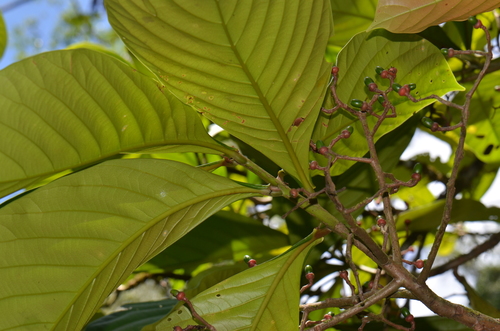
Named for Streams
Paul Carpenter Standley and Louis Otho Williams described Ocotea rivularis in 1951, in the journal Ceiba, which Williams had founded at the Escuela Agrícola Panamericana in Honduras. The epithet rivularis derives from the Latin rivulus, the diminutive of rivus, meaning a small brook or rivulet. The name fits: the herbarium labels that record this tree place it again and again along water, beside the Río Chocuaco, the Río Claro, the Río Riyito.
As a Costa Rican endemic, O. rivularis occurs naturally nowhere else on Earth. Most of the seventy-nine specimen records come from Puntarenas Province, concentrated in the Golfo Dulce region: the Osa Peninsula itself, and the adjacent mainland around Piedras Blancas, Esquinas, and Golfito, where the type was collected. A single 1985 collection from Reserva Biológica Hitoy Cerere in Limón, on the Caribbean slope, shows the species is not confined to the Pacific south. Not every record sits by water. Collectors have taken it from ridges, slopes, and forest interior as well as stream banks, and the modern taxonomic treatment gives no habitat note at all beyond the country and an elevation range of 50 to 300 m.
A Poorly Known Species
What is known of the tree comes almost entirely from herbarium sheets. Henk van der Werff's 2002 synopsis of Central American Ocotea gives the diagnosis in two sentences: the species is recognized by its large obovate leaves, 30-50 cm long, with the apex usually rounded, and by its pubescent flowers. Those flowers are what separate it from Ocotea endresiana, its nearest look-alike, which has smaller leaves and glabrous flowers. Little else has been published. The tree's height has never been recorded, nor its fruit described, nor its flowering and fruiting followed through a season, nor any animal seen to eat it.
Allen collected the type on the 3rd of August, 1950, on forested hills along the upper Río Piedras Blancas near the Río Esquinas, in Puntarenas. The holotype went to the herbarium of the Escuela Agrícola Panamericana in Honduras, where Standley had moved after retiring from the Field Museum and where Williams then worked; a duplicate went to the Missouri Botanical Garden. The name was published the following year in the school's own journal. In 1956 Williams shipped the school's type specimens to the U.S. National Herbarium, which is why the Smithsonian now holds a sheet of the tree that Honduras first catalogued.
Such gaps in the botanical record are common for tropical plants with small ranges. The lowland wet forests of the Osa and the Golfo Dulce, where O. rivularis grows, hold the largest remaining tract of old-growth lowland rainforest on the Pacific coast of Central America, and Xavier Cornejo and his colleagues counted 454 native tree species on the Osa Peninsula alone. The tree itself turns up inside Corcovado and Piedras Blancas national parks, in the Reserva Forestal Golfo Dulce, in the Golfito wildlife refuge, and at Hitoy Cerere. It grows in protected forest, on land botanists visit and collect from.
Conservation Concerns
The IUCN Red List lists O. rivularis as Near Threatened, in an assessment by the Costa Rican botanist Nelson Zamora published in 2022. It replaced a 1998 assessment that had stood unrevised for more than two decades. Most Costa Rican Ocotea have now been assessed: of the 61 species recorded in the country, all but three carry a listing, and 12 of those are threatened, among them three rated Critically Endangered. O. rivularis is not one of the 12. A Near Threatened species, in the Red List's definition, is one that does not qualify as threatened now but is close to qualifying, or likely to qualify, in the near future.
Little evidence supports that listing. Nobody has counted the trees, estimated the population, measured a trend, or studied how the species reproduces and how far its seed travels. For a tree like this one, a Near Threatened rating usually turns on how small the range is, and the range is small: mostly a strip of lowland forest around one gulf, with a handful of outlying records, all of it inside one country. The existing record cannot say whether the tree is holding steady or declining.
Ecological Importance
Trees in the laurel family carry a fruit that is unusual among tropical fruits: a single large seed wrapped in pulp rich in fat and protein rather than sugar and water. That richness is why laurels matter to large fruit-eating birds, and across the Neotropics the birds that take the fruit are wide-gaped species able to swallow it whole and drop the seed somewhere else. The fruit of O. rivularis has never been described. What it looks like, when it ripens, and which animals take it are all unrecorded, and that it behaves like the fruit of its relatives is only an assumption.
The Resplendent Quetzal does not live here. Its dependence on laurels is among the best-documented relationships in Neotropical ornithology, and it is the bird most often named when the family comes up, but the quetzal nests between 1,200 and 3,000 m and drops no lower than about 500 m when it descends after breeding. O. rivularis grows below 300 m. GBIF, the global biodiversity database, holds some 39,000 quetzal records from Costa Rica, and not one comes from the Osa. Nathaniel Wheelwright made his finding that quetzals feed on roughly 18 species of Lauraceae in the cloud forest at Monteverde, in the mountains far to the north.
The birds that could plausibly carry this tree's seed are the ones that share its forest. Yellow-throated Toucans and Baird's Trogon, a bird found only on the Pacific slope of Costa Rica and western Panama, are both common in the Osa lowlands, and both eat fruit. Neither has been recorded feeding on O. rivularis. The toucan's bill lets it swallow big fruits whole, and it disperses the large seeds of other lowland trees; its close relative the Keel-billed Toucan takes Ocotea fruit in the mountains, which is as near as the evidence comes. Whether a trogon could swallow a drupe from this tree is unknown, since the fruit has never been measured. Three-wattled Bellbirds arrive seasonally, dropping out of the highlands after they finish breeding, and in the mountains the bellbird disperses laurels well: Dan Wenny and Douglas Levey showed that males spend most of the day calling from exposed perches in dead trees at the edges of canopy gaps, and that the seeds they regurgitate there survive better than seeds dropped elsewhere, because gap soil kills fewer seedlings with fungal disease.
Resources & Further Reading
Species Information
The two observations of this Costa Rican endemic on record, both from Puntarenas Province, with photographs.
Authoritative taxonomic information from the Royal Botanic Gardens, Kew.
Nomenclatural record: the 1951 protologue in Ceiba, the authorship, and the type collection.
The current conservation assessment, which lists the species as Near Threatened.
Seventy-nine georeferenced specimen records, with provinces, elevations, and protected areas.
The primary source for what Near Threatened and the threatened categories formally mean.
Taxonomy & Regional Studies
The modern taxonomic treatment, and the source of the leaf and flower description and the elevation range.
An analysis of 454 native tree species on the Osa, and of the peninsula's place on the Pacific slope.
Six herbarium specimens from the Reserva Forestal Golfo Dulce, several collected beside rivers.
Why a holotype the protologue places in Honduras is now held at the Smithsonian.
Birds and Seed Dispersal
Bellbirds carry Ocotea endresiana seeds to song perches at the edges of canopy gaps, where fewer seedlings die of fungal disease.
The Monteverde study of the quetzal's dependence on laurel fruits, and the source of the figure of 18 Lauraceae species.
Why gape width governs which birds can swallow a laurel fruit whole, and which therefore disperse it.
The Yellow-throated Toucan dispersing a large-seeded lowland tree in southern Costa Rica.
The elevational ranges of the quetzal and the bellbird, and the bellbird's seasonal descent to the lowlands.